
Good morning
Please click on the image below to view your Mail & Guardian Digital Edition in our PDF reader.
[tnc-pdf-viewer-image file=”https://mg.co.za/wp-content/uploads/2025/12/edition-2025-12-12.pdf” target=”_parent” download=”false” print=”false” fullscreen=”true” share=”false” zoom=”true” open=”false” pagenav=”true” logo=”false” find=”true” current_view=”true” rotate=”true” handtool=”true” doc_prop=”false” toggle_menu=”true” language=”en-US” class=”” page=”” default_zoom=”auto” pagemode=”thumbs”] [/tnc-pdf-viewer-image]
If you have questions or feedback, please don’t hesitate to contact us on subscriptions@mg.co.za
The newly-appointed minister of forestry, fisheries and the environment, Willie Aucamp, has extended the public comment period for South Africa’s proposed environmental regulations governing commercial fracking.
On 7 November, shortly before his dismissal, former environment minister Dion George opened a 30-day window for public comment on draft regulations for exploring and producing onshore petroleum resources requiring hydraulic fracturing. The draft regulations set out how fracking would be authorised, monitored and restricted. Separate regulations are expected to be gazetted by the water and sanitation minister.
On 1 December, Aucamp announced in the Government Gazette that the comment period had now been extended to 13 February 2026.
South Africa first imposed a fracking moratorium in 2011 after public outcry and litigation from environmental groups alarmed by risks to the arid and fragile Karoo Basin. That moratorium is now ostensibly lifted.
“Once those regulations [published by George] are gazetted, I lift the moratorium,” Mineral and Petroleum Resources Minister Gwede Mantashe told Reuters in October. “The economy needs a growth trigger and oil and gas are those triggers.”
In July, Mantashe told Parliament that “mining can’t be killed for the sake of fresh air” as he championed the revival of Karoo shale gas, News24 reported.
South Africa, he said, would run short of gas by 2027, yet “our behaviour reflects a nation that doesn’t want to save itself … We talk about the drying up of gas resources in Mozambique but we don’t talk about our own resources.”
At the time, the Climate Justice Coalition responded that, “the minister’s comments that ‘we can’t kill mining for fresh air are particularly provocative, especially given that fresh air is not a luxury that we can do without … We stand by our position that fracking is not a solution, it is a threat.
“It contaminates water, releases methane which is a toxic and potent greenhouse gas that is 80 times worse than carbon dioxide over a 20 year period, causes earth tremors, and wreaks havoc on our ecosystems. Even more importantly, it violates the rights of the communities who live in the Karoo and depend on its land and water to survive.”
In August 2024, the minister authorised geophysical surveys to investigate the subsurface geology of the south-central Karoo Basin for oil and gas exploration.
Fresh momentum
For more than a decade, fracking has been one of South Africa’s most divisive environmental debates. Although the government briefly lifted the moratorium in 2012, progress stalled amid scientific uncertainty, regulatory gaps and fierce public opposition.
Momentum has now returned. The draft regulations published by Aucamp’s department outline the full environmental framework for onshore shale-gas exploration and production.
They prescribe standards for environmental assessment, require baseline studies before exploration proceeds, and set conditions for continuous monitoring. The regulations also coordinate decision-making between regulators and define the minimum information required for environmental authorisation and water-use licences.
Several high-risk practices are prohibited. These include using local surface or groundwater in areas with less than 400 mm annual rainfall (except deep saline aquifers); disposing of untreated fracturing fluids or process water into rivers, onto land, to wastewater plants or underground; storing process water in pits or dams; dumping drill cuttings or sludge anywhere other than sealed above-ground tanks; reinjecting fluids underground; using specified chemical additives; and abstracting water from groundwater monitoring boreholes.
Exploration and production are also banned in heritage sites, protected areas and key astronomy zones linked to the Square Kilometre Array. Fracking is prohibited within 5km of government dams and waterworks, strategic water-source areas, towns or densely populated areas, and thermal or cold springs.
Some zones are restricted rather than prohibited — notably areas within 5 km of municipal wellfields and parts of the Karoo Central Astronomy Advantage Area. In these areas, fracking may proceed only if impacts can be avoided or adequately mitigated and with approval from the relevant custodial authority.
Highly contested, rejected
The government’s renewed shale-gas ambitions ignore unchanged geological risks, Clarens-based geologist Gideon Groenewald said.
“As an independent geologist, I see a revival of the idea of extracting gas and oil from the shale of the Karoo Supergroup through the patented (1952) methodology of ‘fracking’,” he said.
“It is important to understand that, since the decision to ban further exploration for gas and oil reserves was made in 2011, nothing in terms of the geology has changed. The reason for the banning of the extremely destructive methodology of exploiting the potential gas and oil reserves of South Africa is still as valid as 13 years ago.”
He cautioned that the regulatory burden now falls heavily on environmental assessment practitioners — individuals who, he argues, require deep expertise and impeccable track records to oversee such “highly risky environmental impact scenarios”.
Groenewald said he had “no doubt” that the individual appointed to restart environmental authorisations will have historic data at their disposal before reconsidering what he calls the “highly contested and rejected methodology” of shale-gas extraction.
He also warned about severe consequences for farmers already battling drought and groundwater scarcity.
“As a person who made my living from drilling for groundwater in the Karoo Supergroup, my heart goes out to the farmers in the Great Karoo … who now also have to contend with an influx of petroleum research teams with foreign cultures and social mannerisms that will change the geographical as well as the social landscape of the Karoo.”
He noted that the Karoo Supergroup covers nearly 200 000 km² — from East London to Laingsburg and through Kimberley, Johannesburg and Durban — meaning vast areas could be affected.
Drawing parallels with the legacy of gold mining on the Witwatersrand, Groenewald questioned whether “the omelette (oil and gas) is of more long-term value than the generations of future chickens (clean water)”.
Rearing its head – again
Jan Glazewski, a retired law professor from the University of Cape Town who participated in a study by the authoritative Academy of Science of South Africa (Assaf) on the technical readiness for the shale gas industry, referred to the Council for Scientific and Industrial Research’s (CSIR) Strategic Environmental Assessment (SEA) for shale gas development.
In particular, he referred to the CSIR’s thorough and in-depth study, which did not reject fracking but which imposed a number of caveats and conditions, should fracking go ahead. In his view, he doubted whether the government had the capacity or will to implement these.
Glazewski said he believed the matter was “dead and buried because those conditions made it impossible — now this thing has reared its head up again.
“… My big question is what about all these studies that have been done? Surely, they provide the basis for going forward. What they’re doing now, everyone is fiddling around commenting on the [latest] regulations but they must see this against the background of these comprehensive huge studies.”
Scientific assessments underline the risks
The CSIR’s multi-disciplinary SEA, commissioned by the government, assessed 15 technical domains — including hydrogeology, surface water, biodiversity, heritage, seismicity, waste, infrastructure and socio-economics — and produced an operational decision-making framework for government.
Among its findings: the Karoo contains shale formations with gas potential, but extraction poses high, long-lasting risks, especially to scarce groundwater, sensitive ecosystems and heritage resources. Water-management infrastructure and institutional capacity are insufficient to handle shale-gas demands, and baseline water-data gaps remain widespread.
Risks scale with intensity: small, tightly controlled exploration carries far lower risks than large-scale commercialisation. Groundwater pathways in parts of the Karoo are complex and poorly mapped, creating uncertainty about contamination routes and the longevity of impacts. Wastewater handling, sludge management and induced seismicity also remain significant concerns.
The SEA’s recommendations included rigorous baseline monitoring, strict water-use and waste-management controls, application of the decision-making framework to screen sites, and the designation of no-go or restricted zones — including protected areas, strategic water-source areas and astronomy zones. It urged a staged approach with strong oversight and transparent public participation.
The separate 2016 Assaf consensus report, produced with the South African Academy of Engineering, and commissioned by the department of science and technology, found that South Africa was not technically ready for shale-gas exploration or production. It identified major gaps in legislation, regulatory capacity, monitoring expertise, laboratory infrastructure, skills and baseline environmental data.
It called for a coherent legal framework, strong oversight, comprehensive multidisciplinary baseline studies, long-term monitoring and full alignment with the Astronomy Geographic Advantage Act — including a 30km no-fracking buffer around Square Kilometre Array sites.
Without robust scientific evidence, rigorous regulation and institutional readiness, the report warned, shale-gas development in the Karoo would pose unacceptable risks.
– The Mail & Guardian Cabo Delgado: The Mozambican people forgotten by time:When Bernardo and his wife Alima fled their village of Criação, they carried almost nothing with them. They only hoped to find out what happened to their daughters, who were nine and six when armed men abducted them in 2020. For years, the couple heard nothing. Only recently, a survivor who escaped captivity brought news that they were still alive. “Every thought leads nowhere,” Bernardo tells our teams in Mueda, where his family has lived in a camp for displaced people since October. They are unsure whether they will ever see their daughters again.
Eight years into the conflict in Cabo Delgado, fear and uncertainty are a daily reality for hundreds of thousands of people in this northern Mozambican province. While international attention gravitates toward the reopening of major energy projects and the security around key resources in the province, the people who have been living through this underreported crisis remain out of the spotlight.
Since October 2017, more than 6,000 people have been killed and over one million people – about a third of the population of Cabo Delgado – have been forced to flee their homes, about half of whom remain displaced. Since late July, Cabo Delgado has experienced devastating levels of violence. This year is now the most violent one on record in terms of the number and frequency of security incidents. More than 500 occurred in the first eight months of 2025, including brutal assassinations, kidnappings, lootings and arson.
Attacks have struck most districts of the province and spilled into neighbouring Nampula and Niassa. Tens of thousands of people have recently fled their homes. For many, it is not the first time. Some are returning to the very same camps where they sought refuge during the deadly attacks of 2020 or 2021.
Families often leave their homes with little more than the clothes they wear. But they carry a heavy burden of fear, exhaustion and trauma.
Lives upended, health under threat
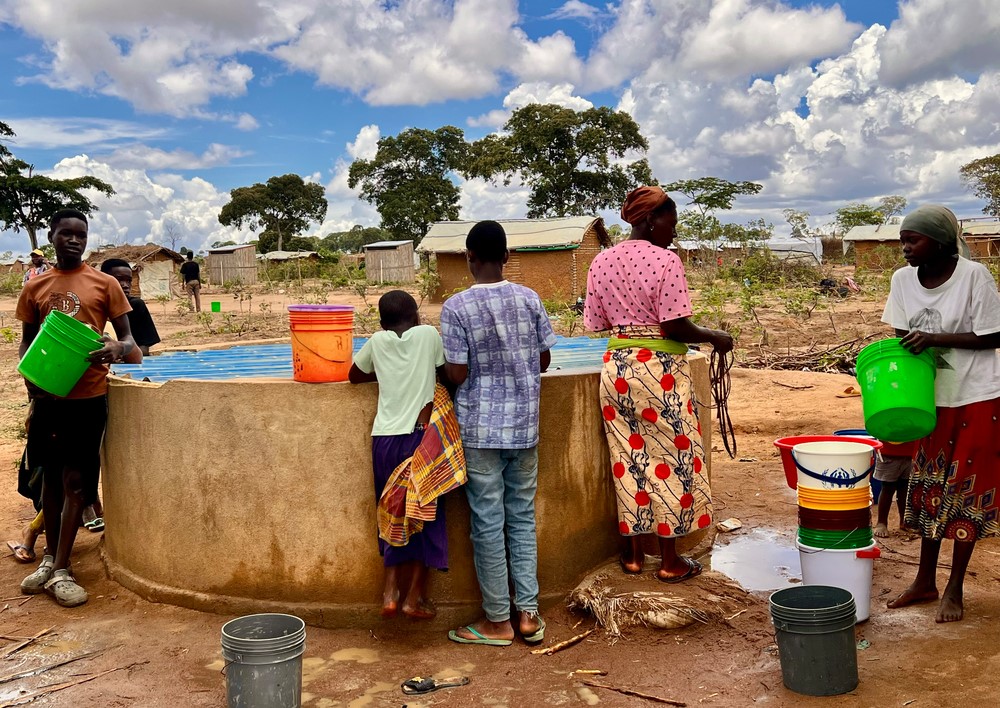
The displacement site of Lianda has been Bertina’s home for three years, despite mounting difficulties. Food is limited. The plastic sheeting covering her house is so damaged that rain leaks inside. Water is scarce: it might take up to three days to collect just 40 litres, which is barely enough for one day for her family of nine.
In her home village in Nangade, she used to harvest a dozen sacks of cashew nuts each year. It was enough to sustain the entire family and build a house with a private water tank. After her village was attacked, only the water tank remains.
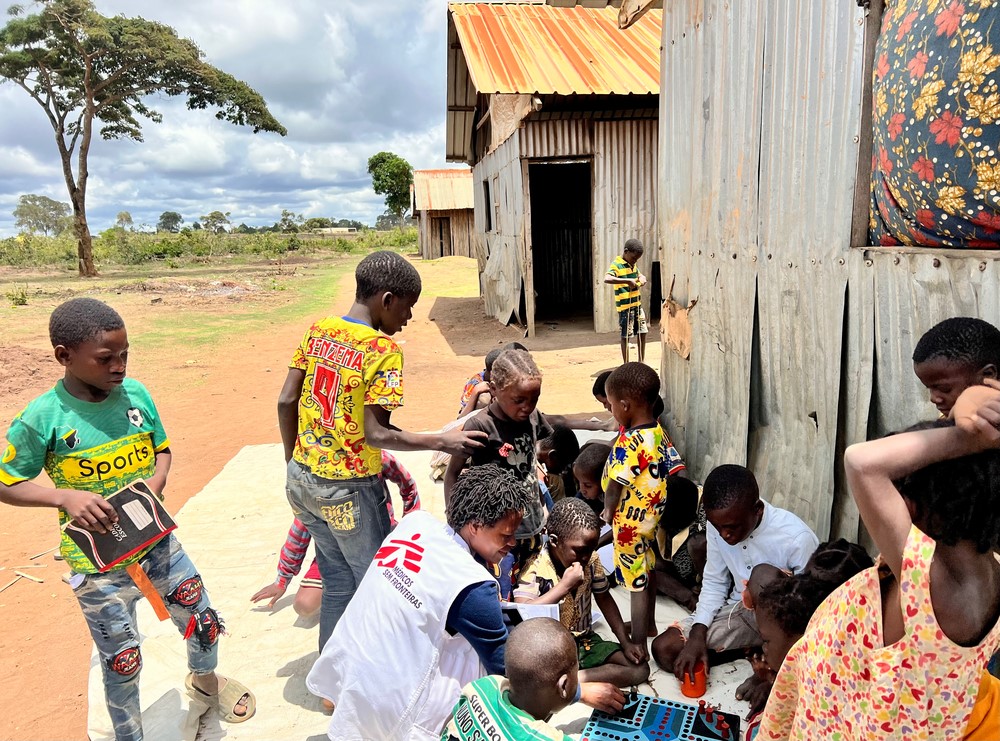
Bertina is not alone in her experience. Many people tell our teams they saw their houses burn down, their businesses vanish; they left behind farmland and possessions; they lost loved ones. And while they now find a sense of safety in the displacement camps, their physical and mental health remains under threat.
Years of conflict have severely weakened northern Mozambique’s already fragile health system. Devastating cyclones, such as Chido in late 2024, regularly hit and add another layer of complexity to this climate-vulnerable country. Multiple facilities have been destroyed or abandoned, while others operate with minimal staff and supplies. Health workers, understandably, are often among those who flee after attacks. This means that the healthcare system, already stretched thin, lacks important resources.
In some districts, measles vaccination coverage remains dangerously low. Pregnant women often give birth at home because movement is unsafe, health centres are closed, or they simply do not have the means to reach them. Treatment for HIV and tuberculosis, which requires regular monitoring and follow-ups, is repeatedly interrupted when violence surges, leaving thousands of people at risk of severe illness and drug resistance.
Humanitarian organisations, including Doctors Without Borders (MSF), face growing challenges reaching the people who need them most. Mobile clinics are routinely suspended due to insecurity. When violence escalates, entire health programmes — from emergency care to community outreach — come to a forced halt.
Eight years on, we cannot look away
Despite this worsening reality, Cabo Delgado rarely gets international media coverage unless major attacks occur or there are developments on energy projects. Yet behind numbers and headlines – or lack thereof – are people living in fear. Families are dismembered, crops are abandoned, water sources are lost, and access to healthcare services is repeatedly interrupted.
MSF is calling on all armed actors to prioritise the protection of civilians and ensure their safe access to basic services. They must respect and protect medical services, enabling health workers to provide care in health structures and in mobile clinics.
Ultimately, people in Cabo Delgado want safety. They want to rebuild their lives. Some still hold on to the hope of returning home, even when nothing is left.
Others no longer believe they will ever go back, but they are unable to make plans for a future elsewhere.
With many escalating crises in the world, it is hard to determine what should get our attention.
But people in Cabo Delgado are simply asking for a chance to live without fear.
– The Mail & Guardian Submit and get free exposure here: Showcase Your Business | Advertise Your Special Offers.