A loud, proud and passionate farewell to Kitchener’s:
No fading out. On Easter Monday at 7am, with the sun rising over an early autumn Joburg city, Andrew the DJ lets Want You In My Soul play right to the very last beat of its eight minutes and 17 seconds.
This happy-sad, chilled house track by Lovebirds — all melodic synth washes, feathery soulful vocals over a hook-laden melody — is the last ever song to play at Kitchener’s Carvery Bar, to give its full name.
Looking back and all we’ve had to get on through / When it really mattered it was there for me and you / Now our world is changing we got to see what we’re gonna do / I know you’re here for me and I will always…
So sings Lovebirds’ vocalist Stee Downes before going back to the chorus about wanting us in his soul.
Thirty-six hours earlier, on the raucous, spilling-onto-the-sidewalks Saturday night, which was the first of a two-night farewell to Kitchener’s, someone asked me what I was going to write.
His rather wasted companion piped up with, “It’s the end of an era.” I retorted I was hoping to come up with a better cliché, but come to think of it, that is actually an apt one.
This edgy and frayed-at-the-edges bar on the corner of Juta and De Beer streets in Braamfontein, part of the old Milner Park Hotel, has over the 15 years of its existence become more than just a cool, decadent spot for people who want to get smashed, dance, talk shit, talk politics and maybe get lucky (although all of that happened).
It is an institution that has plugged into the cultural zeitgeist of Joburg, one that was also queer-friendly and tried its best to provide a dance floor that was safe for women.
It followed in the footsteps of places out on the left-field, such as Jameson’s, Bob’s Bar, 206 and Tokyo Star, which have pushed jolling to seminal highs over the past five decades in the city’s leisure history.
And now Kitchener’s is also no more. It is the end of a decade and a half-long era. The people went big those last two nights, they stumbled home, and at the end, it was the job of the party-master to come back and hand over the key to the landlord on Tuesday morning.
It was unlikely to be a happy parting, because the landlord has plans that don’t feature the people who have run Kitchener’s since 2009.
But Kitchener’s, with its 15 years of glory, will take its place in the pantheon of those revered spots — all politically progressive (to varying degrees) and transformative in their art of partying — that not only tapped into the spirit of their times, but also paved the way in their own unique, trend-setting ways. One thing they all had in common: they did so in an effortlessly cool but ramshackle way, proving that cool cannot be designed or developed.
It is 4pm on Easter Monday afternoon and Andrew Clements, aka the aforementioned Andrew the DJ, and I finally connect for our interview. He has not slept since Saturday, so I have to retire my witty Easter metaphor about having risen on the third day for our chat.
He does indeed sound like someone who has continued the party since seven this morning when he was the last DJ to play at Kitchener’s, and then the person to finally switch off the tears-drizzled, booze-splattered Technics 1200 turntables in that DJ booth in the corner. Damn, if only that booth could talk — just imagine the stories.

“Andrew! Oh, my word, you don’t sound like you’re in a good shape to talk!” I tell him teasingly.
“Take from it what you will,” he replies with a chuckle.
Clements is what you can call a cultural entrepreneur but without the capitalist edge. He has a sharp eye for finding run-down places and turning them into something special — that is exactly what he, Ri Botha and Colleen Balchin did with Kitchener’s. Tastemakers with good politics and noses for fix-uppable dives.
“We take shitholes, and we turn them around,” Clements tells me.
This past weekend, from Saturday noon until 4am on Sunday, and then again Sunday noon until Monday morning, a selection of widely diverse DJs who were on the journey with the threesome each played hour-long sets at the farewell. It was a long, loud weekender for the ages, with many loyal patrons from over the years coming to say goodbye — loud, proud and with passion.
“I’ve been there all week,” Clements says. “It’s been the most hectic week of my life. Yeah, but amazing. Amazing, the whole thing. I’m leaving on such a high, man.”
What was the highlight of the weekend, I ask.
“Talking to all the people who have just given me so much love.”
And what made you sad?
“Nothing, nothing at all.”
You didn’t have a little cry?
“I did, I did, I had a big cry. It was a happy cry. It was about four o’clock this morning or whatever. At the bar, bro. I was just, like, it’s more about my people. That’s why I cried.
“It was just, like, ‘These guys have been fucking amazing for so many years.’ That’s why I wept … because I’m losing these people.”
How did you feel when you shut the door this morning?
“I was elated. I cannot wish for a better send-off. I really cannot fucking wish for a better send-off.”
It is no secret that Clements did not seen eye to eye with the landlord, Adam Levy and vice versa.
Levy is a go-getting and successful property developer who under the Play Braam umbrella has developed or gentrified (depending on your perspective) buildings in the student/bohemian suburb.
Levy also did not mince his words in an interview I did with him last week — the last few years of their relationship were not happy ones. (See page 44.)
Clements wants to be diplomatic about the parting of their ways, saying the contract had come to an end but also that the rent was simply too high to afford.
“I haven’t paid myself in four years,” he says. “Since the beginning of Covid, I have not paid myself a salary.”
Clements says there was somebody internally who would have taken over and bought him out but Levy was not interested.
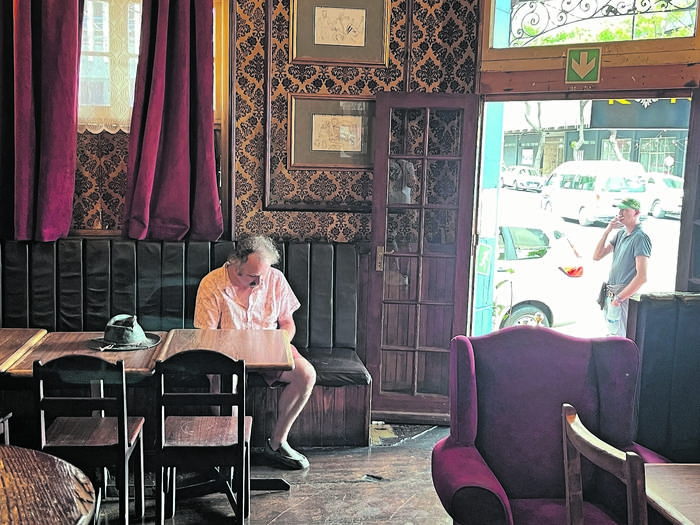
“I think, for years now, in the back of his mind, he thinks he can do better.”
I put it to Clements that Levy called him “a relic of a different time in Kitchener’s life”.
Clements just laughs.
I put it differently: Is it accurate when he said that you didn’t want to move with the new times of Kitchener’s?
“No, I just didn’t want to move with the new times of him.”
We move onto Kitchener’s legacy. How significant was it on the Joburg cultural landscape?
“As significant as it could be,” Clements says emphatically. “Over the last 15 years 100% of the cultural landscape in Joburg was built on Kitchener’s. Before there was Tokyo Star, there was 206. But for the last 15 years it’s been Kitchener’s.”
So, what is next?
“We’re still running the Irish Club, which is great. I’m just going to do that for a while and we’re looking around for something new.”
I’m about to hang up but Clements has remembered something: “I want that record, by the way.”
He has been on my case for a while because I once told him that I had an extra copy of Serge Gainsbourg and Jane Birkin’s notorious 1969 hit Je T’aime … Moi Non Plus.
“Je T’aime?”
“Yeah, I love you.”
By the time Maria McCloy’s DJ set starts at 10pm on Saturday, entering the compact dance floor at Kitchener’s is like walking into a pre-heated oven set at 250 degrees.
That is no deterrent as more and more people stream onto the floor. A staffer is trying to manoeuvre his way towards the back entrance of the bar through this multi-limbed human dancing machine with a trolley stacked with packs of ice.
A skinny drunken guy in a Manchester City replica shirt tries to jump on top of the ice bags — he gets removed swiftly by dancers, without them skipping a beat.
He stumbles away back towards the bar, where patrons stand 10 deep for liquid replenishments.
Back in the so-called second Summer of Love of 1988, English author Rose Boyt wrote a piece for the London Review of Books on an E’d-up dance session she went to: “Happiness is in fashion. I am embraced by several people I do not know. I am smiling and waving my arms about because the music makes me happy. There is nothing inside my head but happiness.”
In Kitchener’s tonight I see similarly happy faces across the dance floor. McCloy is feeding off the love and happiness with a generous set. But there is undoubtedly a tinge of melancholy, like in an autumn of love.
“It was a joyful and emotional night for the crowd of friends, familiar faces on that packed dance floor,” she tells me the next day. “A mix of happiness and despair that our home of so many years was closing and our Kitchener’s closing.”
Saturday night was “beautifully sad and a bit dreamlike too because it’s unbelievable the version of Kitchener’s created by Andrew Clements and his team 15 years ago is over.
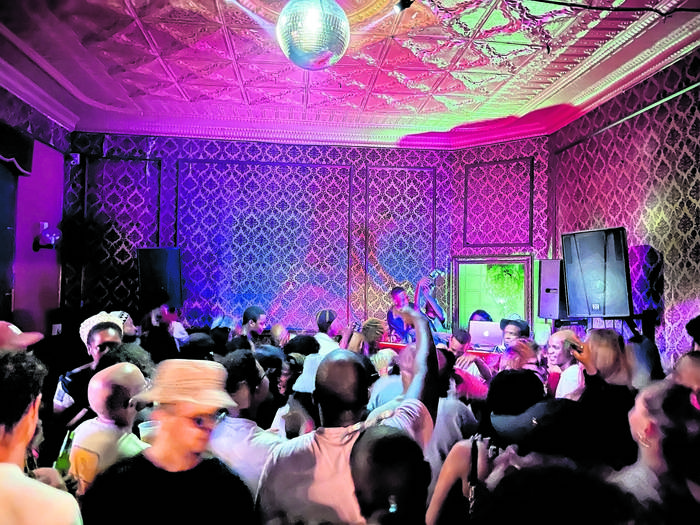
“Sad to say, nowhere else in Joburg has such musical diversity and openness or such a sense of community.
“Clubbing nowadays is more about looking rich, being fancy, expensive liquor, the same ol’ tracks by the same ol’ DJs and the VIP section — not about great music, great sound and an actual dance floor, platforming and developing fresh talent … Kitchener’s was that.
“So, the loss isn’t just about a good time gone or nowhere to hear fresh sounds and be free as a patron or DJ, but also the impact this will have on cultural creation.”
This was made possible, she says, because Kitchener’s was “a place that was not sexist, transphobic or homophobic or classist, [it was] to be surprised by unknown sounds by great DJs on a random Wednesday, to tumble into the party of your life after arriving from elsewhere at 1am…”
McCloy was a Kitchener’s regular when, one day in 2016, Colleen Balchin of Pussy Party (an incubator for women and queer DJs who are excluded because of clubbing’s sexism) said to her, “Your music taste is interesting, come DJ.”
She was scared and avoided Balchin until she was told: “Right, your name is on the flyer for a Pussy Party in two weeks’ time, so you have to come for lessons!”
McCloy recalls: “My first gig was in August 2016 and I guess people liked the mix of African, South African, vintage and modern sounds across all genres, so I kept getting booked.”
Tonight, her last Kitchener’s session is a typical McCloy set: a bit of 80s bubblegum, Afrobeat (Fela Kuti himself), a big dose of nineties kwaito sounds and a little early 2000s Mugwanti that sets off a collective roar of approval.
What was the highlight of Saturday?
“How full it was, the energy and love of the crowd who came to say bye to an era of Braam that’ll remain unmatched; how awesome and so very different from each other, yet so very Kitchener’s, all the DJs were — people danced till they sweated.”
What made you sad?
“A memorial, wake, funeral and ‘after tears’, and then the contemplation of how to now move on, making use of the memories, and honouring the spirit is always sad.”
In the early 1990s, the Tories went after ravers in the UK. John Major’s government passed the Criminal Justice and Public Order Act 1994 which gave police the power to shut down any nocturnal party where amplified music was played, described particularly as “sounds wholly or predominantly characterised by the emission of a succession of repetitive beats” — clearly a legal definition of acid house.
I was reminded of this by a recent podcast I listened to and I’m thinking about it again dancing and sweating on the congested, heaving Kitchener’s dance floor on Saturday night just after 9pm.
“Ag shame,” as we Saffas love to say. It would have been tough if, for some reason, those UK cops had to break up this session — it is Mpumelelo Mcata behind the decks and it is most certainly not acid house he is playing.
DJ-ing as BLK JKS Sound System (Mcata is the guitarist of BLK JKS, one of South Africa’s finest rock bands), he is taking us on a completely different musical route after the previous DJs, who were throwing banger upon hip-hop banger.
This what has made Kitchener’s so predictably good — its DJs’ unpredictability. Mcata, naughty grin on his face, hits play with a most leftfield take on the post-punk band Joy Division’s dark hit Love Will Tear Us Apart — a euphoric version by the Hot 8 Brass Band, famous for blending hip-hop, jazz and funk with traditional New Orleans brass sounds.
No “succession of repetitive beats” but, my goodness, is it making us dance.
His eclectic hour, into which a lot of thought clearly went, is flying past too soon to his final track of his set: I Wanna Be Adored (My Bloody Valentine Remix) by the Stone Roses.
I ask him the following day in an interview why he chose that song.
Mcata says: “For many reasons but mainly for the lyrics — ‘I don’t need to sell my soul / He’s already in me’ … as capitalism is often what pushes us out of these spaces I felt they were fitting.”
I ask him for his highlight of Saturday evening.
“The music and the people, seriously, if the walls at Kitchener’s could talk, they would sing.
“As my wife and I left the club, the legendary Thandiswa Mazwai, Nosisi Ngakane and Masello Motana — three women who are among SA’s greatest living voices in my view, and I say that not just because I’m a biased friend —led an impromptu chorus of traditional wedding songs for us, I mean how incredible is that for a uniquely Kitchener’s moment?”
Saturday and Sunday nights were not only about having enough booze for the thousands (it felt like there were that many) of thirsty patrons or making sure people had entrance tags.
A lot of planning also went into those farewell nights, even though part of the bar/club’s appeal over the past 15 years has always been it seeming like it was always hovering on the edge of chaos.
It was also about the line-ups of DJs across the two days and nights.
“Ri, Andrew and I have tackled so many line-up curations together over the years and I have to say this weekend was some of our finest work,” Balchin says in an interview on Monday.
They were the main moving force behind getting women and queer DJs in the booth at Kitchener’s through the Pussy Party sessions.
Their highlight: “Personally, seeing DJs who first learnt with Pussy Party holding the floor with such grace and power.”
What was the significance of Kitchener’s on Joburg’s cultural landscape?
“With Pussy Party we made a permanent impact on how women and queer people see themselves in club culture locally.
“We are all DJs and music lovers and catering to our artists’ comfort and excellence was a priority. Especially for artists exploring new and more obscure sounds, a quality sound system and in-house gear gives your audience a chance to really hear you and experience your energy. I hope we gave artists a place to soar from.”
Kitchener’s was profoundly political. “The dance floor, nightlife, club culture — these spaces are political,” says Balchin. “I’m grateful that with Pussy Party and my work on the door we were able to make outright statements and real physical changes to say that we will not tolerate bigotry and bullying in our space.”
In the mid-2010s, Braamfontein, which houses Wits University, felt the impact of the student uprisings, especially when police suppressed the protests.
“I think of the student leaders of the Fees Must Fall movement who would gather at Kitchener’s and the huge impact and the terrible emotional scars of that time,” says Balchin. “Kids running from rubber bullets to take refuge in a pub. What dystopia is this?”
What makes you sad about Kitchener’s coming to an end?
“I’m worried about all the staff finding new jobs. I’m worried about the car guards who relied on the regularity of Kitchener’s to make their living. Unlike staff who can move to new jobs, their work is very tightly tied to this specific corner.
“Something just personally sad for me is all the ghosts I will no longer be able to visit from that dance floor.
“We lost too many soldiers along the way.
“Of course, the closing of another small-scale, grassroots, musically adventurous cultural space in a global climate of such closures is tragic. It’s sad that the space was understood more as a bar than a cultural institution.”
Balchin played the last set on Saturday night’s final session, one that McCloy says had her in tears.
“I was grateful to play last on Saturday and wrap the night up on an emotional note. Andrew lent me his James Blake record and our final track for the morning at 4am was Limit to Your Love — one of those Kitchener’s classics.”
In our interview, Mcata compared Kitchener’s to the fictional bar in the TV series Cheers, “where everyone knows your name”.
He isn’t alone feeling like that. On social media there has been an outpouring of sadness over Kitchener’s closure. For regulars, this is genuinely the end of an era. For them, it is rest in peace, Kitchener’s — rest the beats, but keep the memory alive.
Long after tonight is all over …:
“Quish, quish,” my sneakers go on the sticky dance floor as I’m heading to the DJ booth in the corner with my bag of records.
It is late Saturday morning and I’m coming to do a quick sound check before my hour-long set starts at noon to kick off the Kitchener’s send-off. The club-cum-bar is closing after 15 years as central to what was interesting about club culture in Joburg.
We — my friend Marc Latilla and I, who DJ’d at the bar as the Reform Sound System on a regular basis from 2009 up to around 2014 — got an invite on Friday to play on Saturday.
I said “yes” but Marc couldn’t make it at such short notice.
It was also too late to make it onto the flyer, hence the empty bar and the post-jol state of the floor.
The advantage is that I won’t be getting any requests, I smile to myself. And I can be as self-indulgent as I want to be, I think, as I cue up the avant garde jazz classic The Creator has a Master Plan, an unusual interpretation by Le Jazz Club de Tananarive.
When we started our Thursday night sessions in 2009, the Milner Park Hotel, where Kitchener’s is located here in Braamfontein, was still a one-star establishment.
Andrew Clements had just started hiring out the venue for left-of-centre parties and gigs.
You would find weary-looking guys looking up from their dop as you started your session at 7pm. It was simple to clear the bar for friends arriving soonish for our nights — just drop some hip-hop and the regulars would unsteadily scurry off to their rooms upstairs.
Other than music, Latilla’s perhaps bigger passion is Joburg’s history. On his fascinating blog Johannesburg 1912 he has been painstakingly writing up the history of the city’s suburbs, illustrated with maps and historical and current photos.
Braamfontein, Afrikaans for “bramble fountain”, has been known by this name since 1888, he writes.
The Milner Park Hotel, or Kitchener’s as it’s known now, is considered the oldest bar in Johannesburg. It’s on the corner of De Beer and Juta streets, which in the 1890s had a very strong German community with thriving German-owned businesses, Latilla writes, and was even known as “Little Germany”.
Built in 1898, it was originally known as the Hansa Bar and Hotel.
In their book 101 Beloved Bars of Southern Africa, Chris Marais and Pat Hopkins write: “In 1899, Southern Africa slipped into the cataclysmic Boer War, also known as British high commissioner Sir Alfred Milner’s ‘Little War’. At the end of the conflict in 1902, Milner had a meeting with the strong-willed commander of the British forces General Lord Kitchener of Khartoum, at a small, newly built hotel in what is now Braamfontein.
“This inn, whose name is lost in the mists of time, served as a watering hole for British troops and as a stopover for postal riders between Johannesburg and Pretoria. It is not clear if Milner had by then won Kitchener over, or what they discussed.
“What is known is that they met in the hotel’s carvery bar: an intimate room with a small, leather-padded elbow-rest wooden bar, pressed-steel ceiling, smoked-glass-partioned kiosks, sash windows, heavy drapes and velvet-patterned wallpaper. Soon after, this establishment changed its name to the Milner Park Hotel, and the pub’s to Kitchener’s Carvery Bar in acknowledgment of the honour bestowed on them.”
Clements wanders over with a cold beer, lost in thought. I play singles by Gregory Isaacs, Thomas Mapfumo, Amy Winehouse, Minnie Riperton, Letta Mbulu, Lee “Scratch” Perry, Camp Lo, The Movers, Cymande and The Jazz Ministers.
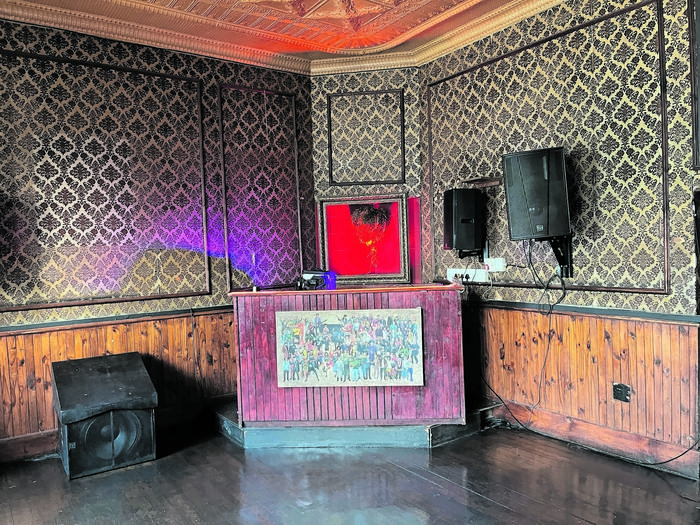
These songs would have worked back in our sessions — they were attended by people who cared about music, who would give you approving winks.
That has always been a Kitchener’s thing with everyone who played here. Not just a place to quench your thirst, but also to tickle your musical taste buds, a welcoming bar.
The pub remains empty and music fan Clements comes over when I do one of those combo things where I play the original — Backstabbers by the O’Jays — mixed into the song sampling it — Wish I Didn’t Miss You by Angie Stone.
“Can I get you another beer?”
“Of course, thanks.”
It has always been a pleasure playing here, I think, as I play a favourite from the days when we DJ’d at Kitchener’s every month: De La Soul’s hip-hop classic Eye Know.
We never saw any carving happening in the Kitchener’s Carvery Bar, as it was formally known. It was always, but always, a peaceful joint.
My time is almost up. It is 10 to one when a friendly looking person in a grey T-shirt carrying a record bag strolls in with an entourage of five.
“I’m Charles,” I introduce myself.
He shakes my hand: “I’m Mr Blanket.”
I don’t share the weak joke that pops into my head that he will probably only be playing covers.
At the end of parties at the Wigan Casino that was closely associated with Northern Soul, the DJs normally ended their weekenders with the same three songs. I have them on a single: first, I’m on My Way by Dean Parrish, then Time Will Pass You By by Tobi Legend and ending with Jimmy Radcliffe’s gorgeously sad Long After Tonight Is All Over.
It is just after 1pm and Mr Blanket has mixed into his set — it’s a house set that would have worked even better at 1am. But this is Kitchener’s and his friends are dancing. What more can one ask for?
Hints at a rebirth – but will it have the same interesting spirit?
In the din of mourning following the unexpected shutdown, after 15 years, of the cutting-edge partying at Braamfontein’s Kitchener’s Bar, there is a contrarian voice: “Kitchener’s isn’t going anywhere … this icon is about to get an extensive restoration and extensions too — an upstairs link into the old Milner Park Hotel,” read a reply to an Instagram repost by Johannesburg In Your Pocket.
“Its long-standing history — now the oldest operating bar in Johannesburg — will be a beacon again for new generations.”
That reply came from Play Braam, the property developer which owns the historical hotel, and which is run by entrepreneur Adam Levy.
We spoke on the phone last week about Kitchener’s closure after it did not renew the contract and how this incarnation of the bar, under the stewardship of Andrew Clements, has come to an end.
“Kitchener’s is transforming while Andrew is moving on — it will be there after I have moved on,” Levy tells me. “Andrew the DJ is a relic from a different time.”
While reading the room — specifically this one, where there are lots of people feeling sad about this beloved cultural institution coming to an end — might not be Levy’s strongest quality, even people who aren’t fans will concede that he has a knack for finding interesting places with potential and developing them with panache.
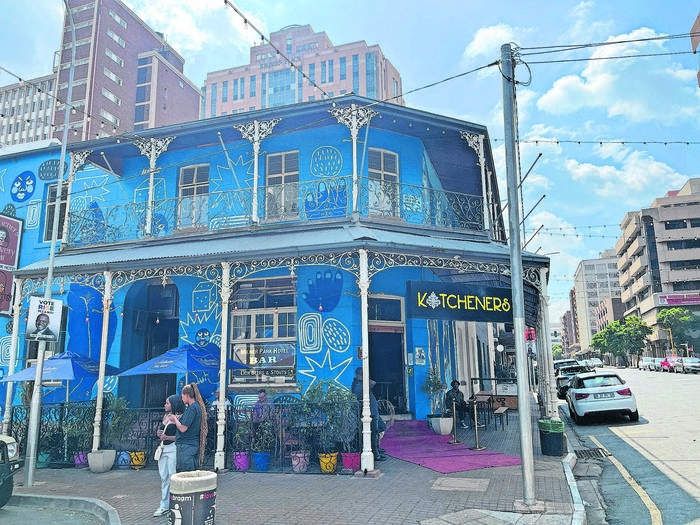
Play Braam owns several other buildings in the area, including the former Neighbourgoods Market (now The Playground) and other structures housing trendy retail and restaurants. Most recently, it has unveiled the Rooftop Basketball Court and Joburg’s first-ever City Beach Club.
Kitchener’s-loving people who expect empathy from Levy should perhaps look elsewhere. He says, “When people talk about Kitchener’s they are nostalgic … about around 2010, when it was transformative, when the best days were in front of it — but then it went to pot since. My job over the last two years was to recalibrate the four blocks around Juta and De Beer streets.
“As Play Braam we are the biggest stakeholders here. With Jozi My Jozi we have reinstalled all the lighting on the Nelson Mandela bridge.”
Levy and his company have signed an agreement with the City of Johannesburg to help with the security and upkeep of Braamfontein, including installing solar lighting.
“The demise of our city is not the only story,” he says and adds that salvaging Johannesburg does not “stop at your front door”.
He promises that, after the renovation, Kitchener’s will be double the size, and it will include access to two floors upstairs in the Milner Park Hotel. There will still be bands and DJs, he says. It will be eight to 10 weeks before it reopens.
Levy can listen to what Kitchener’s DJ Maria McCloy, who is also a cultural and fashion entrepreneur, said after the iconic bar’s shutdown: “Whatever comes in its place under new management can’t compare but one hopes the music remains interesting and the energy welcoming and affordable.”
Electric vehicles have a weighty problem:
The subject of electric cars is a broad one. We have spent considerable word counts mansplaining hybrids, plug-in hybrids and fully electric cars, as well as providing advice on what to consider when purchasing an electric vehicle.
EVs are more friendly to the environment than internal combustion engine-powered vehicles and they are improving in terms of range, price and technology.
However, there is one significant challenge that remains to be addressed — the weight of these vehicles. EVs are generally heavier than cars powered by internal combustion engines (ICE) because of the large battery packs located beneath the floor.
For instance, let’s look at the BMW 420d Gran Coupé, which has a reasonable weight of 1?705kg. In comparison, its electric counterpart, the i4 M50, weighs 2?215kg, because of its high-capacity 83.9kWh battery pack.
On that note, the GMC Hummer EV is classified as a class three medium-duty truck in the US of America, due to its massive weight of just over four?tonnes.
But why do EVs have such a weight disadvantage? After all, they are only batteries, right?
Well, yes, but there are also other factors to take into account, such as electric motors and the additional reinforcement of the suspension system which is necessary in order for it to carry that extra weight.
As for the battery packs, they are usually made of lithium-ion cells, which are quite heavy.
These batteries store the electrical energy that propels the vehicle. In essence, giving a car hundreds of kilometres of driving range means slinging a huge, heavy battery to the bottom of it.
Manufacturing giants such as Toyota and Stellantis are working around the clock to find a workable solution to reducing the weight of these batteries.
Stellantis, in particular, has set an ambitious goal to reduce the overall weight of EV batteries by half by 2030 by developing lighter and more affordable lithium-sulphur batteries, which is a key feature of the new Volvo EX30 as well.
According to the multinational automotive manufacturing corporation, these types of batteries make use of less exotic materials than the lithium-ion batteries of today.
This initiative is largely driven by its investment in Lyten, a company specialising in lithium-sulphur batteries, a promising alternative to the traditional lithium-ion batteries.
Until manufacturers find a viable way to reduce the weight of the batteries in electric cars, they will persist in their inefficiency.
What are the penalties for a heavy EV car?
The heavy batteries contribute to significant understeer, increased inertia and added stress on the suspension system.
Back to the matter of efficiency. The weight of a car affects its real-world driving range.
A heavier car necessitates more energy for movement which, in turn, affects its range, due to the increase in energy demand. This can lead to the rapid depletion of the battery and more frequent visits to the charging station.
During our testing of the BMW iX1 xDrive30, which has a rated weight of 2?010kg, and is fitted with a 64.7kWh battery pack, we were able to drive up to 380km on a single charge.
It’s important to note that the relationship between the vehicle’s weight and its range can be seen as linear because automotive engineers usually account for battery capacity in proportion to the vehicle’s size.
For instance, a large vehicle such as the Lotus Eletre R employs a 112kWh battery pack that feeds power to two electric motors to help carry the 2?640kg behemoth.
EVs tend to understeer because of the weight of the battery packs and weight is distributed differently from ICE-powered cars.
The vehicle’s weight can have an impact on the handling characteristics, particularly cornering.
For instance, the BMW i4 M50, which weighs 2?215 kg, demonstrated a tendency to understeer well before the perceived limit during our 2022 Speed Week event around Slaaihoek in Mpumalanga.
Another disadvantage of EVs weighing more than their ICE counterparts is inertia, simply because the heavier the car, the longer its braking distance becomes. This means a heavy car takes longer to stop than regular cars, posing a safety risk in emergencies.
Greater inertia can also cause more wear and tear on the car’s components, such as brakes and tyres.
Though EVs have some of the best passive and active safety systems in place, several experts and organisations have raised concerns about the increased severity of accidents.
A study estimates that a 450kg increase in vehicle weight has the potential to result in a 47% increase in fatality risk.
Furthermore, the risk to vulnerable road users, such as pedestrians, cyclists and motorcyclists, is a serious concern. The additional weight that EVs carry can result in more severe injuries in a collision with these road users.
Finally, the higher weight of EVs can put additional strain on the suspension system, affecting the vehicle’s performance and longevity.
Carmakers are working feverishly to address these concerns as EV adoption is growing at a rapid rate. EVs represent a crucial step forward in terms of sustainability, as the world is collectively working towards a single goal — net zero emissions.
It is essential that the aforementioned challenges are solved quickly in order to enable a smooth transition to a more sustainable mode of transport.
Submit and get free exposure here: Showcase Your Business | Advertise Your Special Offers.