
Abuse of senior citizens an unspoken shame in South Africa:
Eighty-eight-year-old Lucinda Maree* heard the door slam, the key turn and the lock click into its slot. Then the sound of her daughter’s footsteps as she walked away from the house.
She had earlier forced the widowed Maree to hand over R1?500 of the small pension her husband left her.
Maree cried as she recounted how her unemployed daughter, who is herself over the age of 60 and collects a R2?190 monthly state pension, would lock her inside the house for hours and neglect to give her food.
She would then be told her meal was ready, only to find flies already feasting on the plate.
“I had big trouble staying with her. Every month she demanded R1?500,” Maree said of her only child.
“Every day I was crying. She was locking me in the house. Even at Christmas, she left me in the bedroom. She didn’t come. What if there is a fire, and the whole place burns down, and I am locked inside?”
Her granddaughter, who witnessed her suffering, rescued Maree two years ago and found her a place to live at The Elders Voice KZN in Umbilo, Durban.
Maree is possibly just one of thousands of older people in South Africa who face physical, emotional, economic, psychological and sexual abuse, neglect and abandonment every day — a growing problem according to organisations geared toward the aged.
According to research, “The incidence of elder abuse in South Africa is not clear. Often cases of elder abuse are not registered and when reported to the police, such cases are classified under general or indecent assault or murder.”
Many rely on the R2?190-a-month South African Social Security Agency (Sassa) older-persons grant to pay rent and buy food and electricity.
As Finance Minister Enoch Godongwana prepares to deliver his budget speech next week, few hold out hope he will announce anything more than an increase of R30 or R40 in the grant.
Non-profit organisations for older people say they have not had a state subsidy increase for six years.
Jo-Ann Herbst, founder of The Elders Voice KZN, receives 300 calls every week from people seeking accommodation. Although she runs three facilities — Umbilo, as well as Amanzimtoti and Pennington on the KwaZulu-Natal South Coast — without any state subsidies, she says it is impossible to help them all.
Herbst started the homes with her late husband Harvey when their biker gang, Ripple Effect, which he chaired, saw the need when they began visiting homes and institutions on a regular basis in 2011.
“We started operating from the back of our car where we used to go to these people’s homes and feed them. And we became aware that it was a ‘white pandemic’,” Herbst said.
“Indian people idolise and look after their parents until the day they die. African people, when they are old, want to go to their rural home. Coloured people are generational, so it’s a great-granny and the granny and the dad and everyone lives together.
“White people dump their parents.”
Herbst and her team feed and care for 268 people on a shoestring budget of R53 a person a day. Her residents are mainly, though not exclusively, white, which means businesses do not get broad-based black economic empowerment points for donations, making fundraising a problem.
“Old people are not a sexy topic. People want to donate to a project that has traction. Poverty-stricken people, homelessness: it’s got traction. A kid crying with a dirty little face and tears has traction,” she said.
“An emancipated dog that’s been beaten and now being fed well by an organisation like the SPCA. It’s got traction. What traction does an old person have? They’re old, wrinkly. They are no longer contributing members of society.”
Emigration has been a major cause of children abandoning their parents, even if this was not their intention, Herbst said. When they arrive abroad, they discover life is difficult and they cannot afford to financially support their elderly relatives.
In some cases, people do not have any family to look after them.
Femada Shamam, chief executive of The Association for the Aged (Tafta), said the abuse of older people is a growing social and human rights problem.
In 2023, Tafta, the University of Johannesburg and Cape Town nonprofit iKamva Labantu undertook a research study that found that some of the main causes of the abuse were drug abuse by adult children or grandchildren as well as unemployment and poverty.
“Addiction to alcohol and drugs — particularly whoonga and tik — was found to be a commonly cited risk factor, with family members perpetrating financial, psychological or physical abuse against older persons when under the influence,” Shamam said.
Socio-economic factors were also a key contributor to the abuse, as well as changing value systems, in which elders are no longer afforded respect in families and communities.
“The high unemployment rate and escalating fuel, food and utility costs have resulted in families struggling to survive financially.
“In many homes, the older person’s grant is relied on to provide food for the family.
“In some cases the grant is forcibly taken away, with family members physically assaulting the parent or grandparent to obtain the grant,” Shamam said.
Tafta’s national hotline received more than 230 reports of elder abuse last year, mostly related to family conflict, neglect and financial abuse.
With older people comprising almost 10% of the population, including more than 7?400 centenarians, the country stands at a crossroads.
“Each city in South Africa should work towards becoming an age-friendly city, providing a comprehensive basket of services and resources that support independent living, while ensuring access to essential care,” Shamam said.
There is an urgent need for more dementia and palliative care; affordable housing; municipal-level support including concessions for electricity and water for older people and the organisations housing them; as well as for intergenerational mentorship programmes to encourage economic inclusion.
Shamam believes the Sassa grant should be increased by at least 10% without these concessions or by 5% with mandatory concessions.
“These concessions should apply to essential services such as food and municipal utilities, which extend to institutions housing older people.”
Age-in-Action Western Cape director Irene Snell-Carrol said the grant should be increased to at least R5?000 so older people could afford to rent a room and pay for necessities such as electricity, food and medicine.
She said because non-profits aiding older people had not had state subsidy increases for six years, many were struggling to stay open.
Snell-Carrol’s message for Godongwana was: “I’m looking forward to the budget speech; there are rumours but … there’s no light at the tunnel.
“Government staff will go crazy if they don’t get their increases, so why don’t you treat us the same as you’re looking after your staff?”
* Name has been changed to protect her identity.
Anelisa Mangcu is weaving art into legacy:
Anelisa Mangcu’s journey in the art world was shaped by a rich family legacy, with creativity running deep in her bloodline.
As the great-granddaughter of George Pemba, the iconic South African social realist painter, Mangcu’s early exposure to the power of art sparked a lifelong passion.
“I was in the fortunate position of witnessing joy through art and the act of creating it up close. Like any kid, I was always quite naturally curious about it.”
Mangcu recalls taking all things art-related very seriously as a child, including theatre and dance. In high school, she started a photographic society and was asked to put together a team for the school magazine to document activities at Rustenburg Girls’ High School in Cape Town.
With the help of a teacher, she successfully applied for photography to be introduced as a subject at the school, leaving a legacy behind when she matriculated.
Mangcu went on to earn a degree in creative brand communications from the Vega School of Brand Leadership and later another in curatorship at the Centre for Curating the Archive at Michaelis School of Fine Art through an Andrew Mellon Foundation scholarship.
Ever the forward thinker, Mangcu was 19 when she hosted her first solo show — and sold a painting to former Miss South Africa Jo-Ann Strauss.
She has curated over 50 shows, including solo and group exhibitions and art fair presentations in museums and gallery spaces and at fairs.
Her gallery Under the Aegis, in Cape Town, was established in 2020. For the first three years it didn’t have a physical space but participated in art fairs and other initiatives.
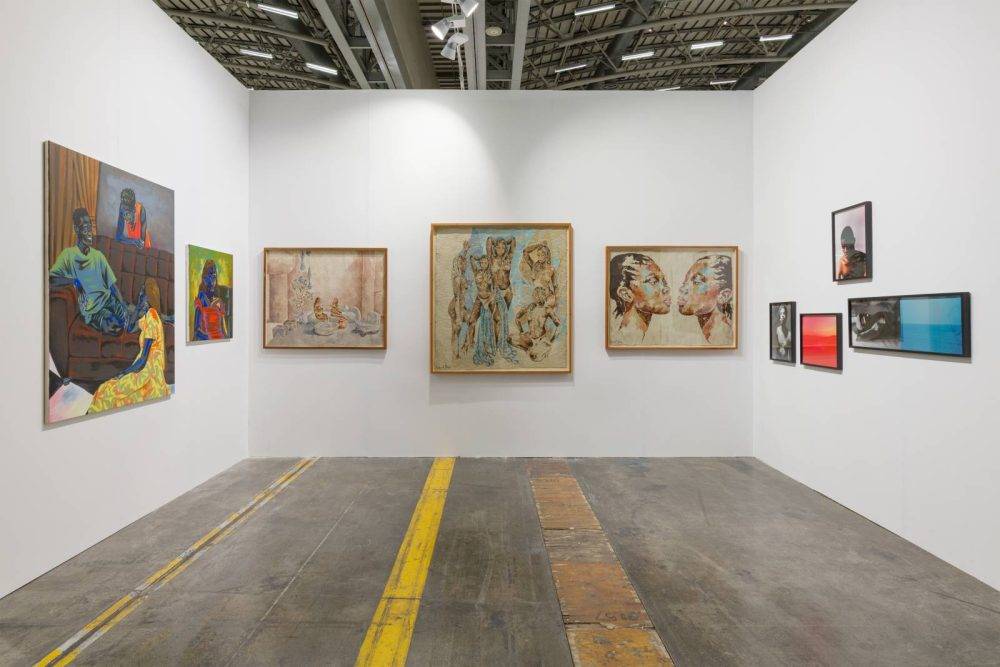
Mangcu didn’t allow the limitations of space prevent her from pursuing her dream of having a physical gallery. It was only in May that a space was opened in Cape Town.
For her, curation is about care —guiding and supporting artists while investing deeply in their journeys.
This philosophy inspired the name Under the Aegis, reflecting both protection and leadership: “When someone is under the aegis of your curatorial direction, they’re under your care, guidance and leadership.”
She also wanted a name that felt distinct from her own identity. As one of the few black woman gallerists in South Africa, she could easily have named the space after herself, but chose instead to create something that would outlive her.
“I like to move in community, rather than with an individualistic mindset. Under the Aegis has a vision of its own — one that we all follow together.”
Mangcu reflected on a milestone year for Under the Aegis, highlighting its participation in major South African art fairs, including the Investec Cape Town Art Fair and RMB Latitudes Art Fair.
At Latitudes, the gallery won the best booth audience award — an especially meaningful achievement for Mangcu, as it marked her first time participating independently, rather than as an employee of another gallery.
The recognition extended beyond the space itself, as artist Buqaqawuli Thamani Nobakada, whose work was exhibited in their booth, received the 2023 audience choice ANNA award.
Following this success, Mangcu returned to Cape Town to collect the keys for Under the Aegis’s first physical space, spending the winter transforming it into a gallery that felt both inviting and true to the team’s vision.
The year also saw the gallery participate in FNB Art Joburg, completing a full circuit of local fairs.
However, last year, the focus shifted towards deepening the gallery’s programming, rather than continuing on the fair circuit.
“So, essentially, what I’m trying to say is we’re really moving at our own pace because it’s not a race.
“We’re all art practitioners with different goals and we’re fulfilling different needs and filling in gaps within the market in different ways.
“I think it’s always been important to kind of know who you are, know how you would like your establishment to be seen and how you want people to engage with it and maybe even the gap that you’re filling in, and play that role, and be adamant and very firm in it because there’s a piece of the pie for everyone.”
Mangcu emphasises the sense of community in the art world, noting that collaboration and support are more present than they might seem.
As a gallerist and curator, her focus is on showcasing remarkable exhibitions, securing institutional recognition for artists and ensuring their work finds a place in public and private collections.
“One thing that’s guaranteed is we will all have our time where we’re no longer physically on this earth but the artworks outlive us. They will outlive us. Stories will outlive us and people’s legacies will live through the works that they do.”
Beyond her gallery, Mangcu also established the company Victory of the Word with artist Athi-Patra Ruga as a vehicle to nurture emerging artists from the Eastern Cape.
Set in the Amathole Mountains of Hogsback, the residency provided eight artists with a space to explore their practice, develop new work and be mentored.
“It was very moving,” Mangcu says. “We put out a call for multi-disciplinary, contemporary artists to submit their vision and the response was incredible.”
After the residency, Bodyland: A Sight for Contemplation debuted at AVA Gallery, during the Cape Town Art Fair, bringing crucial visibility to the artists. The show later travelled to UJ Art Gallery, in Joburg.
“Seeing the response was the most beautiful thing ever,” she recalls. “It encourages us to do another residency when we’re in a position to fund it.”
Although the pandemic delayed further iterations, the residency’s impact endures. Many alumni have since exhibited at major art fairs, secured international residencies and gained gallery representation.
“That’s what we want,” Mangcu explains. “To give them the platform, the tools and then see them thrive. No one institution can fulfil everyone’s needs, so we count on the community to support and uplift each other.”
She acknowledges that keeping a business afloat in its first five years is a challenge, particularly in an unstable economy.
“Some people get lucky, some don’t,” she says, adding that political and social instability often means people prioritise essentials over art. Still, she remains optimistic.
“I’m very blessed that my collectors come in when I need them.”
She reflects on the broader industry, noting South Africa’s art market is shaped by historical and structural inequities: “If you do not come from the infrastructure of a very specific background, then you’re catching on to the bandwagon a little later.”
While this can make the space feel exclusionary, she believes perseverance and strategy can create access: “I don’t think anything is impenetrable if you put your mind and energy into it.”
Rather than dwell on challenges, she focuses on solutions — collaboration, mentorship and reimagining traditional gallery spaces.
“We have an opportunity to fill gaps, to do something better.”
She sees value in learning from established players.
“A lot of them do give energy and insight,” she says. “And that’s where I put my energy, rather than trying to work outside the system.”
This promises to be a defining year for Mangcu.
This month, she will curate the much-anticipated first institutional show for acclaimed Malawian-South African artist Billie Zangewa at the prestigious Norval Foundation in Cape Town. The exhibition, Breeding Ground, will not only showcase Zangewa’s work, but will include a special surprise.
This milestone marks a pivotal moment for Under the Aegis. The gallery will officially open its doors to the public with a full programme, including Buqaqawuli Thamani Nobakada’s debut solo exhibition. This dual launch embodies Mangcu’s commitment to nurturing artists and building a platform that champions both emerging talent and groundbreaking collaborations.
It’s testament to the gallery’s evolving role in South Africa’s vibrant art ecosystem, blending care, community and vision as it continues to thrive.
Cybersecurity is crucial in modernising South African mining:
The use of digital technologies are paramount for the South African mining industry to enhance effective, safe and sustainable operations, as well as to drive global competitiveness.
The modernising of mining is crafted in the South African Mining Extraction Research, Development and Innovation Strategy, which provides a roadmap to 2030 on ways industry, government, research councils and academia could collaborate in developing relevant technological solutions that ensure the survival and digital transformation of the mining industry.
This strategy is a partnership between the government, led by the department of science, technology and innovation, and the Minerals Council South Africa.
The strategy has led to the establishment of research centres co-located in local universities, focusing on mechanised mining systems, real-time information management systems and the strategic application of technology centred around people.
The annual Mining Indaba, held in early February in Cape Town, brought together local, regional and global leaders, experts and companies in the mining sector. A clear emphasis on digital mining was evident in the various discussions and presentations.
The conspicuous absence of cybersecurity from the Mining Indaba’s discussions and agenda underscores its low prioritisation in the industry’s modernisation efforts.
This common, cross-sector misconception — that cybersecurity is merely a supporting rather than a core function — belies the current threat landscape. This perception must change to ensure that digitalisation delivers positive outcomes for mining businesses rather than creating new vulnerabilities.
The mining sector, traditionally viewed as a purely physical operational environment, was once considered immune to cybersecurity threats. But the industry’s increasing reliance on automation, digitalisation, remote access to operational technology (OT) systems (such as Supervisory Control and Data Acquisition, Programmable Logic Controllers and Distributed Control Systems), centralised data analysis and digitally monitored safety and health has made it a prime target for cybercriminals.
These often-aging OT systems, designed for efficiency rather than inherent security, are now exposed to significant digital risks.
Cyberattacks in the mining sector target information technology (IT) systems, OT systems and the industrial internet of things (IIoT). While the sector faces common IT-related risks, the convergence of IT, OT and IIoT significantly expands the threat landscape. Furthermore, the prevalence of legacy OT systems, critical for operations but often digitally vulnerable, introduces another layer of complexity and risk for mining companies.
A recent survey by PwC, conducted among chief executives of various organisations, showed that cybersecurity has risen to the position of the third most concerning risk to organisations, with the estimated cost of a single data breach being R53.1 million, as reported by IBM and TechCentral.
Given the high cost of a single data breach, cybercriminals are increasingly targeting organisations as they streamline their operations through automation and managing facilities and assets remotely with the aid of internet-connected technologies.
In 2024, a series of cyberattacks were reported in the mining sector, locally, regionally and internationally. In August 2024, Sibanye-Stillwater issued a notice under section 22 of the Protection of Personal Information Act, reporting that the mining company had experienced a cyberattack that compromised certain global ICT systems, leading to the exposure of stakeholders’ personal information, such as identity details, health and financial information, banking details and contracts.
In the same month, an Australian gold mining company Evolution Mining Ltd, had a ransomware attack on its IT systems. This incident followed another cyberattack at Australian Northern Minerals Ltd, where sensitive employee information was compromised.
In 2023, a copper mining company in the United States, Freeport-McMoRan, was hit by a cyber incident that affected its information systems and led to their shares declining by almost 2% in a single day.
These cybersecurity incidents highlight the increased digital security concerns in the mining industry. These types of attacks have the potential to disrupt the mineral extraction operations, consequently threatening jobs and leading to possible company closures.
To maintain operational resilience, protect valuable assets and ensure long-term competitiveness, mining companies must prioritise the adoption of cybersecurity technologies and capabilities development.
At a minimum, mining organisations must:
- Develop context-specific cybersecurity strategies tailored to their unique operational needs;
- Gain a comprehensive understanding of their digital landscape, particularly the convergence of IT and OT environments;
- Conduct thorough cybersecurity assessments and risk management exercises to identify specific cyber threats and vulnerabilities;
- Develop and implement robust cybersecurity solutions, including continuous monitoring of cyber events and incidents;
- Provide regular cybersecurity awareness training and education for all employees, leaders and stakeholders; and
- Develop, regularly test and update cybersecurity incident response plans.
The Council of Scientific and Industrial Research (CSIR), in line with its October 2024 National Cybersecurity Survey, recommends that the mining sector integrate cybersecurity as a core component of its risk and safety management strategy. To improve their cybersecurity posture and mitigate escalating cyber threats, mining companies should consider the following strategic actions over and above the technical considerations:
- Invest in cybersecurity: Increase investment in cybersecurity infrastructure, technologies and especially home-grown tools, as well as prioritise the development of a skilled cybersecurity workforce for the mining sector;
- Foster public-private partnerships: Encourage collaboration between the public and private sectors to address shared cybersecurity challenges; and
- Establish sector computer security incident response teams (CSIRTs): These national CSIRTs can monitor, detect, respond to and recover from cyber incidents more effectively than individual companies acting alone. This initiative could also facilitate threat intelligence sharing within the mining sector.
While the mining industry modernises, the digital risks that threaten operations, reputation and revenue cannot be ignored.
Dr Jabu Mtsweni is the head of the Information and Cybersecurity Centre at the Council for Scientific and Industrial Research (CSIR) and a research fellow at the Stellenbosch in Security Institute for Governance and Leadership in ??Africa. Muyowa Mutemwa is the research group leader for data security and analytics at the CSIR.
Submit and get free exposure here: Showcase Your Business | Advertise Your Special Offers.
