
Advancing the teaching of chemistry in Overberg education district:
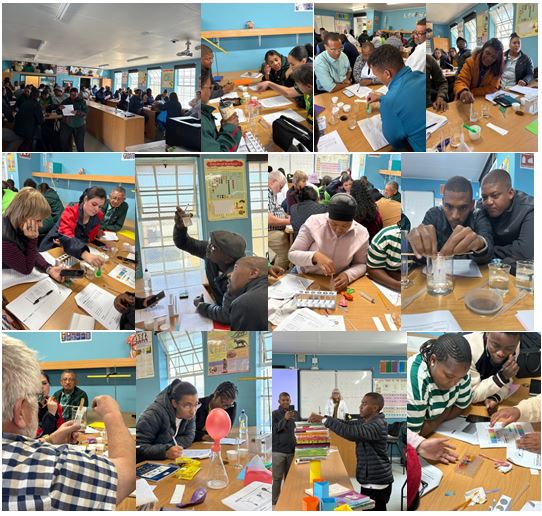
According the CAPS curriculum for Natural Sciences, content of the second term covers the Matter and Materials knowledge area generally referred to as chemistry. To address this part of the curriculum, Advancing Knowledge Non-Profit Company (AK NPC) continued with its professional development programme for Natural Sciences teachers in the Overberg region. A total of 44 intersen (grade 4-7) teachers attended the Inquiry-Based Science Education (IBSE01) course on Friday 9 May 2025 and a smaller group of senior phase (grades 8 and 9) teachers attended the course on Saturday 10 May 2025. The training took place in the science laboratory of De Rust Futura Academy in Grabouw. This science laboratory called a STEM Teaching and Learning Centre (STEM TLC) was constructed through the partnership between AK NPC, Garden Cities Archway Foundation and Western Cape Education Department.
The basic philosophy of the ongoing Advancing Knowledge NPC professional development training is the inquiry-based approach which includes practical and experimental (inquiry-based) hands-on application of curriculum content of each school term. These sessions therefore serve to prepare teachers for the particular term’s curriculum content. The teachers’ participation was arranged in collaboration with the Overberg education district’s science subject advisors Mr Jandre Gerber and Ms Clothilda van Aarde. The facilitators for the chemistry sessions were Ms Zaiboeniesa Ahmed (intersen phase) and Prof Shaheed Hartley (senior phase) assisted by AK NPC staff Saadiqah Fraden, Somila Dlakavu and Yusra Joubert (science interns) and projects coordinator Melissa Petersen.
EXPLORING AND ADVANCING INTERSEN (GRADE 4-7) CHEMISTRY
The science laboratory at De Rust Futura Academy was a hive of activity, noise, enthusiasm and excitement on Friday 9 May 2025 as a total 44 teachers participated in the chemistry activities prepared and presented to them by the facilitator and science interns. Teachers’ basic chemistry knowledge was tested both theoretically and practically but also extended and advanced through carefully selected experiments and investigations. Challenging teachers conceptions of dependent, independent and constant variables always bring out debate as many teachers are not always sure when faced with different experimental scenarios. In the end teachers actively participated in chromatography, pH testing of everyday substances using various indicators, acids and bases reactions, testing the strength of materials, application and balancing of forces, solubility of substances and various chemical reactions. Because of the number of teachers present (44), they were also guided on group work, how to set out investigations and experiments for groups of learners and assessing learners participation in groups. The activities were specifically prepared so that teachers could translate it directly into their lessons for the second term. The following are some of the teachers’ reflections:
- The chemistry experiments were very exciting as it made us think. I like the idea that you can use an experiment that did not quite reach what it was supposed to as a learning opportunity to find out what went wrong. The interaction with colleagues during the experiments certainly makes one think and learn new things. [Teacher]
- The experiments we did today was not difficult or complex. It is definitely what I will do in my science class. That is what I like about this workshop. It is practical and meaningful and in line with what we can use in our lessons. [Teacher]
- I am a new science teacher. I was overwhelmed at first with chemistry content and all the science teachers in the workshop but it was actually nice to be able to talk to each other and see how we teach things at our schools. The workshop definitely helped me on how to plan my practical science lessons. [Teacher]
Teachers expressed their appreciation for motivating them to attend the course. They were very excited and indicated that they enjoyed themselves and learnt how to implement the inquiry-based approach to teaching. [Science Subject Advisor]
CHALLENGING SENIOR PHASE (GRADES 8 and 9) CHEMISTRY TEACHERS
Despite the threat of a storm on Saturday 10 May 2025, teachers attended the training at De Rust Futura Academy’s science laboratory. They responded well to an example which illustrated the scientific method as they could easily transfer it into their natural science lessons. The facilitator engaged teachers in a detailed discussion about matter, phases, periodic table of elements, compounds and mixtures, etc. Teachers participated in the many chemistry activities including separation of mixtures (chromatography experiment), the relationship between mass, volume and density (liquids of differing viscosity experiment), acids and bases, the pH scale and indicators (testing the pH various household substances with different everyday indicators), acid and bases reactions (investigating neutralisation through titration), preparation, testing for and reactions of three gases, namely hydrogen, oxygen and carbon dioxide (preparation of hydrogen gas and reaction with oxygen in pringles box experiment), preparation of oxygen (reaction with potassium chlorate experiment), burning of metals and non-metals in oxygen (experiment with carbon, steel wool and magnesium), testing the acidity or alkalinity of the solution (testing using litmus paper) and carbon dioxide testing. All chemistry activities were extracted from the natural sciences curriculum content and related directly with what teachers had to include in their chemistry lessons. Teachers expressed their impressions of the session in their reflections:
- The sessions were practically-based which is an area that I find difficulty teaching at my school. I liked that everyday substances were used which we could emulate in our classes. I really enjoyed the session. [Teacher]
- I was quite taken aback by the simplicity and ease with which these experiments are done. It gave me a new perspective of teaching chemistry. Inquiry-based teaching of chemistry is an approach I will definitely try out in my science class. [Teacher]
- I consider myself to be an experienced science teacher. It was good to be reminded of the practical approach to in-class teaching as opposed to doing the science experiments as an add-on to my normal science lessons. [Teacher]
Teachers indicated that they enjoyed the training. Thank you for your assistance with the inquiry-based approach. It is important for our teachers to see how this is done first hand and to be hands-on with it as well. [Science Subject Advisor]
This project was made possible by the partnership between Advancing Knowledge Non-Profit Company, Garden Cities Archway Foundation and Western Cape Education Department. Organisations and corporates that want to contribute to this initiative to empower and capacitate science teachers to build a critical mass of future STEM practitioners, are encouraged to make contact with the Director of AK NPC, Prof Shaheed Hartley (shartley@skatt.co.za) or visit www.skatt.co.za
Solo Female Travellers Set Their Sights on Africa:
There’s no doubt about it; solo female travel is on the rise. Global travel brand, Virtuoso, reports that women now make up 71% of solo travellers. In the US, Google searches for ‘solo female travel’ went up 131% last year alone (compared to 2023), and even the briefest look at social media reveals a wealth of Instagram accounts, Facebook groups, and Reddit communities all centred around women’s solo adventures.
While Europe (Italy, Spain and Portugal) remains the top choice for solo travellers, Latin America (Peru, Costa Rica and Ecuador) and Asia (India, Japan, Thailand and Vietnam) are also in demand.
Meanwhile, Africa might just be emerging as the next frontier for solo female adventurers, with women-led safaris transforming the traditional Big 5 experience into something more authentic, immersive and sustainable.
As Antoinette Turner, General Manager of Flight Centre South Africa, explains, Tanzania, Zambia, Botswana and South Africa are all proving popular with solo travellers.
“Africa is becoming more sought after amongst solo women travellers because it offers wide open spaces and authentic experiences untouched by mass tourism,” says Turner. “Unlike overcrowded tourist hotspots, the continent provides room to breathe, reflect, learn and, ultimately, have fun – without the unrelenting pressure of work or home life.”
Kgomotso Ramothea, CEO of ATTA® (The African Travel & Tourism Association) agrees:
“ATTA® has just published a whitepaper on Africa’s untapped tourism niches, and women-only safaris features prominently.”
“Importantly, it’s not about avoiding men, feeling ‘safer’ in women-only groups, wanting to feel ‘empowered’ or even setting off on a journey of self-discovery,” says Ramothea. “Instead, it’s quite simple. Women are increasingly looking for flexibility – and the opportunity to experience Africa on their own terms, and at their own pace.”

Safari ideas
Every woman is different, and operators or accommodation suppliers that can customise diverse experiences will lead the market, says Turner.
“This means blending adventure with cultural immersion, traditional sightseeing and moments of rest and tranquillity, rather than assuming all women want wall-to-wall spa treatments – unless that’s genuinely their preference.”
Turner believes there’s tremendous potential to develop safe, flexible itineraries that go beyond the traditional Big 5 safari.
Some possibilities for South African travellers include:
- Zanzibar for a spice farm, Stone Town and Prison Island tour, night markets, local cooking classes, dhow cruises and plenty of beach time!
- Botswana for an unforgettable trip that takes in both the elephants of Chobe and the waterways of the Okavango Delta. Think game drives, river safaris and sunset cruises (even quad biking in the Makgadikgadi if you’re feeling adventurous!).
- Zambia for a stay at the iconic Royal Livingstone Hotel, adrenaline-fuelled activities at Victoria Falls (including a dip in Devil’s Pool), a walking safari in South Luangwa National Park and the museums, galleries and restaurants of Lusaka.
- Uganda for gorilla trekking in the Bwindi Impenetrable Forest, swimming, canoeing, bird watching and nature walks at Lake Bunyonyi (“place of many little birds”) or seeking out matoke, the national dish of Uganda.
Rwanda for a tour of the country’s vibrant capital, Kigali (which is widely considered one of Africa’s safest cities for solo travellers), a visit to the Kigali Genocide Memorial, a women-led coffee farm tour and a private game drive in Akagera National Park.

What women want
According to Flight Centre’s latest Global Travel Survey – conducted in January 2025 – women travellers are more likely to:
- Place higher priority on safety, peace of mind and stress-free travel planning.
- Value travel agents for their expertise and convenience.
- Consider travel extremely important for mental health.
- Prefer alcohol-free holidays.
- Identify lost luggage and flight delays as their top travel frustrations.
“It’s no different to solo travel,” says Turner. “Ultimately, safety and preparedness remain paramount, followed by freedom, flexibility and ‘time to just be’.”
Top tips for solo travel
For Turner, research, preparation and finding the right travel partners is key.
“Hop onto the solo travel message boards, research your destination, take note of travel tips and packing advice and ensure you deal with partners with a strong track record in solo travel – after all, you want to get the most out of your trip,” she says.
In addition, Turner emphasises the following:
- Be mindful of single supplements. Have the discussion up front and negotiate where possible. Alternatively, explore travelling in low season or shoulder season for better rates.
- Plan your first night well (in other words, avoid arriving in a new destination after dark without trusted transport and accommodation in place).
- Book group activities. It’s a great way to meet like-minded women, expand your circle and even make life-long friends.
- Connect with locals and enjoy authentic experiences.
- Plan rest days and give yourself plenty of space to be spontaneous.
- Invest in comprehensive travel insurance.
- Take care of your valuables (for example, use the hotel safe and consider wearing a money belt when out and about) and protect your personal information.
- Make both hard copies and digital copies of your important travel documents and store them securely.
- Check-in with family and friends back home so that people always know where you are and where you’re headed.
“Female travel – whether solo or with friends – is booming,” says Turner. “Studies show travel companies dedicated exclusively to women have surged by a staggering 230% in recent years. It’s fantastic to see more women of all ages embracing African adventures – and operators designing itineraries that meet the demand for eco-friendly, sustainable, flexible, interesting and enriching experiences that resonate with female travellers,” she concludes.
A call to shift perspective: Africa’s opportunity to pivot in a changing geopolitical landscape:
The world is entering a new geopolitical era – one defined by retreating superpowers, restructured trade dynamics, and accelerated technological rivalries. Recently, we have seen major shifts for Africa, such as the withdrawal of USAID support and changes in tariff regimes, fueling trade wars globally. The IMF has declared that the global economic system that has operated for the past 80 years is being reset. These decisions are not isolated events; they form part of a larger trend toward de-globalisation, which is reshaping global dynamics. As Africa, we cannot ignore the calls for us to re-evaluate our roles in the world economy. These shifts reflect a broader trend toward de-globalisation that is redrawing the map of global influence and interdependence. These shifts represent not only disruption, but also a rare and timely opportunity for our continent to reassess and redefine its place in the world – a phoenix moment if navigated appropriately.
The immediate results are already visible. Cutbacks in USAID have had humanitarian consequences for nations, ranging from impact on community kitchens in Sudan, and HIV/AIDS programmes in South Africa to name a few. Beyond the short-term crisis, however, lies an important question: how can Africa leverage this geopolitical reordering to shift from dependency to agency?
Part of the answer, as with any artful negotiation or bargaining, lies in Africa awakening to a few key fundamentals and strengths that uniquely position it as a relevant force on the global stage.
Let’s start with the obvious one: our immense resource wealth. The continent holds roughly 30% of the world’s critical minerals, including the second-largest manganese reserves. More relevant to current technological shifts and critical to the AI revolution, 70% of global cobalt reserves are in Africa. While rare earth elements essential for electric vehicles and semiconductors are scattered across the continent, demand for critical minerals and rare earth metals is expected to rise fourfold by 2040.
While we have a unique opportunity, the world needs critical minerals and rare earth metals more than ever before to transition to clean energy technologies, manufacture microchips for semiconductors used in military applications, and build industrial infrastructure (critical minerals are essential for the hardware driving artificial intelligence). However, we may also be in danger of missing out on the leverage and development benefits these resources offer if we fail to fully capitalise on the global shifts to leapfrog development. The difference lies in how we choose to act. Without a strategic and unified approach, we risk repeating past patterns – extracting value without retaining it, and exporting raw resources without capturing downstream benefits. The green and digital revolutions will either reinforce old dependencies or provide the continent with an opportunity to leapfrog. As these revolutions accelerate, global demand for these inputs is soaring, placing Africa once again at the centre and offering African nations unprecedented bargaining power in global supply chains.
Our continent’s digital rise adds another layer to our geopolitical relevance. The expansion of data centres from Nairobi to Lagos has the potential to position Africa as a vital node in the global digital infrastructure, particularly in AI development. Rwanda’s Kigali Innovation City and Kenya’s Konza Technopolis are early signals of this shift, aiming to position their countries as hubs for tech innovation, AI research, and smart infrastructure. Data sovereignty, energy-efficient cloud computing, and ethical AI training practices are becoming central issues. Africa has a rare opportunity to shape these conversations by becoming a secure and strategic location for data processing, model training, and digital innovation. Investments in digital infrastructure could enable Africa to not only bypass legacy systems but also become indispensable in the global tech ecosystem. However, mineral wealth and infrastructure alone are not enough; Africa must pair them with strategic labour market advantages.
This brings us to another strength: our people. In contrast to ageing populations in the West and parts of Asia, Africa has the world’s youngest population, with over 60% under the age of 25. This youth bulge has the potential to become a demographic dividend, but only if it is harnessed correctly. Africa’s youth can drive innovation, supply labour, and fuel consumption. However, this potential is not guaranteed. It requires intentional investment in education, vocational training, and entrepreneurship to turn the youth bulge into a global competitive advantage.
Africa’s pivot must be framed within the broader context of intensifying global competition, particularly between the United States, China, and the European Union. Trade wars, technology embargoes, and competing development models have disrupted traditional economic alliances. These rivalries present both risks and rewards for African nations. On the one hand, they could destabilise existing trade flows; on the other, they create an opening to renegotiate Africa’s terms of engagement with global powers.
Both China and the United States are seeking new allies and markets. In this context – and in keeping with the theme of negotiation – Africa must move beyond the role of passive partner to become a savvy negotiator in this evolving landscape. This means negotiating not as recipients of aid or investment, but as equal partners with assets the world needs. It also requires shifting from a fragmented continent of 55 countries to a cohesive bloc capable of driving its own agenda.
This is precisely where the African Continental Free Trade Area (AfCFTA) becomes mission-critical. AfCFTA is the most ambitious trade integration effort on the continent in decades, aiming to connect over 1.4 billion people in a single market. It is expected to boost intra-African trade by over 52% through the elimination of tariffs and non-tariff barriers. Leaders at the World Economic Forum have also called for AfCFTA to be integrated into Africa’s green and digital transformation strategies, positioning it as a framework for not only trade but also innovation, energy, and resilience. Today, regional integration is more important than ever, providing scale, bargaining power, and a path to self-reliance.
If implemented effectively, AfCFTA could unlock the industrialisation Africa has long sought, create value chains that stay on the continent, and enhance resilience against external shocks. It has the potential to bridge Africa’s untapped potential with its prosperity, becoming the most powerful platform to shift from historical disadvantage to global relevance.
In this context, the upcoming G20 Summit, hosted by South Africa in 2025, marks a critical turning point. It offers Africa the opportunity to present a unified voice, advocate for reforms in multilateral institutions, and advance a narrative defined by strength, opportunity, and partnership, not by deficit or need, showcasing Africa’s growing relevance in the global economy. President Cyril Ramaphosa has indicated that inclusive growth and industrialisation will headline the agenda. However, the real impact will depend on whether African leaders can align behind a clear, actionable strategy with measurable outcomes.
While the shifting world order may seem destabilising at first glance, for Africa, it represents a moment of unprecedented opportunity. With the right investments in human capital, infrastructure, and negotiation capabilities, the continent can move from the margins of global decision-making to the centre.
The time to act is now. The tools are available; what is needed is a bold vision, clarity of purpose, and coordinated action. This is Africa’s moment to pivot.
Submit and get free exposure here: Showcase Your Business | Advertise Your Special Offers.
