Afrikaner farmers feel ‘safe and happy’ in US:
Afrikaner small-scale farmer Jan* and his wife Marietjie* were the victims of a farm attack in which their dogs were poisoned and gunmen fired 67 shots into their home.
They survived, unlike fellow Afrikaners Dawid and Rallie de Villiers, in their 80s, who were murdered in their home in Eastern Cape with the perpetrators leaving satanic symbols painted in their blood, according to local media reports.
Or Lindley farmer Attie Potgieter, who was stabbed more than 150 times while his wife and two-year-old daughter were forced to watch before being murdered too.
But not all victims of farm murders are white — scores of black workers have also been caught up in the violence, and black farmers have not been spared, including David Netshilaphala, a 62-year-old small-scale farmer in Limpopo, who disappeared after checking his kraal. Police found his body several weeks later.
Nor are all attackers black people. In August 2022, a Ficksburg farmer, Morgan Barratt, was assaulted by Rudi Gericke and Kleinjan le Grange. In January 2023, Evan Sorour, 28, also a farmer in the Ficksburg area, was shot dead and his father, Reuter, assaulted by Gericke, who was sentenced to 13 years for murder.
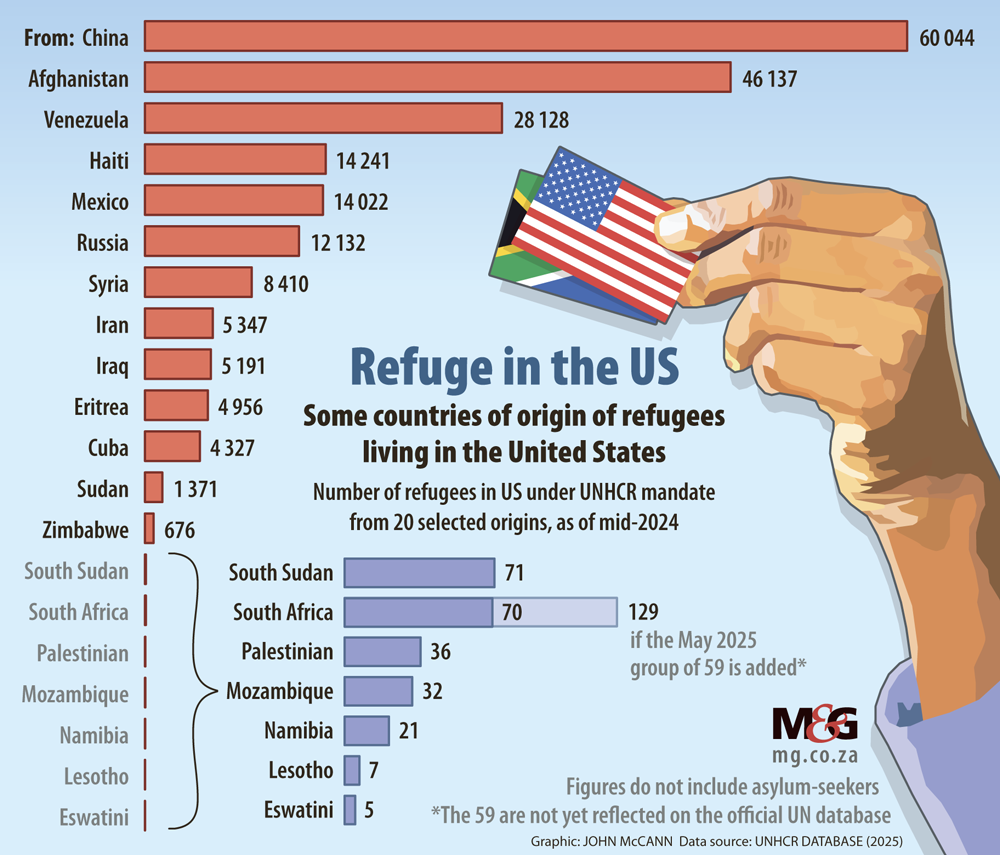
Farm murders are in international headlines after 59 Afrikaners landed in the US under President Donald Trump’s programme to give refugee status to those “who are victims of unjust racial discrimination”.
An executive order signed by Trump said the US will promote the resettlement of Afrikaner “refugees” escaping “government-sponsored race-based discrimination, including racially discriminatory property confiscation”. It has since been expanded to include all minorities, including coloured and Indian South Africans.
But critics in South Africa and elsewhere have pointed out that farm violence also affects black people, and that violent crime is a national issue that has millions of people living in fear, regardless of race.
They have also questioned the vetting process the US embassy used to verify the claims made by those applying for refuge.
The Mail & Guardian asked the US embassy in Pretoria what criteria were used in considering applications from South Africans, particularly Afrikaners, for refugee or asylum status, and whether there specific programmes or mechanisms in place for evaluating claims.
The embassy referred questions to the state department. A spokesperson responded: “To be considered for the US Refugee Admissions Programme in South Africa, individuals must meet all of the following criteria: must be of South African nationality; must be of Afrikaner ethnicity or be a member of a racial minority in South Africa; must be able to articulate a past experience of persecution or fear of future persecution.”
According to the state department’s bureau of population, refugees and migration, refugees from African countries must meet the legal definition under the US Immigration and Nationality Act: “A person who is unable or unwilling to return to their country of origin due to a well-founded fear of persecution based on race, religion, nationality, membership in a particular social group and political opinion.”
US deputy secretary of state Christopher Landau welcomed the first group of Afrikaners to the US on 12??May, including Jan and Marietjie, who shared their experiences in an interview on retired US colonel Chris Wyatt’s YouTube channel. Wyatt, who has lived in Africa, has been outspoken about US-South Africa relations.
In the interview, the couple said they had left family to run their farm in South Africa and relocating to the US had brought them relief.
“Having gone through a farm attack ourselves, where three of my family members in the house were shot, the relief that we’ve experienced on this side is tremendous. We literally didn’t sleep at night for every single sound,” Jan said.
“In that house, they fired 67 shots that night, so if [Marietjie, after the incident] turned on her side, she could literally touch the bullet hole in the wall.
“The middle of the door, when we pushed the door closed, they were thinking that my dad was standing in front of the door, so they shot through the middle of the door at him.
“We got asked by a lot of people, why are we still there? It’s because that’s our heritage. But if it wasn’t for my children, I think we would have endured everything and remained.
“But as a parent, I need to ensure their safety, and they are definitely not safe in South Africa,” he said.
The family was temporarily staying in a four-bedroomed Airbnb house and had viewed one the US government had found for them.
“If I get the opportunity, I would like to do farming again. I told them I’m willing to sweep the streets if that is needed, just to settle in and get going. But we grew up on the farm. That’s our backbone — farming.”
“We planted everything by hand and harvested everything by hand. Our latest venture was 90?000 cabbages. Myself, my wife and two workers planted every plant by hand. We harvested by hand,” Jan added.
Wyatt, who is in touch with some of the relocated Afrikaners, including farmers and with children, told the M&G many are furious about how they have been portrayed in the media, being called “cowards” by President Cyril Ramaphosa and described as “car guards” by Economic Freedom Fighters leader Julius Malema, who also publicly demanded the names and farm addresses of the refugees.
“We did this to ensure our kids have a future — and a bright future,” Smit told Wyatt on the channel. “He can call us cowards. It doesn’t have any negative bearing on any of us. We know the truth. We know what we’ve experienced.”
Marietjie said she was sure others would follow them to the US when they saw that “we are happy and safe and how relaxed we are”.
Wyatt said the mood among the refugees he spoke to was one of “a great sense of relief and safety”.
“They’re not looking over the shoulder. They’re not up at night guarding, taking shifts sleeping. Some of these families, that’s what they had to do,” he told the M&G.
“A lot of them are very apoplectic about what’s going on. They expected to be attacked being the first to come over, but the violations of the Popi [Protection of Personal Information] Act, the effort to destroy their lives and harm them, has really shocked some of them.”
Wyatt said many of the refugees had hidden their identities from the media but there had been attempts to “dox” those who were photographed on arrival in the US.
One news site, he said, visited the house of a woman in Gqeberha and exposed her name.
Wyatt said he “always stopped short of saying there’s a genocide in South Africa”, as Trump has claimed, “because it’s a politically charged term” with a “very specific legal definition”.
However, he argued that he believed the country has reached stage eight — persecution — of the 10 stages identified by Genocide Watch.
He said Trump’s executive order was a response to racial discrimination in education and business, an apparent reference to the government’s black economic empowerment programme.
Critics, including the Democratic Alliance, have slammed the policy as racially divisive but the ANC, which introduced the programme after coming to power, says it is meant to redress the economic and social imbalances created by apartheid.
“Some of them may have had teenage kids who graduated matric with a 90% or 98% and were denied a bursary because of their skin colour. That’s a justification for coming here. Some of them may have been forced to sell equity in a company, or they didn’t get promoted because of their skin. But instead of admitting what’s going on, [critics] want to focus on ‘everyone’s a victim of crime’,” Wyatt said.
He added farm violence and incidents involving black farmworker victims was also underreported.
Afrikaner rights group AfriForum said there were 333 farm attacks and 50 murders in 2022, declining to 296 and 49 incidents, respectively, in 2023.
The police stopped publishing farm murder statistics in 2006-07, integrating them into general murder figures. In 2018-19, it reintroduced specific reporting, noting 47 farm murders. Since then, it has only intermittently included this data.
The latest police statistics, for October to December last year, indicated one murder of a farm owner among 12 farm murders out of 6?953 total reported killings. AfriForum disputed this, claiming eight farm owners were murdered during the period.
* Names were changed on the YouTube video for fear of reprisals.
Trump exposed white fragility during his theatrics in the Oval Office:
“Love your enemy, turn the other cheek.” Many of us have been brought up with these Christian adages. Many who are not Christian, are generally aware of them. Indeed, it is said that if you are able to not succumb to violence even in the face of violent oppression, somehow you are the better person.
Militant Argentinian-Cuban revolutionary Che Guevara may not be an obvious example, but he said, “At the risk of seeming ridiculous, let me say that the true revolutionary is guided by a great feeling of love. It is impossible to think of a genuine revolutionary lacking this quality.”
India’s Mahatma Gandhi built an entire liberation movement of daring the oppressor to be openly evil and not reacting. The United States’ Martin Luther King Jnr was famously moved by Gandhi’s non-violent philosophy of satyagraha, and made it a central plank of his civil rights movement. Even Malcolm X, who embraced violence but after he returned from a holy pilgrimage to Mecca where he witnessed black and white Muslims, he started to walk back from his message of anger towards white people.
American revolutionary socialist and one of the leaders of the Black Panthers, Fred Hampton, was militant and advocated for the oppressed and working class to be armed. He drew no distinction between black and white working class people. He organised and called for unity of the working class so that they are able to take on the bosses and elites of American society.
And this is the conundrum. We can be starry-eyed, turning the other cheek and loving our neighbour as the height of radical struggle, in the hope that the oppressor’s morality kicks in and they see the error of their ways? Nothing in the history of humankind reveals such a Damascus moment and conversion. At the same time we cannot discount that liberation struggles, which placed the military pillar at the centre, generally get consumed by their own violence.
As Brian May from supergroup Queen sang, “Too much love will kill you, it will kill you every time”, we could also add, that too much hate will also do the same.
Today, we are witnessing the weaponising of white fears by their leaders in countries around the world. These leaders, like the US’s Donald Trump, Italy’s Giorgia Meloni and Hungary’s Viktor Orban have successfully convinced themselves that white oppression because of past mistakes (which are deliberately downplayed) is the greatest challenge, not that the majority of the world’s poor and oppressed are black.
We are yet to witness a reaction to this growing weaponising of white fear. Already there is a growing terrorising of black activism, and it has not yet resulted in a rising of black anger, but it could be just a matter of time.
The post-apartheid government of South Africa was an exercise in restraint when it came to getting the beneficiaries of apartheid to pay for the sins of the past.
South Africa’s liberation struggle, as led in the main by the ANC, famously did not place its military struggle at the centre, compared to contemporaries such as the Irish and Palestinian liberation movements. Its military wing was under civilian and political control, and its activities were by and large restricted to urban and rural guerrilla missions, not armed insurrection. It focused on liberating South Africa, not just for black people, who were the targets of colonial dispossession and systematic oppression, but for all people, even those who benefited from apartheid. It is that ethos that primarily influenced how it constructed the South African Constitution and the laws, policies and programmes, including those that promoted transformation.
The problem with a turn the other cheek philosophy is when there is no cathartic moment. A moment where white people in general admit that apartheid and racism was wrong and not just an expedient instrument they used because of fear. Where they admit they either turned a blind eye to the violence meted out to thousands of black people on a daily basis or they were the perpetrators of the violence. In South Africa there have been newsworthy moments such as when former apartheid government minister Adriaan Vlok washed the feet of the ANC’s Frank Chikane in public. But Vlok did it when he represented nobody. It was not popular white leaders like Tony Leon or Helen Zille who offered to wash the feet of black people to say sorry.
It was the opposite.
The behaviour of white leaders was more that they should be thanked and appreciated for giving up power. FW de Klerk did not have the humility to say that he was embarrassed to be receiving the Nobel peace prize for agreeing to dismantle an obviously wrong system.
Any reminder of their oppressive past is viewed as an attack. Hence, instead of dealing with the sins of the past, there is a false narrative of the victimhood of white people. The cathartic moment is not one where ownership is taken for being oppressive. On the contrary ownership is taken that they will not apologise for being superior to others.
In the light of this, how does one then advocate for turning the other cheek? How do you even contemplate turning the other cheek when it can mean you risk losing your dignity?
On 21 May 2025 in the White House’s Oval Office, with the world’s media looking on, South Africa gave a lesson to the world that it is possible to turn the other cheek no matter how belligerent, sneaky, cunning and intransigent the other person is. The US president tried to ambush South Africa, in particular President Cyril Ramaphosa, by playing a video of militancy and anger in South Africa. His ambushing only succeeded in him being witness to something he wishes he has.
The only natural ally of Ramaphosa present who spoke in his defence was the Congress of South African Trade Union’s Zingiswa Losi. The rest who rose and spoke in defence of South Africa and Ramaphosa were those who politically opposed him.
Trump had insisted that golfers Ernie Els, who exposed himself as a probable apartheid supporter, and Retief Goosen, attend the meeting. It was those two who began the defence of the South African government and pooh-poohing that there is a white genocide. Even the leader of the second largest party and the historical class enemy of the ANC, the Democratic Alliance’s John Steenhuisen, was at pains to explain that the ANC and his party are working together so that there is no rising support for this misplaced anger and militancy.
For me, though, it was Johan Rupert, the face of Afrikaner capital and who for many epitomises those who refuse to accept that it was not their magnanimity that brought down apartheid but a noble struggle, that really showed that Ramaphosa and the ANC’s starry-eyed turning the other cheek can actually work.
Rupert said a lot. He said that as much as Trump may be angered by the video of militancy and anger, he, Rupert, is the object of that anger more than anyone else. He told Trump that he does not lock his door at night when he sleeps. He openly and simply stated that there are too many deaths in South Africa, “but it is across the board not only white farmers”.
He cleverly reminded Trump, the property mogul, what New York was like in the 1970s, where it resembled a war zone and how they overcame that. He showed his commitment to South Africa was not just words; he is building three houses for his grandchildren on a farm near Graaff Reinet, the implication being that if he believed for a moment that white people faced imminent danger of being, why would he place his grandchildren in harms’ way. Of course his advocacy for Elon Musk’s Starlink will require more discussion.
Rupert was unafraid, like many poor black people, to highlight the problem of illegal immigrants and their involvement in crime. Moreover, he reminded Steenhuisen that his political party is in charge in Cape Town and the Cape Flats is the murder capital of South Africa.
Rupert showed why leaders like Nelson Mandela, Thabo Mbeki and now Ramaphosa always engage with him. It is not just because of his money, it’s because you do not detect any bitterness in him, and there is a deep-founded commitment to South Africa, not just white South Africa, but this diverse and real South Africa.
I doubt that Trump has the emotional intelligence to understand the moment. There was no chance that he went to bed envious that Ramaphosa and South Africa had what he yearns for — that despite a history of enmity, South Africans are willing to give each other a chance. What he would not give for any of the opposition Democrat and business leaders stepping up to the podium and defending him and his administration. I will not hold my breath.
The Oval Office scene can become as valueless as Vlok washing Chikane’s feet if we do not harness the constructive energy of Rupert into a real economic recovery programme that visibly lifts black people out of poverty. Otherwise the disappointment that black people feel in South Africa will result in their own cathartic moment and they openly and unapologetically own their anger and act it out as well.
Donovan E Williams is a social commentator. @TheSherpaZA on X (formerly Twitter).
NWU Council appoints Prof Hennie Goede as registrar:
The North-West University (NWU) Council has appointed Professor Hennie Goede, currently serving as the executive dean of the Faculty of Theology, as registrar designate. The appointment was made during an extraordinary Council meeting held on 22 May 2025. The date from which Prof Goede will commence his duties as registrar designate will be determined and communicated very soon to ensure a smooth transition at the Faculty of Theology. On such determination, Prof Goede will work alongside and report to the current registrar, Prof Marlene Verhoef, until 31 December 2025.
Prof Goede will officially commence his term as the NWU registrar on 1 January 2026 for a five-year period, concluding on 31 December 2031.
The NWU Council extends its congratulations to Prof Goede and wishes him success in his new role. Council is confident that Prof Goede’s wealth of knowledge and experience in both academic and faculty administration will make an invaluable contribution to the NWU as it implements the new strategy – taking the NWU forward: 2024 and beyond.
As executive dean, Prof Goede has played a pivotal role in shaping the strategic direction of the Faculty of Theology during the past six years. He serves on the university’s Senior Management Committee, the Senate and various subcommittees. He currently chairs the Senate task team on post-graduate enrolments and is also a member of the Council on Higher Education (CHE) Review Panel for Private Higher Education Institutions.
Prof Goede’s association with the NWU began in 2003, when he was appointed as locum tenens in Greek at the former Potchefstroom University for Christian Higher Education. Between 2008 and 2016, he served as minister in the Reformed Church. Since 2016, he has held various academic and leadership roles in the Faculty of Theology at the NWU, including as senior lecturer, subject chair, acting executive dean and as executive dean since 2019. In 2024, he was promoted to associate professor in New Testament Studies.
Prof Goede’s academic journey began at the former Rand Afrikaans University (now University of Johannesburg), where he earned BCom and LLB degrees in 1992 and 1995 respectively, after which he practised law as an attorney. He thereafter pursued honours degrees in Theology and Bible Translation at the former Potchefstroom University for Christian Higher Education (North-West University), both completed in 2002. This was followed by two master’s degrees, obtained in 2003 and 2005, and a doctoral degree in Greek at the NWU in 2011.
Prof Goede’s professional career reflects his multifaceted expertise, spanning law, the ministry and academia. In addition to his pastoral and legal experience, he has supervised and co-supervised numerous master’s-degree students.
His scholarly work has been widely published in academic journals and edited volumes, and he has presented research at both national and international conferences.
Once again, I wish Prof Goede well on his new journey at the NWU. The NWU Council has full confidence in his abilities and knows that he will add value to the extensive role of the Office of the Registrar and the NWU, says Bert Sorgdrager, Council Chairperson.
Submit and get free exposure here: Showcase Your Business | Advertise Your Special Offers.