ANC and DA contemplate end of days:
On the morning after the budget battle, neither the ANC nor the Democratic Alliance (DA) appeared readily able to find the will or a way to salvage the grand coalition they formed 10??months ago.
President Cyril Ramaphosa was contemplating the future of the government without the ANC’s biggest partner, while DA leaders were weighing the case for and against withdrawing from the post-election pact.
The party’s ranks were expecting a final announcement at the weekend, while some of the ANC’s staunchest proponents of working with the former opposition said they believed this was the end of the arrangement.
“What alternative is there after the events of the past days?” one asked.
Ramaphosa’s insistence on building that partnership into a broader, government of national unity (GNU) was always short-term insurance against a standoff such as the one that ensued over Finance Minister Enoch Godongwana’s unpopular VAT increase.
The DA’s refusal to back the first budget Godongwana prepared for tabling in February with a two percentage point increase did not sink the coalition because senior ANC ministers also did not support the hike. The ANC did not waste time hurling recriminations over the prior leaking of budget proposals because it did not believe the DA alone was to blame, such was the unease about the increase.
And there was a readiness to concede, at least among Ramaphosa’s closer allies in the party, that the time had come to make the budget process more transparent and consultative.
But senior ANC government officials view the DA’s revolt against the coalition line on Wednesday to vote against the reworked fiscal framework Godongwana tabled on 12??March as the final straw in a relationship that never settled into a one of reliable cooperation.
Ramaphosa’s office summed up the state of play, moments after the National Assembly voted by 194 to 182 to approve the measure, by warning that it was not possible to be part of the government but reject the budget.
His spokesperson Vincent Magwenya said it was hard to see how six DA cabinet ministers could implement a fiscal framework they had sought to block.
He added a reminder that Ramaphosa never took rushed decisions. The president had, in leaked remarks to the ANC caucus on the eve of the vote, reminded colleagues of his preference to allow opponents plenty of rope to hang themselves.
A DA strategist said the party would not act in “a rushed or rash fashion either”.
The decision is not made any easier for either by the country faces more economic trouble after US President Donald Trump on Wednesday announced he was imposing a 10% tariff on all imports to the US and additional reciprocal tariffs for dozens of countries, including 30% for South Africa.
The stability of the GNU has been a selling point for cabinet ministers trying to encourage foreign investment and find new trade partners after Trump declared diplomatic war on South Africa in February, signalling that exclusion from preferential trade under the African Growth and Opportunity Act would follow.
But the parties have lived at loggerheads over economic and foreign policy, aside from the wrangle over key health and land legislation, and the DA’s frustration was that the ANC refused to share power and let it influence policy where it mattered.
It recently took a decision to stop referring to these battles as red lines because, as one MP put it privately, “that has not worked out well for us a number of times now”.
The VAT increase in itself was not a real red line, as the DA had in negotiations agreed to accept the hike in return for an agreement that the ANC would agree to spending reforms and allowing the party to help shape the country’s economic agenda.
It added further demands to the list in negotiations that stretched from last week to Tuesday’s meeting of parliament’s standing and select finance committees where, with the help of ActionSA, the ANC fudged a way out of the impasse.
These included that the deputy finance minister, Ashor Sarupen, be named as co-chair of Operation Vulindlela, the unit in the presidency that drives structural reforms, alongside his fellow deputy finance minister, David Masondo, as well as an amendment to the Expropriation Act.
The DA is challenging the law in court, as it will now do with the fiscal framework.
“At what stage will the DA realise it has to govern with us, not against us?” asked one ANC member of government, who added that after the events of this week there was no alternative to the party’s exit from the coalition.
“Former president Thabo Mbeki always urges leaders to deal with concrete reality when exercising their duties of leadership and to avoid dealing with an imagined reality. The DA is incapable of that.”
The ANC does not blame DA leader John Steenhuisen for the party’s hard line and believes he probably lost an internal battle “with people who found the GNU incompatible with their beliefs and agenda”.
That is code-speak for Helen Zille, the party’s federal chairperson, whom the ANC has, since the coalition negotiations last year, cast as the hardliner driving DA decision-making.
The reality is more nuanced but an influential DA member said on Thursday he believed that if Ramaphosa were to seek to repair the relationship by offering the DA some of the substantive policy concessions it had sought in return for supporting the fiscal framework, Steenhuisen would be amenable to staying in the coalition.
The real question, he said, was whither the economy, because it would determine how voters, and donors, judged its participation in the GNU.
“The red lines all run along economic reservations,” the source said, adding that the DA’s foreign policy concerns spoke to the country’s economic fortunes.
“Our objective was to get the economy growing. Now, if we are not able to do so, if the ANC’s understanding of the GNU is a continuation of policies that were followed before, then it becomes really difficult either to achieve that change or to benefit politically from the decline of the ANC.”
He likened remaining in the coalition under present conditions to being a passenger on a sinking ship, and commanding the ministries of agriculture, basic education, communications, environment, home affairs and public works as “moving the deck chairs on the Titanic”.
There is considerable scepticism in the DA that the promise of concessions that came from Ramaphosa’s office to its negotiators were sincere. The suspicion of bad faith was inevitable because the ANC was also negotiating with the Economic Freedom Fighters and eventually ActionSA.
The latter, which is outside the coalition and holds six seats in the National Assembly, came through at little political cost by tabling a proposal to the finance committees to approve the fiscal framework, but add a recommendation that Godongwana find an alternative to the VAT increase and fiscal creep in the next 30 days.
The compromise is not unlawful, as some MPs protested, but neither is it binding, and the committee report and subsequent vote paved the way for the tax increases to take effect on 1??May. There is too little time, even if there was the will, to undo the operation of section 7(4) of the VAT Act in respect of the fiscal framework.
“Maybe the president can backtrack and say there is space for compromise. If that is possible, it is certainly in the country’s interest to try and if it depends on the DA and it depends on John Steenhuisen, he would certainly be happy to try,” the DA member said.
DA founder Tony Leon noted that the agreement always rested on an understanding that “the DA would share power, not all power, but some power, in determining the economic weather of the country”.
He said the party, which has highly reliable in-house polling, would be weighing voter sentiment but also, again, whether it could forge a working relationship with the ANC that, although far from ideal, allowed it to conclude that staying in the government, and keeping out worse alternative ANC partners, was in the country’s interest.
“You will get a mixed picture. Some people will say leave immediately and others will say hang in at any price. These are imperfect choices that have to be made within not an inordinate amount of time as a whole range of crises descend on the country, some provoked by the ANC, some not of their choosing.”
Ramaphosa is mindful of the economic risk of letting the DA leave the coalition, but also faces pressure in his own party to call time on the arrangement.
Leon suggested the president should consider whether he wanted to spend the remainder of his term not knowing whether the ANC can muster the necessary numbers on any key vote, noting that, had all uMkhonto weSizwe’s MPs made it to the house on Wednesday, the fiscal framework would not have been approved.
“Jean-Paul Sartre said: ‘If a victory is told in detail, one can no longer distinguish it from a defeat,’ he said, referring to the French philosopher.
“So the ANC has to say to itself: is this how we are going to govern the country, going from vote to vote uncertain whether we will get a ‘yes’ vote in parliament on anything from a motion of no confidence to future budgets and legislation, or do we want a stable coalition with reliable partners?
“If the answer is the latter, they have to look at what kind of partnership it is.”
Nakhane is a lot of things — but not a pop star:
This week, Nakhane launched the music video for Killer 25, his bold rendition of the classic Adamski and Seal song first released in 1990.
While the song was introduced under Adamski’s name, Seal’s distinctive vocals and introspective lyrics helped make it a defining anthem for the early Nineties British rave and house scene.
Touching on themes of breaking free from societal constraints, personal struggles and the need for authenticity, Killer contains ideas that have resonated with listeners across different generations, geographies and backgrounds.
The famous line “It’s the loneliness that’s the killer” speaks to the isolation and emotional disconnection relatable to many.
Its success led to the launch of Seal’s solo career. He later re-recorded Killer for his 1991 debut album but it was George Michael’s 1993 cover of the song that first inspired the young Nakhane.
“I’m so happy it’s finally out because, just on my phone, I have 36 versions of the song,” Nakhane says during a Zoom call, speaking from London, their home of seven years.
The title is a nod to Michael, who named his 1990-released hit song Freedom 90. In this way, Nakhane’s version of Killer honours Michael, along with Adamski and Seal.
The release has been a long time coming, as Nakhane has been performing their version of the song for six years, but it was only last year that they began to work in earnest on a recorded version.
So, why now?
“The fact that I finished it,” says Nakhane. “I mean, that’s a joke, but I’m also being dead serious.
“In my younger years, I used to believe that I had to write a song and finish it the moment that I got the inspiration for it. But then, with my last album, I allowed myself to write a verse and then leave it, then come back to it the next day and write a chorus — to take my time.
“Also, because with that album I chose to be a co-producer on every song, I realised that this was something that I had been doing anyway, but wasn’t being credited for.
“So, while I was writing, I was also producing, and that takes time. But Killer 25 was the first song that I felt, like, ‘Okay, let me stick my neck out here and be a producer,’ you know?
“And that’s something that I’ve been really enjoying and learning a lot from along the way.”
Nakhane has been a captivating figure in South African music for over a decade, dating back to the 2013 release of their first album Brave Confusion. Since then they’ve released two more — You Will Not Die and Bastard Jargon — but they’ve also done much more, branching into acting, writing and film-making.
From their 2015 debut as an author with the novel Piggy Boy Blues to their first film role in the 2017 drama Inxeba (The Wound), to last year’s appearance in the theatrical production The Seeker in London, Nakhane has bravely explored multiple areas of creative expression.
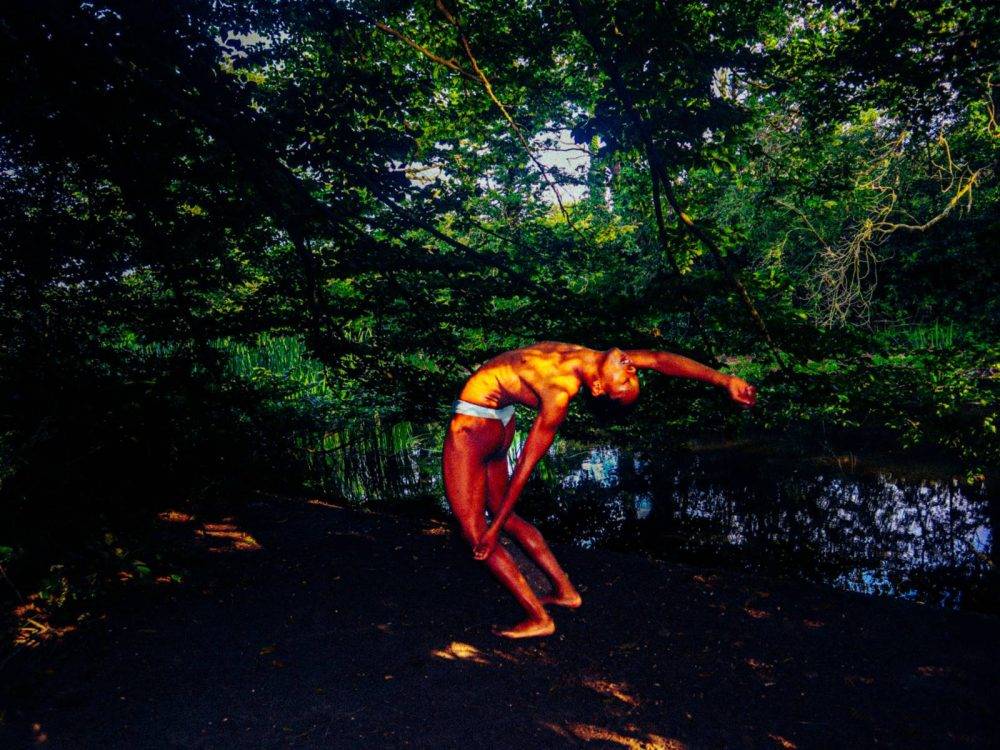
One of the biggest moments of their early career was when they featured on the Black Coffee hit We Dance Again, which became a massive hit locally and internationally. But during our conversation, Nakhane brings it up as one of many moments when people tried to put them in a box.
“When that song came out, everyone assumed that I would just make house music now,” they say.
“And I was, like, ‘No, I’m going to make whatever I’m inspired to make.’ God knows what that is. But I follow the muse and some people don’t necessarily like where the muse is telling me to go.
“But then the thing I create is there forever, hopefully, and whoever is going to discover it in 10, 20, 30 years’ time, it’s there for them.”
In the past few years, the muse has told Nakhane to go in the direction of film-making and the result is his directorial debut, B(l)ind the Sacrifice, an evocative short film that explores the themes of religious tension and social isolation that have been so influential to their music.
It has received critical acclaim and premiered at several international festivals, including the Locarno Film Festival in Switzerland, the Stockholm Film Festival in Sweden and, most recently, the Sundance Film Festival in the US.
During our interview, Nakhane is tight-lipped on the date but says that B(l)ind the Sacrifice will make its homecoming to SA this year.
Nakhane also composed the music for the film and they’re not slowing down their output anytime soon. They tell me they’re planning to release more singles this year and are working on two albums, a novel and two feature films.
Foregoing the endless slashes that would need to be included in their title if they listed all their creative roles, Nakhane simply calls themselves a multimedia artist: “I call myself a multimedia artist because that could be anything,” they explain.
“The public’s very eager to put artists in a box. And by calling myself a multimedia artist, it means they can’t because I said I was playing in different media from the beginning. So, if I come out saying I’m a painter tomorrow, no one will go, ‘Since when?’ Multimedia is infinite. That can be anything.”
One title Nakhane wants nothing to do with is that of pop star. In fact, they describe trying to be one as the biggest failure of their career.
“I listened to bad advice and tried to play a pop star role but it just didn’t fit,” they say. “It was just a step back. So, quite quickly, I was, like, ‘I’m not good at this. And why am I doing this?’ None of this feels good. And it’s not working, you know?
“And I feel like the people who love me and know me could see that it didn’t work but the people who wanted to make money from my music kept telling me it was right.
‘I didn’t like the cultivating of a personality, the shaving off of the rough edges and the making everything easier to consume. And that made me reconsider.
“I was, like, ‘Whoa, okay, what lesson are we learning here?’ And I think I learned the lesson that you don’t just wake up and become a pop star. It’s work and it’s worked at. I just don’t have the disposition for it.”
One aspect of being a pop star that made Nakhane uncomfortable was the idea of trying to be universal, a concept they reject outright.
“I hate that word because in this world ‘universal’ usually means proximity to whiteness,” they say.
“Whenever I hear someone say, ‘Ah, this is universal,’ it normally means it’s accepted from a Western perspective because no one says that Miriam Makeba is universal or that Chinua Achebe is universal. But everyone says William Shakespeare and F Scott Fitzgerald are universal.”
“Baba Zakes Mda doesn’t get to be universal. He’s so provincial, right? I think that’s exactly what I want to be. That specificity and provinciality are so important.
“A lot of the good Western writers were incredibly provincial and specific. James Joyce is so specific, so provincial, so Irish, you know, so Dublin. You have to put yourself in that world.
“So if I, as a black South African from Alice in the rural areas, can put myself in that world and understand it and understand those characters, why is it so difficult for the opposite?”
“Actually, specificity and provinciality are the only things I can say are universal because then you go, ‘Oh, wow, we’re not so different after all.’ Yeah, sure, there are certain cultural things that are not the same as mine but human beings are human beings, no matter where in the world you find them.”
Perhaps that’s the thread that runs through all Nakhane’s creative endeavours — the specificity of being a queer black boy who grew up in a small rural town in the Eastern Cape and had to overcome a barrage of resistance for the right simply to be who they were always born to be.
Their artistic fingerprint is a kind of fearless self-possession that makes you want to joyously embrace your identity, in all its contradictions, even if demanding the space to do so is sometimes painful. It’s for this reason Nakhane’s art, in all the different forms it takes, is a blessing.
Who benefits from the budget war?:
As we piece together the fallout from a chaotic week, we have to ask ourselves — who benefits?
There is a perverse irony in the answer.
The budget war has been fought in the name of the South African people.
The Democratic Alliance’s (DA) original casus belli was the assault on consumers that a substantial VAT increase would have been.
Parties have since been wrangling over what would benefit the country and those living in it.
With the government of national unity (GNU) at breaking point, and uncertainty about the country’s future, it’s clear that no one benefits — least of all the South African people.
We are once more the victims of self-motivated political actors. The failure of the GNU would be an indictment of everyone in it.
At its inception, we dedicated much editorial space to celebrating the rare maturity rushing through the halls of power.
For the first time in recent memory, there was a palpable sense that the government was functioning as intended and in service of those who elected it.
We all felt a cautious tingling of optimism — a feeling that had become foreign to us during the lost Zuma years and the tepid first term of his successor.
That enthusiasm has been well and truly stomped out. We have seen a return to the zero-sum-game politics that have plagued us for so long: an environment where chicanery flourishes and cooperation is secondary.
To finger-point here would only further perpetuate this game, but suffice to say that no one can hold up their head in pride, from the DA, which declared victory after the aborted budget in February, to the ANC, which would rather return to backroom dealing than work with its partners.
And even us, the electorate.
The GNU is a product of our design. Voter turnout is tumbling. Unless we find a way to mobilise as a society and reverse this apathetic trend, how long is it until South Africa’s elected governments are no longer legitimate?
Our present debacle could not happen at a worse time. We are in the crosshairs of the most powerful man on earth. At the time of writing, we are still contemplating the devastating effects that his new tariff hike will have.
This is a moment that calls for strong leaders and a united nation. Right now, we don’t have either.
Submit and get free exposure here: Showcase Your Business | Advertise Your Special Offers.