
ANC assured of a clear majority, Ramaphosa says:
The ANC will surprise its detractors and win a clear majority in the 29 May elections, President Cyril Ramaphosa said on Saturday as he hit the campaign trail in KwaZulu-Natal.
“The ANC has an overarching presence in KZN, and all other political parties that are emerging yesterday and so on, are trying to nibble at the edges and so on and all they will ever do is to nibble at the edges,” he told supporters.
Ramaphosa has spent the past two days in the province that is the stronghold of the former president Jacob Zuma, who threatens to eat into the ANC’s voter base with his fledgling uMKhonto we Sizwe (MK) party, and visited Inanda and Mariannhill on Saturday..
“The ANC has great hegemony here and we will emerge victorious because the people of KZN and indeed the people of South Africa love the ANC and we are going to surprise you and many others who think that no, the ANC is not going to have a clear majority,” Ramaphosa said.
“We are going to have a clear majority, so even the recent making of a party called the MK party will see what the ANC is all about, even here in KZN. I have no doubt about that.”
Ramaphosa faces the toughest election of his career in a vote where the ANC is forecast to lose its outright majority for the first time in 30 years. The party won 57.5% of the vote in the last general elections in 2019.
A survey by the Social Research Foundation published a fortnight ago bore the worst prognosis yet, suggesting the party’s vote share would drop to 37%, with the MK party polling around 13%. Earlier polls suggested the ruling party was in trouble but would still get well above 40% of the vote.
The Electoral Commission of South Africa (IEC) last week asked the constitutional court for leave to appeal a ruling by the electoral court that found Zuma was allowed to run for parliament. It upheld an appeal by the MK party against a decision by the IEC to uphold two objections to Zuma’s parliamentary candidacy for the MP party in the 29 May vote.
It did so on the basis of the prohibition in section 47(1)(e) of the constitution on anyone sentenced to a prison term of 12 months or more without the option of a fine becoming a member of the National Assembly for the next five years.
Zuma was sentenced to 15 months in prison in 2021 for contempt of court.
Banks can’t finance the cannabis industry:
The banking sector is hesitant to invest in cannabis because the current legislation inhibits financial institutions from putting money into the industry. Under the Drugs and Drug Trafficking Act cannabis is still outlawed but new legislation would decriminalise the stimulant, allowing for money to flow into the industry.
Major banks, including Nedbank, FirstRand and Absa, have said they have followed the sector with interest, but have not been proactive in financing it because of the restrictive legislative framework.
“The company is looking at this industry and assessing where it would be appropriate for us to support it, but at this stage we haven’t had any meaningful involvement,” said Sam Moss, head of investor relations at FirstRand.
He said clarity was needed on how the industry would be regulated to ensure the product was used appropriately, in the case of medicinal use, and how the risks of potential abuse would be mitigated.
“If the regulation proves to be robust, we expect to support projects in the value chain, perhaps initially on a relatively restricted basis as the industry matures,” Moss added.
Absa said it had noted the latest legislative developments regarding the cannabis industry and would monitor and adapt the bank’s policy positions in response to the changes in the external environment and client needs.
“Absa recognises the growing focus on the cannabis industry in South Africa to unlock economic opportunities, including job creation. We are committed to participating in the provision of financial products and services within the enabling legislative framework and internal policy positions,” the bank said.
Nedbank’s agriculture head John Hudson highlighted the rigorous regulatory and approval processes that acts as a barrier for the bank to invest in the cannabis industry.
“While cannabis as a sector has potential, it requires proper planning, adequate funding, access to relevant expertise and having an offtake,” he said.
The process of passing enabling legislation and developing policy has dragged on since the constitutional court overturned the laws banning cannabis in 2018.
At present, cannabis can only be grown commercially for the medical export market in terms of a licence issued by the South African Health Products Regulatory Authority.
The cannabis bill, drafted in response to the court’s order, was meant to have been passed by 2020, but has been sent back several times.
In its present form, the law continues to prescribe jail sentences for trading in cannabis, leaving the creation of a framework for a legal cannabis industry to the passing of further legislation.
“The government has been disastrous in terms of its delivery of legislation. It’s been five years since the cannabis for private purposes bill was tabled and it is still sitting on [President Cyril] Ramaphosa’s desk. If it does not get signed off before the elections, another six months could be added before it is even looked at,” said Trenton Birch, the chief executive at Cheeba Africa Cannabis Academy.
“While it’s not a perfect piece of legislation, what it will do is decriminalise cannabis and allow cannabis to be removed from the Drugs Act. Which means cannabis becomes legalised to some degree and investors will more likely be willing to put money into the industry,” he said.
Birch said the banking sector still views cannabis as a narcotic and so it is not interested in reforming its own internal policies to facilitate investment into the sector.
“They have protocols and legislation that they need to adhere to as financial institutions, so they are very risk averse. The last place I would go to for funding as an entrepreneur trying to enter the cannabis space is a bank,” he said.
Birch said the government has also committed minimal financial support, especially for training.
Ramaphosa has made reference to the cannabis economy in several of his State of the Nation addresses. In 2023, the president reiterated the government’s commitment made in 2022 to unlock investment in the hemp and cannabis sector.
“We are moving to create the conditions for the sector to grow,” Ramaphosa said in his speech.
In 2022, the president announced plans for the growth of the cannabis and hemp industry, recognising the industry’s potential for investment.
According to Ramaphosa: “The legal hemp and cannabis sector has the potential to create more than 130?000 new jobs in South Africa.”
In 2021, the South African cannabis industry had an estimated worth of R87.7?million. This figure is projected to reach R406.3?million by 2026, with a projected growth rate of 28.4%.
None of this has happened yet and according to Birch the only way to start a cannabis business right now is to fund it by asking friends and family.
Darryl Weisz, chief executive of investment fund Silverleaf Investments, said looking at global case studies, he’s seen best practice in terms of financing the cannabis industry when the government is integrally involved in the legalisation of cannabis.
“The lack of legislative reform is inhibiting investments into the cannabis industry,” he said.
Weisz noted that marijuana that is not registered as medical cannabis, which can only be offered to the public with a doctor’s script, is still contained in the Drugs Act.
“Nedbank, Absa and FNB would have difficulty financing the sector. Medical cannabis facilities have struggled to get funding from the banks. The legislative hurdles need to be overcome for the industry to be unlocked,” he said.
“The banks are very hesitant. Their hands are tied.” — Additional reporting by Sarah Smit
It’s not often one is fortunate enough to be present at the launches of both generations of a specific product within a brand’s portfolio.
Well, I was that lucky. I was in Cape Town seven years ago when BMW SA introduced us to the first-generation subcompact luxury crossover the X2 and again for the new generation of the model.
Then, they had just two petrol engines on offer at the launch, as they did with this new generation. It was a strange approach but it proved to be a good product with 390?000 units sold globally.
The world has gone SUV crazy and BMW has not been left behind as its X model portfolio has something for everyone.
The all-new, second-generation X2 set headlines alight a few months ago when we first laid eyes on international press release pictures. We were smitten — or at least I was.
The looks scream bold. The huge grille (which we have now come to terms with) and LED headlights plus the illuminated grille — in the instance of the flagship M35i — do justice in their way.
Both derivatives at the launch were decked out with M Sport packages and M Sport Pro, in the M35i.

The lines are sharper than those of its predecessors, which had a more rounded and softer look, even in their sportiest regalia.
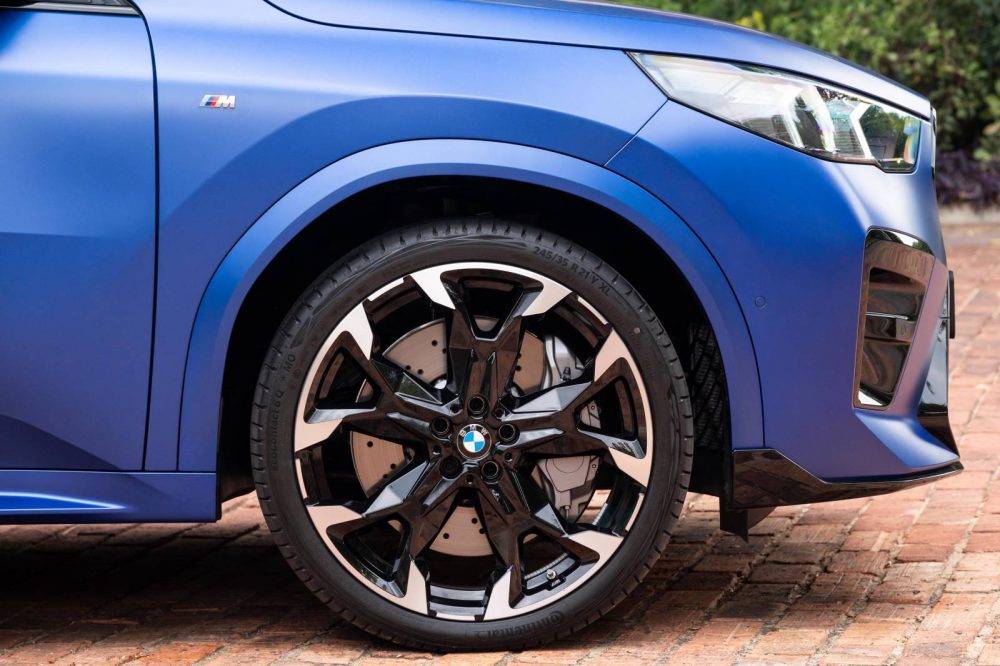
The side profile highlights are the 19 to 21-inch, multi-spoke wheels wearing lovely, comfortable rubber in the S-Drive 18i we sampled first.
The M35i has a lower-profile 245/35/21R rubber, which has serious street cred, but does compromise some comfort.
I adore the M-specific mirrors in the M35i, while the 18i has standard glossy black covers.
The rear end completes the sports coupe silhouette beautifully with a glossy black spoiler and bumper inserts for the 18i, and double gloss, extended quad exhaust outlets, surrounded by what we could call a diffuser, on the M35i.
The new X2 is 194mm longer (at 4,55m), 21mm wider (at 1,84m) and 64mm higher (at 1?590m) than its predecessor.
The exterior look on both models had me smitten and the colour selection is comprehensive.
The interior is minimalistic, spacious and flowing, yet practical.
The low-slung dash allows for better visibility over the curved digital display, which uses the latest BMW operating system 9.
The centre console controls are similar to what you find in the current X1 and I was not a fan. It has visual appeal but lacks a practical and user-friendly aspect.
The seats are possibly the second best thing about the car. They are clad in two-tone leather, with high-quality stitching, while the dash inserts in the M35i boast Alcantara-feel leather.

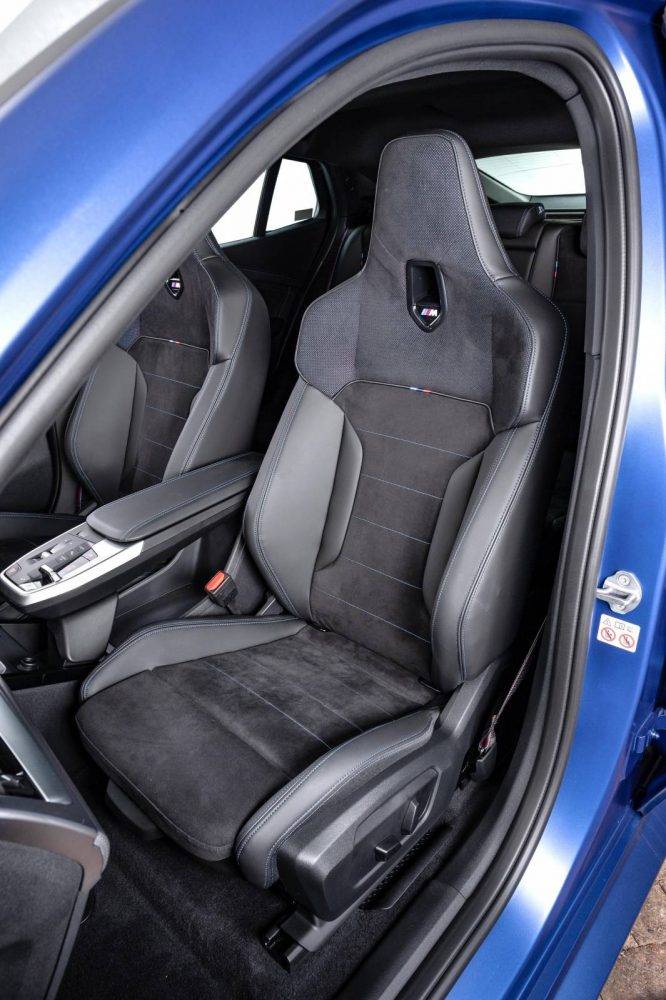
You also get illuminated, powered M sport seats in the range-topper, which are super supportive.
Coupe-style SUVs, for the most part, tend to compromise on boot space, but not the X2, which has the standard 560-litre space.
Both launch models were kitted out with a thumping Harman Kardon sound system.
The overall feel is premium, yet sporty, and it works brilliantly.
You now get a panoramic glass sunroof which does not open but adds an airy ambiance to the cabin.
How does it drive? The 18i has a three-cylinder, 1.5-litre, turbocharged powerplant which might just be the one for most folks, despite its 115kW and 230Nm output, which might not seem like much to haul an SUV this size. But it proved ample to send power to the front wheels via a seven-speed auto box that made gear changes an absolute cinch, even during bursts of spirited driving.
BMW has filtered down the boost function from the new 5 Series, which is activated by tugging the upshift paddle on the steering for a few seconds to get a spurt of power, which is handy for overtaking.
The steering does feel rather sensitive — even to the slightest input at higher speeds.
I found the lane-keeping and departure-safety driving aids in both models intrusive. While I understand the safety aspect, I do wish they had a slightly less sensitive warning system.
The M35i comes gun blazing with a 2.0-litre force-fed mill delivering 233kW and 400Nm through a seven-speed auto gearbox sending power to all four wheels.
This feels intoxicating — until you discover the pops and bangs are not coming from the quad exhaust pipes but rather are synthetically piped through the speakers. Eish, BMW!
Performance, however, is strong. The car jolts with the vigour of a track athlete, romping to a claimed 5.6 seconds in the 0 to 100km/h sprint. The surge of power is relentless right up to the rev limiter, while the handling is brilliant, even with the sensitive steering.
When one needs to shave off the momentum, the 19-inch brakes do a commendable job.
Fake exhaust sound notwithstanding, the new BMW X2 scores high marks as a stylish sibling to the more pragmatic, yet still brilliant, X1.
Priced at R873?793 for the S-Drive 18i and R1?223?935 for the range-topping M35i, with all the standard specifications on both derivatives, I reckon it’s a winning package.
Submit and get free exposure here: Showcase Your Business | Advertise Your Special Offers.
