Are we ready for this vision?:
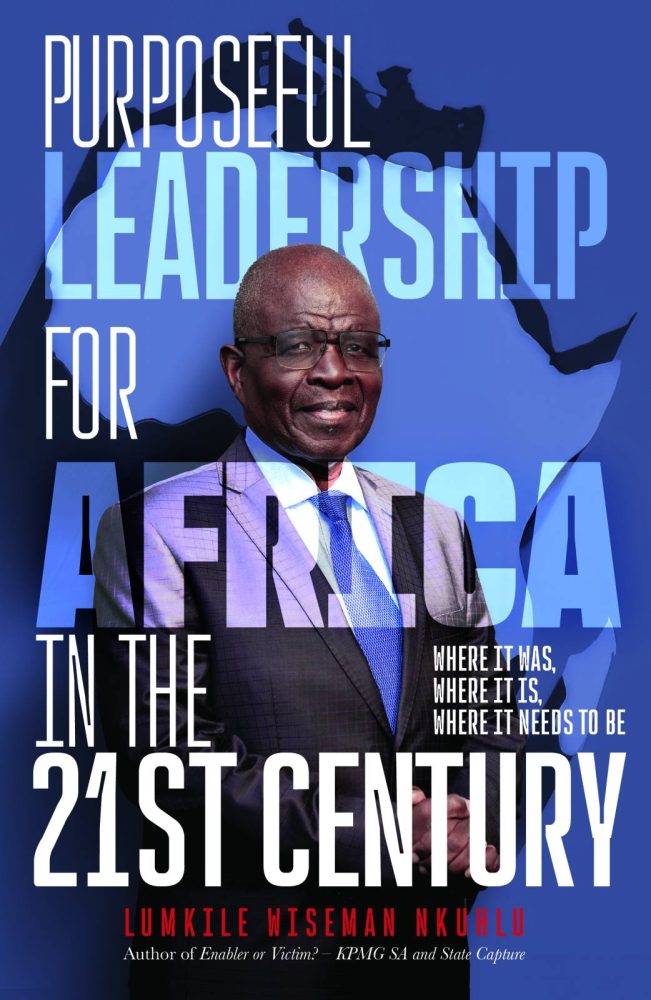
Lumkile Wiseman Nkuhlu has written a most timely and inspirational book that systematically tackles the most significant constraints to Africa’s ability to claim the 21st as an African century — purposeful leadership.
Africa has the natural, mineral and cultural assets to become the most sustainably prosperous, dynamic and innovative continent on Earth. Purposeful, ethically sound, skilled and accountable leadership is the missing key to the desired future.
Nkuhlu has done an excellent job in this book by providing a succinct source of information about the history of the African continent, including the much-neglected ancient history that documents it as the cradle of humanity and of the first human civilisation.
This book is essential reading for all African citizens seeking to understand where we come from, how we got where we are and how we might learn from other continents, especially Asia, to reimagine and shape the future we desire.
The central feature of the analysis is that Africa missed the benefits of the waves of scientific and industrial revolution that swept Europe and North America in the 18th and 19th centuries. These missed opportunities made Africa vulnerable to extractive imperial agents who used access to more sophisticated lethal weapons to conquer it.
The clash of civilisations and value systems, between ubuntu and extractive imperialism, added to Africa’s vulnerability.
Indigenous peoples in Africa, and other parts of the world, who had retained the essence of ubuntu values, became vulnerable to those who they welcomed as strangers who took advantage of their generosity.
Ubuntu, understood as the essence being human interconnectedness and interdependence within the web of life, exposed Africans to becoming victims of colonial conquest by societies such as Europe that had adopted survival-of-the-fittest value systems.
Both the indigenous Khoi and San peoples of South Africa and indigenous people of the Americas paid a heavy price for welcoming shipwrecked Europeans. They lost their land, intellectual property and their freedoms as human beings with rights and responsibilities.
Slavery and dispossession undermined Africa’s opportunities to build on its considerable scientific and technological prowess embodied in the first Egyptian, and other African, civilisations.
The book provides detailed, researched information, as well as the firsthand experiences of an author who was in the right place at the right time.
He was intimately involved in the evolution of both the African Union Charter and the New Partnership for Africa’s Development.
Nkuhlu is sensitive to, and respectful of, the achievements of the main historical actors of the African renaissance and union, without holding back from pointing to missed opportunities by those actors.
For example, he identifies the failures of both president Thabo Mbeki of South Africa and Nigeria’s Olusegun Obasanjo to model the African renaissance in the governance and development pathways of their own countries as living models.
This was a fatal flaw that undermined the sustainability of these initiatives beyond the terms of office of both leaders.
The book deals deftly with the critical issue of the need for Africans to transcend the icy hand of the traumatic legacies of conquest, slavery, dispossession and humiliation to enable the emergence of successful, capable leaders, inspired by a just cause, who reflect the principles and values of the people they lead.
The leadership capabilities outlined in the book bear repeating: personal mastery — self-awareness, imagination, ethics and independence — and a scientific mindset open to innovation and experimentation. These promote the design of meritocratic governance to enable effectiveness in achieving set goals without compromising future generations.
Nkuhlu does not hold back his criticism of South Africa’s missed opportunities to effect transition to a prosperous, inclusive and just society.
Both presidents Nelson Mandela and Mbeki wrestled with the challenges of loyalty to the ANC and its long traditions and practices designed for a liberation movement, not a governing party.
The question of which interests should take precedence — the party or the state representing all citizens — troubled both.
The failure to put the interests of all South Africa’s citizens above those of the party lies at the heart of the cancer of state capture that has undermined our country’s institutions and its fortunes.
The trouble can be traced back to pursuing a political settlement in the hope that socio-economic transformation would follow.
The extractive global economic system that post-apartheid South Africa embraced exacerbated the inequalities and inequities endured by more than 60% of citizens. We need a new socio-economic development model.
The book concludes with an urgent call. Africa is ripe for patriotic political activists, scholars and professionals to emerge and drive transformative action.
Africa needs the success story of a big country like South Africa.
Our country has huge potential to demonstrate the power of visionary, patriotic leadership to inspire a transformative movement to create a just society with sustainable prosperity for all. Nkuhlu’s invitation is open to all freedom-loving Africans.
Are we ready?
Purposeful Leadership For Africa in the 21st Century by Lumkile Wiseman Nkuhlu is published by Tracy McDonald.
Units of measure – with a side of nostalgia:
Do you remember high school?
I don’t mean where or when you went to the grey cluster of buildings in which grown-ups tried to impress upon you how big and important things in your life would soon be. I mean, do you really recall the experience?
It’s always mind-blowing to me when I return to the grounds of my old high school.
Not only because it’s been purchased by Curro and scrubbed clean of anything resembling the place where I pretended to care about learning, but actually cared about music and girls.
But also, because it seems so … small. It’s like someone went around and removed a few centimetres from the height and width of everything.
This place, whose boundaries seemed to at once constrict you and yet also encompassed your whole world, is such a small part of it now.
And, for me, an even weirder part of the experience is meeting your old teachers out “in the wild”, so to speak. It’s very weird that these people, who were once titans of fear and respect, are now just, like, you know, people. Normal people with normal struggles, trying to muddle through life as best they can. Just like the rest of us.
I remember running into a former English teacher at a wedding, not recognising her and thinking she was a cougar flirting with my friend before realising they were catching up on old times.
I remember giving the middle finger to a former accountancy teacher in traffic, then trying to hide in the confined space of my tiny car when I realised who she was.
I remember sitting at a dinner table with a former biology teacher, as she gave me a frank and enlightening discourse on the struggles of being a parent, before I had become one myself.
And I remember running into a school secretary in a pharmacy queue, in an entirely different city, and willing my brain not to explode as she made small talk with me as a fellow adult.
I guess all of this was because I was no longer a 15-year-old idiot, dithering through the corridors and trying to take 25 minutes to go to the bathroom to avoid having to go back to class. I was, in fact, now a peer.
Will wonders never cease?
It is, in some ways, very reassuring to know that this place and these people, who once wielded outsize influence in your life and the lives of all your friends, are just normal, run-of-the-mill places and people.
The most daunting parts of high school are often constructed in our minds.
I mention all of this because Piero Martin’s fascinating book The Seven Measures of the World brought to mind a high school textbook, but in the best possible way. Let me explain:
In this book, Martin is attempting to impart a frankly enormous amount of information about a specific topic. In this case, the topic is actually seven topics, each one a story of how one of the seven essential units that we use to measure the physical world came to be.
It is hard to engage the average reader on a topic this heady without said reader quickly losing interest. But Martin finds a way.
It’s for this reason the book made me think of a high school book and not a book from an institution of higher learning.
Tertiary education textbooks vomit information at you at an alarming rate, almost pelting you with it, not caring if you’re interested, just wanting to bombard you with facts and call it a day. It’s like listening to a nine-year-old tell you about their favourite YouTube series.
But high school books hold your hand a bit more. They take some time to make things interesting, often attempting to make them visually stimulating to engage different parts of the brain. And this, to me, is what Martin’s book felt like.
He doesn’t just tell you about the metre, second, kilogram, kelvin, ampere, mole and candela. He gives you the interesting scenery around their origin, often going quite far out into the weeds, but never straying so far from the original topic that we lose sight of why we’re there.
There are often sidebars on related topics, which are fascinating, as well.
For example, to understand the mole, you need to understand Avogadro’s number. And to understand Avogadro’s number, you need to know a little bit about large numbers and scientific notation.
Martin assumes no knowledge of these topics. He gives it to you — in a way that is as entertaining and informative as the rest of the book.
In other instances, he takes a tangent that is related but not essential to the understanding of the topic at hand. For example, the section in the chapter about the ampere, which diverts us into a discussion about nuclear fusion and the possibility of limitless clean energy.
In summary, books like this often fall into the trap of “knowledge for knowledge’s sake”. Martin has done well to present a potentially dry topic as an engaging and interesting one.
A worthwhile read.
The Seven Measures of the World by Piero Martin is published by Yale University Press.
Confidence in maths a catalyst for educational success:
Maths, often viewed with trepidation by learners and parents alike, holds unparalleled significance in education and beyond. Confidence in maths is not merely about passing exams, it lays the foundation for critical thinking, problem-solving and a world of future opportunities. But only a small fraction of learners attain high levels of achievement by matric.
Confidence in maths can transform a learner’s trajectory. When learners believe in their mathematical abilities, they are more likely to tackle problems, persist in the face of difficulties and embrace maths-related opportunities.
Conversely, a lack of confidence can lead to disengagement and a cascading effect on performance in other subjects. This is particularly true in South Africa, where educational disparities often leave learners without the foundational skills needed to thrive in maths.
Research demonstrates that early interventions are critical. Data published by the department of basic education shows that a mere 3.6% of the cohort of learners who started grade 1 in 2013 achieved a matric maths pass mark of 60% or above in 2024. This stark statistic underscores the urgency of building mathematical confidence and competence early in a learner’s journey.
Numeric, a nonprofit founded in 2012, is tackling this problem head-on. Its programme, an innovative after-school intervention, is proving that change is possible — starting in primary school. By focusing on quintile 2 to 4 schools, where resources and support are often limited, its after-school programmes help to bridge the gap. Learners showed a 24% reduction in school dropouts by matric, a 59% increase in learners writing pure maths exams and an impressive 71% rise in those passing maths with 60% or higher. These findings emerged from a longitudinal quantitative evaluation conducted by external consultants in 2023. Further information can be found here.
The model combines rigorous maths instruction with a focus on instilling confidence and enjoyment in the subject. By equipping learners with a strong mathematical foundation in primary school, the programme ensures they are better prepared for the demands of high school maths and beyond.
Learners who excel in maths often perform better in related subjects such as physical science, accounting and English. This ripple effect demonstrates the subject’s role as a cornerstone of educational success. More than just improving grades, the programme fosters a mindset of perseverance and curiosity.
“We believe every classroom interaction has the power to shape a child’s future, and we are committed to ensuring that experience is positive for every Numeric learner. This commitment is made possible by our intern coaches, who, during their year with us, develop skills and lifelong competencies that they continue to rely on throughout their careers,” says Numeric’s chief executive, Tori Gardner.
While initiatives such as that of Numeric are changing lives, the need for broader support is evident. Current investment disproportionately targets high school interventions, often leaving primary school learners behind. Yet the evidence is clear: early interventions yield higher returns. With increased funding and support, the achievement gap at school level can be met — and later meet South Africa’s demand for skilled professionals.
“Confidence in mathematics is more than a personal asset; it is a societal necessity,” said Gardner. “By fostering this confidence in primary schools, Numeric is not only transforming individual lives but also contributing to a brighter, more equitable future for South Africa.”
Maths is not just about numbers. It is about creating possibilities — one confident learner at a time.
For more information about Numeric, visit numeric.org.
Submit and get free exposure here: Showcase Your Business | Advertise Your Special Offers.