Attorney for mother of Joslin Smith challenges police credibility during trial:
The attorney for Kelly Smith, mother of the still missing seven-year-old Joslin Smith, on Tuesday appeared to try to paint a picture of an incompetent police investigator who may have coordinated his testimony with a colleague before appearing in the Western Cape high court sitting in Saldanha Bay.
Day two of the trial started with the cross-examination of Rural Flying Squad member Constable Yanga Gongotha, who, together with Officer Zuko Kobese, first attended to the call about the missing child on 19 February 2024.
Gongotha told the court on Monday that Smith had shown scant emotion when relaying the details about her missing daughter on the night of her disappearance.
He inferred she appeared to be at a party when he and Kobese found her, and was more interested in the whereabouts of her partner, Jacquen “Boeta” Appollis, who had been looking after Joslin on the day of her disappearance, than her child.
Gongotha testified on Monday that Smith had asked Appollis whether he had filled a gas bottle at the home they shared in the Tsitsiratsitsi informal settlement in Middelpos, Saldanha Bay, instead of asking him about the child.
Smith, Appollis and mutual friend Steveno van Rhyn, who are being charged under common purpose, on Monday pleaded not guilty to charges of kidnapping and human trafficking.
Last year, the state withdrew charges against the fourth accused, Lourentia Lombaard, who has turned state witness.
In its indictment, the state alleges that Smith “communicated during August 2023 her plan to have her children be taken away or sold. The plan was for this to happen in January or February 2024.”
Acting for Smith, accused three, attorney Rinesh Sivnarain asked Gongotha on Tuesday to confirm that he had made his statement about the night of the disappearance “in your own words”, to which the constable answered yes.
Gongotha’s statement was only made on 18 February this year, said Sivnarain, who then asked: “Prior to making the statement, did you make use of any source to refresh your memory?”
Gongotha said he had used his station’s missing person’s register, which was standard protocol.
“Did you speak to anyone? Your colleague or van crew? Did you discuss what happened on the 19th before you made your statement?” asked Sivnarain.
He added: “Would it surprise you if I put it to you that your colleague, Mr Kobese, has a statement that is almost identical to yours?”
As an example, said Sivnarain, paragraph three of both statements were “exactly the same, except that where you say ‘I’, Kobese says ‘we’”.
Sivnarain also tried to refute Gongotha’s earlier testimony, in which he said that when he met Smith at the home of one of Joslin’s friends, she appeared nonplussed, and there was a party atmosphere, with loud music playing in the background.
“My client says she met you at a boy’s house who she received information her daughter Joslin was last seen with.”
“That is not what she told us,” replied Gongotha, who was testifying with the help of an interpreter.
“I am further instructed that when you arrived, [Smith] was in the company of two other people.”
“No, that is not correct,” said Gongotha.
“My instructions are that when you arrived with your colleague, the parent of the house that she had been at, looking for Joslin, arrived in his taxi with his friends, and they had loud music playing in the taxi.”
“That is not correct,” said Gongotha.
“I am instructed that that is the music you heard, it came from the taxi.”
“That is not correct,” said Gongotha.
Sivnarain said Smith would deny asking Appollis about filling a gas bottle when she first saw him. “I am instructed that immediately upon seeing accused number one, she inquired from him about Joslin’s whereabouts.”
“That is not correct,” said Gongotha.
The second witness was Kobese, an officer with 10 years under his belt, who also testified using a translator.
Asked by Judge Nathan Erasmus whether he was willing to have his face shown, given that the trial was being broadcast live, Kobese said he would prefer to remain off camera. The Saldanah community in which he still worked viewed him as “someone who is inciting other people”, he said.
Kobese was the driver of the vehicle in which Gongotha was the passenger. His testimony was led by state prosecutor Aradhana Heermun.
Asked about Smith’s demeanour when she spoke about Joslin being missing, Kobese replied only that she had “given us enough information”.
According to Kobese, it was a man who knew the family who eventually led them to a shack at the back of a house where Appollis was found, his whereabouts allegedly being unknown by Smith prior to this.
Said Kobese: “[Appollis] was coming out of the shack. We asked him about Joslin and he said that he last saw her playing not far from where she lived in Middelpos, with other children.”
Smith and Appollis were “very happy” to see each other, he said. “We could see [Kelly’s] eyes were a little bit full of tears, appearing like she was happy to see her lover.”
Heermun asked whether Smith had asked Appollis about Joslin.
“She never posed any questions in connection with the child,” said Kobese, adding that Smith then spoke about seeing Appollis earlier in the day, at lunch.
She had not offered up this information earlier, said Kobese.
“She told us she went to the house as she wanted to see if her boyfriend did pick up the gas and have it filled.”
He said Smith and Appollis spoke in Afrikaans for a short time, and he was unable to understand what was being said.
Asked by Heermun what his “observations” about Appollis were at this time, Kobese responded: “He appeared to be not giving cooperation in as far as our questions. Every question we asked we had to ask more than once before we got an answer.”
Revolutionizing Social Media Content Creation With Filmora 2025 AI Features:
Introduction
Today’s generation is the digital generation where social media platforms are the go-to platforms for creative expression, brand promotions, building communities, family connections and what not. Whether it’s Instagram, TikTok, YouTube or Facebook, engaging, dynamic and relatable content are what people to interact with and be visible.
That’s why the creator, influencer, or marketers are relying on making beautiful and engaging content. And so they need tools to quickly, easily and creatively make content without compromising the quality of the content and stay ahead in this competitive world. This is where Wondershare Filmora 2025 steps in with its innovative suite of AI-powered features such as AI Image to Video, AI Audio to Video, and AI Video Translation are game-changers for social media content creators.
They help to automate the dull task, bring creativity to content and make content engaging and secures global accessibility. The article discusses the transformative power of Wondershare Filmora 2025 which brings intelligent video editing capabilities and intuitive features to social media content development.

The Power of AI in Content Creation
Today’s world embraces Artificial Intelligence as a real upcoming technology which shapes diverse business sectors particularly the content creation domain. The design purpose of AI tools seeks to examine information while performing routine operations for better workflow outcomes. The analysis of images and audio and video content through AI leads to instant proposals and professional video edits which complete much faster than human editorial processes.
How AI is Transforming the Landscape of Content Creation
With AI, artists can dedicate more time towards creativity and not waste precious hours on mundane work. Editing a video that once took technical work and high-end software is made easy with AI-based solutions that render the work smoother.
This is especially crucial in social media production. There is a constant need for new content, and having the means to create high quality in a short amount of time is essential. AI functionality not only conserves time, but it also allows creators to experiment with new ideas and styles, making it more probable that they will be regarded as pertinent in a competitive and fast-moving marketplace.
The Role of AI in Enhancing Creativity and Efficiency for Content Creators
AI enhances creativity by presenting proposals on effects, animations, as well as styles that are tone-appropriate as well as suitable in application. The software also makes functions like synchronizing a sound with a clip, putting in transitions, or turning a clip into a template more accessible. AI helps ease work on technical stuff for creators with no time to spend on technical work by opening up more room for creativity.
For example, AI features in Filmora 2025 allow you to convert raw clips into a high-end quality video with ease. Such a level of efficiency is crucial in social media production as creators have to produce content on a regular basis without a drop in quality. Using AI, creators can dedicate more time thinking about new ideas as well as communicating with users, whereas traditionally each clip is edited.

AI Image to Video: Bringing Photos to Life
The AI Image to Video feature in Wondershare Filmora 2025 is a breakthrough tool for content creators. This feature is perfect for social media platforms that thrive on short, engaging video content, such as Instagram, TikTok, and Facebook.
Overview of the AI Image to Video Feature
Wondershare Filmora 2025 AI Image to Video is a feature that is a game-changer in that it makes it possible to turn static images into dynamic, engaging videos. The feature is suited for social media that thrives on short, engaging videos, i.e., Instagram, TikTok, and Facebook.
Filmora AI Image to Video feature can turn images into a video with pre-chosen AI-based effects like AI Hug, AI Kiss, AI Fight, or Custom description effect. The effects add a dynamic look to images making your social media content more interactive. AI will analyze images you upload and choose suitable animations that fit into a tone and mood-based video.
This feature is ideal for creating quick material with a dash of creativity and sophistication that will grab attention.
Examples of Creative Use Cases for Social Media
- Family Albums: Turn family holiday photos or wedding pictures into heartwarming videos that resonate with followers on Instagram or Facebook.
- Travel Content: Create travel videos by animating photos of your trips and adding music Perfect for YouTube, Instagram stories, or TikTok travel reels.
Creating Dynamic Memes and GIFs: Elevate your meme game by animating still images into dynamic GIFs and short video memes. Add a layer of humor and engagement to your social media presence on platforms like Twitter and TikTok.

AI Audio to Video: Seamless Sound Integration
Another revolutionary feature included in Filmora 2025 is AI Audio to Video. AI Audio to Video allows creators to turn a file with just sound into a video with AI synchronizing images with both rhythm as well as tone of sound. Be it a podcast, music, or a voiceover, AI Audio to Video makes it quick and easy.
Explanation of the AI Audio to Video Feature
AI Audio to Video is a feature that can create video from audio. The AI reads the rhythm, tone, and speed of the audio, followed by synchronizing corresponding visual elements—like text overlays, animations, and effects—with that. Using this feature, creators can create a highlight reel, a full-length video, or a short digest from audio files with AI-synthesized voiceovers as well as engaging visuals.
Benefits of Automatically Syncing Audio with Video Content
For social media creators, especially those making social media content on social media apps like TikTok, YouTube Shorts, or Instagram Reels, AI Audio to Video is a time-saver. The creators can dedicate more time towards making engaging sound-based material (such as music or narration), as work on constructing a video is taken care of by Filmora. AI Audio to Video also makes it possible for creators to produce more in a shorter timeframe, which is essential in a social media arena that supports regular posting.
Tips for Making the Most Out of This Feature for Social Media Posts
- Choose High-Quality Audio: Ensure your audio file is clear and high-quality to allow the AI to generate the most accurate and effective video content.
- Pick the Right Video Style: Depending on the tone of your audio, choose a video style that complements it.
Add Personalization: Customize the video further by adding text, captions, and background music to give it a unique touch.
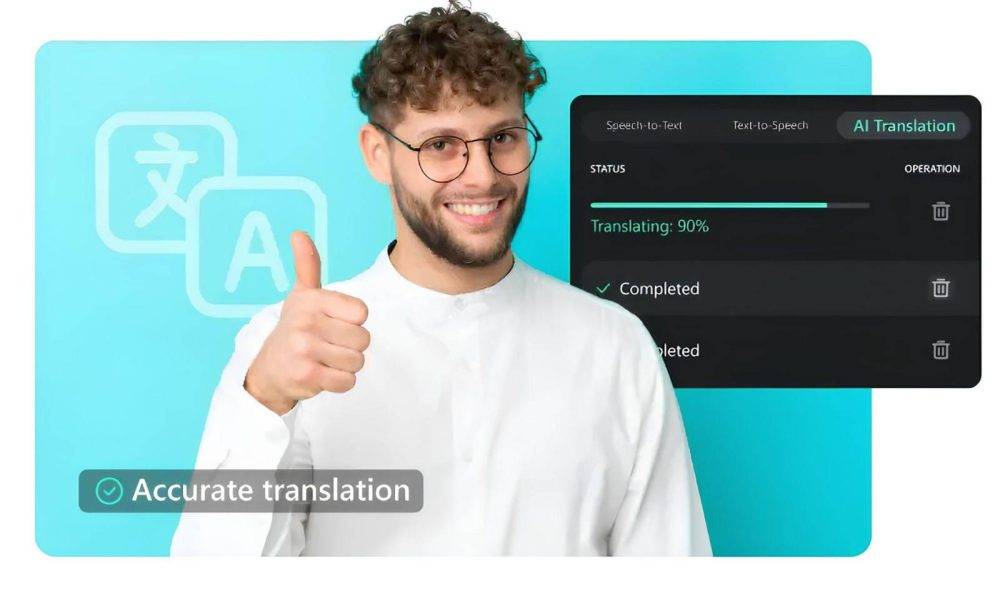
AI Video Translation: Breaking Language Barriers
With social media becoming more global in scope, social media creators no longer target local users alone. AI Video Translation is a vital feature that allows social media creators to reach global fans by crossing language barriers.
Introduction to the AI Video Translation Feature
With its AI Video Translation feature, creators can translate the sound in their videos into multiple languages. Not only does the AI translate words, though – it also ensures that the subtitle is in complete synchronisation with the lips, providing a more authentic experience to viewers.
How AI-Powered Translation Can Reach a Global Audience
Video Translation with AI makes it possible for creators to expand their audience by making available translations that are critical on platforms like YouTube and TikTok. With this feature, creators can translate their content into non-English languages, which can create new channels of global growth and engagement.
Examples of Creative Use Cases for Social Media:
- Global Audience Reach: Content creators on social media sites like YouTube or Instagram can translate their videos into a variety of languages with AI Video Translation, opening it up to a global following. The feature is especially suited to creators that are targeting global markets and growing their viewership in areas with a mix of languages.
- Expanding Your Brand: Businesses and influencers can localize promotional content, tutorials, or product reviews into a wider demographic. Engagement with a brand is enhanced by presenting translated videos, which also facilitate engagement with users who speak a different language.
YouTube Videos: A YouTuber who speaks English can translate their content into Spanish, French, or German, helping them reach non-English speaking audiences and growing their subscriber base.
Enhancing User Engagement with Customization
Customization is key to standing out on social media. While Filmora’s AI features make the video creation process easier, the ability to add personal touches is what makes content truly engaging.
Tips for Customizing Videos with Filmora’s AI Tools
- Background Music: Choose from Filmora’s music library or upload your own to create the perfect atmosphere.
- Text Overlays: Add text to emphasize key points or to provide context to your video. You can use Filmora’s built-in templates or create custom text effects.
- Voiceovers: Add voice narration to give your video a personal touch and guide the viewer through your content.
Creating Compelling Narratives
Success on social media is a result of a great story. Be as authentic as you can with tone, personality, and message in crafting your video. Animations, voiceovers, as well as visual effects are also available in Filmora AI that you can use in order to craft a story that talks with your target.
Future Prospects and Innovations
The future of AI in video editing is incredibly exciting. With Filmora 2025, we are only scratching the surface of what AI can do for content creators. Predictions for the future include more advanced AI features like real-time video editing, deeper integrations with social media platforms, and even AI-generated narratives.
Upcoming Features in Wondershare Filmora 2025
With continuing development in AI, Filmora will be upgrading its AI functions with more advanced editors, improved usability, as well as more simplified production. There will be additional ways in which creators can automate laborious work as well as add more quality.
Final Thoughts on the Impact of AI on Social Media Content Creation
Video production on social media is becoming more efficient, quicker, and more accessible with AI-based solutions from Filmora. With automations that remove drudgework from workloads and high-end customization, creators have more time on their hands to do what really matters: interact with fans and be creative.
Conclusion
Wondershare Filmora 2025 is a social media creator’s ideal, with advanced AI functionality that speeds up the process of making a video and broadens creativity. AI Image to Video, AI Audio to Video, and AI Translation are just some examples of its advanced functionality that helps you produce engaging, dynamic material that will resonate with global users. Be you a social media influencer, a social media marketer, or a social media enthusiast, Wondershare AI functions provide you with the resources you need to boost social media visibility.
Competition Commission takes on Google and Meta to save SA journalism:
The Competition Commission’s report details anticompetitive practices, market distortions and the extraction of advertising revenue from local news publishers, marking a critical moment in South African media history. It also outlines remedial actions that could reshape the digital media ecosystem and revitalise independent journalism in South Africa.
The report highlights several ways in which Google and Meta (Facebook’s parent company) have leveraged their dominant positions to the detriment of South African media.
One way is through monopoly power and unequal bargaining. Google, with its near-monopoly in search, has not equitably shared the value derived from news content with South African publishers. This imbalance has eroded the financial stability of local media over the past 14 years. The report estimates that Google extracted additional value ranging from R300 million to R500 million from publishers in 2023 alone.
In its algorithmic bias, Google’s search engine favours global news media over local, vernacular and community media. This bias has resulted in higher impressions for foreign media, despite lower click-through rates compared to South African media. Similarly, Meta’s algorithms have deprioritised news content, reducing organic reach and referral traffic for local publishers.
Both Google and Meta have shared limited user data with news publishers, placing them at a competitive disadvantage in digital advertising. The platforms’ control over user data has enabled them to offer highly targeted advertising, further undermining the revenue potential of local media.
The exploitation by these tech giants has led to a decline in traditional advertising revenues, forcing local media to cut costs, reduce staff and, in some cases, shut down operations. This has particularly affected community and vernacular media, which play a crucial role in providing news in local languages and covering regional issues.
The shift to digital consumption has devastated traditional advertising revenue streams for local and independent news outlets. The Competition Commission report confirms that Google’s search dominance has decreased referral traffic to South African news publishers, giving global media an advantage while marginalising vernacular and community media.
Meta’s algorithmic changes have reduced organic reach for news content, making it harder for audiences to discover local journalism. Facebook’s deprioritisation of news links has led to a substantial drop in referral traffic to South African news websites. Social media algorithms promote sensationalist content over credible journalism, weakening public trust in professional news sources and fostering misinformation and echo chambers.
These actions have weakened the financial base of independent media, leading to shrinking newsrooms, closing bureaus, and increasing media concentration. The report warns that without intervention, the plurality of voices in South African media will be further eroded.
Holding Big Tech accountable
The Competition Commission is recommending strong remedial actions to rebalance the digital media ecosystem. Key proposals include mandatory compensation for news publishers. Google will be required to compensate South African news media R300 million to R500 million annually for the value extracted from local publishers. The public broadcaster (SABC) and community media will also be included in the compensation scheme.
In addition, Google will need to reduce bias against South African media in its search rankings, stop privileging foreign media and YouTube links over local news sources and restore fair representation of vernacular and community media. Meta will be required to stop downgrading news links and restore referral traffic for South African news publishers.
Google and Meta will need to provide South African publishers with detailed audience insights, enabling them to compete effectively in digital advertising. And if Google, Meta and other platforms fail to comply, the commission proposes a 5% to 10% digital levy on advertising revenues from search engines and social media platforms. This would fund a media industry support initiative.
If the commission’s recommendations are implemented, the South African media sector could see a significant transformation. Compensation from Big Tech could stabilise independent newsrooms, allowing smaller and community-based publishers to reinvest in journalism.
Balancing search engine algorithms would give local publishers a fair shot at visibility, ensuring that diverse perspectives are represented. The restoration of referral traffic and fair representation in search results could strengthen local and indigenous language journalism. If implemented, these remedies could provide a new economic model for media sustainability, reducing reliance on external funding.
The role of the press council
The report also highlights how the Press Council of South Africa stands to benefit from these proposed measures. It recommends that Google and Microsoft make annual contributions to the press council and the Broadcasting Complaints Commission of South Africa, ensuring the financial sustainability of media oversight bodies.
Additionally, the Media Industry Fund, if implemented, could provide further financial support, reinforcing the press council’s ability to uphold journalistic standards and ethical reporting. The commission’s push for greater accountability in digital news distribution may also expand the Council’s role in overseeing online journalism, particularly in tackling misinformation and ensuring media integrity.
The Competition Commission’s report marks a critical juncture for the South African media industry. By addressing the exploitative practices of Big Tech companies and implementing the recommended measures, there is potential to revitalise local media, enhance media diversity, and ensure the sustainability of independent journalism. The road ahead will require concerted efforts from all stakeholders, but the prospects for a more equitable and vibrant media landscape are promising.
The report marks a critical moment in South African media history. For years, tech giants have extracted immense value from news publishers without fair compensation. The Competition Commission’s intervention could set a global precedent for regulating Big Tech’s relationship with the media. But enforcement will be the key challenge. If Google and Meta resist, as they have in other jurisdictions, South Africa’s legal and regulatory institutions will need to take firm action to ensure compliance. The success of these measures will determine whether local journalism can be revived and sustained in the digital era.
Mahmood Sanglay is the chief executive of Muslim Views, an adjudication panel member of the Press Council of South Africa and former president of the Association of Independent Publishers.
Submit and get free exposure here: Showcase Your Business | Advertise Your Special Offers.