
Calls for Shivambu’s head a result of ‘tribalism’, say his supporters:
A faction in the uMkhonto weSizwe party aligned to traditional leaders is calling for a leadership change that could affect not only Floyd Shivambu
A super Cooper by Mini — but is it too expensive?:
I have blurred memories of the Mini 1275e that my parents owned back in the Nineties and the early 2000s.
All I remember is that my mum piled up her students in the back to give them a lift to and from her tuition. To get an image of what that looks like, you might have to picture Mr Bean putting a few passengers in his Mini.
That Mini cost my parents R2 500 back in 1991 and, when they eventually let go of it, they were able to sell the car for R6 000.
If only we could buy cars for R2 500 now. If only we could make a profit on vehicles after piling on years of mileage.
Thirty-five years on, it costs 238 times the price to get into a brand-new Mini Cooper.
For those who are bad at maths, that means the new fifth-generation Mini Cooper starts at R595 000. If you need the five-door variant, it will set you back R617 000 and the Mini Cooper SE, which is electric, is rather reasonably priced at R802 000.
At an entry price of just under R600 000, I was expecting big things from the little Mini.
The exterior
For starters, Mini has never lacked style. This one does not disappoint.
The front has a striking grille that ties into the headlights well. The headlights also have a very cool animation and wink at you when you unlock the vehicle. The daytime running lights run around the oval-shaped headlights and it just looks distinctive in every aspect.
The three-door Cooper sits on 17-inch black alloy wheels that add to the stylish exterior.
The brand has also built itself by making vehicles customisable. For example, I had a bright yellow version on test with black alloy wheels, a white roof and white exterior mirrors. Mini is the one brand that could tie those colours together and make it look fun.
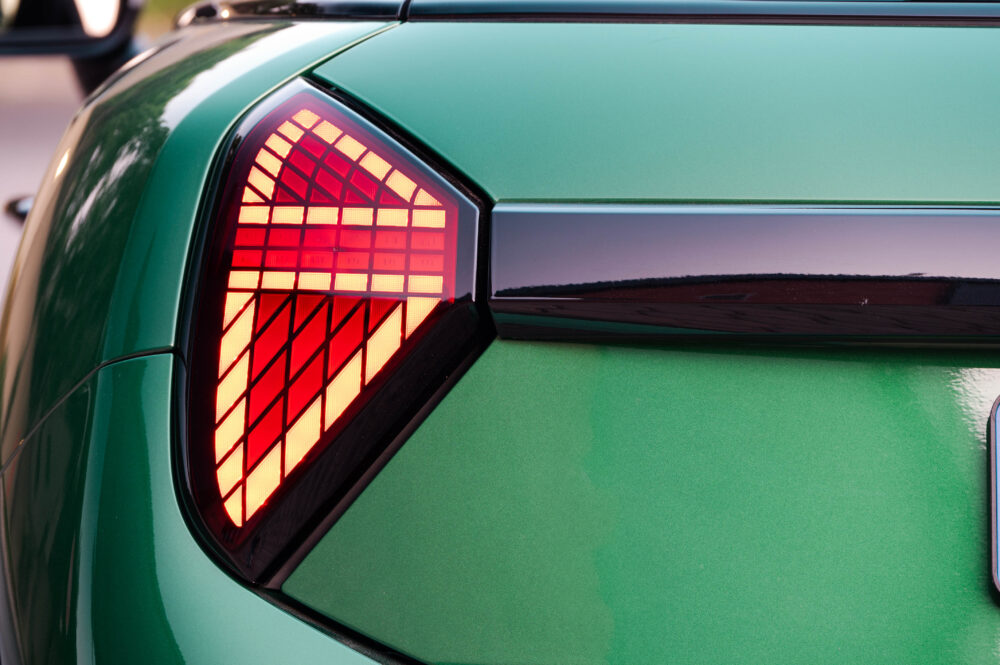
The rear of the vehicle is just as exciting as Mini has brought a completely new design to it. The weirdly shaped triangular tail lights are connected by a black strip with the “Cooper” lettering across it.
Ultimately, the exterior of the vehicle embodies fun and gives you an idea of what the vehicle is about.

The interior
The interior of the fifth-generation Mini Cooper amplifies the message you are given on the outside.
Once you jump in, you are greeted by a superb leather and cloth interior. Majority leather on the seats means that the driver and passenger are comfortable.
For those wanting to squeeze into the back, the room is very limited — that’s why I used the word passenger in the singular above.
It is a three-door, so I did not expect much room for backseat passengers.
The boot space is also very tight. After a short experiment, I realised this is not the vehicle to take on your monthly grocery shopping trip. The boot isn’t able to take more than exactly three Checkers packets.
The dashboard gets some lovely cloth which has ambient lighting projected through it. For me, this was aesthetically pleasing but also subtle enough to not be distracting.
Unlike most vehicles with their large rectangular screens, the Mini Cooper has a circular screen that is 240mm in diameter. That screen has all your driving information, so you don’t get an instrument cluster.
It is a touch odd to not have an instrument cluster, because there’s nothing behind your steering wheel, but Mini has taken a minimalist approach and decided to just push everything into that one screen.
The infotainment system can be changed to different experiences: Core, Go-Kart, Green, Vivid and Timeless. The Timeless experience set the infotainment screen into an elegant and classic format with an analog clock that made me feel like I was back in that Mini 1275e again — but with some technology.
The car just gets more unique as the stop-start button is shaped like a key that needs to be twisted to start the vehicle. The gear shifter is also tiny and placed under the infotainment screen next to the stop-start button.

The drive
I was surprised by the drive. For a small vehicle, on the poor roads we have, it was exceptionally smooth.
Mini has given the Cooper a three-cylinder 1.5 litre turbocharged engine that delivers 115kW of power and 230Nm of torque.
This was more than enough power to get you by. In a vehicle this small, those numbers are impressive.
There was also no turbo lag and the car gave an instant kick whenever you needed the speed.
Because the car is so tiny, and has a good amount of power, it is really fun to drive.
Navigating bendy roads becomes exciting and it’s the type of car that makes you want to drive it all the time.
Safety
The 2025 Mini Cooper E has earned a five-star safety rating from both the European New Car Assessment Programme (Euro NCAP) and its counterpart the Australasian New Car Assessment Program (Ancap). Euro NCAP tests show it achieved an 89% score for adult occupant protection, 85% for child occupant protection, 77% for pedestrian protection and 79% for its active safety systems.
It also has safety features such as automatic emergency braking, adaptive cruise control and parking sensors. Blind-spot monitors, rear cross-traffic alerts, lane-departure warnings, rear automatic braking and an exit-warning system are optional.
Verdict
Easy to park, fun to drive and with great manoeuvrability, the Mini Cooper is a gem on the road.
The exterior and interior both embody the fun nature of the car and it has a personality that very few manufacturers can match.
And, while it is no longer the Nineties, where you could purchase a car for under R10 000, the hefty price tag of R595 000 is just about the only downside of this little vehicle.
Living ‘fossil’ found: Rare velvet worm species named after teenage explorer:
In March 2022, Rohan Barnard was on a farm in the Swartberg Mountains, between Calitzdorp and Oudtshoorn, flipping over rocks searching for ants, reptiles and other critters, when he stumbled upon the find of a lifetime.
In an ancient forest patch, buried deep in the moist sand below a pile of leaf litter at the edge of a small river, the grade nine student found a slate black velvet worm.
Because Barnard was already familiar with how rare velvet worms are, he took a specimen and also posted an image of it to the biodiversity observation app iNaturalist.
“I had a basic knowledge of the Cape velvet worms, having found one for the first time on Table Mountain in 2019,” said Barnard, now a third-year BSc student in conservation ecology and entomology at Stellenbosch University.
His older brother was under assignment from his zoology lecturer, Savel Daniels, an evolutionary biologist at Stellenbosch, to collect velvet worms. “With my interest in ants, I gladly assisted him in this task,” said Barnard.
The lineage of velvet worms dates back more than 500 million years, making it a living relic of the Cambrian period. With their soft bodies and non-jointed legs, these nocturnal predators have changed little over millions of years, earning them the moniker of “living fossils”.
Little did Barnard know at the time that he had just discovered a new species of velvet worm, now fittingly named Rohan’s velvet worm or Peripatopsis barnardi, in scientific terms.
Even more remarkably, it represents the first ever species from the Little Karoo, indicating that the area was historically more forested than at present.
Prehistorical lineage
According to Daniels, one of South Africa’s foremost specialists on velvet worms, it is remarkable that such a prehistorical lineage of these ancient habitat specialists still exists today.
After viewing the rare find on iNaturalist, Daniels visited the same area in July 2022 and collected a paratype and another nine specimens for analysis. These velvet worms were hand-collected from under logs or stones, under moss close to stream beds and in decomposing leaf litter and placed into labelled plastic jars.
The results of his analysis and the announcement of seven new species of velvet worms, was recently published in the journal, Ecology and Evolution.
The seven new species are P. fernkloofi, P. jonkershoeki, P. kogelbergi, P. landroskoppie, P. limietbergi and P. palmeri. Apart from P. barnardi, all were named after their places of origin.
South Africa’s velvet worms are mainly found in prehistoric Afrotemperate forest patches in deep gorges in the Cape Fold Mountains, according to Daniels, who is the first author on the paper.
“In the present study, we sampled the Cape Fold Mountains, looking specifically for areas where we have not collected velvet worms before,” he noted.
The origin of these forest patches can be traced to the early Miocene, about 23 to 15 million years ago, when the region used to be temperate and sub-tropical, he said.
“During the late Miocene, however, the region underwent significant climatic changes, with a decrease in rainfall due to the advent of the proto Benguela current along the West Coast, and two geotectonic uplifting events.
“These events resulted in a complex mosaic of habitat connectivity and isolation, what we know today as the Cape Fold Mountains, driving the speciation of habitat specialists such as velvet worms.”

DNA techniques
Daniels used new mitochondrial and nuclear DNA sequencing techniques, combined with morphological analysis and scanning electron microscopy, to determine that P. barnardi diverged from its most recent common ancestor about 15.2 million years ago. Another novel finding from the Cederberg Mountains, P. cederbergiensis, traces its lineage to 12.47 million years ago.
Velvet worms are soft-bodied arthropods in the phylum Onychophora and are a sibling grouping to the true arthropods.
“Now, most people would remember from school biology that the true arthropods are the animals with hard exoskeletons — a classic example would be a crab or a crayfish or a dragonfly or a locust or an insect, for that matter.
“So, velvet worms are a very ancient group of animals. They have a fossil record dating back over 500 million years. If you think about how long these animals have been around in the terrestrial environment, and the fact that they are generally confined to forested habitats,” he said, noting that some species can occur in relatively arid areas, where they would be under logs or rocks, generally in proximity to a stream.
“Nevertheless, if you look at these ancient animals, these velvet worms, they are very good for us to use as non-model organisms to track how environmental change would have occurred from, for example, the Miocene.”
For the study, they sequenced a number of genes for newly collected velvet worms in areas, for example, the Little Karoo. “And what we can do with this data is we can reconstruct the evolutionary history of the group and then we can apply divergence time estimation.”
This provides a calibration point for when specification would have occurred. “And what these results clearly show is that, historically, velvet worms were more widely spread because, currently, if you think of the Karoo, you think of a relatively arid area, but the fact that there are velvet worms at the base of the great Swartberg mountains there suggests that, historically, the area was much wetter than what it is in a contemporary scenario.”
What the study shows is that the contraction and expansion of forests through ancient times has “essentially resulted in the cladogenesis we observe, or the speciation, that we’re seeing”.
On the study’s importance, Daniels said that first, it indicates the power of citizen science which is “where we first saw the post of the animals from the Little Karoo”.
“But I think, secondly, that it also suggests that all of these isolated little forest patches that we find across the Cape Fold Mountains in deep gorges and kloof areas essentially harbour very unique biodiversity.
“I think finally that what it is says is that we need more focused studies to sample these isolated areas for a large number of invertebrate species — animals without backbones — because, ultimately, what this will reveal is that the biodiversity of invertebrates in the Cape Fold Mountains is significantly higher than what we’ve thought until the present.”
Lucky find
In the Cape Fold Mountains, “we now know that every mountain peak has an endemic species”.
“This suggests that, in unsampled areas, there is likely to be additional novel diversity waiting to be found,” he added.
Crucially, it means that these prehistoric forest fragments must be conserved to limit extinction.
Barnard counts himself lucky to be able to see the velvet worms.
“I have developed more of an appreciation for the uniqueness of these creatures, but my interest hasn’t changed from being excited to find them in the wild and being able to show them to people who have never seen them before,” he said.
“I would still like to see all the Cape velvet worm species, but some of them are extremely rare. Currently, I have seen six out of 34 species.”
It still feels surreal to have such a fossil-like creature named after him: “It is incredible to realise that I’ve uncovered a living fossil. It is as if I have found a missing link that we did not even know about.
“It gives me hope that there is still so much left to discover. But it also makes me worried for the future, that we will lose animals and plants to extinction that we did not even know existed.”
Submit and get free exposure here: Showcase Your Business | Advertise Your Special Offers.
