
Challenges, strategies and the will of the people in forming political coalitions in South Africa:
South African law dictates that once the result of an election is announced, the first sitting of that legislative body must be held within 14 days. At that first sitting, be it of a municipal council, a provincial legislature or the National Assembly, the legislative body elects the government. The executive positions of that body, including the positions of mayor, premier and president, respectively, are voted on and elected.
Following the Electoral Commission of South Africa’s (IEC’s) announcement of the 2024 election results on 2 June, the clock is ticking to the 16 June deadline. When there is an outright winner, the formation of government is a foregone conclusion.
That party’s majority will always provide a clear path to electing the executive and supporting policies and passing budgets and legislation. But when no party emerges victorious with a clear majority — which is now the case in three provinces (Gauteng, KwaZulu-Natal and Northern Cape) and nationally for the first time since democracy — it necessitates the formation of coalitions, to collectively produce a majority.
What will happen in the next two weeks with respect to coalition building?
Political parties have been holding discussions to form coalitions that can secure a majority in the three provincial legislatures referred to above. With respect to the National Assembly, it is less clear, because a government of national unity is touted, which will be somewhat different to an ordinary coalition. While the headlines are dominated by “coalition talks” and everyone has an opinion on what parties should be doing, the public has little specific information about the nature of these discussions, what agreements are being negotiated, how parties are considering sharing power and potentially compromising on policy positions.
The 14-day period to form a government is one of the issues that has been identified as a stumbling block in the formation of well-considered and stable coalitions. To expect such a short period to produce long-lasting partnerships that need to collectively deal with complex political issues, while still representing the interests of their constituents, and needing to compromise, has been shown to be unrealistic and set for failure.
One of the effects of the 14-day period is described by Professor Jaap de Visser, the South African Research Chair in multilevel government, law and development at the University of the Western Cape, as “the tail wagging the dog”.
Without sufficient time for realistic agreements to be developed, parties negotiate in haste to create a majority. The coalitions that are formed may not be sufficiently based on a shared vision, an understanding of how the parties will work together and what potential compromises parties will make. The 14-day period may also be insufficient because the membership of each party should be consulted, and it should be a collective decision to enter a coalition, not merely the prerogative of leadership.
South Africa’s recent coalition experience at the municipal level is marred by high levels of instability, coalitions collapsing and service delivery problems. While over-generalising does not help, some of these failures are caused by poorly considered coalitions that were formed on shaky ground, or without a proper consideration of how parties would work together. There is now the concern that some of what we have seen unfold at the local level will be replicated provincially and nationally.
What can happen when parties enter coalitions without a meeting of the minds?
There is no legislation, and nor should there be, to dictate how parties create coalitions. Parties must be given the room to negotiate. They need to be nimble, to respond to political developments. What was once considered a viable partner may not be the case any longer. Parties should be and are free to enter into a coalition with whomever they choose.
But political parties need to act with maturity, with respect for the electorate, those who voted for them, their members and for the overall benefit of the country. Our coalition politics has become inherently transactional, which is unacceptable. When there is no outright winner, one would expect that parties that share more in common are likely to gravitate to each other.
But this is not always possible, depending on the share of the vote in that election. Sometimes parties will need to work with others that may be dissimilar to them in various ways. When this happens, unless there is a clear agreement and plan, problems are likely to emerge.
But even when parties are more in unison on issues, stability is not a guarantee, because egos and power plays can quickly disrupt things. When one partner in a coalition sees a potential to gain by throwing their lot in with other parties, coalitions can collapse as we have seen in municipalities across the country, perhaps best exemplified by the City of Johannesburg’s “musical chairs” coalition experience.
Parties will argue that if they do not win outright and have a chance to be in power as part of a coalition, this gives them the best chance to implement their programmes and to represent the interests of their supporters. That they need to negotiate and compromise on policies is simply an inescapable political reality. There is truth to this.
But the problem emerges when parties join forces not based on at least some degree of a meeting of the minds, but purely to get power. It is a tight balancing act, and parties take the risk of deepening or alienating their support base depending on their choices.
It would be naïve to think that parties do not consider these issues or do not understand the consequences of joining with party A over party B. Political expediency and winning are powerful forces, however, and may override principle and long-term considerations. It is also worth noting that parties already have pre-existing relationships with other parties.
Not just in the coalitions that have been a common feature of our local politics for years, but public representatives are forced to work with each other, sitting on committees together and through the general work of legislatures. It is not the case that when parties need to consider their coalition choices, they are beginning from nothing.
How can parties deepen public trust through coalition building?
The degree to which the Multi-Party Charter will be a force remains to be seen, but the grouping of almost a dozen parties must be commended for its work before the elections, and its public release of its pre-election agreement. As we develop our coalition politics we need to develop a culture of greater transparency, and knowing before we go vote what coalitions have emerged, or are being considered, is a vital part of the voting calculus.
It would have been incredibly powerful for the electorate to know before the elections the party or parties that their party of choice was considering or may already have entered into some form of coalition arrangement, and on what basis. How can one vote, from a meaningfully informed position without this knowledge? Just as we have established the right to access information about the private funding of political parties, political parties’ coalition plans are essential for the voter.
But there is no legislation to compel parties to do this. Politically, they do not want to limit their choices pre-election, because they want to be free to join whomever they want. But the problem is that if a party, post-election, enters into a coalition it is possible that they will have to, to some degree, water down the votes of their supporters. The platforms that the voter supported may have to be compromised. There is the same amount of power, of jobs, of access to the state, that a single party would enjoy, but now it must be shared, and this will inevitably lead to negotiation.
Compromise is an inescapable political reality when it comes to coalition politics, and this is not necessarily problematic. Our proportional representation electoral system was designed knowing that it could produce coalition governments. Such partnerships can be positive and beneficial for the country, because parties are forced to work together, and can lead to developing policies and passing legislation that is palatable to a wider section of society.
And despite the negative press and associations with coalition governments in South Africa, they are not inherently bad. They are not doomed to fail, if parties conduct themselves with maturity, if they develop well-considered agreements and act with the interests of the public in mind. But the rights of the electorate, to participate meaningfully and from an informed position must be balanced with the rights of political parties.
What now?
We cannot expect a political party to poll its supporters and voters each time a decision needs to be made, and this includes coalition building. That is what its membership and leadership must do, and parties must be free to take decisions, to change their minds. When you vote for a party, you are giving them a level of licence to operate on your behalf, to represent your interests. Voters are not forever beholden to a party, and the decisions that their party of choice takes will determine whether they continue to give their support, or sanction them by not voting for them next time.
While this is with reference to the post-election period, it is encouraging that Ramaphosa has noted that coalition agreements should be made public. This has been one of the major proposals touted by civil society, government, and academics. Until now, when parties built coalitions, the agreements were not public and we had very little insight into what deals had been cut, and what compromises had been made. Agreements will provide us with crucial information that will assist in holding coalition governments accountable.
This is a move in the right direction, but it is not enough. It is imperative that the electorate is apprised of this information before they vote. With the local government elections two years away, My Vote Counts will work towards this objective. We are entering a new politics and regardless of which parties come into power, the principles of transparency and accountability, as well as the rights of the voter and the public, must always be considered, upheld, and developed.
Joel Bregman is a senior researcher at My Vote Counts.
Embracing the IDAC: A critical step in South Africa’s fight against corruption:
President Cyril Ramaphosa signed off on the National Prosecuting Authority Amendment Act, 2024 (the Amendment Act) on 24 May. The Act brings the Investigating Directorate Against Corruption (IDAC) into being as a permanent statutory body under the National Prosecuting Authority Act, 1998. The IDAC’s mandate includes the investigation and prosecution of, among others, high-profile or complex corruption cases.
These cases may be referred to the IDAC by the national director of public prosecutions. Notably, they may also “arise from the recommendations of commissions of inquiry” — a welcome acknowledgement of the constitutional status of such commissions and the need to action their outputs appropriately. Indeed, the IDAC could very well commence its work by acting on the Zondo commission’s recommendations, which may perhaps finally see the main agents of state capture in orange.
What we do not need to see, especially in the current uncertain political environment, is premature criticism of this body’s capacity to combat corruption. Yet some have already questioned whether the IDAC has the requisite degree of independence, arguing that it is “a wholly inadequate and deeply unconstitutional response to the urgent need for radical reform … to counter serious corruption”.
This argument is premature and unfortunate. While “radical reform” to combat corruption is still needed, this does not negate the value of incremental reform — some progress always beats stalemate and, certainly, inaction. Even when it comes to basic human rights, the Constitution recognises that their realisation can sometimes be a “progressive” affair.
The IDAC should therefore be welcomed as one small but significant cog in the state’s corruption-busting machinery. It does not dismantle or displace other parts of this machinery. Nor does it prevent its future refinement and development, which may well entail the more “radical” addition of a constitutionally entrenched standing anti-corruption commission (ACC).
In the heated atmosphere of inter-party negotiations following the 29 May elections, it is easy to think that policy debates of this sort should be put on hold. After all, depending on the outcome of those negotiations, the political will to fight corruption may be entirely lacking or comprehensively revitalised.
In the latter event, the creation of the IDAC may seem like the feeble last gasp of a dying ANC-majority order — and so something that requires replacement as soon as possible. But the introduction of the IDAC is clearly much more than this. To argue otherwise confuses questions of fluctuating political will with more enduring and significant questions of the constitutional allocation of state authority, including that of the prosecuting authority.
Whatever the outcome of the current negotiations, it is doubtful that the Constitution, which impliedly entrenches the separation of powers, will be amended any time soon. None of the possible scenarios seems likely to result in the two-thirds majority required to achieve as much. The ongoing fight against corruption, whether government-led, civil-society-driven or both, will thus need to be waged using the existing constitutional, and regulatory, frameworks — at least for now.
As for the existing constitutional framework, it is finally being properly recognised as including a fourth “integrity and accountability” branch of state. This branch includes the likes of the corruption-busting or “watchdog entities” irrespective of whether they are constitutionally enshrined or merely constitutionally supported.
So, for example, in the 2020 Sonke Gender Justice case, the constitutional court struck down two sections of the Correctional Services Act, 1998, for insufficiently guaranteeing the independence of the Judicial Inspectorate of Correctional Services (JICS). The Sonke case built on the foundations laid a decade prior in the remarkable Glenister II judgment. In so doing, the court in Sonke went so far as to group the JICS, as a statutory prisons-watchdog, alongside the likes of, “the South African Human Rights Commission … the Electoral Commission, the Public Protector and the Independent Police Investigative Directorate”, as well as “the prosecuting authority”.
The court thus signalled the constitutional permissibility of creating independent integrity and accountability institutions through statute, but which should nonetheless fall under the fourth branch of state, and be respected as such. In line with this decision, the Amendment Act establishes the IDAC as a statutory body which, unlike its 2019 predecessor, is not an executive creation and thus cannot be executively extinguished.
While the IDAC, like any statutorily-created body, is vulnerable to legislative repeal, this is far less likely, and less worrisome, than the prospect of its dismantling through an exercise of executive discretion.
The establishment of the IDAC must be appreciated in light of related endeavours to strengthen the prosecuting authority’s independence, expertise and capacity. One such example is the new Corporate Alternative Dispute Resolution Policy — a sound and salutary effort that aligns not only with international best practice, but also with the prosecuting authority’s own commitment to being “effective” as a “public, representative service, which … must adhere to the highest ethical and professional standards.”
In short, it is wrong to dismiss the IDAC as a temporary, ineffective and constitutionally unsupported measure that must necessarily give way to a constitutionally enshrined anti-corruption commission. This is so for several reasons.
First, the political will for a constitutional anti-corruption commission might well prove lacking. In that event, it would obviously be better to retain the IDAC, and for minority political parties and civil society to actively support its effective functioning.
Second, in the event that the necessary two-thirds majority were to be achieved, thus enabling an amendment to the Constitution to provide for an anti-corruption commission, there is no reason the IDAC and the ACC could not complement each other. Corruption is a protean monster whose defeat requires multiple institutions working in a coordinated way.
Third, the arguments regarding the vulnerability of the IDAC to constitutional attack are weak. The IDAC does not have the independence deficiencies the Judicial Inspectorate of Correctional Services suffered. In Sonke Gender Justice this boiled down to the fact that the department of correctional services retained control of the JICS’s budget. It followed that the requirements of structural and operational independence needed for such “watchdog bodies” were not met.
This lesson was clearly taken on board when the IDAC was established. For example, concessions were made during the Amendment Act’s passage through parliament to bolster the independence of the prosecuting authority. Should these proposals be adopted, the Amendment Act has every chance of withstanding constitutional attack.
In summary, it is dangerous to talk of the constitutional vulnerability of a body like the IDAC in circumstances where the constitutional enshrinement of the anti-corruption commission is not a foregone conclusion. It is imperative that the IDAC be able to commence its work effectively. Deputy national director of public prosecutions Anton du Plessis has rightly noted that the IDAC is “required now… and we are totally comfortable with whatever broader reforms have to happen down the line”.
In his gracious post-election speech, Ramaphosa committed the ANC to “work together for the good of everyone … peacefully and in accordance with the prescripts of our Constitution and the rule of law”. That commitment, however, is assailed on all sides by populists who seek political power by promising the electorate quick-fix — and often impracticable — solutions. There are also those in the ANC who would support the party’s permanent re-orientation in a populist direction.
In this sense, the ANC is teetering on a narrow ledge, with contrasting options on either side. One — the populist option — amounts to an onslaught against the hard-won tenets of our Constitution and will surely lead to economic ruin, and the other — the rule-of-law option — opens a path to constitutional renewal. The ANC’s reasonable centrists are striving to find the right arguments to justify the latter option. At this crucial juncture, what they need is not partisan point-scoring, but intelligent support.
In relation to the IDAC, this means proceeding on the basis that our president signed the Amendment Act in good faith and in the interests of the country. More specifically — and in his own words — he did so to make the IDAC “a permanent, prosecution-led agency with full criminal investigative powers … to overcome challenges with capacity and expertise within the NPA”. We should take Ramaphosa at his word.
In relation to the current inter-party negotiations, this means encouraging the ANC to take a leap of faith from the “rule-of-law” side of the ledge. To quote the French poet, Appollinaire, this may just be the “push” the ANC needs to “fly” again – to become the party that fought for, and drove, the adoption of our supreme Constitution.
Lauren Kohn is a legal scholar and specialist in various public-law fields. She is Young Research Fellow of the University of Cape Town where she lectures in, among others, administrative and constitutional law. Kohn is also an admitted attorney of the High Court of South Africa. In furthering efforts to enhance integrity and accountability in the country, Kohn is spearheading the Law and Governance Academy of Southern Africa (LAGASA), which is in the process of establishment as an institutional PBO-project of the GI-TOC. Kohn’s first article on state capture redress is available here.
Theunis Roux is professor of law and head of the School of Global and Public Law at the University of New South Wales, Sydney. Before moving to Australia, he was the founding director of the South African Institute for Advanced Constitutional, Public, Human Rights and International Law.
Hands-on inquiry-based training offered to grades 8 and 9 natural sciences teachers :
They learned how to perform simple experiments that can easily be transferred to their daily natural science classes
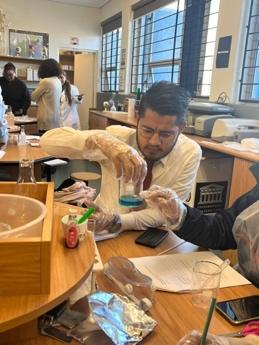
Advancing Knowledge Non-Profit Company (AK NPC) held its second round of training for natural sciences teachers in the science laboratory of Portia Primary School in Lansdowne. Four sessions of training were held in May 2024 for educators teaching natural sciences in the senior phase (grades 8 and 9). The first round was conducted in April 2024 for intersen phase (grades 4-7) teachers. A total of 28 grades 8 and 9 natural science teachers from 20 western cape schools registered for the course.
The training was offered in the form of a short course called Inquiry-Based Science Education (IBSE01) endorsed by the South African Council of Educators (SACE). The SACE endorsement means teachers who successfully complete the course obtain Professional Development (PD) points which can be used to demonstrate their development, especially when they submit applications for promotion posts. The central theme of the training was inculcating critical inquiry skills using a practical approach.
Teachers were involved in hands-on training from experienced facilitators using mostly everyday resource materials, developing teaching aids in natural science and performing simple experiments that can easily be transferred to their daily natural science classes. They were guided through the important elements of inquiry-based approach dealing with the scientific method and clarifying challenging conceptions around dependent, independent and constant variables through the practical application of curriculum content.
The course was supported by the Garden Cities Archway Foundation and the GET Natural Sciences provincial office of the Western Cape Education Department. The Natural Sciences curriculum is divided into four knowledge areas, each of which was addressed in the sessions held throughout the month of May 2024.
Investigating chemistry with an inquiry-based approach
The senior phase (grades 8 and 9) chemistry component (matter and materials knowledge area) of Natural Science was facilitated by Weedaad Haas, supported by the AK NPC science interns Saadiqah Fraden and Michaela Willoughby on Wednesday 8 May 2024. Teachers were guided through the elements of inquiry-based science lessons and drawn in discussing this approach by conducting simple chemistry experiments themselves and critiquing the outcomes they reached.
The different pedagogical approaches used to distinguish between experiments and investigations led to many challenges in teachers’ understanding of dependent, independent and constant variables. Many teachers were taken by the hand in doing the experiments, as confidence in doing practical work varies between teachers and schools.
In the end, the environment created was one where teachers needed to feel safe to ask questions and challenge their own understanding, knowledge and skills as well creating a supportive community of practice amongst the participating natural science teachers. As one science teacher expressed as part of their evaluation of the session: “I certainly enjoyed the session especially the experiments where accuracy in measurement influences the results you obtain. And in chemistry everyone can see from the outcomes, whether your experiments work or not. This would be very exciting to do with our science learners.”

Delving into astronomy as an inquiry-based adventure
On Wednesday 15 May 2024, Facilitator Andrew Firth supported by Mark Ogilvie and AK NPC interns took the senior phase teachers on a journey from earth to the other planets in our solar system, from our Milky Way to other galaxies. Teachers were challenged on their basic understanding of astronomy, the changes from day to night, how the moon influences tides, and what happens during eclipses.
Software packages like Stellarium (a programme for viewing stars, constellations and folklore) and Celestria (viewing planets, comparing planets and individual planets, moons, etc.) were loaded on teachers’ laptop computers and they were guided how to use these programmes as part of their teaching resources, to make lessons more interesting for their learners. One teacher said: “We were never given courses in astronomy during our studies, and we had to basically develop our own resources. This session has not only provided us with much-needed resources, but also guided us on how to use the software in our natural science lessons.”


Viewing life sciences through an inquiry-based lens
The life sciences sessions for senior phase natural sciences were facilitated by Fadlie Wagiet and Dawn Faro, supported by AK NPC interns on Wednesday 22 May 2024. Teachers were engaged with a series of hands-on inquiry-based activities including preparing slides for microscopy, working with the microscope to view slides of different organelles, developing models to represent how human vital organs work, testing the various parts of photosynthesis in leaves including demonstrating the role of starch, oxygen and carbon dioxide in photosynthesis process.
The activities were specifically developed to allow ease of application in teachers’ everyday natural science classes. This is indeed what a group of three teachers agreed on, who said: “What is nice is that we can basically take these life sciences activities and let our learners do this as part of their practical work.”


Sparking physics with inquiry-based activities
The senior phase physics component (energy and change knowledge area) of natural science was presented by experienced facilitator Robert Solomon supported by the science interns of AK NPC on Tuesday 28 May 2024. During this session teachers were involved in a number of inquiry-based investigative activities which they could directly apply in their natural science classes including energy transfers (convection, conduction and radiation), electromagnetism and especially electric circuits.
A number of scenarios were presented to teachers where they were challenged to build circuits, change aspects of the circuits and make predictions and defend their explanations based on the practical activity on which they were working. The session was very lively. One group of teachers said that they would keep their learners very busy with the activities that they were exposed to in the session.


Course evaluation
The following are excerpts from grade 8 and 9 natural sciences teachers’ views, as expressed in their evaluation forms:
- As a novice teacher and sometimes getting demotivated learners it can be really difficult. With the training, I will be able to make my learners have fun and engage, rather than to give them more notes that they don’t enjoy.
- The sessions allowed me to discover new ways in which a lesson can be interpreted in class. They were all so different and made me excited for when I need to eventually teach the topic.
- As a first-year teacher, I really needed a broader perspective on the topics and this training helped me with that. It made it easier for me to understand and pass it to the learners.
- Definitely learnt a lot. Got new insights on most of the topics. Thoroughly enjoyed it.
- The training added significant value towards my professional development both in terms of how I viewed practical work and how important it is to have our learners do it as it plays a huge role on how they grasp the content.
- This programme training was extremely beneficial and interesting. One could relate to the various activities that were completed and even use everyday products to create experiments.
- Each session was different and benefitted the variety of content of the work. Doing the content physically and without long theory explanation, and just getting into it helps in understanding the topic.
- I’m more confident with practical, hands-on experiments, for example I was afraid to operate electronic devices like resistors, and now I’m confident to do practicals in class. I definitely liked the inquiry-based training.
Teachers received their Inquiry-Based Science Education (IBSE01) course certificates at the end of the last session.
For more information, contact Professor Shaheed Hartley (shartley@skatt.co.za), Academic Head of Advancing Knowledge NPC.
Submit and get free exposure here: Showcase Your Business | Advertise Your Special Offers.
