
Chinette Gallichan killed in Johannesburg CBD: ‘attack on rule of law’:
The murder of attorney Chinette Gallichan is an attack on the rule of law and South Africa’s constitutional democracy, says Freedom Under Law.
Gallichan, a labour lawyer, was shot dead outside the Commission for Conciliation, Mediation and Arbitration (CCMA) offices in the Johannesburg CBD on Monday morning while on her way to a labour matter linked to Sibanye-Stillwater, where she worked.
Police said two suspects were being sought and the motive was under investigation, though witness accounts and early reports suggest Gallichan might have been targeted.
Freedom Under Law said it was deeply troubled by the reports of Gallichan’s killing. “According to news reports, Ms Gallichan was shot in central Johannesburg in broad daylight … The killing has been described as having the hallmarks of a targeted hit.”
The circumstances, it said, raised concerning questions about whether organised crime might have played a role, a concern echoed by other legal sector groups.
The non-profit legal group said it had raised its concern about previous murders of several lawyers, investigators and whistleblowers in what had appeared to be deliberate and concerted attempts to prevent criminal behaviour from being exposed.
“The killing of attorney Bouwer van Niekerk in September 2025 was a recent example of this trend. It is not yet clear whether the killing of Ms Gallichan is another example of this worrying trend but whatever the underlying reason, her death represents an attack on the rule of law and therefore on our constitutional democracy.”
Freedom Under Law said a society based on the rule of law required that lawyers be able to represent their clients fearlessly, without fear that fulfilling their basic professional duties could put their lives at risk.
“If lawyers cannot do so, the entire legal system and therefore our entire system of government would be under serious threat. We cannot allow the threat of violence to be normalised or to be used to intimidate legal practitioners and to manipulate the legal system.”
Freedom Under Law reiterated its call on law enforcement agencies to act quickly and decisively to bring all those responsible for Gallichan’s murder to justice.
In a letter to the editor of the Saturday Star, advocate Anton Du Plessis, the chief executive of Business Against Crime South Africa, expressed his concern after Gallichan’s fatal shooting, noting the growing risks faced by individuals operating within the country’s criminal justice system.
“This incident reflects a broader and deeply concerning pattern in which legal professionals, investigators, prosecutors and witnesses are increasingly exposed to intimidation and violence,” Du Plessis said.
“In organised crime environments, such violence is not incidental. It is used to exert pressure on the system, to influence outcomes and to shield criminal networks from accountability.”
International analysis, including findings from the Global Organised Crime Index published by the Global Initiative Against Transnational Organised Crime, highlights that the targeting of justice system actors is a defining feature of highly criminalised environments.
“It further underscores the importance of strengthening protection mechanisms and institutional resilience as a priority response.”
Du Plessis noted that South Africa has important foundations in place, including an effective formal witness protection system.
“However, the current threat environment suggests that protection measures may need to evolve to address a wider range of individuals operating within the system, particularly those exposed through their professional roles.”
The issue of impunity remained central. “Where there is a perception that individuals can act without consequence, the risk of targeted violence increases and the integrity of the system is undermined.
“This is not just another violent incident. When officers of the court are targeted, it has implications for the integrity of the rule of law. If those who operate within the justice system are not able to do so safely, the system itself is weakened.”
Du Plessis said that strengthening coordination, protection measures and prioritisation of cases involving justice system actors would be important in reinforcing accountability and restoring deterrence.
“Business and civil society can play a constructive role in supporting these efforts, particularly in strengthening system capability and coordination but that such support must reinforce — and not replace — the role of the state.
South Africa had the institutional framework and capability required to respond to the challenges, he said. “The priority now is to ensure that these are aligned and applied effectively, so that the system delivers consistent outcomes and maintains public confidence.”
Thando Mama steals the spotlight at Spier Light Art Festival:
There is one exhibition I have never quite managed to capture. Neither in photographs nor in words. It takes place annually in Stellenbosch, at the sprawling Spier Wine Farm. I made my way to the farm on Friday evening, just before sunset.
The evening felt far too short though. Summer sunsets in Cape Town arrive at around 8pm. Just as it gets dark and the light art illuminates brighter, organisers begin gently shooing visitors out. By 9pm the bar is closed. I felt a bit short-changed.
Part of the charm of Spier Light Art is that there is no fixed route. Twenty-one artists have scattered their light-based works across the farm’s 621 hectares, leaving visitors to wander and discover them almost by accident.
The Spier team has also introduced ticketed food experiences; picnics on the lawns or sit-down dinners for those inclined to linger. Sadly, the wine-tasting room is closed at night. It would have been a nice-add on.
Among the standouts are the burning car by Ronald Abdou and Zach Stewart, Strijdom van der Merwe’s Artefacts, Abri de Swardt’s hypnotic Flood Light and Kenneth Shandu’s umbrellas in When the Sky Falls.
But the most striking work is Thando Mama’s 1994 Revisited. It is a mesmerising scientific blend of video, sound and sculpture installed inside what appears to be an ordinary shed. It is the kind of piece that leaves you wondering: How did the artist do this? It takes the viewer to the country’s transition into democracy in an artistic video-art-projection form.
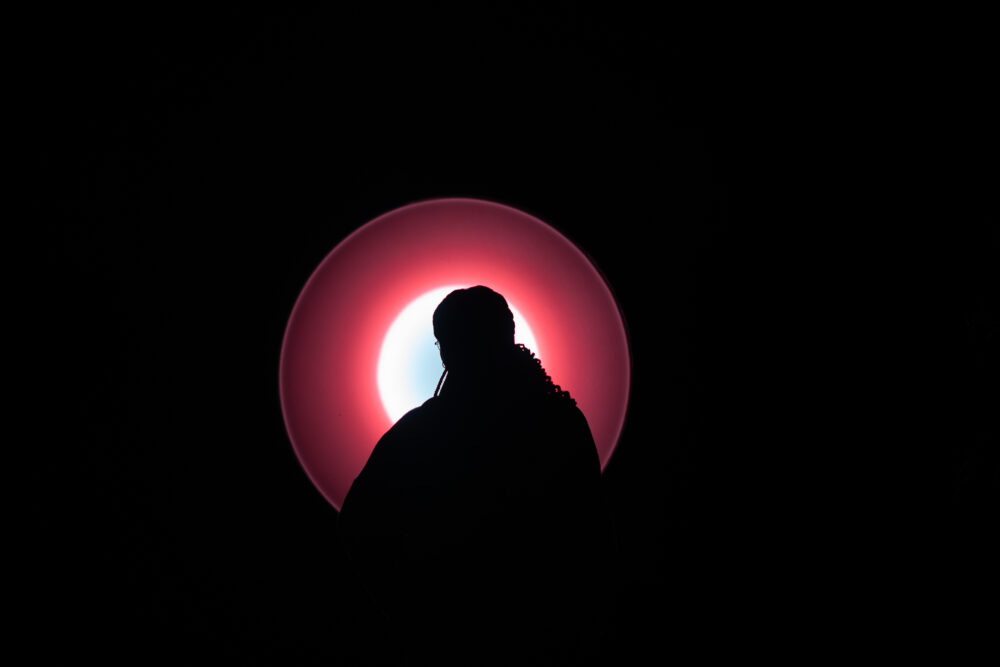

On the opening night, I met Mama’s son, Chuma,19, who had travelled all the way from Mnqaba village in the Eastern Cape. He told me he was a writer and graphic designer. I challenged him to write his own review of the Spier Light Art.
What follows is Chuma’s account of the evening, in his own words:
I found myself at yet another meaningful art event, surrounded by creative expressions ranging from simple and captivating paintings to more abstract and complex artistic crafts with significant representations relative to issues found in modern-day society.
My father’s work stands out the most to me. I could not help but feel that as an invited artist, he had reached a significant milestone in his career. Welcome, reader. I invite you to tag along on a short journey through my experience at the Spier Wine Farm during the Spier Light Art Event.
On the way to the farm, my expectations did not exceed those of the ordinary: a warm atmosphere, like-minded creatives and professional artworks on display. Yet the lessons I learnt from observing the creative masterpieces stretched far beyond my expectations. To visualise what I mean, you will need to take this walk from my perspective, briefly stepping into my shoes as we set off towards the picture I paint with words.
I walk slowly through the grounds beneath the dark and mysterious evening sky, accompanied by relatives and distant family members. As I look around, I notice others have also seized the event to bond and spend time with their families. Laughter and overlapping chatter from diverse groups drift through the air like music to fill in and complete the art event.
Young artists and seasoned creatives sit with glasses filled with the farm’s wine, most of them celebrating the night, the crafts or perhaps the simple fact that art exists in a country that often seems to forget and downplay its value and importance.
The artworks feel alive. Some tell a story in the form of photography and film, others create strange sounds with elemental rocks and vibrations. A few more seem confrontational as if demanding everyone’s full attention. Each installation feels like a puzzle about society I have to solve, untold stories I have to start and conclude myself, challenging assumptions of what is considered “art”, questioning creative standards and reminding me gradually that creativity isn’t always a comfortable truth to the eye. It could be a simple-looking craft with an intricate meaning behind it or a complex illustration without meaning but the desire to express a single emotion, the simple desire to create art.
Going back to my father’s artwork,1994 Revisited, the work does not simply exist as a decoration in the exhibition. It stands as evidence or “proof” of years of dedication, experimentation and passion in fine art through motion picture and visual art. I realise that what I am looking at isn’t his best work but it’s the message he wanted to encapsulate and communicate — something I think new artists must learn to do more of, instead of sacrificing the craft to meet expectations and general standards. After all, it seems art is not bound by rules.
Each artist at the Spier Light Event has taken an emotion, a thought, a frustration in some cases and a question and has given it shape in the form of awareness for all to see.
In that sense, the exhibition is not only a collection of artworks; it is a collection of manifestos; all worthy of being given a chance.
The Spier Light Art festival is open daily until Monday, April 6. At the Spier Wine Farm. Entrance is free, however, one must book online to ensure the farm can manage visitor numbers.
National Police Commissioner Fannie Masemola is reportedly facing criminal charges relating to the controversial R360 million Medicare24 contract awarded to businessperson and alleged leader of the Big Five cartel, Vusimuzi “Cat” Matlala.
On Wednesday, the Special Investigating Unit served Masemola with a warrant for an upcoming court appearance on 21 April.
This comes after 12 police officials appeared in the North Gauteng High Court in Pretoria on charges of corruption and fraud in their involvement with Matlala’s healthcare contract.
The list of implicated South African Police Service (SAPS) officers include Brigadiers Brian Cartwright, Rachel Matjeng, Alpheus Ngema, Patrick Nthengwe and Colonel Tumisho Maleka.
The Investigative Directorate Against Corruption said the 12 SAPS officials contravened the Public Finance Management Act and facilitated the unlawful procurement process for Matlala.
The controversial R360m Medicare24 tender was approved during Masemola’s tenure as police commissioner. However, Masemola later cancelled the contract after media reports about poor service delivery and the illegal awarding of the contract to Matlala’s company.
Suspended police minister Senzo Mchunu told the Mail and Guardian on Wednesday that he had raised alarm about the contract with Masemola and that the arrests vindicated his side of the story.
Multiple witness testimony at the Madlanga commission and parliament’s ad hoc committee have linked Mchunu to Matlala — an association the suspended minister has denied.
“I was correct in directing the national commissioner to review and cancel the contract. The investigation and subsequent cancellation process started way back in 2024. The 12 senior generals are not the only ones who will be arrested. There will be more,” Mchunu said.
Along with Matlala, the 12 SAPS senior officials will return to the dock on 7 April. The state opposed Matlala’s bail application while the rest of his co-accused were granted bail of between R40 000 and R80 000, with stringent conditions attached.
“Treasury regulations were violated and Matlala and Medicare24 were favoured by SAPS bid evaluation committee members, which will become apparent from the evidence later in the process,” said National Prosecuting Authority spokesperson Kaizer Kganyago.
“Medicare24 did not have the facilities/equipment and/or staff to make good on the tender, which was budgeted for approximately R360 million but owing to the collusion between the SAPS officials and Medicare 24, the lowest bid, which was approximately R228 million, which bid came from Matlala, was awarded this contract, nonetheless,” he said.
Matlala received more than R50m before Masemola cancelled the illegal contract.
Submit and get free exposure here: Showcase Your Business | Advertise Your Special Offers.
