
City Power goes ahead with plan to separate Joburg residents from hospital electricity networks:
Every night, as Sindile Sibanyoni tucks her 11-year-old child in bed, she hopes the electricity doesn’t fail overnight, endangering the life of her son who relies on oxygen to stay alive.
Her fear has intensified because City Power needs to provide additional power to essential services such as hospitals and plans to move houses off these networks.
“We have received a notice from City Power that our area will not be spared from load-shedding when the city reallocates houses to power cut-prone areas to have additional megawatts sent to these so-called essential areas,” said Sibanyoni.
She lives in Power Park, not far from Chris Hani Baragwanath Academic Hospital and Dr Matseke Memorial Hospital in Soweto, Johannesburg.
The reallocation of electricity follows the high court’s ruling that ordered Electricity Minister Kgosientsho Ramokgopa to take “all reasonable steps” to prevent any interruption of power as a result of load-shedding to hospitals, public schools and police stations. The City of Johannesburg has approved steps to move houses in these exempt areas to other networks that aren’t exempt from load-shedding.
Besides having been exempted from load-shedding, Power Park is one of the areas in Johannesburg that has been red-flagged because people have not been paying their electricity bills.
“We have always known that our turn would come for us to also experience load-shedding, but I had found solace in that we would be spared because we are close to Dr Matseke Memorial Hospital. I am poor and cannot afford to have solar panels on my roof. This needs to be stopped,” she said.
The prolonged power outages that are a common occurrence in the country worries Sibanyoni.
“The problem is that although everyone needs to experience power cuts, I cannot afford to have five minutes off. The neighbouring townships experience extended hours of load-shedding, five hours minimum.
“This means that I have to be prepared for a funeral before my son dies because the machine he is plugged into keeps him alive, said Sibanyoni. “I am not sure what needs to be done. I have written letters to the council and no help has been given.”
Timothy Hutler, a former construction worker living in Brixton, echoed Sibanyoni’s plight saying that removing residences from load-shedding exempted areas would be detrimental for his wife, who needs a dialysis machine to survive.
“We have been waiting for a new kidney for the past two years and we have not been lucky. My wife lives on a dialysis machine or she will die. We moved to Brixton because of the friendly electricity plan. Our finances have depleted because of the medical bills, so solar is not an option,” he said.
Brixton is linked to Garden City Hospital and also has a water tower, fire station and a police station.
City Power
Since the court’s December 2023 decision ordering cities to implement it by 31 January, City Power has been reconfiguring its network to separate residents connected to essential service networks and move them to a different one.
City Power spokesperson Isaac Mangena said: “The judgment has us tied. If Eskom says it demands 4 000 megawatts, we need to give them those megawatts by load-shedding residential areas and excluding the hospitals to allow them to continue with their business of saving lives. This means residents need to be removed from the network so that they can have their separate feed.”
He added that this meant the city needed to spend more money to reconfigure the electricity system and procure new cables to separate the networks.
“When the city was built, it was not designed for load-shedding. That is why you will find that residential areas are connected to essential services. Those that are benefiting from the exemption are those who are still embedded in the networks. But everyone needs to experience load-shedding for fairness in the country.”
Mangena said the process would be expedited because the city was not disconnecting people from the grid or their substations. Instead they are changing the network cable.
He did not give a completion date, saying that this would depend on the budget.
He added that the city had to ensure that the effect of the reconfiguration was minimal. A delay in the separation means that hospitals such as Dr Yusuf Dadoo in Krugersdorp experiences load-shedding because it is not yet separated from the residential feeders.
Mangena said: “Helen Joseph Hospital in Auckland Park recently got separated and is now exempted because of the separation. The reason it was experiencing load-shedding [before the exemption] is because it was not separated from the network because of budgetary constraints, which made it difficult to exempt it in time.”
Hemp can play an important role in dealing with climate change and pollution:
Sheldon Cramer uses three words to champion the environmental benefits of industrial hemp farming in South Africa: zero carbon footprint.
“Hemp sucks up carbon dioxide (CO2),” the chairperson of the KwaZulu Hemp Association and the chief executive of KwaZulu Hemp Processors, enthused. “At some of our controlled grow operations for the medicinal stuff, we actually put CO2 into the grow environment to help the plant grow better. So, if you want to solve carbon emission problems, grow hemp like we grow sugarcane. It’s really that simple.”
Cramer, better known as Bobby Greenhash, told how at his “massive grow” operation in KwaZulu-Natal, hemp seed was put into the ground, where it grew, well, just like a weed.
“There was no water given; there were no fertilisers, composting; nothing,” he said, of his flagship research project in Eshowe.
“It was put in the fallow sugarcane field to set benchmarks to see how the specific strains that we are rolling out and introducing within the KwaZulu-Natal region would grow … And we didn’t even water or anything and within 90 days, it got over 8m tall, which is fantastic for fibre.”
But there are so many uses and benefits with industrial hemp and “you’re looking at anything from cosmetics, medicinal, biomass, textiles, fibre, plastics and biofuels. “And, literally when you’re harvesting it, the foliage and leaves that fall off, naturally as it dries out in the field, re-nitrates the soil. So, you don’t have to put nitrates back into the soil, it already does that … You don’t need fertilisers and pesticides and all that stuff to grow it.”
He cited a local project he is running involving macadamia farmers who are growing hemp in between their rows of macadamia trees as windbreakers. Traditionally, they used cinnamon grass. “But with the hemp, they’re getting a cash harvest every 90 days. And it’s nitrating the soil and they don’t have to water it because it catches the runoff from the irrigation of the mac trees. As a supplementary or complementary crop, it’s insane.”
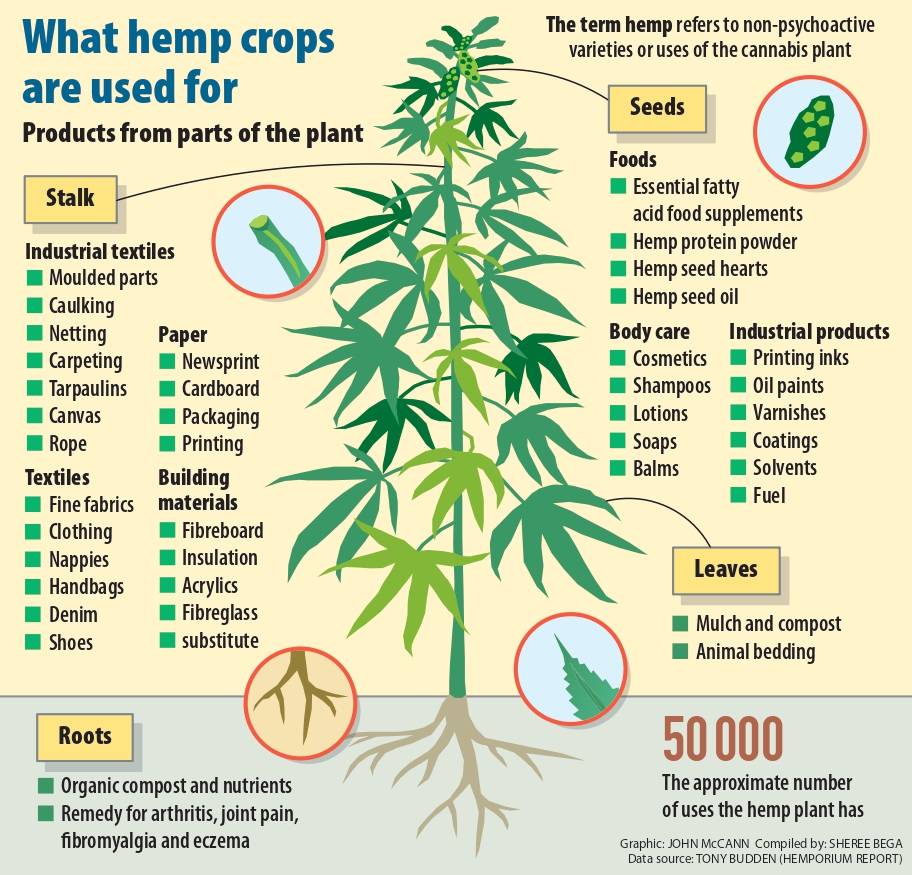
One plant with a multitude of uses
During his 2023 State of the Nation address President Cyril Ramaphosa restated the government’s commitment in 2022 to unlocking investment in the hemp and cannabis sector, noting how it has the potential to create more than 130 000 jobs. In 2022, the president indicated that the hemp and cannabis sector could be worth R406 billion by 2026.
“We are moving to create the conditions for the sector to grow,” he said last year. “Urgent work is being finalised by [the] government to create an enabling environment for a whole plant, all legitimate purposes approach for complementary medicines, food, cosmetics and industrial products aligned to international conventions and best practices.”
Industrial hemp is a cousin of the psychotropic dagga (marijuana) and is cultivated in totally different ways, according to Hemporium, which was established in 1996 as Africa’s first cannabis/hemp company.
Sectors that have been identified as focal points for industrial hemp are agri-fibres for car parts such as dashboards and door panels; eco-friendly paper; natural cement, bricks and insulation for housing, animal bedding and nutrition from the essential fatty-acid-rich seeds.
“Hemp is a descriptive term that refers to the non-psychoactive uses and varieties of the cannabis plant,” said Hemporium director and co-founder Tony Budden. “These include fibre products (textiles), nutrition products, construction material, bio-composite, cosmetics, fuel, medicines, paper and more.”
On the environmental benefits of industrial hemp, Budden noted that “one plant has a multitude of uses, it does not require pesticides or herbicides, conditions the soil, absorbs carbon, uses less water than cotton and is zero-waste.
“One of the things with hemp is that it is obviously prized for its environmental friendliness. That’s one of the reasons that’s being pushed forward specifically when it’s compared to cotton, or on the building side – brick and cement – or the way it’s farmed, the amount of fertilisers and agrochemicals that it needs compared to the things that it would be replacing.”
There are environmental effects from a monoculture crop like hemp but it’s a rotation crop so it’s such a short crop. “It’s three to four months, especially when you’re growing it for fibre – you’re getting a double use out of that land, so you’ll rotate it with a winter crop. Anywhere where there’s summer rainfall, you would need very little supplementary water.”
There will always be some carbon produced on the harvesting or processing side “but most of that is offset with the amount of carbon hemp absorbs while it is growing – it’s a better than zero carbon crop”, Budden added. This is particularly true in the construction sector.
“You’re replacing brick and cement, which is a massive net carbon producer with hempcrete, which is hemp mixed with lime,” he said, explaining that this goes through a process of calcification where the lime and the hemp bond and form calcium carbonate. “And that absorbs carbon while it is drying so there is also carbon sequestration, not only in the cultivation, but also in this process.”
Ancient use
Industrial hemp is a plant in the botanical class of Cannabis sativa cultivars and is grown specifically for industrial use, according to Ian du Plooy and the Agricultural Research Council’s – Vegetable, Industrial crops and Medicinal Plants campus (ARC-VIMP) cannabis team.
The plant, he said, has historically close relations with humans, and has been used since ancient times in various civilisations for its fibres, seed and oil. With hemp declared as an agricultural crop, the cultivation, research and sale of hemp in South Africa is now legitimate for permit holders. “Although we do not have much experience on hemp production in South Africa, the legalisation of hemp has led to a revival of interest in this versatile plant.”
The ARC-VIMP engaged in a comprehensive research programme on industrial hemp together with the department of agriculture, land reform and rural development. Initial results from cultivar evaluation trials in all nine provinces confirmed most hemp cultivars are sensitive to day length and better adapted to traditional production areas such as the Eastern and Western Cape as well as certain areas in Kwa-Zulu Natal with longer day lengths.
Du Plooy noted that some varieties were identified as to be adapted to other production areas such as Gauteng, Mpumalanga and Limpopo although “economic viability” is still to be confirmed.
Fighting climate change and pollution
South Africa, like the rest of the world, experiences the effects of climate change and
pollution in many agricultural production areas, which are mainly caused by human activities with global warming, accumulation of heavy metals in soil and biodiversity destruction. Metals from mining and mine dumps, municipal wastes, downwash from power lines, irresponsible management of fertilisers, pesticides, and sewage “have left much land unsuitable for cultivation”.
Although local experience and knowledge are still limited, “hemp has very good prospects for phytoremediation (using plants to clean up contaminated environments) as well as carbon sequestration – storing or capturing carbon.
“Phytoremediation, by utilising specific plants to remove metal pollutants from soil, can be considered as a feasible and sustainable practice for remediating polluted soil. Hemp grows fast and has a deep taproot as well as extensive fibrous root system, adapted to a wide range of soil conditions.”
Industrial hemp can take up metals and store them in different parts of the plant, with no detriment to the plant itself. Hemp grown for phytoremediation of contaminated soils also produces marketable products used for bioenergy production, timber fibre, pulp, and fodder.
Hemp’s carbon-capturing capabilities are “impressive”, he added, pointing to research by Cambridge University, which revealed how one hectare of hemp can absorb between eight to 15 tonnes of carbon dioxide.
“In comparison, forests capture two to six tonnes, depending on the type of trees, region, etc. Unlike other crops or trees, the CO2 absorbed by industrial hemp is locked within its fibres, which are used in a diverse range of applications, from textiles and paper to construction materials”, he said.
Hemp cultivation can play an important role in alleviating the negative effect of climate change and pollution in the country, with the potential of soil remediation and earning carbon credits, he added.
Novel products
A February 2023 cannabis report by the Institute for Economic Justice noted that there are many potential applications for hemp. “In the long-term, hemp may prove to be the largest cannabis market if environmental policies encourage hemp-based substitutes for materials like cotton, oil-based plastics, and some conventional cement-based building materials through the use of hempcrete.”
However, these are relatively novel products, for which the value chain and end markets are undeveloped. “South Africa lacks processing and manufacturing capacity to enable cultivators to connect to markets … Industrial policy support for investment in hemp processing is important, but more fundamentally the challenge is market creation.”
For Cramer, the sky’s the limit. “Eighty percent of the plastics that go to BMW are hemp-based plastics so it lowers their carbon tax. We are aiming to tap into those markets,” he said.
“The crop has the potential of becoming the next biggest GDP contributor within the KwaZulu-Natal region and hopefully down the line, geographics play a big role in it because it doesn’t just grow anywhere.”
Financial watchdog sinks teeth into Banxso investigation: Investors have raised concerns that the parameters of the inquiry appear vague
Submit and get free exposure here: Showcase Your Business | Advertise Your Special Offers.
