Climate crisis puts older adults at high risk from extreme heat, Unep warns:
Older people face increasing health risks from extreme heat as climate change intensifies, the United Nations Environment Programme (Unep) has warned.
In the latest edition of its Frontiers Report, released this week, it said adults aged 65 and above are becoming an increasingly dominant part of societies worldwide, especially in the cities of low and middle-income countries.
The report highlights other effects of climate change, including the melting of glaciers that reawaken ancient pathogens and floods that risk releasing dangerous chemicals, as well as potential solutions to these emerging environmental issues.
Older people are highly vulnerable to extreme weather events. Since the 1990s, there is an estimated 85% rise in annual heat-related deaths of older people. Poor air quality arising from extreme weather events also results in subsequent health issues. Similarly, floods affect low-lying coastal cities, which are home to many older persons.
The global population aged 65 and older is projected to increase from 10% in 2024 to 16% by 2050, primarily in low and middle-income countries, the report notes. Concurrently, climate change is exacerbating risks such as heatwaves, air pollution and floods, which disproportionately threaten older human beings.
The world is also becoming increasingly urbanised, with about 57% of its population now living in cities. By 2050, this figure is expected to rise to 68%.
“A rising number of cities will therefore soon face the new reality of increasingly ageing urban dwellers. Maintaining good health and vitality is crucial at any age and minimising risk factors for diseases become even more critical as we age,” the report said.
“In addition to the genetic, physiological, behavioural and social influences, environmental conditions play a crucial role, especially in cities that bring together a high concentration of a variety of environmental health risks.”
The risks of respiratory, cardiovascular and metabolic diseases, and the increased risk of mortality, become particularly acute for frail people with reduced mobility and chronic health issues.
Air pollution and chemical contamination increase the risk of cardiovascular and respiratory diseases, neurodegenerative diseases, dementia, depression and anxiety. Poverty, crowded cities and social isolation also raise the vulnerability of older people.
The report recommends transforming cities into age-friendly, pollution-free, resilient, accessible spaces with expansive vegetation through better urban planning.
Investing in weather stations to monitor extreme heat is critical to protect lives while community-based disaster risk management and access to information are key approaches to help aging people adapt successfully to climate change, it said.
The report follows the United Nations Human Rights Council resolution 58/13 to develop an “international legally binding instrument on the human rights of older persons”.
Zombie microbes
It warns of the “awakening” of ancient microbes in the cryosphere, which makes up half of the Earth’s land surface.
Should global temperatures rise more than 2?C above pre-industrial levels, this would significantly reduce the cryosphere in mass, which includes glaciers, seasonal snow, ice sheets and shelves, sea ice, seasonally frozen ground, and permafrost. “In a best-case scenario, it would take centuries for cryosphere conditions to return.”
The cryosphere is surprisingly rich in ancient life, including fungi, bacteria, and viruses, of which some are pathogens. Much of this life is currently dormant. Warming could reactivate and remobilise modern and ancient microorganisms in cryospheric environments.
“Some might thrive, modifying existing microbial communities, while some might not survive resulting in a loss of microbial diversity.This can enhance the powers of existing pathogens through natural gene transfers, resulting in heightened risk of antimicrobial resistance,” said the report.
Cryospheric regions are home to 670 million people. This population could rise to 844 million by 2050, spanning the Alps, the Andes, Greenland, Hindu Kush Himalaya, Siberia, and the Tibetan Plateau as well as billions more who live in areas with water originating from those frozen areas.
To slow down the decline of the cryosphere, the report recommends cutting greenhouse gas emissions — including black carbon emissions from diesel engines — open-field agricultural burning, and wildfires and limiting tourism in fragile frozen regions. Scientific research must also accelerate into the diversity of cryospheric microorganisms that will not survive the cryosphere’s decline.
Banned chemicals re-emerge
Global climate change is contributing to longer, more severe, and more frequent floods. A flood can carry significant volumes of sediment and debris, the report said.
Sediments and debris often include common inorganic toxic pollutants, for example arsenic, cadmium, chromium, lead, manganese, mercury or persistent organic pollutants (for example pesticides), sometimes preserved in the environment over centuries.
When floods occur, these can re-enter cities or the food system. The persistent nature of these chemicals means even banned and phased-out chemicals can be remobilised.
In recent years, extreme rainfall and subsequent flooding have demonstrated their ability to remobilise legacy pollutants accumulated in the environment.
Extensive petroleum operations and incidences of oil spills in the Niger Delta of Nigeria over decades has led to severe contamination with ecological and human health consequences, the report said.
A catastrophic flood event in the Niger Delta in 2012 mobilised sediments contaminated with carcinogenic polycyclic aromatic hydrocarbons and deposited them over extensive portions of the floodplain.”
After the worst flooding in more than 100 years along the Elbe River in the Czech Republic and Germany in 2002, hexachlorocyclohexane concentrations in fish downstream of former production sites of the pesticide, lindane, increased more than 20-fold.
The same flood also mobilised legacy radionuclides and heavy metal pollutants from former uranium-mining waste dumps and tailing ponds in the Elbe region.
The Pakistan flood of 2010 inundated a fifth of the country’s total land area. It, together with a series of smaller flash floods, swept away a significant but unknown portion of 2 835 metric tonnes of obsolete pesticides and other persistent organic pollutants kept in storage facilities for proper disposal.
“The release of these obsolete chemicals into the environment will likely cause further contamination in soils, water, and sediments, and the damage needs to be monitored and assessed,” the report said.
Effective measures to reduce this imminent risk include traditional control measures like polders, dikes and retention basins, improved drainage systems, nature-based solutions like the sponge-city approach, regular monitoring of pollutants in diverse locations and products, and studying and tackling the economic impacts of this kind of pollution.
The risk of ageing dams
Another emerging threat the report addresses is the risk of ageing dams. It notes that alongside many benefits, dams can harm indigenous and fishing-dependent communities, as well as degrade ecosystems.
There are about 62 000 large dams and millions of smaller barriers that exist worldwide, with expected effects on 90% of the world’s river volume by 2030. Large ageing dams are increasingly being removed in Europe and North America, once they become unsafe, obsolete, or economically unviable.
Greater natural river connectivity means healthier ecosystems and greater biodiversity, renewing species’ access to tens or even hundreds of kilometres of upstream habitats.
The report noted, however, that where urbanisation, industrial agriculture or deforestation are common, dam removal alone may not significantly improve a river’s health. Large dam removals have the largest impact, though removing multiple small barriers may result in similar effects.
Adhering to the UN’s principles for ecosystem-restoration initiatives when considering the removal of river barriers is critical, the report said.
The death of satire: What does murder represent today?:
Not long ago, the Western media was showing videos of people being ruthlessly killed. They were recordings of beheadings by jihadis of the Islamic State of Iraq and Syria. The first of them was posted online in 2014. More followed soon after. They were shown at every news cycle on almost every news channel. Naturally, CNN, the BBC, Euronews and the rest wouldn’t show the entire clip. The videos were edited. Still, just enough was shown — enough to get the reaction they wanted to elicit from their audience.
The common wisdom is that such clips desensitise the viewer to the loss of a human life. The truth is that they have a hypnotic effect on the mind. You cannot help watching what’s unfolding in front of you even though you’ve watched the video a thousand times and you know exactly what will happen next and the images have made you sick every time.
Why is watching someone getting killed so shocking, at times even traumatising? It wasn’t always so. I’m not saying that humans were less sensitive to murder in the past because they were more used to it. My point is that a human life represents something else today and that its loss is felt differently as a result. What does murder represent for us today?
For the majority of people today, murder represents the desecration of a superlative value. In modern society, a human life is sacrosanct. The belief is that it possesses dignity. If you kill a person, you violate something sacred and eternal.
This has been the common opinion in the West since the last quarter of the 18th century. The 1776 text of the American Declaration of Independence and the 1789 Declaration of the Rights of Man and of the Citizen elevate a human life to the rank of something with inviolable rights which must be protected by law and government. The former says that “all men are created equal”. Article 1 of the latter says that, “Men are born and remain free and equal in rights.” Article 1 of the 1948 Universal Declaration of Human Rights makes explicit what remains implicit in the first two texts. “All human beings are born free and [are] equal in dignity and rights.”
Note that it speaks of humanity not as a species but as disunited into citizens and members of a political association. The attribution of sacrality depends on this limitation. It is not as an animal that a human being has dignity, but as a being that secures its rights by instituting government, by forming a political association, i.e. a people or nation.
Everything leads us to suppose that the dignity of man derives from the supreme power accorded the nation. Article 3 of the Declaration of the Rights of Man and of the Citizen: “The principle of all sovereignty resides essentially in the nation. No body nor individual may exercise any authority which does not proceed directly from the nation.”
The American Declaration of Independence speaks of the powers of government deriving from the consent of the governed. The sovereignty of the people or nation is absolute, indivisible, unconditional. We have a formidable metaphysical predicate in a political text that turns man the citizen into a political monster, a being with unlimited power. Is it any wonder that modernity is the age of man’s dominion over the earth, an anthropo-cene?
It is in any case why we hear the same refrain from Jean-Jacques Rousseau to Immanuel Kant: do not use a human being merely as a means but only as an end in itself. A man is not a thing to be enjoyed but a person that is owed respect. When people see someone being humiliated by having their dignity trampled on, the response is usually swift and violent. The time for talking is over. It is time to act.
Let me illustrate this last point with the following example. The latest war between Hamas and Israel in Gaza began on 7 October 2023. The left was outraged by the loss of Palestinian lives at the hands of the Israeli army, but less by the loss of life on the other side, let alone by the kidnapping of 250 Israeli citizens. The left accords full moral status to Palestinians but almost none to Israelis. That is why it felt the loss of the former so much more strongly than the loss of the latter.
Students protesting in the US went on marches. They occupied university campuses and put up tents everywhere. They raised blockades on bridges and highways. The time for talking was over.
Conversely, the right accords full moral status to Israelis but almost none to Palestinians. It was outraged by the massacre of 1 200 Israelis on 7 October but almost not at all by the loss of Palestinian lives in the months that followed.
The left and right share a belief in the dignity of a human life. For both, a human life has value in itself. The reason they are locked in an insurmountable battle to the point that they are incapable of hearing each other out is because of their additional belief that the members of one nation are full-blooded humans, whereas the members of the other are “humans” in name only.
What does this example tell us? Perhaps most strikingly the fact that the moral worth we attribute to people depends on our political leaning and on our identification with the left or right. Our politics dictates our perception of who is and isn’t human, whose loss we should mourn and whose loss we can safely ignore.
The other thing it demonstrates is the fact that we have an emotive attachment to values and not, as Kant believes, a rational one. Our perception of a murder testifies to the fact that humans are wedded to their values emotively rather than rationally, that they have an unconscious attachment to them instead of being persuaded of their truth.
Imagine someone trampling on your values in front of you. The scene would fill you with disdain and horror. The reaction by liberals is the illiberal one where, instead of hearing out what the violator has to say and what his reasons are for doing what he did, the liberal wants to see him crushed.
Allow me to cite another example, the violent protests by Muslims around the world at the French weekly Charlie Hebdo’s cartoons of the prophet Mohamed in January 2015, which led to the death of 8 of its staff. The outrage was caused by two factors. First, the cartoons violated a taboo. They depicted the prophet, which is haraam. Second, as is generally the purpose of caricatures, they mocked and ridiculed him. Someone deemed holy by 1.8 billion people was made to look grotesque.
The response by the French Muslim protesters made one thing clear. Up until then, the French believed that every citizen, though he may be opposed to others in virtue of his faith, nevertheless has enough in common with the rest to consider himself part of the same national community. The protests showed that this appearance of belonging is just that, an appearance. Satire is an integral part of French political culture. It is unthinkable without it. But it is anathema to Islam. The two are irreconcilable to the point that one has to give way to the other or reprisals follow.
This raises two difficult questions. The first is: how can cultures with competing values coexist in the same society? Isn’t it necessary for one of them to give way to the other? even in a democracy? Or does this show the impossibility of multiculturalism? The alternative, naturally, is to take one’s values less seriously or with a greater dose of irony. But is irony, satire, mockery and the rest possible in an age dominated by sincerity of belief and conviction, i.e. by wokism?
I cannot offer an answer to the first question here. As for the second, it is certainly true that were the left and the right capable of taking themselves or their values with a greater dose of irony, that would make for a healthier civilisation. Sadly, the importance they both attach to identity, and to identity politics in particular, makes that impossible. The golden age of satire and mockery — i.e. from the late 1960s to the early 2000s – is long over.
Rafael Winkler is a professor in the philosophy department at the University of Johannesburg.
China: The future woven into the present:
During a recent visit to Shanghai, China, to attend the Mobile World Congress — the world’s largest exhibition and conference for the mobile technology industry — I expected to see flying delivery drones, machines autonomously completing mundane tasks and robots that talk.
It was not that futuristic but I saw technology being developed to pave the way for such a future — and it was fascinating.
The three-day conference had displays of new smart watches and laptops — one was 3D and another was transparent — and cars that were entirely automated and could transform from an SUV into a pick-up (a bakkie, in local terms).
I teased a robot that copied my hand gestures and saw a human-figured robot carry and deliver a crate. The developers said it was a prototype. They spoke about other advancements, like faster 5G networks and assistants, powered by artificial intelligence, to hold us accountable with our diets, exercise and tasks.
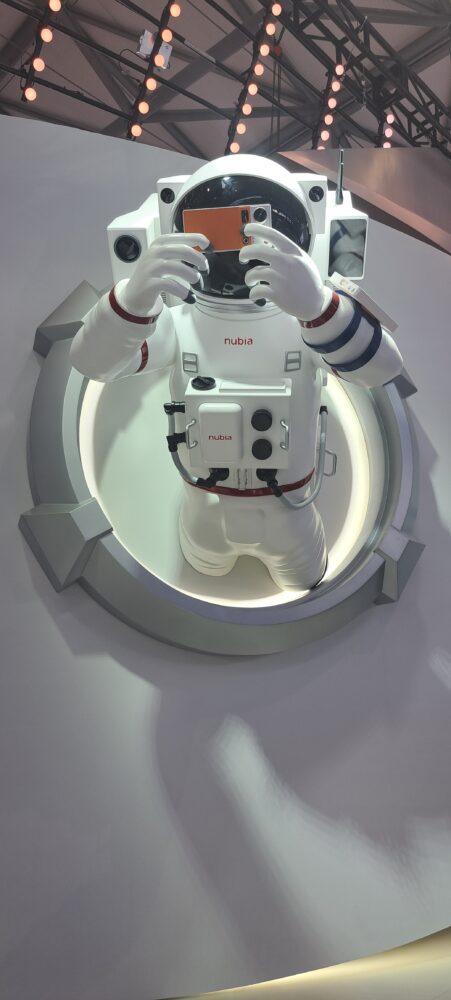

The really fascinating way that technology is deployed in China is in the streets. The locals had everything at their fingertips — literally.
Ahead of the trip, I was informed that everything was cashless and mostly digital. I didn’t need to worry about exchanging currencies and carrying cash. I just had to set my Visa card to international payments, and I was sorted. However, China has localised its pay options through WeChat and Alipay, so I was a bit limited in this regard.
The country also localised its social media platforms — so the things the West uses to communicate: WhatsApp, Instagram, Facebook and Google, were blocked.
I found that out at the last second, so I downloaded a paid VPN to bypass the firewalls a few minutes before boarding a 12-hour flight to Hong Kong and hoped it would give me connection — just to let my family know I was safe, and share some pictures on Instagram, obviously.
We flew Cathay Pacific — between viewing the plane glide through the clouds via the screen in front of me and bingeing on series, sleeping and daydreaming, I was somewhat entertained through the flight.
Hong Kong’s airport seemed pretty usual to me — big, well-lit with signboards everywhere — people in a rush or snoozing, and three South Africans looking for a meal at 6am (midnight South African time). China’s Pudong International Airport even had sleep-pods!
My first “this is cool!” moment was before boarding my flight from Hong Kong to Shanghai. I had my boarding pass and passport in my hand, ready to give to the attendant at the gate. Instead, a camera scanned my weary face and in an instant confirmed my identity, my flight details and my seat number. No people needed.
It was warm when we landed in Shanghai and the first step of the entry process was through a self-service e-channel or automated border control. I had input information from my travel documents, and scanned my fingerprints, so it could verify my identity.
“Quick and easy,” I thought. But I still had to face the intimidating man at immigration control who triple-checked my passport before I stood before a screen that verified my identity — again.
We proceeded to our DiDi — an e-hailing service — built into the WeChat app, to transport us to our hotel. It was an electric vehicle, a minibus, with automated doors, USB charging ports in the doors and the driver sat on the left-hand side.
There were screens across the dashboard and some cars had screens in the back to provide entertainment for passengers.
I downloaded Duolingo before the trip, in the hopes of learning some Chinese words to help me get around more easily, but I only used three: “Ni hao” (hello), xièxie (thank you) and TsingTao (a brand of beer).
Thankfully, the locals had a translation app to lower the language barrier. They spoke into it, and the app read the translation back to us in English. We responded in English and they read the Chinese translation. It was easier than I expected.
The cars were mostly electric, so the roads were not fogged with fumes. I expected a clean city, so I wasn’t surprised by that, but I was pleased to see pot plants with gorgeous flowers lining the highways.
The roads wound high and low between bridges and buildings. The pavements on the inner-city streets were lined with yellow and turquoise bicycles and multi-coloured scooters decorated with little stickers. They were parked under the shade of the many leafy trees in Shanghai.
The scooters were also electric and the bicycles were accessible to anyone. Locals use an app to unlock the shared bicycles for 1.5RMB (R4) for an hour and up to 2RMB (R5) for the day. Locals can either buy an electric scooter or hire them from a company for about 280RMB (R700) a month.
There was always movement in the streets — elderly women drove scooters as swiftly as the hipster 20-year-olds. Locals were constantly on their phones — while walking, eating, working and even driving.
I was not accustomed to exposing my devices out of fear of being robbed, but in China, I learnt to be a bit free with that. I appreciated that part of the communist state.
The hotel had a little robotic helper that glided across the ground floor, through the lifts and back to its spot until it was given its next task. Kind of like the robot vacuum cleaners in homes, but this one was half my height and had a compartment to deliver food or parcels to customers. It even had a cutesy bow tie and suit jacket as a whimsical detail. That seemed very futuristic to me and exactly how I imagined China to be.
In the evenings the city transformed into another world — the soft tones of the trees and the quiet humming from the electric vehicles were replaced by bright neon lights, music and a playground for Shanghai’s children, adults, friends and lovers.
Swings whooshed, the merry-go-rounds whirled and kids moved around in quirky electric cars with lights and music.
Surveillance cameras are stuck into corners of billboards and buildings — something I became very aware of, once I noticed them.
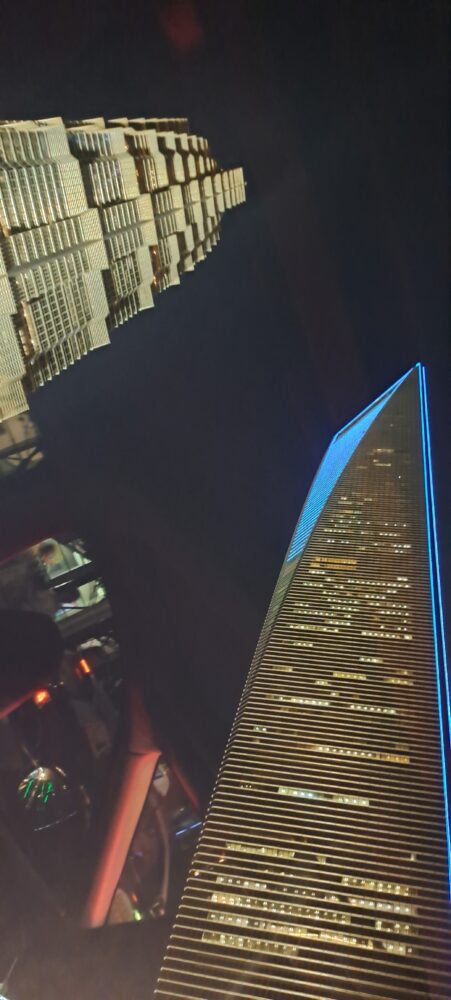
Shanghai’s skyline was more than I imagined it to be — tall skyscrapers and bright lights — which mesmerised and overwhelmed me.
The colonial-style buildings at The Bund, which overlooks the Huangpu River, glowed in a brilliant gold. This is the business district and is home to the country’s central bank. I was fascinated by the glamour of the space.
I went up the second-tallest building in the world, The Shanghai Tower, to observe the city from above, and I got to experience the city from down below — walking alongside locals in People’s Square towards The Bund, and eat and shop at Xintiandi and at The Yuyuan Bazaar. This is a beautiful market characterised by traditional Chinese architecture, featuring curved roofs, wood carvings and colourful lanterns.
My eating experiences deserve their own chapter but the spicy, soupy noodles; tangy seafood and dumplings, mushrooms, flower-bud teas and the best coffee I ever have are still lingering on my taste buds.
It was a novel experience but the future I had imagined — flying drones and talking robots — wasn’t hovering dramatically overhead. Instead, it was woven quietly into daily life, in the silent glide of electric vehicles, the soft whir of delivery robots and the glow of neon lights reflecting off skyscrapers.
It wasn’t science fiction; it was practical, human and happening now. And while I might have arrived expecting spectacle, I left marvelling at how seamlessly technology and city life had blended — a glimpse of what might one day become ordinary, everywhere.
The journalist’s trip to Shanghai, China was sponsored by Huawei Technologies.
Submit and get free exposure here: Showcase Your Business | Advertise Your Special Offers.