ClimateLaunchPad Green Business Ideas Competition: Regional Finals:

Young Africans pitch their innovations for a greener and cleaner future
Eight African start-ups are taking the virtual stage to pitch their green innovations addressing the challenges and adverse impact of climate change.
The Africa regional grand final of the ClimateLaunchpad Green Business Ideas Competition will take place on Friday 3 November. Two start-ups will emerge as Africa’s green champions and advance to represent the continent on the world stage at the global final.
ClimateLaunchpad is the world’s largest green business ideas competition, dedicated to combating climate change through innovation and entrepreneurship. It is an annual global tournament which takes place virtually to minimise its carbon footprint and live up to the principles of being clean and green.
This competition serves as a platform for eco-entrepreneurs and green innovators to showcase their ideas within key thematic areas, namely: climate adaptation and resilience, blue economy, circular economy, clean energy, food systems, sustainable mobility, urban solutions and the Next Big Thing.
Local organising teams from the 12 participating African countries support the Netherlands-based ClimateLaunchpad team with the shortlisting of applications and training bootcamps, which all the start-up entrepreneurs undergo before competing. The participating nations include South Africa, Kenya, Nigeria, Ghana, Egypt, Morocco, Tanzania, Uganda, Angola, Mozambique as well as the island nations of Mauritius and Cape Verde.
South Africa is this year’s host of the ClimateLaunchpad regional finals.
The Africa regional semi-finals held on Tuesday comprised 36 start-ups that had won their respective national finals. Each country was represented by three finalists, with Uganda emerging as the continent’s giant of green entrepreneurship: all three of their representatives made it into the Top 8 and will be moving on to Friday’s grand regional final.
The finalists competing for top glory and a spot at the global finals are:
Start-up: Jodoor
Entrepreneur: Sokayna Bellam
Country: Morocco
Jodoor is an AgriTech Startup willing to democratise controlled environment agriculture in Africa. They provide affordable turnkey soilless farms that can produce +100 varieties of pesticide-free leafy vegetables year-round, while saving 80% water and fertiliser.
Start-up: Gro-gel (Kulisha Dunia)
Entrepreneur: Akello Maria Goretti
Country: Uganda
Thematic Area: Adaptation & Resilience
Gro-gel produces a cellulose-based biodegradable hydrogel from biomass (rice husks) that holds water in the soil for plants. The raw biomass makes the hydrogel a good soil amendment.
Start-up: Smart Women in Environment and Development Organization (SWEDO)
Entrepreneur: Mariah Kizza
Country: Uganda
Thematic area: Clean Energy
SWEDO seeks to reduce environmental damage by replacing charcoal with briquettes from organic waste that will be of high value and standardised through mechanisation, resulting in improved storage.
Start-up: Pazelgreen Technologies Limited
Entrepreneur: Oluwadamilola Olowoseunre
Country: Nigeria
Thematic area: Circular Economies
Pazelgreen Technologies’ sustainable and cost-effective industrial cooling process addresses the problem of post-harvest loss of fruits and vegetables caused by climate change.
Start-up: Ecolozik
Entrepreneur: Kevin Henrage
Country: Mauritius
Thematic area: The Next Big Thing
Ecolozik customers are fashion brands and manufacturers prioritising sustainability and seeking eco-friendly packaging alternatives. They value reducing plastic pollution and are eager to make a positive change in the industry. By adopting Ecolozik’s algae-based packaging, they achieve both environmental and economic benefits.
Start-up: Merge
Entrepreneur: Ramy Salah
Country: Egypt
Thematic area: Sustainable Mobility
Merge is solving the problem of inefficiency and waste in the shipping industry. The traditional model of shipping often results in empty truck space, known as empty miles, which leads to increased costs, longer delivery times, and unnecessary carbon emissions.
Start-up: Ecopak
Entrepreneur: Nokhilesh Mihir Sham
Country: Mauritius
Thematic area: Circular Economies
EcoPak solves two problems, as the compostable plant-based (banana fibres and other plants) take-away box is both biodegradable and will degrade without any environmental impact.
Start-up: Helton Traders
Entrepreneur: Hellen Munyasa
Country: Uganda
Thematic area: Urban Solutions
Helton Traders LLP focuses on manufacturing 100% Polyethylene terephthalate (PET) sewing threads from recycled post-consumer PET plastic bottles.
The quality of the pitches presented by the start-ups demonstrated that Africans, particularly young Africans, are at the forefront of moving the continent to be on par with the rest of the world when it comes to compliance with international climate policy and climate action through green innovation and smart entrepreneurship.
Rest Kanju, Executive Director of Indalo Inclusive, the national hosting partner of the ClimateLaunchpad, says the timing of the regional finals could not have been better as they come just a month before COP28 where the nations of the world will converge to decide on the future of the planet we share, and it is important that African solutions be recognised and included.
“As we transition to a green, low-carbon economy, what we want are bottom-up solutions that are inclusive — by Africans for Africans — because they understand the needs of their communities,” comments Kanju.
You can watch young Africans finding solutions for a green future through smart entrepreneurship by live streaming the regional grand final of the ClimateLaunchpad Green Business Ideas Competition on finals.climatelaunchpad.org.
The post ClimateLaunchPad Green Business Ideas Competition: Regional Finals appeared first on The Mail & Guardian.
Africa fails to grasp the moment:

Sub-Saharan African states have gone into the African Growth and Opportunity Act (Agoa) summit in Johannesburg with a hope of negotiating improved trade agreements with — and excise-free exports to — the US.
They do so at a time when the continent has lost much of the cohesion and unity that existed at the time Agoa was signed and when new competition between the US and Russia — and more recently China — has put increased economic pressure on them to fall in line with either side.
Anthoni van Nieuwkerk, professor of international and diplomacy studies at the University of South Africa’s Thabo Mbeki African School of Public and International Affairs, said Africa had collectively lost much of the influence it had attained when Agoa was signed in 2000.
“When Thabo Mbeki was president he worked with a couple of other leaders to turn the Organisation of African Unity into the African Union. They launched the New Partnership for Africa’s Development (Nepad). They talked about the [African] Renaissance as the philosophical and ideological framework,” Van Nieuwkerk said.
This demonstration of the continent’s unity — and ability to put its house in order — allowed Mbeki and other leaders to approach the G7, the G20 and Western countries to negotiate trade pacts as equal partners, rather than seeking soft loans or free debt.
“On that basis he was accepted, because the West knew the guy meant business,” he said.
“We know the history since then. Nobody has replaced that energy and vision he had to say that Africa can be a rightful partner in multilateral international affairs.”
He said the African Union’s Vision 2063 — the continent’s development blueprint to achieve inclusive and sustainable socio-economic development over a 50-year period — was “very well written” but fell short when it came to implementation and was “not really going anywhere” as a result.
A number of factors in the intervening years had resulted in Africa failing to “grasp the moment and become a player on the international stage with confidence and dignity and standing tall”.
These included the Covid-19 pandemic, which came on the heels of a global economic collapse and increasing tension between the West and Russia, which had worsened since the annexation of Crimea in 2014 and ultimately resulted in the war in Ukraine.
A decline in US influence, combined with the rise of China as an economic, political and military superpower, had also resulted in the established rules for the diplomatic game “becoming unsettled, changing or being ignored”, Van Nieuwkerk said.
African states were being increasingly “sought after’’ by competing forces and were being “forced to take sides” through economic leveraging or the threat of sanctions, should they not fall in line with the positions taken by Western countries on international issues.
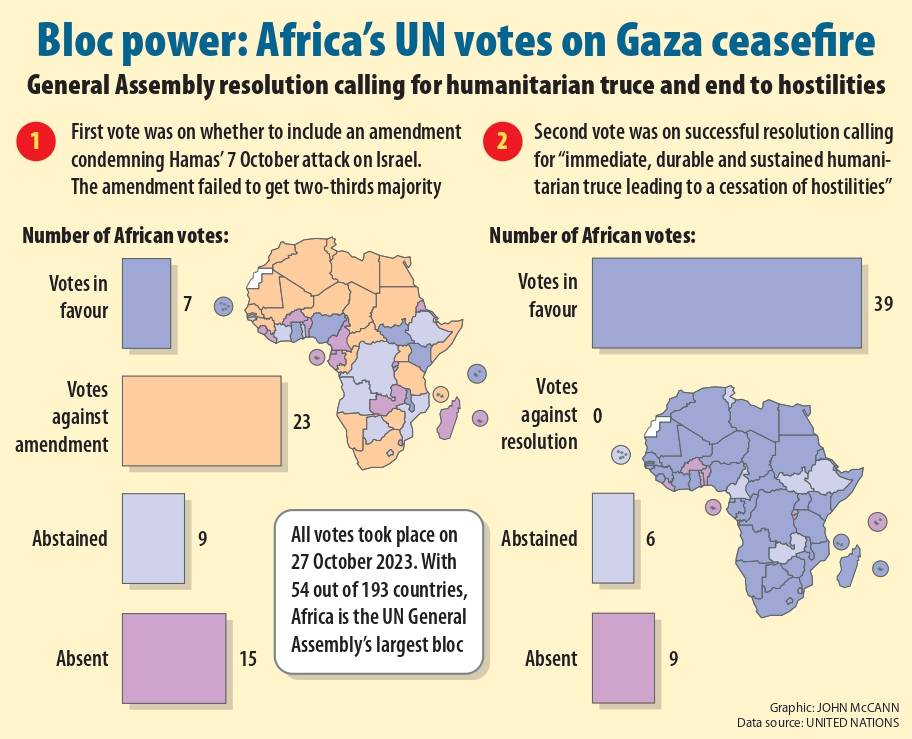
Agoa was taking place in this context, in a recalibrated international environment, in which a new cold war was turning increasingly violent and in which economic pressure on countries to take specific positions was increasing.
“Africa has been unable to position itself as a significant role player to influence any of these things. It has lost the moment,” Van Nieuwkerk said.
“Africa is not able to speak with one voice. The G20 accepting the AU as a member has been meaningless. The AU doesn’t have the ability to fight for the interests of the continent.”
The continent lacked unity and remained divided by history, colonialism and language, along with a lack of cohesion in collective regional diplomatic instruments.
Van Nieuwkerk suggested that instead of attempting to play a role on the international stage, the AU should “get its house in order” and focus on the conflicts on the continent first.
“Instead of flying to Ukraine to propose mediation, the AU should have stopped in Sudan, in South Sudan, in Mali, in the DRC and intervened first. Get your own house in order before going to Ukraine for mediation,” he said.
Until the AU found a way to cohere, to create continental stability and development, it would not have the ability — or the stature — to be able to talk business with the G20 as equals, he said.
The addition of more African states to Brics (Brazil, Russia, India, China and South Africa) was positive — along with the potential further growth of the bloc — as it brought the potential of access to new economic opportunities through working with the member states.
This also brought the risk of an “uneasy alignment” between democracies, such as South Africa, Brazil and India, and countries such as Russia and China, and new entrants including Saudi Arabia and Ethiopia, which might sabotage the potential benefits of Brics for African countries.
Van Nieuwkerk said the show of unity at the UN by African states in the vote in favour of a ceasefire in Gaza — none voted against it — was an indication of unity but was tempered by the understanding of African countries having been the victims of the violence of colonialism and occupation themselves.
Israel maintained a strong economic presence on the continent, supplying a number of states with defence and security technology, and its influence, interest and power “cannot be underestimated”, he said.
Political analyst Sanusha Naidu come under growing pressure through trade forums in a bid to influence what stance they take on international issues such as Gaza and Ukraine.
Countries were being increasingly “courted” at a time when there was a lack of a continental identity, which was crucial if a common stance was to be taken in multilateral forums and would allow the continent leverage, if not the ability to influence outcomes, on international issues.
The vote by African states at the UN was “significant” and was likely to bring countries under more pressure at forums such as Agoa, a pressure which would increase as Israel moved to consolidate its interests in Africa at a time when the narrative was shifting against it internationally.
Against this backdrop, there was a need for the AU to be “far more coherent, cohesive and emboldened” in its stance for the continent to exert the level of influence it needed to further its common interests in multilateral forums.
The post Africa fails to grasp the moment appeared first on The Mail & Guardian.

1A I’m a helluva ass to misunderstand this musical giant (4,9)
The post Cryptic Crossword 403 appeared first on The Mail & Guardian.
Submit and get free exposure here: Showcase Your Business | Advertise Your Special Offers.