The bleak, washed-out blue sky and pollution-smudged horizons are upon us in Johannesburg, and how we regret all the whinging that went with the many consecutive days of cloud-covered rainy days that we experienced not so long ago.
As we pile on the layers of clothing to deal with the first real cold front of winter, we know that it is only going to get worse. The sky will fade so much that it ends up looking like a pair of jeans that has spent many years being washed in the harshest washing powder. And these jeans are now being worn by an old-school mechanic who still believes in lying on a dirty floor to slide under cars to do repairs.
A white-knuckle ride on the highways with the deadly game of keep-right-pass-left playing out around you reveals a depressing vista. In the areas where there are fewer buildings are occupied by the toxic-looking remnants of mine dumps, some trees with bare brown branches and open veld with yellowed grasses often blackened by fires.
And without any hope of a cleansing afternoon downpour the smoke and pollution hangs heavy in the air.
The consequences of all this are severe damage to our mental and physical health. It might make for stunning sunsets but the shockingly polluted air plays havoc with our respiratory systems. Colds, fly, sinus problems and hacking coughs make the winter months unbearable.
And the relentless colour palette of dirty grey, brown and sickly yellow leave us longing to escape to somewhere where there are better colours on offer. The sparkling blue of the sea and the bright greens of lush vegetation.
Those fortunate enough to live in these more pleasant surroundings will sit back smugly and say we are suffering the consequences of choosing to make Johannesburg our home.
To “suffer the consequences” seems like such a quaint concept, something that our parents would say to us when we were irresponsible teenagers.
There are countless examples in the world we live in of people who don’t conform to the definition of “suffer the consequences. It means: “to accept and deal with the results of a particular action or situation, often ones that are bad or not convenient.”
We all know about the “bad” consequences but we also know that it is not the people responsible for this who are suffering. The thousands of children dying of starvation in Gaza are a particularly shocking example.
At a more local level there are many examples of “not convenient” consequences. As I sit at home writing this, our latest water outage has extended to more than 48 hours. Our ward councillor has posted a video of water gushing from a leak in a pipe in the neighbouring suburb that can only be described as resembling one of the sluice gates in the Vaal Dam being opened.
He thinks this “might have something to do” with our lack of water. May “bad” consequences rain down upon those responsible for the shocking state of our water supply.
Another “not convenient” situation is a result of traffic cops having a quota of traffic fines to fill and finding it much easier, and probably safer, to do this at a completely innocuous three-way stop in the suburbs.
There’s mayhem on the roads just a block away but a disproportionately large gang of cops prefer to lurk behind some parked cars and wait to pounce on law-abiding drivers who have dared not to come to a complete stop when making a left-hand turn at the three-way stop.
And even if you do come to a complete stop you are not safe. “Ah, Mr Stephen, you failed to stop with your wheels behind the line,” says the formidable woman in the tight uniform, just waiting for the slightest hint of irritation in my voice. Definitely “not convenient”.
Or how about the long list of consequences generated by the electricity problem? These have been well publicised for years but there are more minor ones that are “not convenient”, especially for my blood pressure.
All over Joburg there are spaghetti-like clusters of wires that indicate there are people enjoying free electricity from illegal connections. There are also many timid people in the suburbs who scrape together the money every month to pay their ever-increasing bill from City Power.
We know that complaining about the regular power interruptions won’t work and we dread having to become embroiled in a dispute over our bills. The mere mention of a visit to the offices in Braamfontein is more shocking than a week going by without a power outage.
So we always pay. You would think that as good “customers” we would be treated with some care and consideration. But, no, if the monthly payment is delayed, even by a day or two, an email arrives with the frightening heading “Pre-termination notice”.
You can bet those people with the long, drooping wires snaking into their homes don’t get “pre-termination notices”.
As the winter deepens with the days of sunlight getting shorter and the dark nights getting longer, as our skin dries out in the moistureless atmosphere and cries out for the application of expensive lotions, it is hard not to become resigned to the fact that the innocent suffer the consequences while the culprits carry blissfully on with their lives.
And then the human race overturns our assumptions once again. The Japanese minister of agriculture has resigned after saying, amid soaring food prices, that he doesn’t buy rice because he gets it for free
Police Minister Senzo Mchunu debunks Trump’s ‘white genocide’ claims in quarterly crime report:
While the police department does not categorise crimes by race, two of the farm owners who were murdered during the fourth quarter of the 2024-25 financial year were black, Police Minister Senzo Mchunu says.
Presenting the latest quarterly crime statistics, covering the period from January to the end of March, on Friday, Mchunu said there have been six farm attacks this year affecting two farm owners, one farm dweller, two employees and one manager. He said this was a decrease from 12 attacks during the same period last year, in line with a general trend downwards in crime.
The quarterly statistics come two days after President Cyril Ramaphosa led a South African delegation to the White House where US President Donald Trump ambushed him with false accusations of white genocide in South Africa, particularly on farms.
At Friday’s briefing, Mchunu said the term “genocide” has been forcefully introduced in the conversation about crime with false material circulated in the media and at the White House.
“We have respect for the USA as a country, we have respect for the people in that country and for President Trump, but we have no respect for this genocide story, at all. It is totally unfounded and unsubstantiated,” he said.
He said the pictures of crosses lining a roadside, used by Trump on Wednesday to back his accusations, flowed from a case in KwaZulu-Natal in which a farmer and his wife had been killed in their home in 2020.
“The incident sparked a very strong protest by the farming community. The crosses symbolised killings on farms over years, they are not graves,” Mchunu said.
“Three suspects were arrested and sentenced for their murder and they are in jail. This debunks the claim that nothing gets done when crime is committed.”
Mchunu also noted police’s rescue of an American pastor who was kidnapped in the Eastern Cape in April, with the suspects in that case also apprehended.
“We do not deny that the levels of crime in the country are high; we are very concerned. Crime cuts across all divides. We are currently intensifying the fight against crime and criminals,” he said.
Mchunu said there had been significant decreases in most crime categories during the quarter under review, although gender-based violence continued to be a concern.
Rape incidents increased in both Gauteng and KwaZulu-Natal, which contributed 19.1% and 19.9%, respectively, to the national total, while the rest of the provinces recorded decreases.
“While we acknowledge that GBV+F [gender-based violence and femicide] affects all genders, women remain disproportionately affected by rape, assault GBH [with grievous bodily harm] and murder,” Mchunu said.
“Our resolve to fight GBV+F is unwavering. To this end, the justice, crime prevention and security cluster [in the cabinet] has launched a 90-day GBV+F blitz, which began on 1 May.”
Only Northern Cape recorded an increase in murders to 12% of the national average while the high-crime provinces such Gauteng, KwaZulu-Natal, Western Cape and Eastern Cape, recorded slight dips.
Mchunu said 22 police officers, six who were on duty and 16 who were off duty, were killed during the first quarter of the year, 10 of them in Gauteng.
Since the start of the year, 178 757 suspects have been arrested, said Mchunu, adding that while the prison population was over maximum capacity police kept making arrests, which led to imprisonment.
Illegal possession of firearms and ammunition remained one of the police’s most pressing issues, with a 2.7% increase and 4 023 cases. Police destroyed 16 049 firearms in February and confiscated 1 641 illegal firearms and 24 288 rounds of ammunition during their Operation Shanela drive.
Gauteng recorded the highest level of corruption-related commercial crimes at 12 074, followed by the Western Cape at 7 244.
Stock theft fell 8.9% during the quarter, which Mchunu attributed to a meeting in the Free State attended by farmers from across the country. He highlighted a police operation in the Eastern Cape where 231 cattle worth R2.7 million, 81 sheep worth over R160 000 and 78 goats valued at over R150 000 were rescued in different parts of the province.
He said the National Policing Policy approved by cabinet in May, following an inaugural police summit, would address professionalism and community engagement.
Mchunu rejected media reports of rampant land grabs but said that sporadic unlawful land invasions did occur as a result of inequality.
“Land invasions are not government policy but are, by and large, acts of desperation for land by African people who find themselves landless and in need to settle,” he said, adding that land invasions warranted the country’s expropriation policy to address the problem in a lawful and orderly manner.
Mchunu said Rural Development and Land Reform Minister Mzwanele Nyhontso would clarify the issue of land invasions next week.
“I do want to urge the public to exercise caution when consuming and sharing information, especially on social media platforms, where old or recycled news stories are often circulated to create panic,” Mchunu added.
The case of the minister and the HIV activists: Are we entering denialism 2.0?:
In the leafy office park not far from Charlotte Maxeke Johannesburg Academic Hospital, you’ll find them just past the security boom. Dozens of vehicles, leftovers from what were once busy, purposeful operations, sitting under the Highveld sun. Engines dead and tyres flat.
A few months ago, these brightly painted trucks and trailers emblazoned with Pepfar and USAid logos were on the move — part of a push to take HIV services to groups of people that government clinics often didn’t reach. But that was before US President Donald Trump abruptly stopped all Pepfar funding for HIV and TB projects which reached South Africa through the United States Agency for International Aid, USAid, in February.
The rainy Jozi summer and months of doing nothing have left rust spidering from cracks and leaves piling up on windscreens. Parked in a neat row, vehicles from one such organisation, the Anova Health Institute, the nonprofit in South Africa that received the most money from the US government’s Aids fund, Pepfar, have plastic tape strung between them, flapping in the wind like something out of a crime scene.
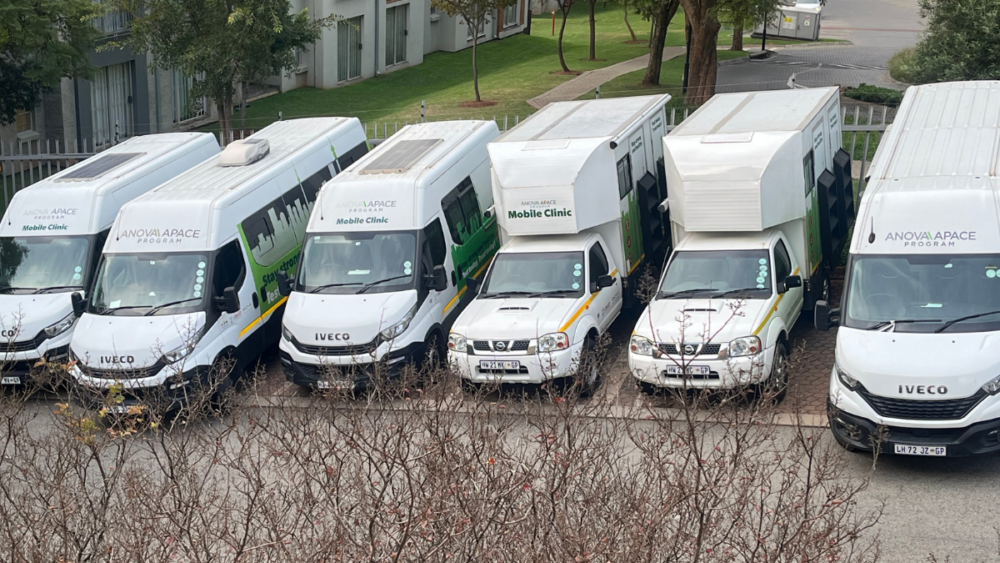
The parking lot is a metaphor for the crisis that has pitted the government against HIV activists and researchers, who warn we’ve entered another era of denialism, courtesy of the Trump administration.
At a press conference last week, Health Minister Aaron Motsoaledi gave a public tongue-lashing to the media, activists and researchers, accusing them of making an “AfriForum-style” scene to “spread disinformation”.
But unlike his predecessor, Manto Tshabalala-Msimang, who denied the link between HIV and Aids and propagated false cures such as beetroot and garlic, Motsoaledi is a man of science and evidence-based treatment.
In his first round as health minister, between 2009 and 2019, he reigned over the roll-out of what has since become the world’s largest HIV treatment programme. And in February, he launched another campaign, to find and treat 1.1-million people who know they’re HIV positive but are not on antiretroviral treatment (ART), by December.
But a day after the “Close the Gap” project saw the light of day, on February 26, all hell broke loose when the Trump administration pulled its funding for just over half of the US government-funded projects that would have helped the health department to achieve its HIV goals. The rest of the US-funded programmes will probably all end in September, at the end of the American government’s financial year.
Activists warn they’ve since seen a horrifying, fast-paced crisis playing out with ever increasing numbers of people skipping their HIV treatment, or not using prevention methods, because NGO clinics have closed.
They say they fear the collapse of the HIV programme they — and the minister — fought so hard for.
But Motsoaledi says activists are effectively lying because US government funding comprises only 17% of the country’s HIV budget of R46 billion.
“I want to state it clearly that propagating wrong information about the start of the HIV and Aids campaign in South Africa, in the matter that it is being done, is no different from the approach adopted by AfriForum and its ilk which led Trump to trash the whole country,” Motsoaledi, who is attending the World Health Assembly in Geneva this week, lashed out at the media at a press conference on May 15.
“I am saying so because we have already been phoned by the funders we have spoken to, who are asking us, why should they put their money in the programme that is said to be collapsing. Is their money going to collapse together with the programme?”
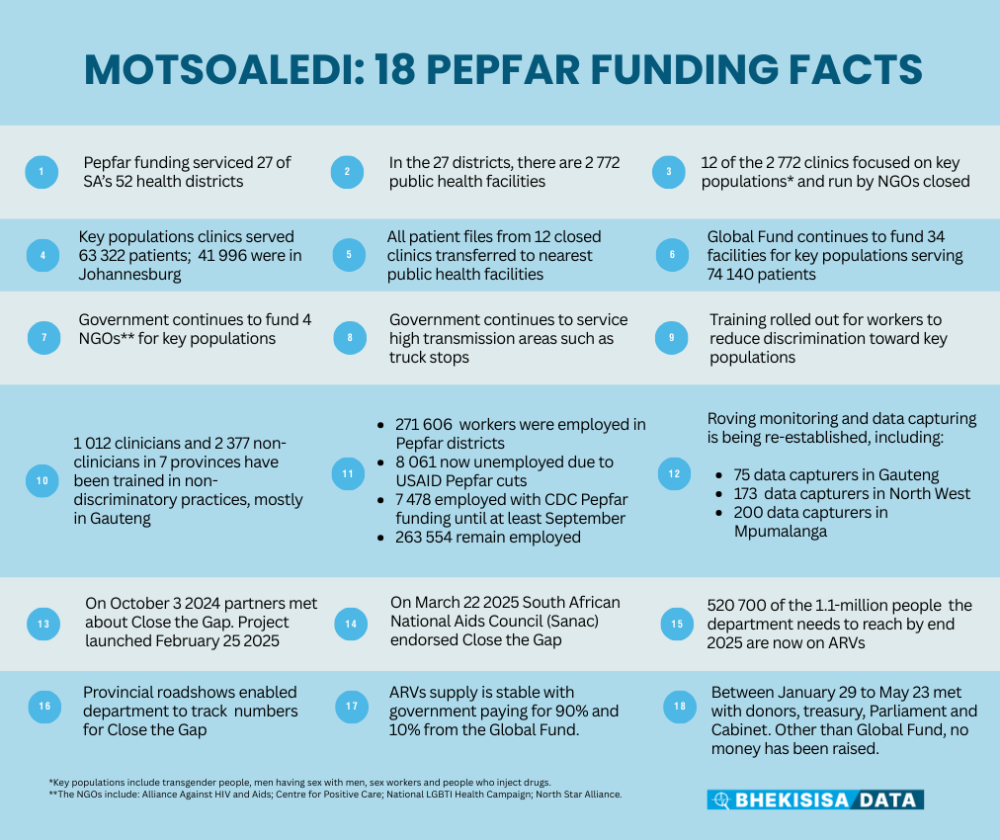
Other than an extra R1 billion from the Global fund for HIV, TB and Malaria, not a cent has been raised to replace US funds.
“The minister is in denial that there’s a crisis at all,” cautions Fatima Hassan, a lawyer who played a crucial part in the early 2000s to force the government to give people with HIV free ARVs, and who now heads the Health Justice Initiative. “We have been here before. No amount of finger pointing will save lives — only urgency, evidence, partnership, proper planning and resources will.
“Once again, South Africa will have to deal with the harmful public health consequences of not just the Trump administration, but also our own government’s failure to adequately plan for months now.”
Sex worker
Back in the parking lot, known as the Isle of Houghton, the Anova Health Institute’s six mobile clinics are standing idle.
Over the past three years, they’ve been used to test between 4 000 and 6 000 people each month for HIV in Gauteng — and to put those who tested positive onto ART treatment — in areas where government clinics are either too far from people’s homes to easily walk to or to reach people, such as teenagers or gay and bisexual men, who might face snickering neighbours or dismissive health workers at state facilities when they ask for condoms or HIV tests.
The US government is allowing Anova to keep only two of its mobile clinics and even those they can’t use because they no longer have money for staff to run them, says one of the institute’s public health specialists, Kate Rees. Since the funding cuts, Anova has had to stop almost all its work helping the government’s district health services to test and treat people for HIV and to hand out anti-HIV pills to prevent infection.

The stop-work order is already being felt in the data — March 2025 health department figures show that 30% fewer people took up ART in the City of Johannesburg than in March 2024, says Rees.
Johannesburg is one of the 27 health districts where Pepfar funded programmes. Among these were 12 clinics, across the 27 districts, with tailor-made HIV services for sex workers, transgender people, men who have sex with men and injecting drug users, groups with a much higher chance of getting HIV than the general population.
But because of population density, of 63 322 clients these clinics served, 41 996 — two-thirds — live in Johannesburg, Motsoaledi explained at the press conference.
WATCH THE HEALTH MINISTER’S PRESS CONFERENCE
As all these programmes have been shut down, people who got their treatment there, collected free condoms, lubricants or anti-HIV medication, now have to go to state clinics.
Motsoaledi says all the patients’ files have been transferred to the nearest government facility. But many have told Bhekisisa they’ve been refused services — often because government nurses tell them they don’t have transfer letters or they “don’t deserve to be helped”.
The HIV advocacy organisation Treatment Action Campaign and national sex worker movement, Sisonke, confirmed many more such experiences on a webinar hosted last week by Bhekisisa and the Southern African HIV Clinicians Society.
Motsoaledi says 1 012 clinicians and 2 377 non-clinician workers at government health facilities, most of them in Gauteng, are being trained to make key populations feel more comfortable to visit state clinics for HIV services.
But the health department has, in fact, been busy with such training for years, the former acting head of HIV in the health department, Thatho Chidarikire, told Bhekisisa’s TV programme, Health Beat in May 2023.
Despite that, severe discrimination against transgender people and sex workers persists, surveys by the Ritshidze group have shown.
One sex worker, who is pregnant and fearful she will transmit the virus to her child, told Bhekisisa this month: “I have defaulted on my ART for two months now. I have tried to go to a public clinic, but I wasn’t helped.
“Sex workers are seen as dirty people who go and sleep around. We even struggle to get condoms. People like me are now forced to do business without protection because it’s our only source of income and it’s the way we put food on the table.”
People on ART
Data commissioned by the health minister himself backs up HIV activists’ and scientists’ fears about the potential impact of US funding cuts on South Africa’s HIV programme.
One such modelling study shows that if South Africa fails to replace the Pepfar funds the country has lost, we might see between 150 000 and 295 000 extra new HIV infections over the next four years (in addition to the estimated 130 000 new infections we already have each year) and up to a 38% increase in Aids-related deaths.
With Pepfar data, the health department calculated it needs an extra R2.82 billion to get through the financial year and the minister’s own staff — including Nicholas Crisp, the deputy director general in the national health department who made the sums — told Bhekisisa in April without replacement funds, South Africa’s HIV programme would be “unsustainable.”
But at his press conference, Motsoaledi announced that the health department has, in fact, made what HIV scientists like Ezintsha head Francois Venter describes as “inconceivable” progress with getting people with HIV who stopped treatment, back onto their pills.
According to the minister, government health workers have managed to find close to half — 520 700 — of the 1.1 million people with HIV that they’ve been looking for and put them on treatment.

But, explains Anova’s Rees, those numbers are incredibly misleading.
“The minister didn’t subtract the number of people who were lost from care — those who stopped treatment or died — from the people with HIV who started or restarted treatment. If that was the number we were interested in, we would have reached our targets years ago,” Rees says.
She says that’s part of the reason why South Africa’s total number of people on ART has been lingering between 5.7 and 5.9 million for the past two years.
“Because of people who fall off treatment, we’re seeing static programme growth. So we’re not seeing significant increases in the number of people on treatment overall. That means that although the 500 000 people they say they’ve now put onto treatment may have been added to the treatment group, another 500 000 who had already been on treatment could very well also have stopped their treatment during this time. In many cases, it’s possibly the same people cycling in and out of treatment.”
The health department’s struggle, even with US government funding, to keep people on HIV treatment throughout their disease is also reflected in the second “95” of the country’s 95-95-95 goals. With the aim to stop Aids as a public health threat by 2030, these UN targets require us to, by the end of this year, have diagnosed 95% of people with HIV, have put 95% of diagnosed people onto ART and to make sure those on treatment use their pills each day, so that they have too little virus in their bodies to infect others (scientists call this being “virally suppressed”).
Right now, the minister said at his press conference, South Africa is at 96-79-94, which means we’re struggling to get people who know they’ve got HIV onto treatment, or to prevent people who are on treatment, from defaulting on drugs.
Covid vs the funding crisis
So how did South Africa get to a point where the health department and HIV scientists are yet again at loggerheads?
Not so long ago, on 5 March 2020, to be precise, shortly after South Africa’s first SARS-CoV-2 infection had been confirmed, then health minister Zweli Mkhize put the epidemiologist Salim Abdool Karim live on national TV. The scientist’s task was to explain to the nation what we knew about the unfamiliar new germ — the cause of Covid-19 — that was already causing havoc in the country. For two hours that evening, the nation sat glued to their TV screens to listen to science; an unthinkable scenario a few days before that.
Abdool Karim could do something Mkhize couldn’t — break down the cause of Covid, and where we were headed, in language everyone could understand. People were desperate for information and the government used experts — of which there were many — to keep South Africa up to date.
The important thing was that Abdool Karim wasn’t working for the government. He did chair the Covid ministerial committee, but, like the other scientists who served on it, he wasn’t a government employee.
He and others were merely people whose skills the health department was prepared to draw on — ironically, most of these were also HIV scientists, the same people who today feel they’re being snubbed by the government.
“We saw amazing leadership during Covid,” says Linda-Gail Bekker, an HIV scientist who heads the Desmond Tutu Health Foundation and was a co-chief investigator of the J&J Covid jab in South Africa. “[Because of the leadership], private funding followed. But we’re not seeing it this time around. My concern is it doesn’t feel like anyone [in the health department] is in charge.”
It’s not surprising Bekker feels this way.
The deputy director general position for HIV and TB has been vacant for five years, empty since Yogan Pillay, who now works for the Gates Foundation, left the position in May 2020. Health department spokesperson, Foster Mohale, says interviews for the position only started in the past few months.
Information hard to get
During the pandemic, there were daily press releases, vaccine dashboards and almost daily meetings with experts on the Covid ministerial committee. Now, other than the odd press conference, information that should be public, or opportunities for the government to respond to media or doctor’s questions — is non-existent.
We’ve seen that first hand at Bhekisisa. When we co-hosted a webinar on 8 May with the Southern African HIV Clinicians Society, we invited the acting deputy director general, Ramphelane Morewane, to answer clinicians’ and journalists’ questions. His office told us he was on leave in the days prior to it, but “would definitely be there”.
But Morewane didn’t turn up, no one was sent in his place, and no one explained why the health department couldn’t make it.
As a journalist during Covid, I had the numbers of people like the deputy director general in charge of vaccines on speed dial. This time around, I’m struggling to get mere copies of important government circulars, like the one that instructed government clinics how to hand out ART for six months at a time, and who qualifies for it.
HEADING: FIRST TAKE: THE HEALTH DEPARTMENT’S FEBRUARY CIRCULAR WITH INCORRECT GUIDELINES
Eventually, I got the first version through a non-government contact, but the health department had included incorrect guidelines for six-month dispensations. I’ve asked Morewane for the corrected circular several times, as well as the health department spokesperson and even the deputy director general, Sandile Buthelezi, whom I’ve always found helpful.
I’ve received nothing.
Why a corrected government circular that will help to clear up confusion has to be kept a secret is a mystery to me, and many of the doctors whom I’ve spoken with feel the same way.
It’s as if government decision-makers now regard the scientists and activists the health department worked with so well during Covid as enemies, rather than allies, some experts say.
“We need to all put our minds together in a room and work out what are our best buys and how do we get those out to people who need it the most,” explains Bekker. “The government can’t solve this problem on its own.”
The head of the Southern African HIV Clinicians Society, Ndiviwe Mphothulo, concurs: “History tells us the reason our ART programmes have been so successful is because the government worked with civil society. People who won’t learn from history, repeat the mistakes from history.”
Transwoman: ‘I couldn’t even get condoms’
Back in Hillbrow, close to the parking lot with the now unused mobile clinics, a young transwoman is considering buying her ART pills on the black market. By the end of May, the three-month supply of ART she got from the US-funded Wits Reproductive Health Research Institute clinic, which closed down in February, will run out.
“I’m anxious and depressed, each day,” she says. “At the Wits clinic, I got my treatment without being made fun of and I got self-testing kits for my sexual partners. But, most importantly, I could get mental health for free.
“My friends visited the government Hillbrow clinic the other day. I couldn’t even get condoms, let alone treatment.”
Additional reporting by Anna-Maria van Niekerk. Graphics created by Zano Kunene and Tanya Pampalone.
This story was produced by the Bhekisisa Centre for Health Journalism. Sign up for the newsletter.
Submit and get free exposure here: Showcase Your Business | Advertise Your Special Offers.