Crocodile hunting wanes but legends live on in DRC:
The fearsome slender-snouted crocodile can make torch lights explode just with its eyes — so the legend goes in the Democratic Republic of the Congo.
Along the Congo River, such myths stay with the Banunu fishermen, even if their traditions and livelihoods are not what they once were.
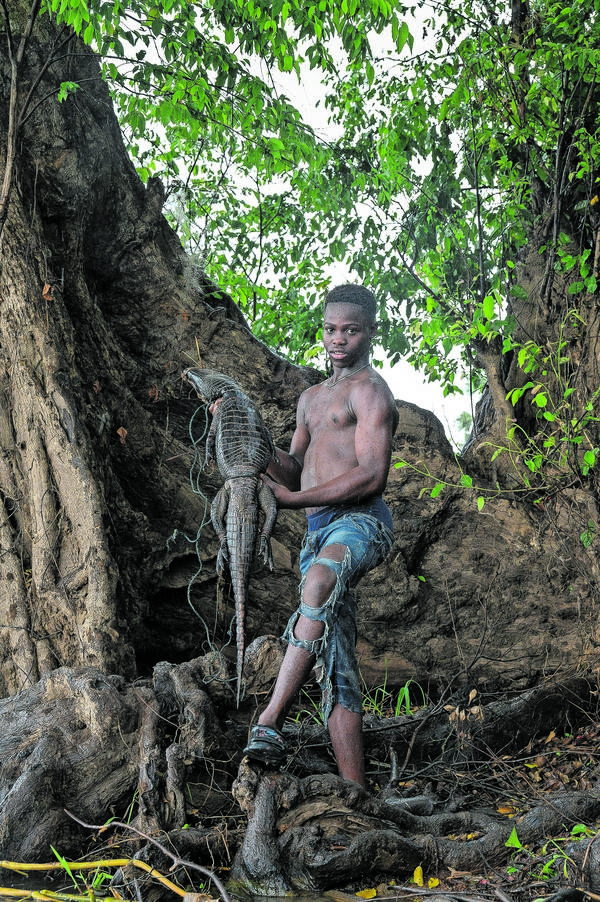
Michel Koko, known as Lebe, has been a fisherman for 10 years, following in his father’s footsteps. His hunting successes include crocodiles of all sizes, monitor lizards and many kinds of fish.
At 4?700km, the Congo is the second-longest river in Africa after the Nile. Koko is Libinza, a tribe related to the Banunu-Bobangi who, since the 18th century, have lived on the banks of the river in northwestern Equateur province and Mai-Ndombe province near the capital, Kinshasa.
The tribe is known for its extraordinary fishing and hunting superstitions.
“My father left me his spear,” Koko said, convinced this is why he almost never misses his target.
Banunu fishermen inherit spears and ancestral totems believed to have spiritual significance. Their elders also bequeath them their “clairvoyance”. With the help of palm wine, makasu kola nuts or mondongo bush fruits, they say they can see into the future.
“If they see only death, they won’t hunt that day,” Koko says.
He is in Mbandaka, the capital of Equateur province and about 700km upstream from Kinshasa.
Koko has a deep knowledge of crocodiles. He knows how to communicate with them, attracting them by imitating their cries, he said.
The “mbama” crocodile with a long snout responds by pouring water out of his mouth.
“That’s the moment to deliver him the fatal blow,” Koko said.
But, with the short-snouted “ngando”, it is more complicated.
“You have to position yourself in the middle of the pirogue because he can appear from anywhere,” the hunter continued.
The animal possesses “infrared vision” and can deliver an electric shock, he said.
“If a crocodile bites you, it is important not to scream,” Koko warned. “If you say nothing, he will think you are a tree trunk and let go.”
At the age of 91, Papa Baron Missiki reminisces about his days hunting crocodiles, as well as buffalos, antelopes, elephants and hippopotamuses.
He is now retired but his son, also called Missiki, keeps up the tradition.
With pride for their community and their experience, the fishermen become nostalgic recounting their tales from years gone by.
Koko remembers a time when crocodile hunting was lucrative, back when the DRC was known as Zaire from 1971 to 1997.
President Mobutu Sese Seko was in power and crocodile skin was sought after for its supposed miraculous qualities such as protecting families against evil spirits, but also for use in the fashion industry.
“We would leave to go hunting with bags of salt in the pirogue to ensure the conservation of their skin,” Koko said. “It was like gold at the time, we didn’t care about their flesh.”
Nowadays, the selling of wild crocodile skin “is forbidden” to preserve the species, adds the fisherman.
He says animal numbers have dwindled on the river, which he puts down to overfishing, climate change and increased numbers of motorised boats on the waterway.
“We can only hunt the dwarf crocodile called ngokia and sometimes the monitor lizard known as the mbambi,” Koko said.
“Seeing how easily dwarf crocodiles reproduce, it is impossible this species will disappear.”
To keep their heads above water financially, the fishermen take up jobs in local businesses, trade or invest in fish farming.
“How do we live without selling wild animals?” asked Lucie, a vendor at Lingunda market in Mbandaka.
“It enables us to pay for the children’s school, the rent, and everyday life.” — AFP
Ford Ranger Wildtrak: Workhorse – and a weekender: The Ford Ranger Wildtrak SuperCab delivers practicality and comfort
Reflecting on Karl Marx’s legacy in Africa on his 206th birthday:
Karl Marx was born on 5 May 1818, in Trier, Germany, to a middle-class family of Jewish ancestry. His father, Heinrich Marx, was a lawyer and his mother, Henriette Pressburg, descended from a long line of rabbis. His family converted to Christianity when he was six years old because of intense anti-Semitic sentiments.
Marx displayed exceptional academic abilities from a young age. But it was at the University of Berlin where Marx’s intellectual journey truly began. Under the influence of prominent philosophers such as Georg Wilhelm Friedrich Hegel and Ludwig Feuerbach, Marx developed his dialectical materialist worldview, laying the groundwork for his later works on political economy and socialism.
In 1842, Marx moved to Cologne, where he became editor of the Rheinische Zeitung, a liberal newspaper. It was during this time that he first encountered Friedrich Engels, with whom he would form a lifelong intellectual partnership. It was during this period that Marx covered the story of the passing of the Wood Theft Laws in the Rhine Provincial Assembly and drew one of his more important conclusions in relation to the law and the poor. The law effectively sought to classify the collecting of fallen wood as theft.
Marx wrote: “The law is not exempt from the general obligation to tell the truth. It is doubly obliged to do so, for it is the universal and authentic exponent of the legal nature of things. Hence the legal nature of things cannot be regulated according to the law; on the contrary, the law must be regulated according to the legal nature of things. But if the law applies the term theft to an action that is scarcely even a violation of forest regulations, then the law lies, and the poor are sacrificed to a legal lie.”
Through a series of articles Marx exposed the mutually dependent relationship between the newly developing bourgeois legal system and capitalist advancement. Analysis that began with a specific issue in Germany would come to mark the skewed nature of law in the service of the elites globally.
In 1848, Marx and Engels co-authored The Communist Manifesto, a seminal text that would come to define the principles of modern communism. It was written into the tumult of a wave of revolutionary uprisings across Europe and aimed to speak to and for struggle from within struggle. The manifesto called for the overthrow of capitalist society by the working class and the establishment of a classless, socialist society.
After the publication of the Communist Manifesto Marx was forced into exile, first in Brussels and later in London. Despite facing financial hardship and political persecution, he continued his intellectual and political militancy. He devoted himself to the study of political economy, producing his most significant work, Das Kapital, which analysed the capitalist mode of production and its inherent contradictions. Das Kapital, first published on 14 September 1867, is one of the most influential works in the history of economics and political philosophy, which provides a comprehensive analysis of capitalism and its inherent contradictions.
From the 1880s onwards, and less than 15 years after the publication of Das Kapital the earliest roots of socialism as an organising force emerged in South Africa among mineworkers on the Witwatersrand. British imperialism had brought capitalism to South Africa and, inspired by the labour movement in Europe, many mine workers began organising under the banner of socialism, beginning what would become one of the main pillars of struggle, not just in South Africa, but across the continent.
In West Africa the giant of African liberation, Kwame Nkrumah, was deeply influenced and inspired by Marxism as a method when he wrote Class Struggle in Africa. In this classic in the canon of African political thought Nkrumah he showed that while Africa straddled both the feudal and industrial world, and was very diverse, Africa, like the rest of the world, had at its core a class struggle. This, he argued, meant that the African revolution was at the centre of the global socialist revolution.
He wrote: “One of these distortions has been the suggestion that the class structures which exist in other parts of the world do not exist in Africa … In essence it is, as the rest of the world, a struggle between the oppressors and the oppressed. The African Revolution is an integral part of the world socialist revolution, and just as the class struggle is basic to world revolutionary processes, so also is it fundamental to the struggle of the workers and peasants of Africa.”
Marx’s critique of imperialism and neo-colonialism were critically important to many other African radicals. This critique is not, as the liberal bloc in our public sphere would have us believe, dated. Questions of economic sovereignty and justice are no less urgent than in the past.
Western powers and multinational corporations continue to exploit Africa’s natural resources, exploit its labour, and perpetuate dependency through unequal trade relations and debt burdens. Marxism, as an ongoing theoretical practice advanced by great thinkers like Rosa Luxemburg, Vladimir Lenin, Amilcar Cabral and Walter Rodney, offers potent tools for understanding how capitalist exploitation perpetuates underdevelopment and dependency in Africa and conceptualising alternatives that prioritise the flourishing of the people over the profits of the few.
From the anti-colonial struggles of the mid-20th century to contemporary movements against dictatorship and neoliberalism, Marxists have been at the forefront of the fight for true freedom and equality across Africa. In countries such as Ghana, Angola, Mozambique and Guinea-Bissau and the Cape Verde Islands Marxist-inspired liberation movements fought against colonial rule ultimately achieving independence and laying the groundwork for socialist development.
This history of African Marxism, in theory and practice, has largely been forgotten as liberalism has become hegemonic among many academics, journalists, NGO workers and students. Radical ideas and practices have been disparaged as dated and dangerously utopian while liberalism, which continues to oppress most Africans, has been normalised, often with the support of Western funding for universities, NGOs and media.
But across the continent there are growing organisations and networks of radicals challenging the hegemony of liberalism. From Ghana to Kenya and Swaziland radicals, often young people, are returning to the revolutionary classics — to thinkers such as Cabral and Rodney as well as, of course, Karl Marx.
Internationally the radical tradition is more vital than it has been in a long time and thinkers like Angela Davis and Ruthie Wilson Gilmour who draw, among other sources, on the Marxist tradition are avidly read by many people. As the brave students who are opposing the Israeli genocide in encampments and protests across the United States show us the era of struggle is not over. As Western imperialism reveals itself in all its horror in Gaza there is a new call to conscience across the world, a new refusal of liberalism and, among many, a new engagement with the radical tradition, and with Marx, a great thinker without whom modernity cannot be understood.
Dr Vashna Jagarnath is a historian, labour activist and educator.
Submit and get free exposure here: Showcase Your Business | Advertise Your Special Offers.