
DA calls for ANC top seven to be arrested for contempt of court:

A precedent has already been set by former president Jacob Zuma’s contempt of court order, opposition MP Siviwe Gwarube said
Europe records drop in fossil fuels. Africa should do so too:

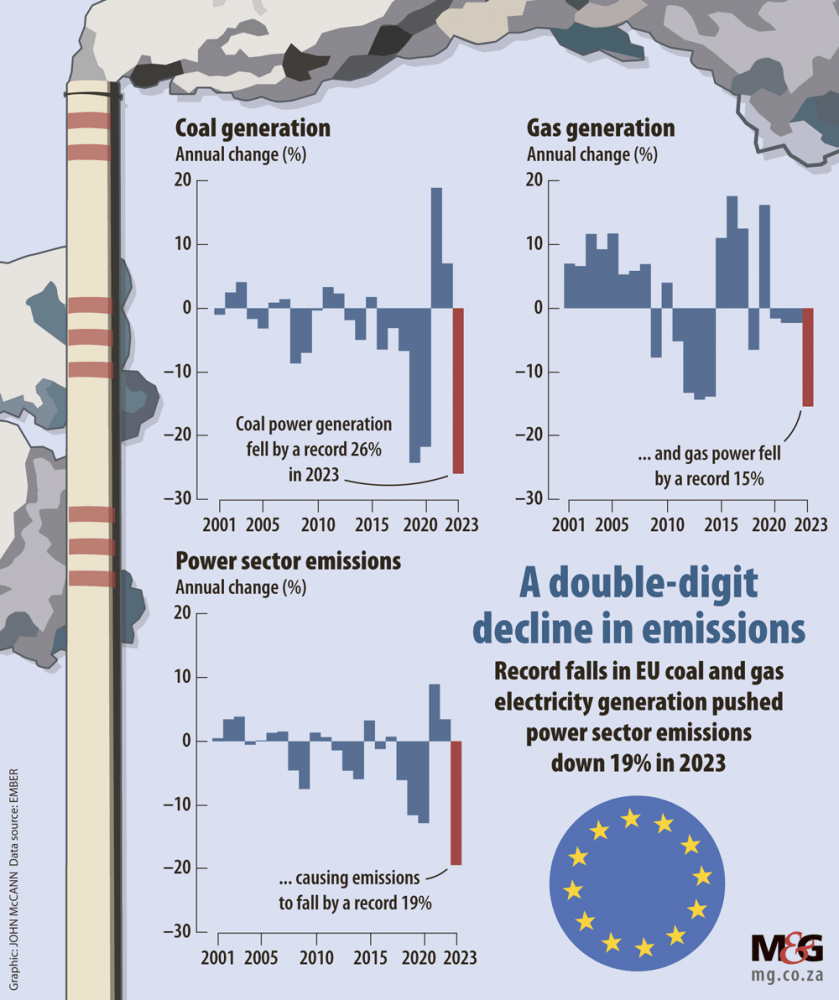
European countries marked a major change in the source of electricity in 2023, with a significant drop in energy produced from coal and gas while that from solar and wind surged.
According to the European Electricity Review published recently by think-tank Ember, fossil fuels dropped by 19% and made up less than a third of Europe’s power for the first time. Coal displayed a major drop in generation and makes up only 12% of Europe’s electricity generation. Wind and solar contributed 27% to the European Union’s electricity.
Naturally, this led to a reduction in emissions.
There was also a drop in electricity demand, which could partially be attributed to warmer weather experienced in the region last year. But electricity grids and storage increased, which helped facilitate this renewable energy growth.
Linda Kalcher, the executive director of Strategic Perspectives, a pan-European think-tank that promotes effective climate action, said in a statement that she believes decarbonising by lowering fossil fuel use and increasing renewable energy in this way is crucial for future economic prosperity.
“Europe is building up the power mix of the future. Fossil fuels are on their way out and renewable energy is on the rise. This means a more secure and affordable access to electricity for citizens and industry, making the EU a top competitor in the zero-carbon industrial era. The trends outlined by Ember confirm that Europe has what it takes to ace the transformation needed from here to 2040 and reap its benefits.”
Bruce Douglas, the chief executive of the Global Renewables Alliance, said the growth in renewable energy must increase and not be allowed to slip.
“This report shows the power of renewables — replacing gas and coal on the grid — with wind generating more electricity than gas in the EU for the first time ever. However, it’s vital that the EU urgently removes barriers to faster expansion. This means redirecting financial flows, fortifying supply chains, streamlining permitting processes and modernising grids.”
The report is contrary to people in South Africa’s energy space who argue that Europe is returning to fossil fuels following Russia’s invasion of Ukraine. People such as Minister of Mineral Resources and Energy Gwede Mantashe have been quoted extensively in the media using Europe as an example of why South Africa needs to stick to coal.
“The energy crisis and Russia’s invasion of Ukraine did not lead to coal and gas resurgence — far from it,” said Ember’s Europe programme director, Sarah Brown. “Coal is nearing phase-out, and as wind and solar grow, gas will be next to enter terminal decline.”
African countries do not have anywhere near the same finances or technology as their European counterparts. Western countries, which have contributed to the climate crisis, need to help the continent achieve the transition from fossil fuels to renewable energy through support mechanisms such as training, funds and technology.
Wangari Muchiri, the Africa director of the Global Wind Energy Council, said in a statement: “It is encouraging that Europe is leading the way in decarbonising the power sector, and that wind power has surpassed gas in the EU’s electricity generation. We need that leadership to trickle down to Africa in the form of finances and technological transfer into the continent’s vast renewable energy potential. Africa has the potential to become a global leader in sustainable energy, with enough capacity to foster its energy sovereignty and export the surplus.”
Recent reports that the world breached 1.5°C in the year starting February 2023 to the end of January 2024 should be a wake-up call.
It is not a complete disaster yet because that threshold needs to be cleared for several years, but it is an eye-opener. In South Africa the transition to renewable energy needs to happen with full transparency, dialogues, timelines and cohesive plans implemented in a way that protects livelihoods.
The Integrated Resource Plan, South Africa’s energy blueprint, in its current form scales down the shift to renewable energy. As the Mail & Guardian reported (“Revised Integrated Resource Plan needed ‘ASAP’, 9 January 2024): “Among the contentious elements of the draft IRP is that the plan appears to roll back the amount of wind and solar energy that will be procured compared to the 2019 iteration. The 2023 plan suggests that only 8 083 megawatts of new wind and solar capacity will come online from 2024 to 2030, while the IRP 2019 suggested 15 200MW of wind and solar would be installed during this period. The draft IRP 2023 also sets out the installation of far more gas generation capacity than was envisioned in the 2019 plan.”
Renewable energy needs to be enabled to flourish. The grid needs expanding, and technology such as batteries, solar and inverters need to be rolled out. Through appropriate financing, it is possible to achieve cleaner energy for all that doesn’t come at the cost of livelihoods.
A report by Climate Analytics, a global climate science and policy institute, found that for sub-Saharan Africa to meet energy demands and reach climate targets there needs to be a $ 100 billion a year in investments in renewable energy.
Africa must not be left behind in the shift to renewable energy, something Amos Wemanya, an energy leader at Power Shift Africa, feels strongly about.
“The continent’s renewable energy potential is enormous, yet it accounts for only 10% of the continent’s electricity generation mix, and only 20% of the total installed electricity generation capacity in Africa in 2019. The problem has always been the meagre financial flows which must be corrected through a radical reform of the financial architecture.”
It’s all Mercedes-Benz, just electric:

One can argue that electric cars are endemic to premium brands. Think about it. Almost every premium car manufacturer has one, or a few, voltage-powered cars in its arsenal and I reckon that there’s method in this madness.
At least this was the case a decade ago and it accelerated after the EU’s announcement to ban ICE (internal-combustion engine) cars by 2035.
Of course, this hasty move seems to be catching up with the industry.
Car manufacturers have poured a great deal of investment into EVs but it is now evident that they comprise only 30% of the total vehicle market, which is in stark contrast to many manufacturers’ forecasts for their respective model ranges.
One of the biggest challenges remains charging infrastructure, which in South Africa is still rather sporadic, if you intend to travel slightly longer distances, something that is more than likely for the average motorist.
The relatively high capital outlay for EVs compared to conventionally powered vehicles is another significant obstacle and their high depreciation rate makes it worse.
The latter can be attributed to the low demand for EVs in general.
Another aspect we rarely chat about is the degradation of the batteries, depending on use.
Much like that in your smartphone, the performance of EVs’ batteries diminishes with age, changes in ambient temperatures, etc. It is something you ought to be mindful of, particularly if you are considering buying a used EV.
That said, we managed to spend some time behind the wheel of the Mercedes-Benz EQE 350+ SUV, which takes the fight to the Audi e-tron 55 S-line, BMW iX xDrive 50 and, to an extent, the Jaguar iPace.
The Jag is the oldest vehicle here, having been launched in 2019, and I have it on good authority that the current model will remain on sale for a little while longer before we see a replacement — if we do at all.
Back to the EQE 350+ SUV, though, and it is obvious the Stuttgart marque has taken a cookie-cutter approach to its EQ SUV range.
I did a double-take after taking delivery of the EQE as it looked uncannily similar to its EQS SUV sibling, right down to the front and rear styling, not to mention the cabin.
It is great for economies of scale for the brand but the range does lack distinction for the onlooker.
That said, the styling is fairly consistent with the rest of the current Merc design brief, with the blacked-out “grille” being the only telltale sign this is the electric model in the lineup.
There are mostly rounded surfaces, probably in the interests of efficient aerodynamics, while the AMG Line does add some elegant, if not entirely sporty, undertones to the package.

Hopping into the cabin, you are met with the intergalactic architecture that we experienced in the EQS SUV and EQE 43 and this one easily ranks among the classiest of the German triumvirate.
It is fairly airy and minimalist in its approach, with very little in the way of physical inputs, instead opting for the haptic variety. Thankfully, these are kept mostly on the steering wheel but they are fiddly to use.
Hopefully, the firm can return to physical buttons, which are not only better for functionality, but also add a tactile feel to the vehicle.
Most of the vehicle’s functionalities are embedded in the infotainment screen, which remains intuitive to use and has huge, but uncomplicated, depth to the various functions.
Space comes in spades for both the interior and the boot side, the latter yielding a 520-litre cavern to swallow up luggage and groceries and some awkward oddments.
You can stretch it to 1?675 litres with the rear seats folded forward, which is handy for those long items, such as curtain rails, golf clubs and fishing rods.
So, the EQE SUV has the practicality aspect thoroughly licked.
Powering this e-mobile is an 89?kilowatt-hour battery that is good for around 460km on a full charge.
This is very good when compared to the BMW iX and trounces the Audi e-tron, in which we battled to eke out more than 350km.
Charging at a 60kW DC charger from 25% to full took close to two hours, which is quite a lengthy period but, then again, I did run the battery down in the interests of credible, consumer-focused reporting.
To extract the most out of the EV ownership experience, you need to trickle charge from your mains at home overnight and when the electricity demand is off-peak. Public DC chargers, although convenient, are vulnerable to load-shedding as the heavy current dispensed requires power directly from the grid.
At my residential tariff rate, it cost me around R295 to charge the EQE to full, which gave me between 430km and 460km of travel range. That is still substantially cheaper than diesel or petrol.
The vehicle’s power, meanwhile, might not set your hair on fire with 215kW and 765Nm, which pales in comparison to the BMW iX xDrive 50’s 386kW and 765Nm.
And it is here that I feel the EQE has its work cut out for it. While it does ride well on glass-smooth surfaces, the ride quality gets decidedly fidgety when it’s presented with any road imperfections.
It’s unyielding, sending undesirable shockwaves into the cabin and making its hefty 2.5?tonnes of weight known. I reckon a much softer spring rate or better-calibrated air suspension could work a charm on the damping front.
Another area that needs attention is the regenerative braking system, which sadly uses the brake pedal, so one can feel the pedal self-depressing to the floor. This means that the final few centimetres of pedal travel as you slow down are nonexistent as the pedal becomes too hard to depress further.
It could catch an untrained driver unawares, especially if you add inclement weather and a downhill gradient to that cocktail mix.
What the EQE has in its favour is the excellent cabin, which is well laid out and firmly screwed together — and that driving range.
But it falls behind the Beemer in the way it drives. It is simply not as well polished and damped, which is a great pity when you consider that it is priced within a whisker of the more powerful BMW.
That is not to say it errs on the side of tacky — quite the contrary — but it simply isn’t the benchmark in this premium electric car segment.
Submit and get free exposure here: Showcase Your Business | Advertise Your Special Offers.
