Demystifying EVs, plug-in hybrids and hybrids:
Back in the day, if you wanted to buy a vehicle, your choices were limited to petrol or diesel. Oh, how simple it was …
Over the years, a few electric cars trickled onto catalogues but now, in 2023, when carmakers are making grand claims surrounding zero emissions, the choices aren’t as straightforward.
The world has changed, with the mushrooming of hybrid, plug-in and fully electric vehicles as governments push towards a zero-emissions future. Global powers, such as Europe, the US and Australia, plan to ban internal combustion engine (ICE) vehicles by 2035.
While no cut-off date for ICE-powered vehicles has been set in South Africa yet, vehicle manufacturers have started rolling out electric cars, forcing drivers to gradually make a mobility mindshift towards electrified transport.
Right now, you can buy a hybrid, plug-in hybrid or fully electric vehicle in South Africa. While these are somewhat rare still, many do not know the differences between them.
We look at the three forms of electrification and which one is best suited for our market.
Hybrid
The history books tell us Ferdinand Porsche made the first hybrid car, known as the Lohner–Porsche Mixed Hybrid, in 1900. His prototypes were two-wheeled, battery-powered electric cars with two hub-mounted motors at the front axle.
As the technology was mastered, Porsche developed cars that used hub-mounted electric motors at each wheel, powered by batteries and a petrol-engine generator, to reduce emissions and improve efficiency.
All that happened about 110 years before the launch of the Cayenne S Hybrid in 2010.
Many marques have since mastered the technology as an alternative to the latter two forms of electrification. The truth of the matter, though, is that plenty of manufacturers are still playing catch-up and have only recently added hybrid models to their ranges.
But what is a hybrid car? Well, in a nutshell, a hybrid vehicle is equipped with a petrol or a diesel powerplant, paired with an electric motor.
Hybrids can drive with an electric motor, ICE engine or a combination of the two. The vehicle calculates and decides when the different powerplants take over — a transition that occurs seamlessly while moving.
Hybrid cars tend to use a relatively small battery pack, so their fully electric driving range is minimal.
Charging them is easy — the battery can be recharged on the move by the engine or the power generated when the car is coasting or braking.
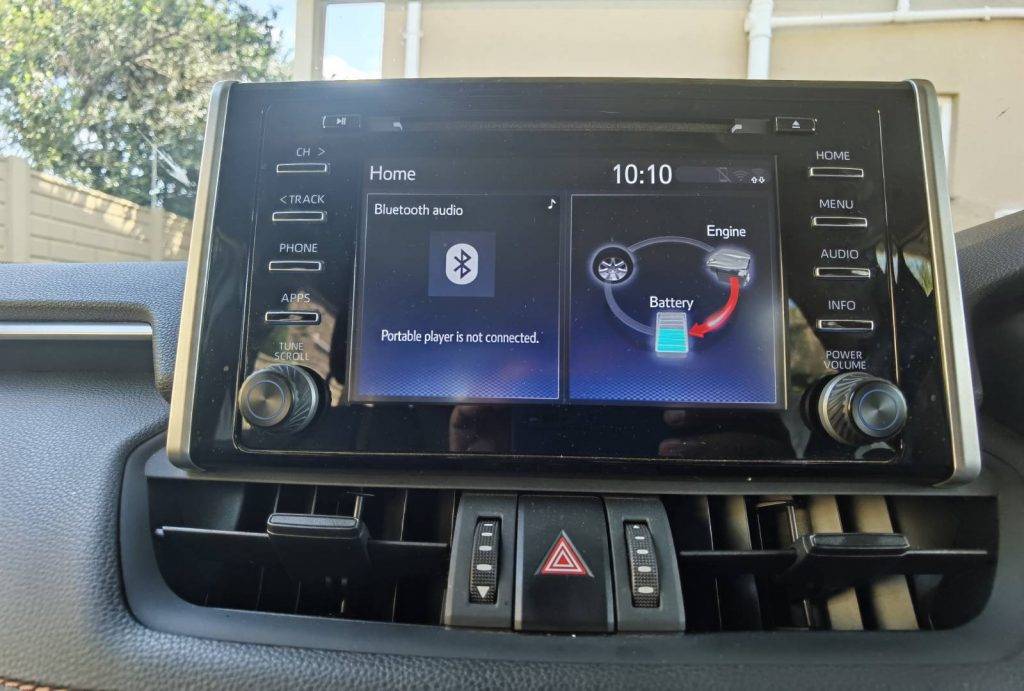
The list of hybrid vehicles available in South Africa is large. An appropriate example, in this case, is the Toyota RAV4 Hybrid which packs a 2.5-litre 4-cylinder engine paired with two electric motors. The engine alone pumps out 131kW and 221Nm, while the electric motors supply 88kW and 202Nm. When the two systems work together, they produce about 163kW of usable power.
Regarding efficiency, the RAV4 Hybrid seems to be a winner, with our long-term vehicle figures hovering around the 6.4l/100km mark.
Plug-in hybrid
Think a hybrid vehicle with a bigger battery, a dedicated charging port as well as a combustion engine. It’s that simple. A plug-in hybrid electric vehicle (or PHEV) is, in some ways, similar to its hybrid counterpart, yet there seems to be a growing demand for PHEVs in South Africa, regardless of the charging infrastructure concerns.
A PHEV packs a bigger electric motor plus a larger battery that can be recharged using a conventional power socket or at a dedicated EV charging station.
Their ability to continue running, even when the battery is depleted, and their potential to save you lots of money has made them more attractive than fully electric cars.
Due to their bigger batteries, plug-in hybrids can travel longer distances on battery power than other hybrids before the engine takes over.
Their EV range is generally between 32km and 50km, however, some models, such as the Jaguar E-Pace and F-Pace PHEVs, claim a range of up to 66km.
An advantage of having a PHEV is you don’t need to worry about stopping at a charging station to recharge the battery because the conventional engine automatically kicks in and recharges it. No range anxiety here.
All electric
All-electric vehicles are all about simplicity. They do away with the ICE in exchange for electric motors that don’t emit harmful fumes. On paper, that translates to cheaper running costs in addition to being able to whizz past crowded filling stations.
They pack a larger battery than hybrids that powers one or more electric motors, depending on the type of car. The battery packs can be recharged as you drive, through regenerative braking or by charging them at a charging station.
More and more manufacturers have mastered the technology and the range of all-electric vehicles available today is large, as is their range.
The 2019-spec BMW i3 only travelled up to 260km on a full charge. I only managed to get about 190km back in the day.
Today, the likes of the BMW iX and Jaguar I-Pace give you a range of up to 630km and 470km, respectively, on a single charge.
Owners can recharge their car’s batteries at home overnight and public fast-chargers are becoming more common and accessible.
For perspective, recharging the BMW i4 M50’s 83.9kWh battery pack from 20% to 90% at an 80kW fast-charger took almost an hour, adding about 400km of driving range.
The i4 comes with a BMW charging card, a flexible fast-charger for charging up to 11kW and a charging cable to use in the comfort of your home.
I know what you are thinking … load-shedding. But there are work-arounds for that.
What’s best in South Africa?
Looking at the EV infrastructure in South Africa, we aren’t where we would want to be, unlike first-world countries all over the world, where electric cars dominate.
That aside, fully electric cars do not come cheap, and the lack of a subsidy from the government makes them inaccessible to the average consumer, leaving them with no option but to stick to their ICE-powered vehicles.
Hybrids and plug-in hybrid cars are the best solution for now but they are more expensive than already-pricy ICE cars, however, they are more affordable than going full electric. Just think of the long-term fuel savings …
Until we solve our EV infrastructure and power problems, hybrid and plug-in hybrid cars make a world of sense in SA.
The end of the energy crisis might be in sight — from our roofs:
Over the course of this year, Eskom’s energy availability factor — the gauge of its available generation capacity unaffected by breakdowns — has continued to reach record week-on-week lows.
In the first week of 2023, less than half of the utility’s generation capacity was available — almost 10% lower than at the start of 2022. In week 10 of this year, the figure was about 4% lower than in the same week of last year and 7% lower than in 2021.

The question on every South African’s mind, especially in the wake of former Eskom chief executive André de Ruyter’s explosive interview with e.tv’s Annika Larsen — in which he spoke frankly about the endemic corruption and mismanagement at the utility — is simple, but desperate, “When will it end?”
De Ruyter’s answer to that question was not an optimistic one. He said to expect at least stage six blackouts (and possibly worse) during winter.
Several experts and commentators have echoed De Ruyter’s bleak view. In interviews with Biznews, former Eskom executive Robbie van Heerden said load-shedding would go to stage eight this winter and not abate for many years thereafter. Research and consulting firm Intellidex’s capital markets head Peter Attard Montalto said that, according to his analysis, we should expect consistent stage seven load-shedding from July.
After his e.tv interview, De Ruyter seems to have gone missing. No one — including the ANC’s lawyers who are trying to serve papers on him in an attempt to sue him for defamation over claims he made in the interview — has been able to find him in weeks.
I hope De Ruyter is safe. It is a lamentable sign of South Africa’s decline that someone of his calibre, who tried his best to fix some of the mess, can’t speak out about corruption without legitimately fearing Soviet-style assassination.
I also hope De Ruyter (and the others) are mistaken. Is this a false hope? After February’s budget speech, for the first time, I don’t think it is.
The national government has — albeit 10 years too late — finally woken up to a simple fact. For decades, South Africa has put all its energy eggs in the Eskom basket. But since returns on this investment continue to diminish, maybe we need some more eggs.
Early attempts at egg diversification have shown encouraging results. In August 2021, the licensing threshold for generation by those other than Eskom was raised to 100MW. This allowed new solutions to the energy crisis to spring up.
Notably, the City of Cape Town announced plans last year to procure hundreds of megawatts from independent power producers, lessening the municipality’s reliance on Eskom.
Unfortunately, due to national government red tape, most of Cape Town’s plans were never going to materialise as quickly as needed. The city only planned to be able to mitigate three stages of load-shedding by 2027. After load-shedding rose to stage six in June 2022 — a serious threat to municipal infrastructure — Mayor Geordin Hill-Lewis drafted a “10-point plan” for the national government to end the crisis.
One of the mayor’s suggestions was to exempt municipalities from “unnecessary legislation and regulations (including those governing municipal procurement) that will delay bringing new generation capacity online”.
“This problem is solvable if we all work together,” Hill-Lewis wrote. “But it requires clear and decisive leadership, and a willingness to do things differently.”
Clear and decisive leadership finally seems finally to have been shown by finance minister Enoch Godongwana, who seems to recognise that there are millions of eggs that can be put in the energy basket. And they’re easy to find; they’re above most of our heads.
First, great news for Capetonians. Godongwana has granted the city — in line with the mayor’s request — an exemption from provisions of the Preferential Procurement Policy Framework Act that require a competitive tender process for all contracts of a certain value. This means the city can — and will — start buying electricity from anyone willing to sell it, including residents and businesses with solar installations.
The fact that electricity can now be sold on to municipalities makes investing in solar much more financially viable. The private sector has already come up with a range of innovative financing models to make it even more accessible (including rental of units represented by tokens on a blockchain, my current project).
However, the single factor deterring most middle-class South Africans from investing in solar panels on their roofs has been the cost. Going “off grid” costs most households between R150 000 and R300 000. Godongwana’s announcement of a 25% rebate for installation costs up to R15 000 lowers this, though the relatively small cap possibly means it won’t lower the cost enough to make solar affordable for most households.
The second bit of good news, though, is that the treasury is finally recognising that the economic benefits of households generating electricity justify a cost to the fiscus. If successful in aiding the country’s security of supply, rebates could continue and even increase over time.
On the other hand, the 125% rebate on offer to businesses — without a threshold — is a significant immediate step. It will (directly) offer improved energy security to those driving the economy as well as (indirectly) making every South African more energy secure, especially those living in municipalities (such as Cape Town) that plan to buy energy from residents producing an excess.
These are all steps in the right direction and we can all only hope they will gather momentum. The good news is, we don’t have to walk very far. Just a few steps up a ladder lands us right on the answer to South Africa’s energy crisis.
Ahren Posthumus is the spokesperson of the SunCash Initiative
Submit and get free exposure here: Showcase Your Business | Advertise Your Special Offers.