
Dodge Colt can still turn heads:

Imagine if I challenged you to name a Dodge model that was, at some point, sold in South Africa. Would your mind instantly go to the Caliber or the Journey?
Dodge hasn’t exactly been the talk of the town in our country in recent years, with only a handful of family cars available, which didn’t exactly make a splash.
The 1970s were a time when America was churning out the jaw-dropping, awe-inspiring muscle cars that adorned the walls of many a teenage boy’s bedroom.
But South Africa has missed out on all the high-octane action. Or have we? Thanks to a unique collaboration between two powerhouse brands, we have been gifted a little gem of a sports car that has the older generations waxing nostalgic.
The Dodge Colt GS is a rally-inspired sports coupe that
originated from a time when Chrysler and Mitsubishi collaborated to manufacture a rally car that could compete with other popular sports cars, such as the AMC Gremlin, Chevrolet Vega and the Ford Pinto.
During the early 1970s, there was a massive shift in the automotive mindset as the fuel crisis forced manufacturers to produce exciting, yet frugal, vehicles.
This was an interesting change, specifically for American automotive producers, as their forte was in the enormous-engine variety.
Picture this — when the Dodge Colt entered the South African market, it was welcomed with open arms and became an instant fan favourite. Think of it as the equivalent of the modern-day GTI — a car perfect for die-hard enthusiasts, which doesn’t cost an arm and a leg.
And the one I got to test was particularly special.
The Dodge Colt GS, or Grand Sport, is a fascinating vehicle. With a heritage in rally racing, it’s no surprise that it is a purpose-built sports car, from its engine to its ride height and nimble shape, paired with rear-wheel-drive.
The Dodge Colt is perfectly set up to be a fun driver’s car, especially given the era from which it stems. It came with a 1.6-litre naturally aspirated Saturn racing motor from Mitsubishi with upgraded SU carburettors. It was unique to the GS and produced an impressive 82kW, 7kW more than the standard model.
In its prime, it would do 0 to 100km/h in a blistering 10.5 seconds.
This particular car was one of the first 100 Dodge Colts to arrive in South Africa straight from Japan. A small Japanese pattern embroidered into the back of the seats celebrates the car’s heritage.
With only 4 600 units of this model ever produced, seeing one of them in the flesh is a treat few will ever have.

As I observed the attention it received from bystanders, I realised just how popular this little sports car is among older enthusiasts who remember its glory days and are thrilled to see it again.
Unfortunately, most of the Dodge Colts were sold at the coast and have succumbed to the plague of rust over the years. Finding one, especially one in its original condition like our test model, is rare. This Colt was so well looked after that the paint and engine were still original.
With only 70?000km on the clock, the owner Kreson Sathaih has cherished this little car for 17 years and he has no intention of ever getting rid of it.
A Dodge Colt was, after all, the first car he ever owned and, although it wasn’t this particular unit, the vehicle holds a special place in his heart, and rightly so.
It is a car bursting with character. The sound of its throaty engine fills the air as you confidently throw it out of a corner, and despite its relatively high ground clearance, the car glides over speed bumps and gravel roads as if they were non-existent.
The small, lightweight body makes for an incredibly enjoyable driving experience.
While the interior might be a bit cramped, its old-school dials and slides are a nice throwback touch.
The wooden trim pieces throughout the car give it a unique and timeless look that’s hard to find in modern vehicles.
Although the backseat space may be limited, the Dodge Colt has the power to transport you back to a time when being a car enthusiast meant something entirely different. It was an era when automakers were pushing the boundaries of what was possible, creating anything but ordinary cars.
And that’s precisely what the Colt is — a small, lightweight car with a punchy motor that captured the imaginations of anyone with a drop of petrol in their veins.
Even today, seeing one on the road is enough to bring a smile to any car enthusiast’s face. It’s a shame they don’t make them like they used to.
Woman dies while waiting 24 hours for ambulance:

The response time of the Western Cape emergency medical services (EMS) in gang red zone areas on the Cape Flats has again been thrust into the spotlight after the death of a woman who had to wait 24 hours for assistance.
Fatgiyah Boyes, 33, allegedly died of heart failure at her home in Donegal Court, Hanover Park, on 26 April. A day before her death, Boyes’ friend and neighbour, Zakiyah Petersen, requested an ambulance at about 12.50pm through 10177, the dedicated ambulance service number for Cape Town.
Petersen received a message from EMS confirming that an ambulance had arrived at the stipulated location, despite the fact that it had not. She received the same arrival message after her second request for an ambulance.
With two reference numbers, and no medical assistance, Boyes and Petersen’s mothers worked throughout the night to ease Boyes’s discomfort and pain.
On 26 April, a community group requested assistance for Boyes and a third reference number was logged. But Boyes died at about midday. The family waited another two hours for an ambulance to arrive and declare her dead.
EMS said the matter was under investigation.
“We acknowledge this complaint, have spoken to the person concerned, and will give feedback as per departmental policies to the complainant,” said Byron la Hoe, of the Western Cape department of health and wellness. “Once the investigation is completed, we will be able to provide adequate feedback.”
Petersen said this was not the first time residents had had to wait hours for emergency services. She named other patients who had waited for three hours for emergency medical assistance.
Hanover Park was declared a permanent red zone in September 2016. The implementation of red zones was in response to increased incidents of violence against ambulances and EMS officials in and around Cape Town.
Police spokesperson for the province Colonel Andre Traut said in the same way that the public and vehicles that travel through high-risk areas are exposed to criminal elements, so too are medical workers and vehicles.
Traut described the theft of items such as cellphones and wallets in previous attacks on medical staff as opportunistic crimes.
Between January and April, 16 assault incidents against medical staff and vehicles were reported in the Western Cape. Of the 16, one, described as “threatening behaviour”, took place in Hanover Park, in March.
Plagued by gangsterism and infighting, Hanover Park was at the top of the list to receive the latest instalment of the gunshot detection system known as SoundThinking (formerly called ShotSpotter), which the city procured last year. It was first introduced to the Cape Flats, including Hanover Park, in July 2016 and operated until 2019.
From January to last month, the system detected 60 to 74 gunshots a month. During a surge in gang fighting in December, 127 gunshots, with 460 rounds fired, were detected in Hanover Park.
When an area is declared a red zone, ambulances must be accompanied by armed law enforcement, though escorts are not limited to the South African Police Service (SAPS).
“The EMS vehicle meets the SAPS escort at a police station,” said La Hoe, but added that when a police escort was unavailable, “the EMS does receive assistance from the City of Cape Town law enforcement when escorts are required for ambulances.”
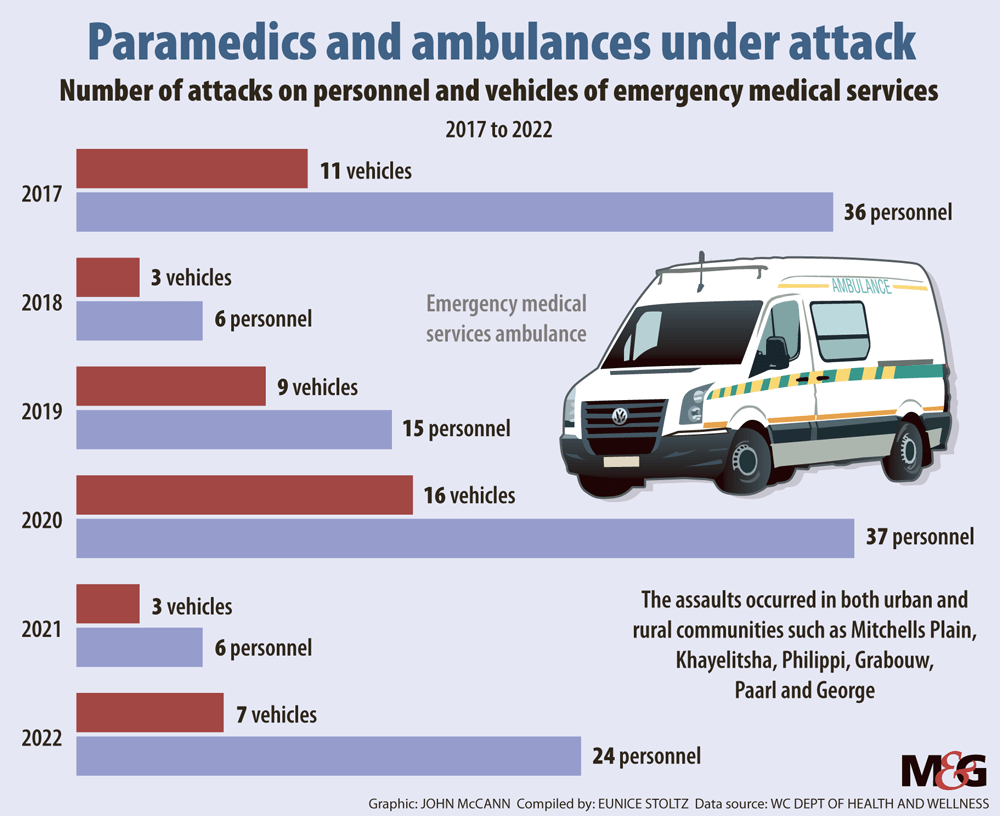
Traut said: “Escorts are conducted on an integrated approach where SAPS [and] other law enforcement agencies offer services, depending on the location and availability of a patrol vehicle.”
He said it was standard practice that an emergency vehicle approaches a police station or calls to request an escort from an agreed-upon location.
“These escorts are conducted as a priority and delays are only caused when all available patrol vehicles are occupied with emergencies that are channelled our way.”
In the case of Boyes, it has been alleged that an ambulance could not reach the destination because there was no available police escort.
According to staff at Manenberg police station, which is about 6km from Donegal Court, the ambulance service would have requested an escort from the Philippi police station. The station is 2.2km from the requested location.
Although the Mail & Guardian’s inquiry was acknowledged, numerous attempts to speak to Philippi police to clarify whether an escort was requested on 25 or 26 April went unanswered.
An EMS official with close to 20 years’ experience agreed to speak to the M&G on condition of anonymity about the difficulties of working in such an environment.
The official said each EMS vehicle is supposed to be fitted with a mobile data terminal (MDT) system. The MDT system gives updates in real time in relation to dispatching services, communicating with the emergency control room, emergency stock and patient information. It also stores information for future use.
The MDT system, in the form of a handheld tablet, also “permanently flashes the red zones” at the bottom of the screen. “It is so integrated that we do not even have to take the radio and ask where the problems are,” said the official.
In a case where a patient is in a red zone, the emergency vehicle will go to the nearest police station, state the case “and the police go with you [to] go and save the patient”.
“That is in theory. Unfortunately, it does not always happen that way.”
In some cases, when medical staff request a police escort “they don’t add assertiveness to it and the police do not take them seriously”, said the official, adding that in some cases, there are no police vans available to act as escorts.

A 2018 study by the University of Boras in Sweden suggests the waiting times for EMS in Hanover Park increased in the period 2016 to 2018. The study formed part of an international Swedish scholarship called Minor Field Studies and enabled the author, Fia Gleby, to work with the universities of Cape Town and Stellenbosch. Gleby explored how access to ambulance services is affected by red zones.
Using a quantitative method, the study compared EMS response times for Cape Town and Hanover Park.
The response times in both areas increased in the 2016 to 2018 period but the time it took for the control centres to dispatch an ambulance to Hanover Park more than doubled in the two years. In the city, dispatch time increased from a median of four to almost nine minutes.
“In Hanover Park, the comparable numbers show an increase from eight minutes to almost 22 minutes” before an ambulance is dispatched to an emergency, the study found.
In addition, the time it took from dispatching an ambulance to collecting and transporting the patient to a hospital was 40% higher in Hanover Park than in Cape Town.
Gleby wrote: “By requiring a police escort for EMS when red zones are allocated, resources are allocated away from their primary function, which further limits SAPS capacity. In addition, having to wait for an escort during busy times likely severely affects EMS ability to offer an efficient and effective service.”
She added it may be “tempting” to remove the safety routine because it affected the waiting period for the patient and limited police capacity but said this would compromise the safety of medical staff.
La Hoe said the health department “is prioritising staff safety in the organisation and has implemented essential measures to ensure that EMS officials are kept safe”.
He said police escorts were dispatched to high-risk areas such as Chicago in Paarl, Beacon Valley and Tafelsig in Mitchells Plain and Hanover Park.
The department had adopted a “whole-of-society approach”, where neighbourhood watches and community groups partnered with the department and he urged the public to help protect and support EMS officials.
Submit and get free exposure here: Showcase Your Business | Advertise Your Special Offers.
