Durban is undergoing quite a revival:
Places and spaces rise and fall. And when it comes to the rise of certain provinces in South Africa, well-run metros are one of the biggest attractions for investment.
From what I can see, eThekwini metro is taking a feather out of the City of Cape Town’s cap, because it is now moving and shaking.
Durban has one of the busiest ports in the country, and its conference centre is blowing up with bookings when it comes to the corporate side of things.
With its sandy beaches, great year-round climate and warm ocean, I think Durban should be one of our top destinations in the country for business and leisure.
But Durbs is often in the news for all the wrong things: crime, the 2021 riots and accompanying destruction to severe floods and polluted water that causes high E.?coli counts and the closure of beaches. If the perception of Durban, along with infrastructure, crime prevention and service delivery, can be improved, this location can boom.
Albeit busy, the Durban port is seriously congested and needs attention. That was on the cards but will have to wait until the high court decides next year whether the losing bidder, APM Terminals, or International Container Terminal Services, which won the bid, will proceed with investing millions in upgrades and new equipment at the port. And it will take time to turn Transnet, the state-owned logistics company, around.
But a notable deal that was recently closed concerns the much-needed rejuvenation of the iconic beachfront property Joe Cool’s at 137??Marine Parade. eThekwini has appointed a company to redevelop the site on a 45-year lease agreement. For non-Durbanites, Joe Cool’s was the coolest place to be in its heyday.
eThekwini is on a mission to release the potential of state-owned real estate. Its proactive land release strategy, along with a detailed RFP (request for proposals) for the beachfront redevelopment opened the door to industry professionals in November 2022.
The tender was granted to Imvusa Trading 595 CC, which will begin construction early next year after the necessary approvals have been achieved. The municipality has said the beachfront redevelopment will create 80 jobs during the construction period.
eThekwini’s mayor, Cyril Xaba, has emphasised that they will guarantee the retention of all current jobs, and new positions will also be established because the new site will be 68% bigger than the existing one. The redevelopment will bring in new tenants, including a Mugg & Bean restaurant, while retaining the existing tenants such as Wimpy, Steers, Fishaways and Milky Lane.

The municipality also has plans to redevelop the old Funworld site. Its formal announcement of these plans will be published soon.
Investment flows where confidence goes and Southern Sun will also make some major moves. The group was awarded a 50-year lease and it will invest R1??billion in the rejuvenation of the Elangeni and Maharani hotels. The current lease was set to end in December 2025. This was an essential move by the municipality, especially when jobs are concerned — the two hotels employ about 500 people and these jobs are now safe.
I spoke to Thapelo E Mmusinyane, the head of real estate for the eThekwini municipality. He says when they released these hotel properties to the market for tender, the number of responses received was the highest ever. This shows the keen confidence from investors who want to get stuck in and revive these iconic assets in Durban.
He also mentioned that eThekwini has put into action initiatives to attract investment and foster growth. One is the economic development incentive policy, which seeks to facilitate and create a supportive environment for new investments while maintaining existing ones.
This initiative provides property rates relief to eligible businesses and developments that contribute to local economic growth, job creation and infrastructure development. As a result of this policy intervention, the municipality has secured R217??billion in ongoing investment developments, with additional projects planned that are expected to generate about 300??000 jobs.
eThekwini is the only municipality in the country offering a property rates reduction incentive to property developers and owners. I am certain that property players will welcome the incentive with open arms, especially because rates have been soaring higher than inflation over the past 10 years.
“Some of these projects are key drivers in promoting new developments, particularly in strategic growth areas like the north — where Oceans Umhlanga, Sibaya Coastal Precinct, Brickworks and Whetstone Business Park are located — and the west, where some of the industrial developments like Cato Ridge dry port, Keystone Park, Giba Business Estate and the Westown mixed use development are located,” Mmusinyane said.
eThekwini signed a memorandum of understanding with the national department of public works to release surplus properties and land that it does not need to drive development. The Passenger Rail Agency of South Africa has already released stations in the municipality jurisdiction.
This makes so much sense for the sustainability of a municipality. Why sell the goose that lays the golden egg? In this case, the goose is prime real estate assets, and the egg is income from the property.
In September this year, eThekwini released 34 out of 149 properties for tender. The target for this financial year is 50 — all with the goal of retaining asset ownership, partnering with a developer to make them modern and functional, and turning Durban into a key tourism node.
Some of the other famous leased landmark properties advertised for redevelopment in September were Kings Park Stadium and the Durban Country Club, which will be hosting the Investec South Africa Open Championships in 2025.
“The awarded properties have a capital investment pipeline of R4??billion with R1.4??billion of that earmarked for the beachfront alone and which will create a total of 1??500 jobs during construction and 5??500 jobs post construction,” Mmusinyane said.
The beachfront’s Golden Mile plays a crucial role when it comes to tourism assets. The municipality is working to restore this city’s shine by protecting and enhancing this area. It would be wonderful to see the strip transformed back to its former glory and I think the Durban metro is on a mission to do exactly that.
I was pleasantly surprised when I saw the stern approach that the municipality took when it forced the legendary Hilton Hotel to reopen. The Hilton Durban shut down during the Covid-19 pandemic when the lockdowns devastated the hospitality sector. The International Convention Centre was also hit, which affected the Hilton Durban.
This led to eThekwini almost expropriating the Hilton Hotel. The municipality has a condition in the title deed that if the hotel stops operating as a five-star hotel, the municipality has the option to buy it back. Upon evoking this condition, the hotel owner reopened the hotel to avoid losing it.
It’s unfortunate that more municipalities don’t have leases with clauses like these in place. Such agreements would significantly help ensure the smooth operation of hotels — especially those occupying prime real estate such as the mothballed Hyatt Hotel in Rosebank.
eThekwini has 565??070 properties in its portfolio, valued at R704??billion, according to Statistics South Africa.
Durban has a lot of vacant land, some of which is protected for environmental purposes.
About 68% of the municipality’s land is classified as “rural.” The communal land under the Ingonyama Trust is included in this. The remaining 32% comprises residential, commercial and industrial areas.
Mmusinyane mentioned that eThekwini has decided not to sell its municipal-owned properties unless it will be used for gap housing.
The municipality has ambitious plans to achieve R1??billion in net property income annually. It owns 9% of the property in its jurisdiction. If eThekwini continues with its current strategy — bringing properties to market when lease agreements expire — they will maintain market-related rentals and enhance their revenue stream, thus ensuring financial sustainability for the municipality. Viva, Durban.
Ask Ash is a column that examines South Africa’s property, architecture and living spaces. Continue the conversation with her on email (ash@askash.co.za) and X (@askashbroker)
Settlement of the Bela Act dispute has shifted to adults’ concerns, sidelining those of children:
Every child in South Africa should have equitable access to quality education, regardless of language, location or socioeconomic background. The recent talk of a settlement involving the Basic Education Laws Amendment (Bela) Act is both a concern and has implications for children across the country.
The decision not to implement clauses 4 and 5 sparked significant debate. These clauses aimed to address the critical issues of language and policies in public schools — two areas that directly influence access to education for children, particularly those from underprivileged communities. Although the agreement may be seen as a victory by certain parties, it jeopardises the fundamental rights of the most vulnerable children in our education system.
Clause 4 sought to give the head of the provincial department of education the authority to oversee and, where necessary, amend a public school’s language policy. The intention is to ensure that language policies do not create barriers to entry or exclude children based on their linguistic background.
This clause is a vital step toward fostering inclusivity. Restrictive language policies disproportionately affect children from rural and township areas. These policies often alienate children who are not proficient in the dominant language of instruction, impeding their ability to learn, develop and thrive.
Early childhood education is particularly affected, because language plays a crucial role in developing cognitive, social and emotional skills. We have seen how inclusive language policies — where children are taught in their home language while gradually transitioning to a second language — build confidence and set children up for success.
By rejecting clause 4, the opportunity to address these issues and ensure equitable access to education for all children, regardless of their linguistic background, has been missed.
Clause 5 is aimed to give the provincial head of department final authority over public schools’ admission policies, ensuring they are fair, non-discriminatory and reflective of the constitutional right to education. This clause is aimed to prevent schools from using restrictive admission policies to exclude children based on socioeconomic, geographical or linguistic factors.
Many children in underprivileged communities are denied access to quality education because of admission policies that fail to consider their unique circumstances. In many cases, such policies reinforce inequality by favouring learners from affluent backgrounds or specific language groups, leaving others behind.
While some stakeholders view clause 5 as infringing on the autonomy of school governing bodies, it was designed to protect children’s rights and ensure equity in school admissions. By choosing not to implement this clause, we risk perpetuating cycles of exclusion and inequality, particularly in schools where resources and opportunities are limited.
The focus should always be on the child and their right to quality education. But this settlement has shifted the focus to adult-centred concerns, leaving the children on the sidelines.
Teachers are already overburdened, and centralising admission policies could add layers of administrative strain. This approach risks overlooking the specific needs of communities and the best interests of the children.
Clauses 4 and 5 represent pathways to creating a more inclusive and equitable education system in South Africa. By ensuring fair language and admission policies, these clauses aim to address the barriers that prevent underprivileged children from receiving quality education.
The decision to abandon these clauses may leave many children, particularly those in rural and township schools, vulnerable to exclusion. Language barriers and restrictive admissions will continue to hinder children’s ability to learn and thrive, exacerbating existing inequalities in our education system.
Education policies should prioritise the best interests of children. The current possible settlement may address the concerns of unions and other stakeholders, but it fails to centre the conversation on the children who are most affected. Quality education is a constitutional right for every child, and any decisions that affect access to this right must place children’s needs above all else.
The government, unions and civil society must re-examine how we can collectively address the problems posed by language and admission policies. The Bela Act, with its inclusive intentions, presented a pathway to bridging divides and creating equitable opportunities for children across South Africa.
Although this possible settlement may conclude the current debate, the work is far from over. We must find new ways to ensure that every child — regardless of their language or background — has access to the quality education they deserve.
Barriers must be broken down to build a future where education is a right, not a privilege.
Theresa Michael is the chief executive of Afrika Tikkun Bambanani.
Side-effects of medical aids in 2025:
South Africa’s medical schemes have increased premiums and reduced benefits while complicating their offerings, making it difficult for consumers to find the best value for money.
The five biggest medical schemes — Discovery Health, Bonitas Medical Fund, Momentum, Medihelp and Bestmed — offer a range of hospital plans at varying prices for 2025, but financial advisers have warned that there are myriad pitfalls to watch out for when selecting an option.
These schemes have also implemented premium price hikes on plans ranging from 7.4% to 14.9% effective from 1 January.
Independent financial adviser Verona Pillay of ASI Financial Services highlighted trends such as a rising number of claims, increased medical costs and ageing memberships that have led to diminishing benefits.
To manage costs, medical aid schemes have gradually hollowed out benefits.
Pillay said five trends affecting members include:
• Higher co-payments: Many plans now require members to pay a portion of high-cost procedures, specialist consultations and diagnostic tests.
• Reduced day-to-day benefits: Out-of-hospital benefits such as GP visits and dental care have been cut in favour of hospital coverage.
• Network restrictions: Plans limit members to specific networks, reducing flexibility and increasing out-of-pocket expenses for out-of-network care.
• Benefit sub-limits: Hospital plan sub-limits for specific treatments, for example cancer care or prosthetics, are common.
• Higher premiums: Despite fewer benefits the premiums rise above inflation.
Pillay advised consumers to carefully consider their needs and the potential pitfalls of plans.
“Many plans have cut back out-of-hospital benefits such as GP visits, dental, optical and over-the-counter medication. The effect is that members are left paying for routine healthcare out of pocket, which reduces the perceived value of the plan,” she said.
The biggest pitfalls to watch out for when selecting a medical scheme are waiting periods, co-payments, benefit limits and exclusions and network restrictions.
“When deciding to pay a premium for a medical aid, consumers often overlook critical details that only become apparent when they face a health issue,” Pillay said.
Some schemes impose a general waiting period of three months when no claims are allowed except for prescribed minimum benefits (PMBs), while others may offer no cover for pre-existing conditions during the first year.
Co-payments and benefit limits could also leave consumers exposed as schemes often cover only a portion of the cost for hospitalisation, specialist consultations or procedures.
“For hospital admissions co-payments may apply for certain procedures, for example scopes, MRIs and elective surgeries, while benefit sub-limits include restrictions on coverage for high-cost items like prosthetics, specialised surgery, or cancer treatment,” Pillay said. “The effect is that members face significant out-of-pocket expenses,” she said.
Consumers may also not be fully aware of plan-specific exclusions or network limitations for certain treatments and high-cost drugs.
“Plans often restrict members to specific hospitals, doctors, and pharmacies [network providers]. Using non-network providers results in reduced or no cover,” Pillay said.
“During emergencies or complex treatments, members may find their preferred or nearest providers are not covered, leading to delays, stress or unexpected costs.”
Before choosing, consumers should also review waiting periods and plan for alternative coverage during that time.
Another crucial aspect of medical aid cover consumers need to be aware of is the law regarding chronic conditions and prescribed minimum benefits, because schemes sometimes neglect their responsibilities to pay for these treatments and instead claim co-payments from members.
Under the Medical Schemes Act of 1998 all registered medical schemes must cover 271 medical conditions and 26 chronic conditions, known as the chronic disease list (CDL).
The list includes 26 common illnesses such as hypertension (high blood pressure), diabetes (type one and two), asthma, epilepsy, hyperlipidaemia (high cholesterol), HIV/Aids and chronic renal failure.
“Whether you are on a hospital plan or a comprehensive plan, your scheme is legally required to cover the 26 CDL chronic conditions and the broader 271 PMBs,” Pillay said.
But if members choose a non-designated service provider they may face co-payments unless it’s an emergency.
“Treatment for chronic PMBs usually requires pre-authorisation and registration with the scheme’s chronic programme and members must adhere to the scheme’s protocols, such as using generic medications or following specific treatment plans,” Pillay said.
The Mail & Guardian explored the cheapest and most expensive hospital plans, as well as the cost of the top comprehensive cover, to find out where the pitfalls and value lie.
Here is a breakdown of what is offered by the country’s big five medical schemes.
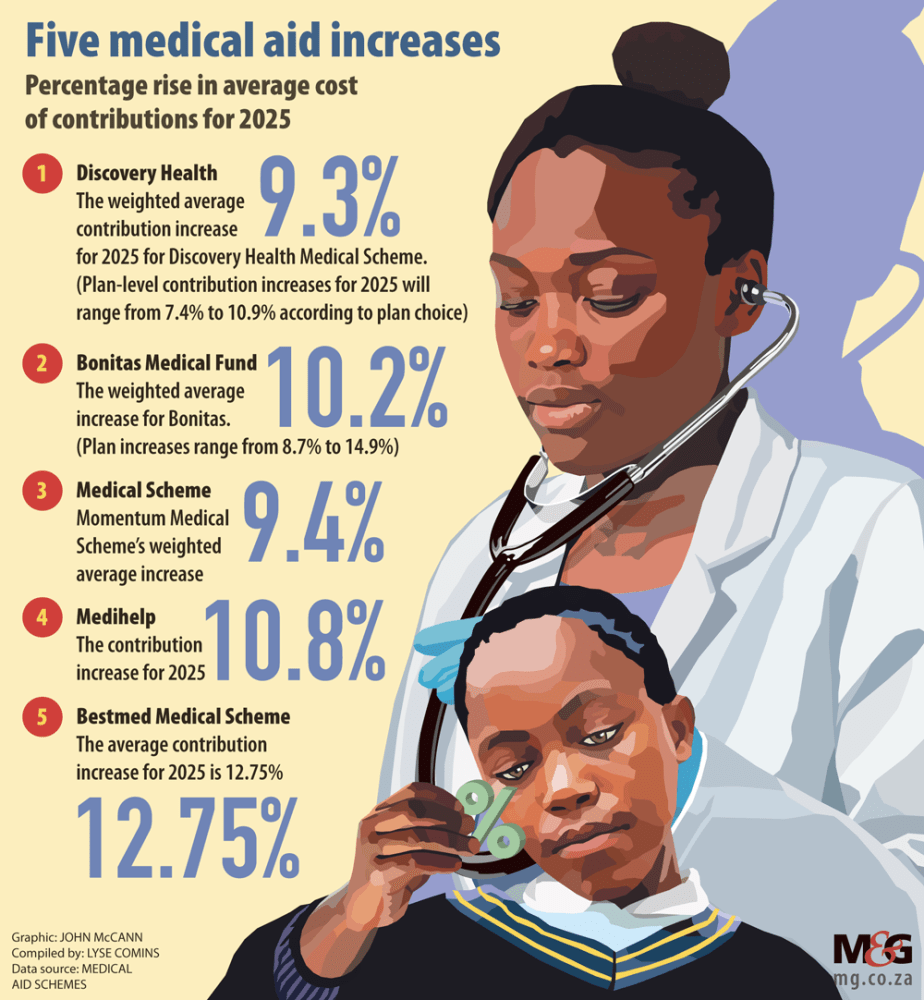
Discovery Health
By far the country’s largest medical scheme with 2??788??242 members and beneficiaries, Discovery Health offers its cheapest hospital plan, Active Smart, at R1?350 a month for the principal member. This is one of the cheapest on the market, but there are red flags.
This plan, targeted at active young professionals (although anyone is free to join), provides access to a limited network of private hospitals and co-payments may apply for certain procedures.
There is an extensive list of exclusions. For example, it does not cover hospital admissions related to investigations, dentistry, benign skin growths and lesions, as well as back, neck, knee and shoulder surgery.
The scheme’s most expensive hospital plan, Classic Core, is R3?652 a month and offers greater freedom of choice and wider cover for surgeries without hospital network restrictions.
The oncology limit for Active Smart includes only prescribed minimum benefits, which means the latest advanced treatments may not be available. The limit for Classic Core is R250?000. If the treatment costs more, a co-payment of 20% kicks in.
Discovery Health’s top comprehensive plan costs R11??430 a month.
There are no overall annual limits.
Bonitas Medical Fund
The scheme’s cheapest hospital plan, BonEssential Select, costs R2?192 monthly. It provides access to private hospitals within a designated network and includes preventative care benefits such as flu vaccines and screenings.
The Hospital Standard plan, at R3??252 a month, offers a more comprehensive hospital coverage without network restrictions.
On both plans oncology cover is unlimited for prescribed minimum benefits and there are co-payments of 20% to 30% for using a non-designated service provider.
On Hospital Standard there is an additional R168 100 per family for non-PMBs, with 20% co-payment once this has been reached.
BonComprehensive is the scheme’s top offering, priced at R11??321 a month.
There are no overall annual limits on any plans.
Momentum Medical Scheme
Momentum’s Ingwe plan, starting at just R589 a month for low-income earners, is the most affordable option among the top five schemes. But it is restricted to network providers and offers limited benefits.
The Evolve option is next-cheapest at R1??847 a month for the main member and offers some day-to-day benefits. There is no overall annual limit on these options.
Oncology is for PMBs only on the Ingwe plan while Evolve offers R200??000 per beneficiary a year at network oncologists, after which a 20% co-payment applies.
The scheme’s top plan is the Extender Option at R9??160 a month.
There is no overall annual hospital limit on any plans.
Medihelp Medical Scheme
Medihelp’s MedMove! — priced at R1 638 a month — is a basic hospital plan with no overall limits.
At the other end of the spectrum is MedVital, which costs R2??244 a month for the network option.
Oncology cover on Medmove! is unlimited but subject to treatment protocols, which means some treatment may be excluded and comes with a 25% co-payment for deviation from these and a 30% co-payment for using non-designated service providers. Cover for oncology is R250??000 per family on Medvital.
The scheme’s top plan is MedPlus at R14??184 a month.
There is no overall annual hospital limit.
Bestmed Medical Scheme
Bestmed’s Beat1 Network plan, at R2??111 a month, is a hospital-only plan with access to network providers. It includes maternity benefits and preventative care but imposes co-payments for out-of-network services.
The Beat4 plan, priced at R6??832 monthly, offers a combination of hospital and savings benefits with fewer restrictions.
Both plans pay 100% of the scheme tariff for oncology subject to treatment protocols at a designated service provider.
The scheme’s top comprehensive plan is Pace4, which costs R11??662.
There is no overall annual hospital limit on any plans.
According to the Council for Medical Schemes’s latest report for 2023 released in November, 71 medical schemes cover 14.7% of the country’s population, down from 16% in 2022.
The average age of the medical scheme population is 34 with almost 40% of beneficiaries living in Gauteng, underscoring the correlation between economic activity and medical scheme membership. Western Cape and KwaZulu-Natal came in second and third, with 15% and 14%, respectively.
Total healthcare expenditure on benefits paid in 2023 increased to R239??billion, up 9.44% from 2022.
Submit and get free exposure here: Showcase Your Business | Advertise Your Special Offers.