
easyMarkets Wins ‘Broker of the Year 2024’ and TradingView’s ‘Best of the Best’:
LIMASSOL, Cyprus, easyMarkets a trusted name in trading excellence, is proud to announce that it has been awarded ‘Broker of the Year 2024’ and TradingView’s Best of the Best, marking the company’s second consecutive win, following its Best CFD/Forex Broker 2023 recognition last year.
This remarkable achievement emphasizes easyMarkets ongoing commitment to delivering an exceptional trading experience. It reflects the trust traders worldwide have placed in the platform and reinforces the company’s leadership position in the global trading community.
Celebrating People, Trust, and Innovation
“Our win at the TradingView Awards is a celebration of the people,” said Mr. Garen Meserlian, Chief Marketing Officer of easyMarkets. “TradingView has built a strong, vibrant community of traders, and their voices are key to shaping the future of the industry. This award further reinforces our belief that trust, simplicity, and accessibility are what truly matter. We’re deeply grateful to everyone who voted, and this recognition is because of them.”
What Sets easyMarkets Apart?
easyMarkets stand out for its unwavering commitment to creating a platform that caters to the true needs of traders. The platform is built with reliability, transparency, innovation, and ease of use in mind, providing traders with the tools and resources they need to succeed in today’s fast-paced financial markets.
TradingView’s ‘Best of the Best’ Honor: A Perfect Match
Along with the Broker of the Year title, easyMarkets was also honored with TradingView’s ‘Best of the Best’ recognition. This prestigious title speaks to the seamless integration of TradingView’s charting and technical analysis tools with the easyMarkets platform. This partnership improves the overall trading experience, empowering traders to make informed decisions and execute their strategies with greater precision.
Vice President of International Growth at TradingView, Rauan Khassan, commented: “Our shared goal is to offer traders the best trading access and features. At TradingView, we are proud to recognize easyMarkets as the Best Broker of the Year 2024, a prestigious award given to one standout performer who has demonstrated exceptional achievements across all categories.
Commitment to Traders and Innovation
This award reinforces easyMarkets dedication to serving the trading community. The company continues to innovate, ensuring that traders have access to the best technology, tools, and support. As easyMarkets looks ahead, the company plans to introduce new features and expand its platform to provide even more value to traders around the world.
“We are incredibly excited about the future,” said Mr. Nikos Antoniades, CEO of easyMarkets. “This award is a great acknowledgment of our hard work, inspiring us to keep improving and innovating. Our mission is clear: to empower every trader, regardless of experience, with the tools and resources they need to succeed.”
If you haven’t yet explored what easyMarkets has to offer, now is the perfect time to join a platform that’s Trusted, Verified, and Awarded.
Trade with easyMarkets, Broker of the year!
For more information on easyMarkets and its recognition as TradingView’s ‘Broker of the Year’, please contact Garen Meserlian, CMO, Email: support@easymarkets.com, Tel: +357 25 828899
About easyMarkets
easyMarkets, founded in 2001, is an award-winning global broker. One of the first to offer an online experience with innovative risk management tools, including free guaranteed stop loss, easyTrade, Freeze Rate, and dealCancellation, easyMarkets provides its sizeable clientele with a streamlined, accessible, and flexible trading experience. Offering over 275 tradeable instruments, tight fixed spreads, and 24/5 dedicated support to traders around the world, easyMarkets continues to revolutionize the trading sector by providing unparalleled security and safeguards for client funds and consistently prioritizing client commitment and satisfaction.
G20 Summit: A question of global power and influence:
As the G20 summit unfolds, South Africa has assumed a pivotal role on the global stage. Hosting the summit for the first time on African soil, South Africa’s leadership offers a significant opportunity to address the interests of the Global South. But this position also brings challenges, especially amid current geopolitical tensions.
A notable concern is the United States’ approach to South Africa’s hosting duties. US Secretary of State Marco Rubio chose not to attend the recent G20 Foreign Ministers’ meeting in Johannesburg, reportedly because of policy disagreements with South Africa. Instead, the US was represented by Dana Brown, the acting ambassador to South Africa. Additionally, US Treasury Secretary Scott Bessent announced he would not attend the G20 Finance Ministers’ meeting in Cape Town, citing domestic obligations.
This raises the question: does the US see South Africa as a mere host rather than an influential player? More importantly, does this selective engagement reveal that global decision-making remains firmly in the hands of a few elite nations, with others merely participating in a carefully controlled system?
Italian philosopher Antonio Gramsci’s concept of hegemony helps us understand this dynamic. Hegemony isn’t just about military or economic might — it’s about shaping ideas, narratives and global norms in a way that benefits the most powerful. The G20 is often framed as a space where emerging economies can engage with established powers on equal footing. Yet, when Western nations choose when and how to engage, their selective participation sends a clear message about who really holds power.
The glaring neglect of African crises in global governance discussions adds to this concern. The Democratic Republic of the Congo (DRC), for instance, remains embroiled in conflict, yet its struggles barely register in G20 agendas. While including the African Union in the G20 is hailed as progress, is it truly meaningful or just a symbolic gesture? The economic and political challenges facing many African nations — ranging from instability in the Sahel to governance crises in East Africa — continue to be sidelined in favour of issues deemed more strategically important to global powers.
Meanwhile, the US and Russia’s discussions in Saudi Arabia on Ukraine, a conflict that, while undoubtedly significant, has overshadowed other humanitarian crises, particularly in Africa. Why is it that conflicts in Europe command swift and sustained diplomatic attention while the suffering in places like the DRC is met with silence? The answer lies in the interests of global elites who shape the priorities of international governance.
Gramsci’s idea of a “passive revolution” — where dominant powers make limited concessions to maintain control — seems particularly relevant. The AU’s seat at the G20 table may appear to be a victory, but without real influence, it remains a controlled shift rather than a transformative one. African nations still await meaningful involvement in decisions that affect their future.
South Africa’s hosting of the G20 should be an opportunity to challenge these global hierarchies. But the reluctance of Western powers to fully engage suggests that true decision-making power remains out of reach for many in the Global South. If the G20 is to be more than a symbolic gathering, it must confront the deep-rooted inequalities that continue to define global governance. It must go beyond empty inclusivity and truly address the needs of marginalised nations, from the DRC to the broader African continent. Otherwise, it risks remaining yet another platform where the powerful dictate terms while the rest of the world listens.
Beyond the immediate questions of representation, the G20 summit also highlights the larger structural inequalities in global governance. Historically, forums such as the United Nations, the World Bank and the International Monetary Fund have been dominated by Western nations, with developing countries having little say in decision-making processes.
Consider the issue of global economic policy. Decisions made at the G20 directly affect developing economies, particularly in Africa, where financial dependencies on Western institutions remain strong. When Western leaders prioritise economic discussions over diplomatic ones, they reinforce a system where financial control is maintained without meaningful discussions on broader political and social issues. The prioritisation of finance over diplomacy suggests a continued neoliberal agenda focusing on market-driven solutions rather than addressing deep-seated inequalities in governance, trade and development.
At the same time, the neglect of African issues in these discussions highlights the role of elites in shaping global narratives. While conflicts in Ukraine and the Middle East receive extensive media coverage and diplomatic intervention, ongoing African crises are often dismissed as “local” problems rather than global concerns. This neglect is not accidental — it reflects a broader ideological positioning where African issues are deemed secondary to the interests of Western powers.
For example, the failure to address the conflict in the DRC is emblematic of this marginalisation. Despite its vast mineral wealth, which is critical to global supply chains for electronics and renewable energy technologies, the DRC remains mainly excluded from meaningful diplomatic interventions. The lack of international attention to the region’s crises reveals a hierarchy of global concern that privileges certain regions while ignoring others.
This selectivity is not a matter of oversight; it is a deliberate strategy ensuring the maintenance of global power structures. By keeping African nations on the periphery of key discussions, global elites reinforce a system where decision-making remains concentrated in the hands of a few. While symbolically significant, the AU’s inclusion in the G20 does little to challenge this entrenched hierarchy unless it is accompanied by real decision-making power.
What can be done to challenge this status quo? First, South Africa, as a host nation, must push for substantive discussions that go beyond surface-level inclusion. It must demand that African issues be given equal weight to those of Western powers. Second, African nations must unite in advocating for reforms in global governance structures, ensuring that their voices are not merely tokenistic but genuinely influential.
Finally, there must be a broader reckoning with the role of elites in shaping global policy. Gramsci’s analysis reminds us that hegemony is not maintained solely through force but through the control of ideas and narratives. Challenging this dominance requires institutional reforms and a shift in framing and addressing global issues. Until African nations are treated as equal players rather than passive participants, forums like the G20 will remain spaces of controlled participation rather than genuine collaboration.
As the G20 process unfolds, the world must ask itself: will this be another gathering where global powers reinforce their dominance, or will it mark a turning point in how international governance is structured? The answer is whether emerging economies, particularly in Africa, can break free from the cycle of passive revolution and assert their rightful place in shaping the global future.
Thabo Motshweni is a PhD candidate at the University of Johannesburg’s department of sociology and a research Intern at the Centre for Social Change and Centre for Sociological Research and Practice.
A breath of fresh air: How Kigali’s car-free Sundays keep people moving:
The streets of Rwanda’s capital are packed with minibus taxis and cars. It almost has the feel of a busy afternoon in downtown Johannesburg — but for the scores of motorcycles that jostle for space and weave through the traffic.
But from 7am to 10am two Sundays every month, there isn’t a single car in sight. That’s when the streets of Kigali go car-free. But the roads will still be busy. City officials estimate that 10 000 people come out for those Sundays, getting on bicycles, strapping on skates, hopping on skateboards or slipping into tackies.
For the past two years, Remy Ishimwe, 24, has jogged with friends every car-free Sunday.
“It’s a breath of fresh air having no cars on the roads,” he says as a group of joggers passes, ululating and singing, this past Sunday.
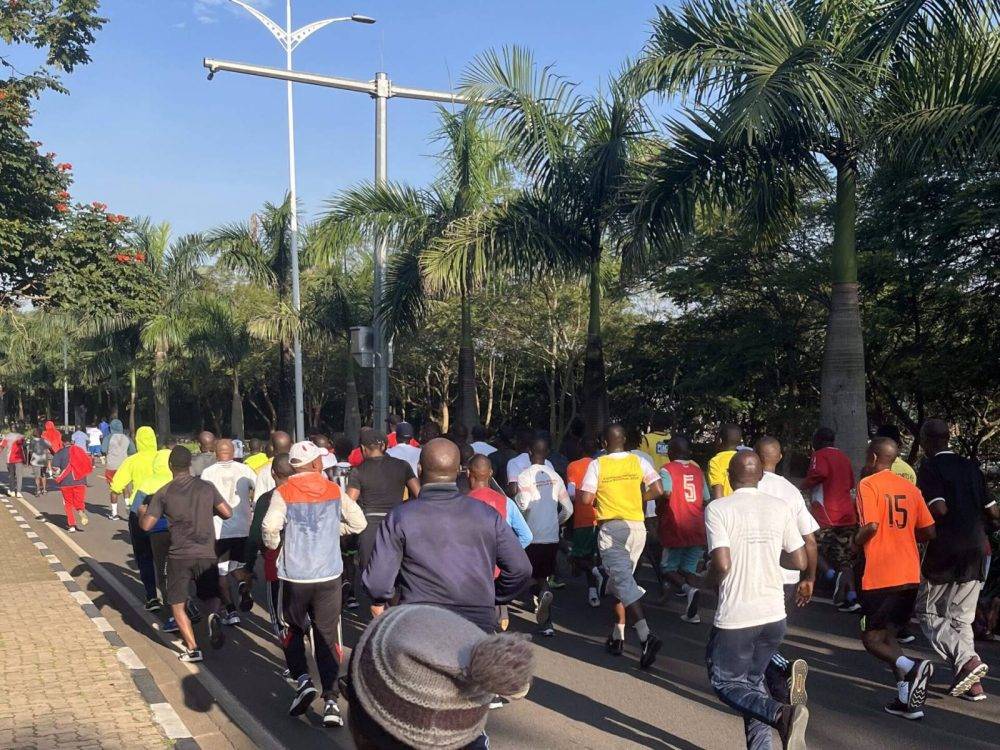
Public health officials say the project — which has been running for the past nine years — is an attempt to keep the air, and those who live in the city, healthier.
“From the beginning, it was a win-win collaborative initiative to help make Kigali green, improve air quality and promote physical activity,” says Joseph Mucumbitsi, chairperson of the Rwanda NCD Alliance at the NCD Alliance Global Forum, a global public health conference which was held in Kigali last week.
“It’s a good example of how you can bring together prevention and early detection for noncommunicable diseases (NCDs, such as heart and lung disease), physical activity and clean air.”
Getting people moving
Every year cities around the world, from Jinja in Uganda to Vancouver in Canada, celebrate car-free days.
Projects like this, which includes international Car-Free Day, can help solve a worldwide problem. Nearly 1.8 billion people (a third of all adults worldwide) don’t get enough physical activity to keep them healthy, putting them at risk of developing conditions like type 2 diabetes, heart disease and certain cancers. It can also help lower air pollution from vehicles, which contributes to climate change and health problems, such as strokes, cancer and asthma.
“They’re a powerful way to change the behaviour and mindsets of citizens and policymakers by showing them what cities without traffic, noise or air pollution can look like,” says Carly Gilbert-Patrick, who leads the active mobility team at the United Nations Environment Programme.
‘Local government buy-in is key’
In South Africa, Cape Town has also been experimenting with car-free Sundays for the past few months. With help from the city’s urban mobility directorate, the nonprofit Young Urbanists South Africa closes off Bree Street to traffic from 10am to 5pm.
The experiment, which started in October and will end in March, draws about 1 000 people every week, according to Roland Postma, managing director of Young Urbanists. He says the project also has a healthy living element. With the help of artificial intelligence cameras, they measure the speed of people walking and cycling.
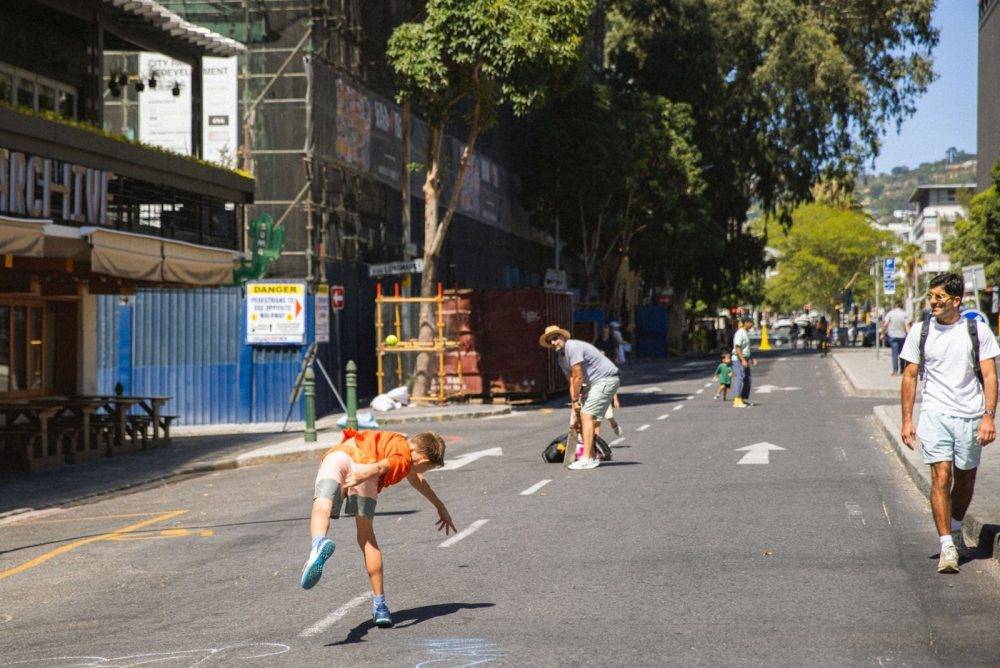
Mayoral committee member for urban mobility Rob Quintas says the city hopes other parts of the city will organise similar days on their streets.
But it won’t be easy.
In 2015, some streets in Sandton went car-free. At the time, the City of Johannesburg estimated that 120 000 commuters and 75 000 cars crammed through the district. The project brought down the number of cars on four main roads leading into Sandton by 8% compared to two years before the event, which can help lower air pollution in the area. But studies have also found that car-free days aren’t the only answer to clearing the air — it can just shift traffic and air pollution to another part of the city.
Reginald Kgwedi, transport economist and founder of the Transport and Logistics Students Association, a networking platform that connects transport and logistics students, says part of the problem is that there isn’t public transport infrastructure to support non-motorised transport like walking and cycling.
And South Africans love their cars.
“The culture here is that we drive from home to work and to the shops because there aren’t safe and reliable alternatives in the form of public transport,” he says.
And safety, especially in Johannesburg is an issue when you tell people to walk the streets. “Is it safe in terms of crime and the accidents that can happen?”
But the bigger issue is that projects like the Sandton car-free month, aren’t a priority for the government making their solutions short-lived. “There are grants that local governments can apply for to implement such projects but there is no political will.”
Ariella Rojhani, director of the partnership for healthy cities at Vital Strategies, an international public health nonprofit that works with cities around the world to roll out projects like car-free days, says that it isn’t just a South African problem — local government buy-in is key.
“You have to engage local governments,” Rojhani says. “Mayors themselves are policy leaders and they have jurisdictions that maybe even national governments don’t.”
Hands-on health
Kigali has had the buy-in from city officials from the start. It started in 2016 with a once-a-month event and has spread to streets in four districts across the city; a few other cities around the country have also started their own car-free days.
On car-free Sundays, coaches lead warm-up sessions and residents kick around soccer balls or play table tennis in the streets. The health ministry takes an even more hands-on approach to improving residents’ health.
“We have screenings for high blood pressure and blood sugar,” says Francois Uwinkindi, division manager for NCDs at the Rwanda Biomedical Centre. “We’re also seeing other programmes like education campaigns on other health issues here, like HIV prevention and self-breast examinations for cancer.”
From 2016 to 2020, nearly 50 000 people were screened for NCDs. Nearly a quarter of those tested had high blood pressure, 10% had high blood sugar and 11% were obese.
But the screening process still needs to be improved, says Uwinkindi. Some people are screened more often than they need to be, while some of those who are at risk don’t go for treatment.
“We tell them to go to their nearest health facility for confirmation and they can then get on treatment, but we don’t have a system to track the movement of them and that’s something we need to come up with a strategy to evaluate.”
Ishimwe had his weight and blood pressure checked a few times. He knows he’s healthy.
“It’s good for the health of the citizens,” he said before rejoining the crowd. “You see how everyone is so excited to run?”
This story was produced by the Bhekisisa Centre for Health Journalism. Sign up for the newsletter.
Submit and get free exposure here: Showcase Your Business | Advertise Your Special Offers.
