
EFF manifesto launch fails uncharacteristically to pull expected crowds:

The Economic Freedom Fighter’s leader Julius Malema delivered a revised manifesto reiterating much of the party’s 2019 policy line on Saturday at the Moses Mabhida Stadium in Durban.
In what was unfamiliar to the EFF leader, Malema delivered his manifesto to a lacklustre audience having failed to deliver on his promise to fill up the stadium. Malema was also let down by the wet weather conditions which resulted in many of the party supporters fleeing for cover in the middle of his speech.
The party leader made various promises, some of which would need the constitution to be amended.
The party leader is hoping that his 248-page manifesto document called “Our Land & Jobs Now. Stop Load-Shedding” will deliver him a victory in the coming elections.
The EFF’s choice of venue for this year’s manifesto is partly believed to be a major part of its strategy to yank away the KwaZulu-Natal province under the ANC.
The party’s manifesto seeks to change the constitution in what it says will strengthen democratic participation. The party said parliament must not depend on the president to initiate and pass laws.
The party said parliament will have the final say on the appointments of the governor of the South African Reserve Bank (SARB), Chapter 9 institutions, state enterprises, the commissioner of the SARB and the inspector general.
“The EFF government will change the constitutional structure, including the abolition of the provincial sphere of government, accompanied by a mass restructuring, and strengthening of local government spheres into a unitary state,” it said.
It has again called for the reduction, frequency, and cost of elections by holding national and local government elections at the same time to enhance political stability and accountability.
“The EFF government will amend the constitution to change the National Prosecution Authority to be a Chapter 9 institution,” it said. This means it will be independent, and subject only to the constitution and the law.
Correctional services
The party’s manifesto wants the correctional services system to be transformed to include compulsory education and skills for all prisoners.
It said that this would be followed by the scrapping of the criminal record statuses of ex-convicts who were convicted of certain schedules of crime, depending on the seriousness of the crimes committed.
“The EFF government will ensure that there is substance to rehabilitation programmes to properly reintegrate ex-offenders as productive, useful, and law-abiding citizens. The EFF government will ensure that no correctional services facility or programme is run by a private corporation or company.
“The EFF government will ensure equality before the law, regardless of class, gender, or race. The EFF government will prioritise rehabilitation, correctional behaviour, and counselling programmes as the fundamental programmes run by correctional services, complemented by skills development and academic training rehabilitation programmes, it stated.
The document states that it will establish economic justice courts to adjudicate civil matters involving both individuals and corporations, to achieve maximum justice for those who have been unlawfully mistreated and exploited by corporations. It will also criminalise the use of state agencies to victimise, harass, or kill members of the population, whether privately or publicly.
State security
The party’s manifesto states that it will call for the restructuring of the State Security Agency (SSA) by separating its domestic and foreign intelligence functions.
“This restructuring will aim to enhance operational effectiveness, reduce the potential for political manipulation, and ensure that the agency better serves the interests of all South Africans, in line with the EFF’s goals for efficient governance.”
The document added that it will strengthen accountability within the SSA by ensuring regular and transparent reporting to parliamentary committees responsible for overseeing intelligence services.
“The EFF government will expand efforts to foster dialogue and cooperation with external stakeholders. This approach will enhance transparency and accountability in the functioning of the SSA, consistent with our values of participatory democracy. The EFF will emphasise and enhance collaboration between the SSA and other law enforcement agencies to protect the South African citizens and sovereignty of the country,” it stated.
State capacity
The party has committed to re-nationalise SASOL, ArcelorMittal and maximally expand the capacity of the African Exploration Mining and Finance Corporation (AEMFC) as a state-owned mining company.
Part of revitalising state capacity will include the establishment of a State-owned Assets Supervision and Administration Commission (SASAC) which it said will consistently oversee state-owned companies and intervene when things go wrong.
“The EFF government will position the larger state-owned companies to initiate massive infrastructure and developmental investments in other parts of the world, particularly on the African continent,” it said.
The party wants to amend the Public Finance Management Act and Municipal Finance Management Act to make it compulsory for all spheres of government to directly provide services in areas that are inherent functions of the state.
“The EFF government will insource all outsourced security guards, cleaners, drivers, gardeners, and general workers who work at government departments and facilities, hospitals, clinics, police stations, border post offices, correctional facilities, schools and state-owned companies and it will employ an additional 80 000 workers within six months of being elected to government, with pension and leave benefits,” it said.
The party said that it would employ all public servants on a full-time basis, with a clear employment contract and performance agreement.
“The EFF government will review and upgrade the salaries of teachers, nurses, police officials, soldiers, warders, and all general workers to narrow the gap between the highest and lowest paid government workers. A minimum of 50% of all senior positions in government must be occupied by women, with equal pay, by 2025,” it stated.
Malema says coal and nuclear are needed to end load-shedding:

Economic Freedom Fighters leader Julius Malema says when the party gets a chance to govern, it will stop the plans to decommission seven coal-fired power stations, which are expected to be closed by 2032.
Speaking during the party’s manifesto launch on Saturday themed “our land, jobs now and end load-shedding”, Malema said decommissioning power plants goes against the needs of South Africans.
Malema added that ending load-shedding includes extending the lifespan of coal-fired power stations until the renewable energy sector can prove it can generate enough megawatts to sustain the country.
Shutting down coal power stations is part of the country’s plan to move away from fossil fuels, including coal. This is part of the Paris Agreement– a legally binding document signed by countries with the goal to hold “the increase in the global average temperature to well below 2°C above pre-industrial levels”. As part of the agreement, South Africa plans to move to cleaner energy to lower emissions.
South Africans have been subjected to 16 years of load-shedding due to bad planning, a lack of maintenance and corruption like looting at Eskom all of which have contributed towards slow economic growth.
Concerns about insufficient baseload – the minimum level of demand on the electrical grid at a time – have characterised discussions around renewable energy, specifically about what happens during peak demand periods when the sun isn’t shining or there is no wind.
Malema said to solve load-shedding, the party will ensure “the security of electricity supply for at least the next 20 years, emulating successful models like that of China, to foster national sovereignty and sustainable economic growth”.
This is as the country was plunged into stage six load-shedding on Saturday after Eskom said it faced setbacks due to multiple generating units being taken out of service (ten generating units).
In a statement, Eskom said it had lost 50% of its generating units because of tube leaks. “This resulted in insufficient generation capacity. Additionally, the delay in returning three units from planned maintenance also contributed to inadequate generation capacity and increased reliance on emergency reserves,” Eskom said.
On Saturday, Malema said the EFF government will enhance technical capacity by collaborating with China and other friendly nations to repair and restore coal power stations,” Malema said.
“The EFF government will engage with strategic partners to build a nuclear power plant in South Africa through a transparent procurement process.”
“This facility is planned to produce between 3 000 and 6 000 megawatts of electricity, under a 20-year Build-Operate-Transfer (BOT) contract. This initiative will augment South Africa’s electricity generation capacity and symbolise a significant step towards energy independence and sustainable development,” Malema said.
He added that the EFF manifesto’s plans to solve the electricity crisis extend to eradicating illegal electricity connections, launching an electricity safety campaign and investing in the electrification of the African continent.
Tour of Komati power station reveals dilemmas:
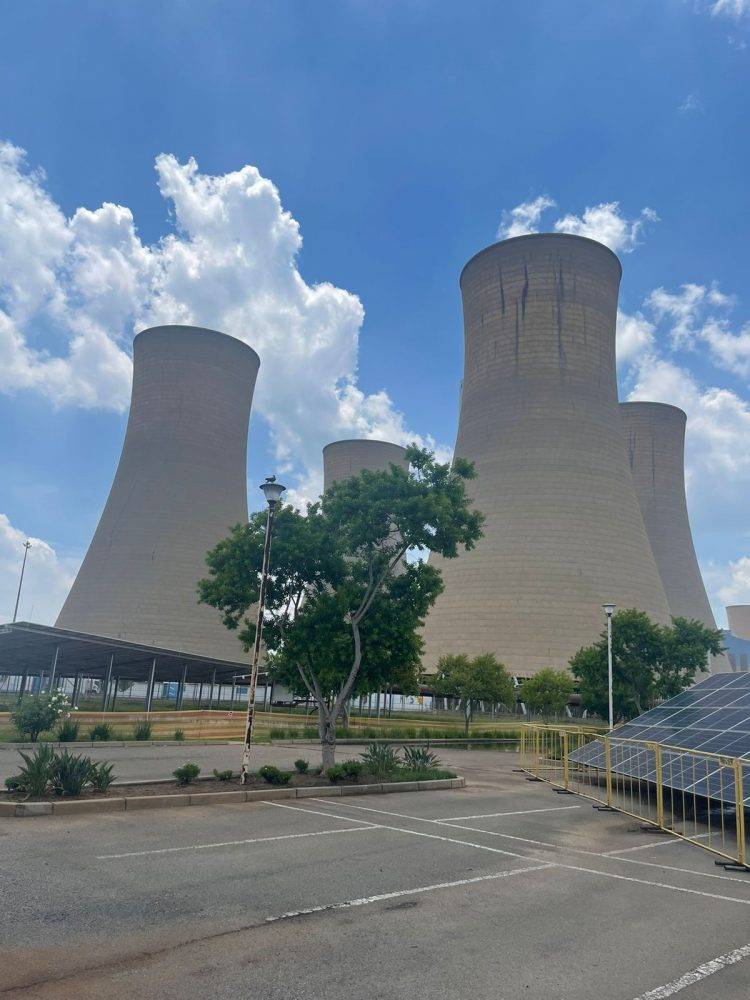
Achieving a just transition needs years of planning – without it, people will suffer

Submit and get free exposure here: Showcase Your Business | Advertise Your Special Offers.
