Ekurhuleni finances in the positive, says Malema:

Economic Freedom Fighters leader Julius Malema has denied claims that Ekurhuleni is in a state of financial disrepair — an allegation the party has suggested is being used against it in the run-up to the pivotal 2024 elections.
“Today they want to create an impression that Ekurhuleni has got financial problems. They even put a motion in the council that Ekurhuleni is about to be bankrupt. We went into the council, opened the books of the municipality. Ekurhuleni is in the positive. It is not negative” Malema said.
“The finances of Ekurhuleni were stabilised by the EFF.”
Malema was addressing more than 5 000 EFF members at the party’s Gauteng provincial ground forces forum on Sunday.
The province will be an important battleground for the party, where it currently co-governs two metros — Ekurhuleni and Johannesburg — alongside the ANC, under a deal in which they have agreed that smaller parties’ councillors ascend to the mayoral positions. But recent reports suggest that cracks are emerging in the EFF-ANC partnership.
Malema’s statement about Ekurhuleni’s financial position echo those of EFF Gauteng leader Nkululeko Dunga, who said the allegation that the party is misusing funds is politically motivated.
This after ANC Ekurhuleni chairperson Jongizizwe Dlabathi complained that the EFF’s leadership were using taxpayers’ money for their personal use.
“This is propaganda by the ANC in the metro, because despite the [allegations] from Jongizizwe, Ekurhuleni is more financially stable and in a better position than any other municipalities in the province,” Dunga told the Mail & Guardian.
He said unlike other metros, Ekurhuleni had demonstrated through its first quarter report that its financial position was better, saying: “We hit the 93% target on the collection rate meaning our budget is funded. We are only servicing the current debt [to] Eskom with no overdue amount.”
“The City of Tshwane’s finances are in shambles, the City of Johannesburg cannot collect revenue and they are struggling to pay workers, and the financial office there is run by an ANC cadre, Dada Morero.”
The face-off between the ANC and the EFF comes as the latter party appears to be gaining considerable ground ahead of the election.
As both parties prepare for the battle at the polls, the ANC’s highest decision body, the national executive committee (NEC), last month discussed re-evaluating the coalition with the EFF, citing fear of losing votes in 2024.
A presentation to the NEC by the ANC’s head of political education, David Makhura, accused the EFF of abusing its coalition partnerships with the ANC to undermine the governing party’s support. “The EFF uses coalitions to contest the ANC’s social base and further damage its brand,” the document read.
It said the party’s internal research showed that in by-elections, the EFF was still growing “mainly in the traditional base of the ANC; its growth is levelling up below 20%”.
On Monday, Mzwandile Masina, a former ANC Ekurhuleni chairperson, also said the party should not maintain the partnership, saying the relationship confused supporters and legitimised the EFF.
At the beginning of his address on Sunday, Malema suggested an ANC loss at the polls next year is a foregone conclusion. “Those who think and believe the ANC will survive the 2024 national and provincial elections need very close medical and psychiatric observation,” the EFF leader said.
“We are in no doubt that from 2024 onwards, the EFF will constitute the government of South Africa and will play a central role in the governance of the province of Gauteng, KwaZulu-Natal, Limpopo, North West, Mpumalanga and all over South Africa.”
The post Ekurhuleni finances in the positive, says Malema appeared first on The Mail & Guardian.
Gaza: The pain of tragedy viewed from afar:
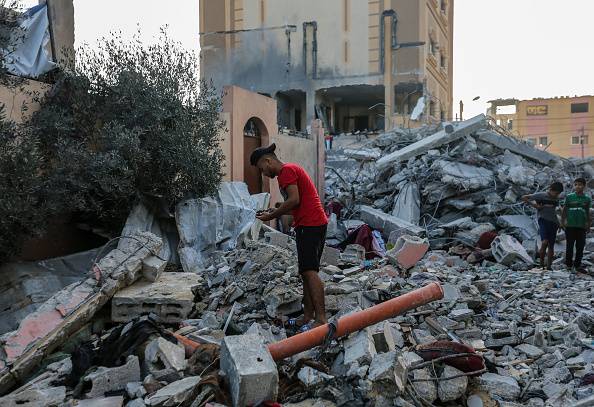
Outraged. All the words scramble to make their way through, I open my mouth to say something but no words come out. Nothing can describe any of this. Some have used the word “genocide” but it feels inadequate. The scale of the tragedy is immense, with more than *9 000 people killed, most of them women and children. It’s a term too limited to capture the sheer terror experienced when they heard the last explosion. The birds could escape, but they couldn’t. Instead they were trapped under the rubble of their own homes along with their memories and dreams killed by Israeli missiles.
The word also falls short in describing a father holding in a bag the remains of what he could find of his child who was torn to pieces by the bombardment. It doesn’t convey the heartbreaking image of a father covering his seven-year-old with a blanket before burying him, so he doesn’t feel cold in the grave. It can’t capture the three-year-old who survived, with his face covered in red blood, while his entire family was killed by Israel. What could a three-year-old possibly be guilty of?
“The kids died before eating.” These words by a Gazan mother haunt my thoughts. And a boy begging his father to “wake up” but nothing can bring him back for Israel has killed him. I heard a story about two sisters who survived one bombardment only to be killed in the next. A girl wrote her name on her arm — Ameera Shehab — so that she could be identified if she were killed by the Israeli missiles.
The Israeli bombardment continues relentlessly, targeting hospitals, schools, churches, mosques, bakeries and thousands of houses — whole neighbourhoods — resulting in thousands of deaths and leaving the survivors homeless. Israel has imposed a blockade on the Gaza Strip, depriving people of food, water, medical attention and electricity.
While the Western media keeps mentioning the “attack on 7 October”, this is not the whole story. Every story needs context, and so does this one. The roots of this crisis go back further than 2006, when Gaza was besieged, with 2.3 million people, half of whom are children, subjected to Israeli control over what goes in and out of Gaza, including basic goods, medicine and even fishing restrictions.
Rescind that, this didn’t start in 2006. This story goes back further than 1948, when the people of Palestine, whether Muslims or Christians, were dispossessed, their lands seized, and they were subjected to ethnic cleansing and numerous massacres to establish the “State of Israel”.
These injustices persist, with ongoing killings of Palestinian whether in Gaza, the West Bank or Jerusalem, land seizures and imprisoning thousands of political prisoners, including children and women. All these atrocities and injustices have been met with international silence, and only occasional condemnations of the actions of the “apartheid State of Israel” against the indigenous people of the land. No concrete action has been taken to stop this suffering.
I’m not Gazan but all Palestinians are family. I was thinking the other day about how each Palestinian has a story. Some in Gaza, some in the West Bank, some in what is now called Israel. And some in the diaspora, my family being one of them. My family fled the West Bank after Israel occupied it in 1967. I have never visited Palestine. Israel will not allow me to enter Palestine, despite the fact that I have family there. Despite my grandfather’s house being there, I cannot go and live there. But Palestine is the only place that I can truly call home even if I have no documents to prove I’m Palestinian.
My father has lived in South Africa since he was in his twenties so he got the citizenship and I grew up here too, so South Africa is my second home.
As a South African Palestinian, I can’t help but draw parallels between the shared histories and struggles of the two peoples, their resistance and fights for their lives, rights and liberation. It’s not a complicated issue; it’s simply a matter of years of occupation, apartheid and genocide. People in Palestine are crying for our help, and I can only hear South Africa chanting “Amandla” to which Palestinians will respond “Awethu”.
*The number of people killed was updated more than three times before I could finalise the writing of this article.
??Maryam Douglas is a Palestinian-South African student based in Gqeberha.
The post Gaza: The pain of tragedy viewed from afar appeared first on The Mail & Guardian.
Ramokgopa promises November delivery date for updated IRP:
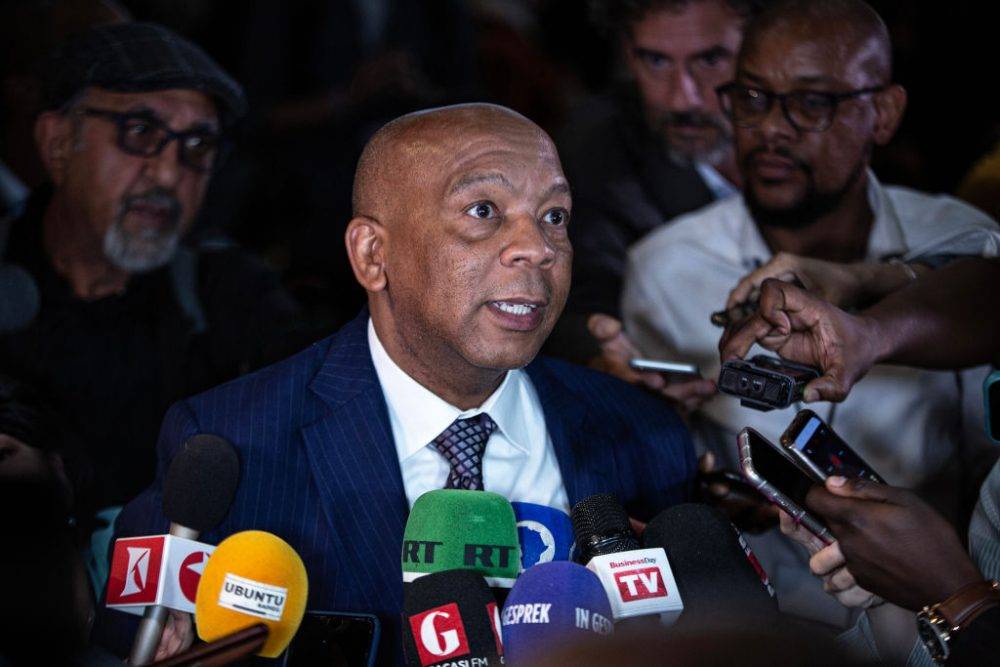
The updated Integrated Resource Plan (IRP) — which will set out the country’s electricity investment strategy up until 2030 — is at “an advanced stage”, according to Electricity Minister Kgosientsho Ramokgopa.
Ramokgopa, who was updating the public on the implementation of the Energy Action Plan on Sunday, indicated that the development of the so-called “IRP 2023” has reached the final stretch.
The minister said he was confident that the IRP would be presented to cabinet before the end of November, conceding that this date will mark a three-month delay.
Mineral Resources and Energy Minister Gwede Mantashe, who is in charge of developing the IRP, has received criticism for his failure to table an updated plan.
The IRP is an electricity infrastructure plan which shows the country’s long-term electricity demand, how this demand will be supplied — and what it will cost. Without the IRP 2023, South Africa has had to rely on the assumptions contained in the 2019 version of the plan.
“It’s important because it will inform all of our actions going into the future — what will constitute our energy mix. And of course that will determine what kind of investments, the scale of investments, that we will be making in the South African economy to ensure that we are able to meet that need, that we are able to resolve load-shedding and that, in the long term there is energy security,” Ramokgopa said on Sunday.
Two weeks ago, the Democratic Alliance lambasted President Cyril Ramaphosa’s cabinet for allowing Mantashe to drag his feet on the IRP.
“Mantashe has missed several self-imposed deadlines to release an updated IRP, a failure for which he has faced no real consequences,” the opposition party said in a statement.
The DA later added: “It boggles the mind that Ramaphosa has been quick to establish a national crisis committee and energy task teams but has failed to show the same zeal in expediting South Africa’s electricity generation roadmap through the IRP.”
If the governing ANC fails to bring the electricity crisis to heel, ongoing load-shedding could count against the party in the upcoming elections.
Ramokgopa also provided an update on the return of Koeberg unit one, a process which has also been beset by delays. “All the work has been done now on the part of Eskom,” the minister noted, adding that the utility is now awaiting feedback from the regulator.
Koeberg unit one has been offline since December 2022 for maintenance, refuelling and refurbishment. The Koeberg refurbishments are part of Eskom’s efforts to extend the nuclear power station’s operating licence for another 20 years.
Once unit one gets the “thumbs up”, Ramokgopa said, unit two can be taken offline — scheduled to happen on 25 November. The minister noted, however, that there is still a chance the regulator will not approve Koeberg unit one’s return to operation.
The post Ramokgopa promises November delivery date for updated IRP appeared first on The Mail & Guardian.
Submit and get free exposure here: Showcase Your Business | Advertise Your Special Offers.