
Empire, knowledge and erasure: Bombing Iran is bombing memory:
Empire does not begin with bombs. It begins with stories. Before missiles strike, a narrative must be written to make the target bombable. Colonial narrative, as postcolonial historian Ranajit Guha shows in A Conquest Foretold, transforms conquest into destiny. It prepares the public to accept war as not only inevitable but righteous.
It is not simply that Iran was bombed on 13 June 2025. It is that the idea of Iran and its right to hold memory, to produce knowledge, to exist as a civilisational subject was already rendered illegible.
The Israeli assault on Iran was defended in familiar terms — an imminent nuclear threat, national security, surgical precision. But these are not explanations. They are scripts. Like the invasion of Iraq in 2003, the attack on Iran was rationalised through an architecture of claims that do not require evidence, only repetition. Intelligence reports denying Iran’s weapons programme were irrelevant. The narrative had already been written.
Guha’s insight is clear — Empire writes the future in advance. The British conquest of India was not sealed at the Battle of Plassey in 1757. That battle was a minor military affair. And yet, in British imperial historiography, Plassey was elevated to a grand foundational moment, the start of British rule in India, the point at which the East India Company became a territorial power.
As Guha points out, it was this narrative that was repeated in schoolbooks, official dispatches and parliamentary speeches. It provided the ideological foundation for expanding British rule. While the real event was modest and sordid, the story told about it became grand and civilisational.
Guha painstakingly shows that conquest must be justified, not just enacted. He draws from the writings of figures like Robert Orme, an official historian of the East India Company, who openly declared that “the sword is the charter”. This chilling phrase captures the heart of imperial logic — that might creates right. Violence, if victorious, rewrites itself as law. The act of domination becomes the foundation of legitimacy.
What Guha reveals is that empires do not just win battles, they write the laws and the history books. They tell the story in such a way that the destruction appears noble, even necessary. The conquered are not only defeated on the ground; they are also written out of history.
This symbolic process, Guha argues, is what transforms the “instant of aggression” into the logic of rule. The colonial archive did not record India’s conquest merely as fact. It reworked it as a historical necessity, a fulfilment of a moral and civilisational order. This allowed future wars, occupations and annexations to be narrated not as violence, but as destiny. Guha calls this “a conquest foretold”, a fate legitimised before it is ever enforced.
This continues today. The West does not simply bomb places. It un-names them. In the mainstream media, Iran is rarely presented as a site of knowledge, history or intellectual contribution. It is a shadow space: nuclear, irrational, volatile, fanatical, alien, frightening. Colonial narratives render people fungible, bombable and, ultimately, forgettable. They reduce cities to targets, its people to collateral and magnificent civilisational archives to dust.
Literary theorist Edward Said showed clearly that the Orient was never just misunderstood. It was constructed. It was imagined as timeless, barbaric, hyper-religious and fundamentally unfit for self-rule. This epistemic violence enabled actual violence. When the drones strike, they do so on the back of a long intellectual history that emptied the East of sovereignty.
Said’s Orientalism is a study of how European and American thinkers created a fictional image of the East, a world of despots, harems, fanaticism and mystery. This fantasy was not harmless. It underpinned policy, war and occupation. Said wanted readers to understand that power works not only through tanks and armies, but also through language, maps and books.
How we speak about a place, whether on TV or in schools, shapes what we believe can or should happen to it. When the East is painted as irrational and dangerous, bombing it becomes not a horror, but a duty.
Orientalism, Said shows, is not an error of perception. It is a system of power. Through universities, literature, policy and media, the West defined the East as the inverse of itself: irrational, feminine, despotic. This representation justified intervention. If the East could not govern itself, then governance must be imposed from without. Once internalised, this logic rendered bombing not only possible but legible as order, as responsibility, as peacekeeping. Violence becomes virtue.
Iran has a long and magnificent intellectual history. The Academy of Gundishapur in Khuzestan, Iran, was one of the oldest universities in the world. Founded in the third century CE, it was a centre for multilingual scholarship where Sanskrit medical texts were translated into Middle Persian, Greek logic was systematised and Babylonian astronomy refined. It was here that clinical observation became a method of medical teaching, surgery was formalised and knowledge travelled across linguistic and cultural lines, centuries before Oxford opened its gates in 1096 or Cambridge in 1209.
The very model of the Western university, its division into faculties, the logic of disputation, the canon of philosophy and science, was shaped by Iranian and Islamic precedents. The Bayt al-Hikma (House of Wisdom) in Abbasid Baghdad, deeply influenced by Persian scholarship, became the template for later European institutions.
When Arabic and Persian texts were translated into Latin in Andalusia and Sicily, they were not curiosities, they were the architecture of another world being absorbed. There would be no scholastic tradition without al-Farabi and al-Tusi, no experimental method without al-Razi and no algebra without al-Khwarizmi.
These networks extended even further south. Persian texts and Islamic jurisprudence travelled along trans-Saharan trade routes into West Africa. At Sankoré University in Timbuktu, scholars studied Avicenna and al-Ghazali alongside local astronomers and jurists. Libraries in desert towns preserved manuscripts copied in Persian script. These were not isolated developments. They formed part of an intellectual system that preceded and shaped the European Enlightenment.
From Baghdad’s Bayt al-Hikma to the libraries of Timbuktu, Persian and Arabic texts travelled along trade routes, translated, adapted and taught across generations. The commentaries of al-Farabi, al-Tusi and Avicenna informed the very structure of the Western university. Algebra, optics and medicine — none of these can be understood without Iran.
This history was not just ignored by European colonialism. It was actively erased. During colonial rule in India, the British administration removed Persian as a court and scholarly language, replacing it with English and thereby severing centuries of transregional intellectual continuity between South Asia, Central Asia and the Iranian plateau. Persian manuscripts were stripped of context and displayed as exotic artefacts in museums. Its philosophy was recast as mysticism. Its scientific legacy was reduced to footnotes or omitted altogether.
Tabriz, struck in the June 2025 attack, is not just a military site. It is the city of Shams al-Din Tabrizi, Rumi’s teacher and a centre of Persian mysticism and learning. It is a node in a centuries-old network of philosophy, theology, mathematics, astronomy and poetry that spanned from Khurasan to Mali. These were not isolated traditions. They were the foundations of a civilisational archive beyond the borders and imagination of Europe.
And yet, in the dominant Western imagination, Iran is nothing but a sinister, irrational enemy of the West.
This is not ignorance. It is design. It is an instance of what Guha and Said both expose: the strategic construction of the South as a site of absence. A place whose people are forgettable, whose knowledge is disposable, whose destruction is thinkable.
We have seen this before. Iraq’s libraries were looted. Mosul’s university was razed. Gaza’s schools, universities and archives were bombed into nothingness. In each case, what is attacked is not just infrastructure but the right to remember, to dream, to transmit. Epistemic erasure is not collateral damage. It is the method of neocolonial domination.
To centre the epistemic is not to look away from the dead. It is to insist that their lives were lived in full. It is to understand that the people of Iran are not footnotes to someone else’s future. That they are authors, carriers of meaning and custodians of a world that Empire has tried again and again to silence.
This war, like all imperial wars, is not just about sovereignty. It is about the terms of knowledge. Who gets to define history. Who gets to remember.
Until we refuse the stories that make us invisible and tell our own stories, we will never escape the imperial forces that deny our full and equal humanity.
Vashna Jagarnath is a historian, political risk and diversity, equity, and inclusion consultant, labour expert, pan-African and South Asian political analyst and curriculum specialist.
South Africa’s export economy at risk as global carbon rules tighten:
South Africa’s carbon-intensive export model faces rising risks in a global economy that is increasingly shaped by climate policy, clean energy industrial strategies and cross-border carbon pricing.
This is according to a new report released by Net Zero Tracker, which noted that, as countries ratchet up decarbonisation to meet their Paris Agreement climate commitments, the clean energy transition is redrawing the global trade map.
“South Africa’s formal net zero target for 2050 sits uneasily alongside short-term energy decisions that prioritise fossil fuel expansion and delay coal phase-out,” the analysis from researchers at Net Zero Tracker said, adding that this is undermining confidence in the country’s decarbonisation trajectory and exposing its carbon-intensive exports to growing international risk.
Overall, 78% of South Africa’s exports, worth $ 135 billion, are sold to countries with net zero targets, supporting 1.2 million domestic jobs — or 7.5% of national employment in 2023.
The report found that 422 000 South African jobs are tied to exports to economies with active or incoming carbon border adjustment mechanisms (CBAMs), with almost 90 000 linked to countries considering similar measures.
CBAMs involve the imposition of a carbon tariff on imported goods, based on the level of embedded emissions in the goods and the carbon price paid by the manufacturers thereof in the country of origin.
China, South Africa’s largest trading partner, imported $ 31.1 billion in goods and services in 2023, more than 98% from sectors where the emissions intensity of the country’s production exceeds that of China, Net Zero Tracker said.
“As China moves to price domestic carbon more systematically, these sectors may face growing carbon scrutiny. As climate policies like CBAMs gain traction, there is a risk that Global South countries like South Africa are unfairly penalised, despite having low historical and per capita emissions.”
The Basic group — Brazil, South Africa, India, and China — has criticised CBAMs as an “unfair shifting of responsibilities from developed to developing countries”, warning they
could “aggravate the trust deficit amongst parties”, the analysis noted.
“For developed countries, closing this trust gap and aligning trade with international equity requires upholding the Paris Agreement principle of common but differentiated responsibilities and ensuring unilateral measures like CBAMs are paired with financial, technical and capacity support for developing economies,” it said.
Key sectors under threat
Alongside government policy, multinational companies are decarbonising supply chains, increasing the economic costs of inaction for countries that lag on driving decarbonisation of their electricity grids.
In South Africa’s 10 largest export markets, 323 major companies — representing $ 11 trillion in annual revenue — have full value chain net zero commitments, “meaning South African firms in their supply chains will have to measure and reduce their own emissions”.
South Africa’s key export industries face especially acute exposure, according to the report, which said that mining and basic metals made up over 50% of South Africa’s export value in 2023, supporting more than 404 000 jobs.
The country’s basic metals sector has nearly twice the embodied carbon dioxide emissions of its next most carbon-intensive peer country, accounting for 32% of exports and 14% of GDP. More than 80% of basic metals exports go to net zero-aligned markets, and 30% — worth $ 16.7 billion and supporting 23,000 jobs — go to countries with active or incoming CBAMs.
The automotive sector, South Africa’s third-largest exporter, is also at risk with 65% of its export value being exposed to CBAMs that are either active, incoming or under discussion.
“South Africa’s embodied carbon dioxide emissions from auto manufacturing are the second highest in the world, and while existing CBAM schemes are currently focussed on raw materials their scope is expected to expand, so a proactive approach to mitigating this risk will be rewarded.”
In agriculture, South Africa faces growing competitive pressure from lower-emissions suppliers, the report said. Across all top agricultural export categories and destination markets, alternative producers exist with at least three times lower embodied emissions — and are poised to scale into those markets.
‘Environmental colonialism’
With the second-highest carbon intensity of electricity generation among major economies (behind only India), and high embodied emissions in goods, South Africa’s exports will become more vulnerable. This has implications for jobs and tackling poverty in one of the world’s most unequal societies, the analysis said.
“Yet South Africa also holds key advantages: world-class renewable energy resources, critical minerals essential to the global transition and access to major trade and diplomatic frameworks, including Brics.”
The country is a leading producer of platinum group metals, manganese, vanadium and chromium, which are critical to clean energy technologies, such as hydrogen fuel cells, batteries and wind turbines, the report said. The researchers noted, too, that the International Energy Agency projects that the country will surpass its target of nearly 30 gigawatts of total renewable capacity by 2030, as outlined in its Integrated Resource Plan.
As the US administration undermines the multilateral rules-based system, and the global trade landscape shifts beneath its feet, South Africa’s path forward is clear, according to the authors. This is to “pivot both geographically and strategically from climate laggard to leader in climate-aligned, trade-competitive growth”.
This path, however, hinges on developed countries, especially those backing South Africa’s Just Energy Transition Partnership — the UK, EU, Denmark, France, Germany and the Netherlands — delivering on their commitment to support the country’s clean energy transition.
“These governments should carefully address concerns expressed by South Africa’s government and industries to avoid CBAMs from being seen as ‘environmental colonialism’ or overly protectionist,” the researchers urged.
“Climate-related trade measures like CBAMs should be accompanied by finance and capacity-building support — otherwise these policies risk further entrenching inequality and reinforcing the perception that wealthy countries are protecting their own industry while ‘kicking away the ladder’ for others.”
Why 100% fruit juice should come with a sugar warning label:
Apples, oranges and grapes are healthy fruits. But when they are turned into juice they pack as much, or more, sugar than some sodas or energy drinks.
Under South Africa’s proposed food labelling regulations 100% fruit juices won’t be required to show a high sugar warning on their packaging because their sugars are “naturally occurring”. But because of their sugar content, nutritional experts say, when people consume too much of them, there isn’t really a healthier option between soda, flavoured water and energy drinks.
“Coke has too much sugar, but fruit juices also have too much natural sugar,” says Edzani Mphaphuli, executive director of Grow Great, a nonprofit which works to shape childhood nutrition policies.
Sugar is helping drive South Africa’s obesity rise. Over one in 10 children under five are already overweight and researchers have found that drinking just one sugar-sweetened beverage a day raises the chances of a child being overweight by more than half.
That’s part of what our proposed food labelling regulations are meant to combat.
Under the current draft — which the health department is still reviewing, according to spokesperson Foster Mohale — fruit juices will fall through a definition loophole. But that’s not what researchers who gave input on the rules recommended or what many public health experts advise.
“Our evaluation used the criteria of ‘free sugars’, where all 100% fruit juices would have carried a warning label,” says Tamryn Frank, a researcher at the University of the Western Cape who was part of the technical team. “That highlights the importance of reconsidering the best term to include when the final regulation is published.”
The World Health Organisation (WHO) says “free sugars” are sugars added to products like sodas and energy drinks, as well as those naturally found in fruits. But our current draft proposal says only products with “added sugar” will be required to carry a label.
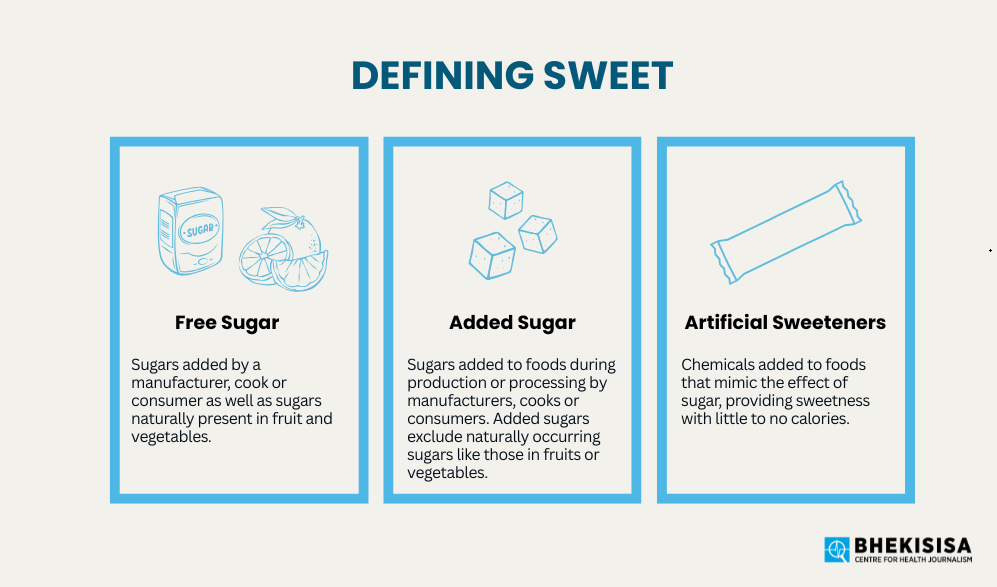
The draft regulations say any drink with more than 5g of sugar (just over one teaspoon) per 100ml, or any amount of artificial sweetener (such as the calorie-free chemicals aspartame or sucralose) must show a black-and-white triangle with the word “warning” in bold capital letters.
If passed in their current form, researchers say almost six in 10 of all sodas, energy drinks and juices sold at supermarkets in the country would carry a warning label. But while 94% of soft drinks and 97% of energy drinks would need warning labels for high sugar or artificial sweeteners, just 30% of juices would be labelled.
Pure 100% fruit juices won’t carry a warning label because their sugar is natural. But not all juices are completely natural — some contain added sugar or sweeteners — so those with more than just over a teaspoon of sugar per 100ml will still need to carry a “high in sugar” warning.
We did the sums to work out which drinks have the most sugar and which will — or won’t — need a warning label, according to the current version of the regulations.
Fruit juices
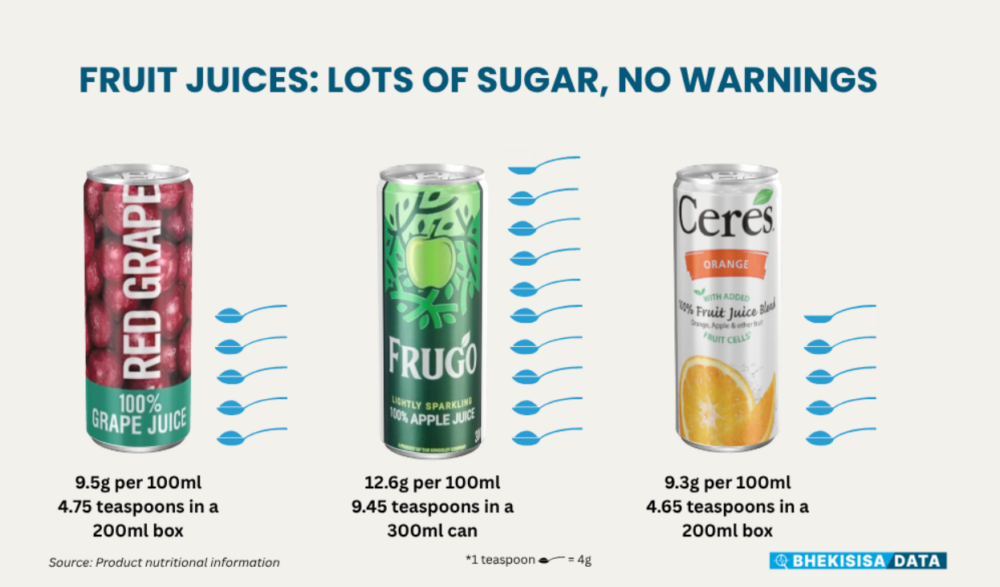
While they didn’t have any artificial sweeteners, all the juices we compared — Fruugo sparkling apple juice, Ceres orange and Rhodes grape juice — had more sugar than all of the other drinks we compared, except for Coke.
“Because they come straight from nature, people think they must be healthy. But it’s not exactly the same thing as eating a single fruit,” explains Mphaphuli. “Juice is highly concentrated and you need to dilute it with water if you’re going to give it to a child [to reduce the sugar content].”
Whole fruits are filled with fibre, which slows digestion and helps control blood sugar. But that fibre is shed when fruit is turned into juice. Without it, sugar reaches the bloodstream faster, which can cause spikes and drops in energy.
Research has shown that swapping a fruit juice for some types of whole fruit three times a week can lower a person’s chances of getting type 2 diabetes — probably because juice raises blood sugar faster and has less fibre.
A study published in the South African Journal of Clinical Nutrition earlier this year found that almost three-quarters of fruit juices have more sugar than the proposed limit. But, as regulations stand now, only 17% would require a warning label because most of the sugar is natural, not added (because the regulations only look at the total amount of sugar in products with added sugar and not those with natural sugars).
Sodas
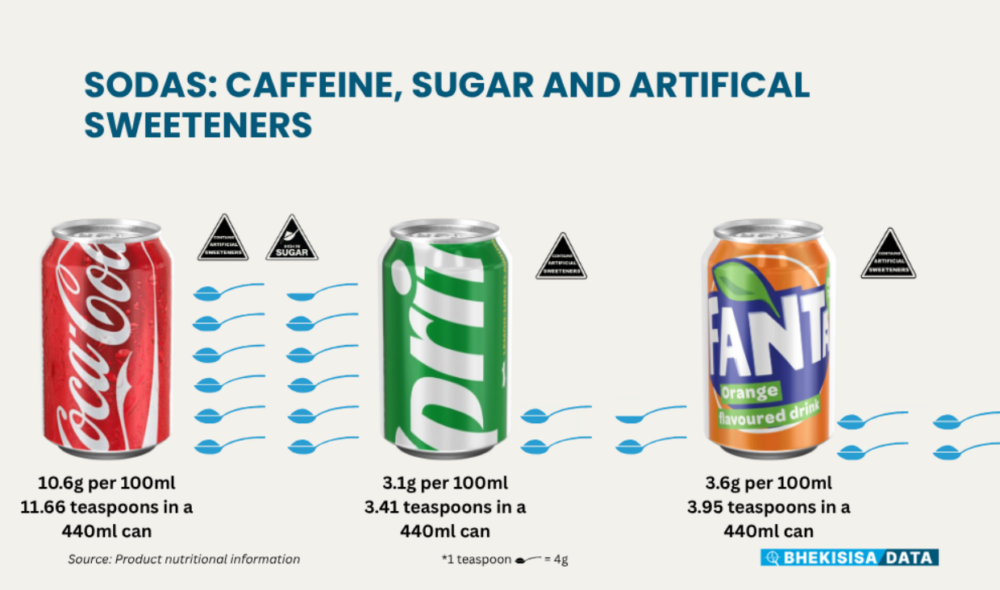
Among the three sodas, Coke has the most sugar — and is the only one that contains caffeine, a stimulant, which means it speeds up the messages travelling between the brain and the body, and can therefore make you sleep less well. Too much caffeine can lead to anxiety, restlessness and affect the way your heart beats.
The WHO says an adult should not consume more than six to 12 teaspoons of sugar per day. A can of original taste 440ml of Coke contains 2.65 teaspoons of sugar per 100ml, which means an entire can contains about 11.5 teaspoons of sugar — more than the maximum WHO daily limit.
Sodas are some of the sweetest drinks you can buy and, research shows, South Africans love them: we drink an average of 254 Coca-Cola products per person per year, almost triple the global average of 89.
Before South Africa’s tax on sugar beverages was introduced in 2018, which requires manufacturers to pay 2.1 cents tax for every gram of sugar that exceeds 4g of sugar per 100ml, the average 330ml can of soda had about 10 teaspoons of sugar. But, to avoid the tax, some producers changed the ingredients in their drinks. For example, says Frank, Sprite and Fanta drinks lowered the sugar content but added non-nutritive sweeteners to keep the sweetness.
While chemical sweeteners, which are often used in “diet” drinks, can help people with short-term weight loss, the WHO says they should “not be used as a means of achieving weight control or reducing the risk of noncommunicable diseases” like obesity in the long run. Meanwhile, the International Agency for Research on Cancer has listed aspartame, a sweetener found in diet drinks such as Fanta Zero, as a possible cause of cancer, though more research is needed.
The new regulations will require sugary drinks containing artificial sweeteners to carry the following warning on the front of the container: “This product contains artificial sweeteners. Excessive consumption may be detrimental to your health.” Manufacturers will also not be allowed to market such products to children.
“None of these products are recommended as part of a healthy diet because they don’t contain any nutrients other than sugar and energy,” says Makoma Bopape, a nutrition researcher and lecturer at the University of Limpopo. Bopape was part of the technical group who worked on the labels. “What makes it worse is the fact that some contain sweeteners.”
Energy drinks
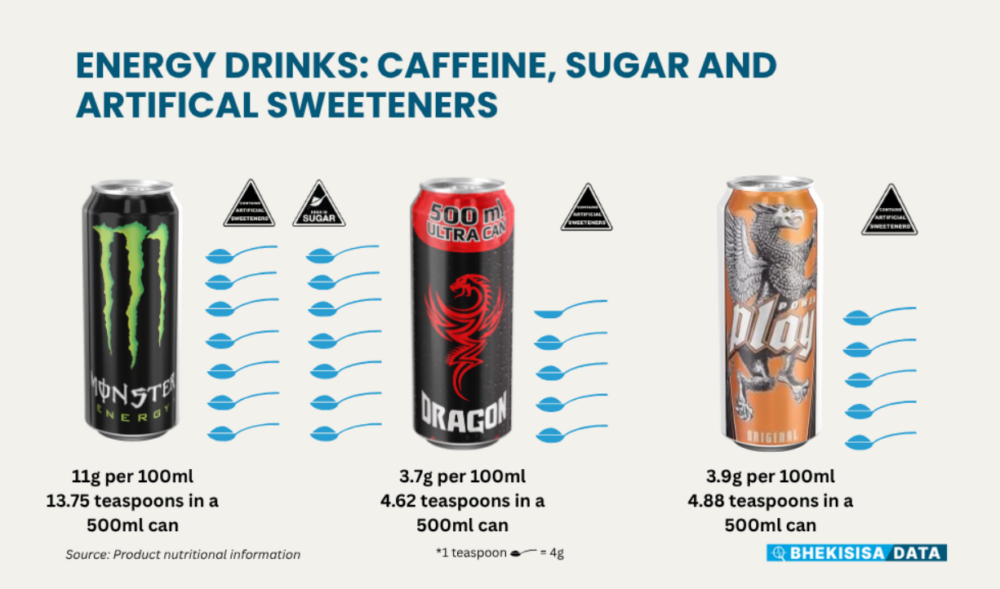
Monster has nearly four times more sugar than both Dragon and Power Play and all contain artificial sweeteners.
A 500ml can of Monster has around 13 teaspoons of sugar — more than the maximum sugar intake the WHO recommends for adults per day.
Energy drinks aren’t just packed with sugar, like many sodas, they also contain caffeine. Experts say teens who weigh between 40kg and 70kg shouldn’t consume more than 100mg — 175mg of caffeine a day. At an average of about 150mg, all three energy drinks contain almost the maximum amount of caffeine per can per day that experts recommend.
Under the proposed regulations, these three drinks would all need a warning label — either for high sugar or containing artificial sweeteners.
Flavoured water
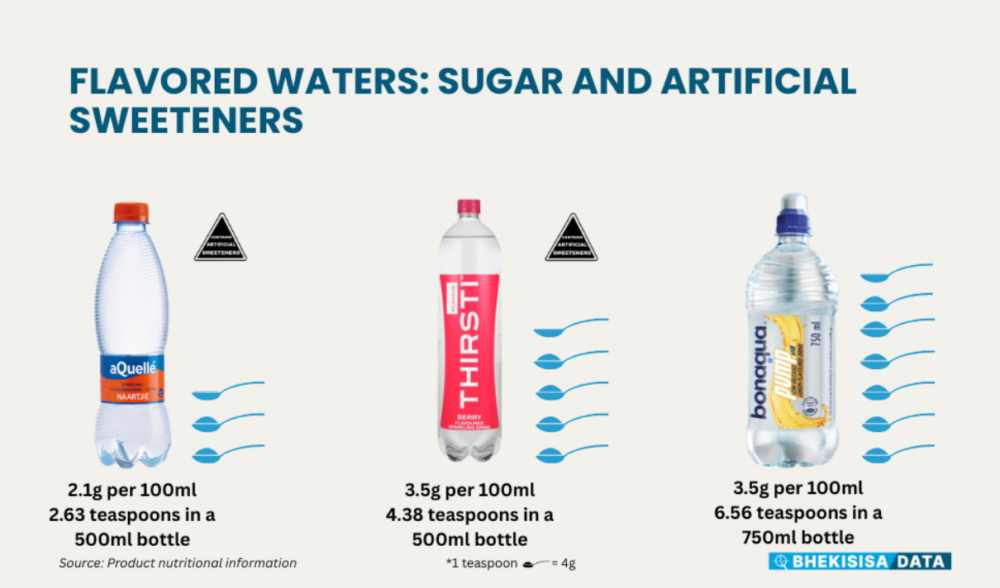
Of the three flavoured waters we looked at, Bonaqua Pump Lemon is the only one that does not contain any artificial sweeteners.
Even though they’re often marketed as “healthier” options, the flavoured waters we looked at had similar amounts of sugar and sweeteners as sodas. One option had both sugar and three sweeteners — making it more soda than water.
aQuelle naartjie and Thirsti berry use artificial sweeteners to keep the sugar low, but they respectively also contain nearly two and four full teaspoons of sugar in a 500ml bottle.
Bopape says plain water — not flavoured water — should be the preferred drink of choice.
This story was produced by the Bhekisisa Centre for Health Journalism. Sign up for the newsletter.
Submit and get free exposure here: Showcase Your Business | Advertise Your Special Offers.
