Fixing water leaks will help avert a national disaster:
We keep emphasising that South Africa is a water-stressed country and that we are reaching the limits to the resource regarding demand and growth. Yet nearly 50% — and in some areas as much as 70% — of all treated water supplied by municipalities is lost before it reaches paying or needy customers because of failing infrastructure and governance, as well as vandalism and theft. The situation, together with poor water use behaviour by consumers, puts our habitats and security at risk.
On 7 October we marked World Habitat Day and as we enter a critical period in Gauteng and other provinces with the closure of the Lesotho Highlands transfer tunnel for maintenance for the next six months, let us use the opportunity to remedy this growing problem.
The risk and cost of non-revenue water (NRW) losses to many countries has been widely documented. While some countries have demonstrated greater resilience and have recovered from these losses, for South Africa a continued trajectory can be devastating.
Not only is this an enormous financial concern, but elevated NRW loss also creates a distraction from municipalities providing full-service coverage, at a reliable level and at an affordable price. High levels of NRW loss are detrimental to the financial viability of water institutions, as well to the quality of water itself.
Non-revenue water encompasses all water losses throughout the water supply chain, from abstraction to the treatment plant and to the customer’s tap. Managing and reducing NRW loss is essential to ensure the sustainability of water supply systems, improve financial viability, and fulfil the government’s commitment to safe and reliable water services to consumers. Neglecting the NRW loss problem has severe consequences.
Wasting scarce money
The first and most foremost effect of NRW loss is an increased cost to the customer and lost revenue to the water services authority.
The cost of revenue loss as a result of unaccounted-for water is estimated at more than R16 billion a year. This is already affecting the financial stability of municipalities, making it difficult to cover operational costs and invest in system improvements. This has a knock-on effect on supporting water entities such as water boards and water intermediaries, which are forced to carry these huge debts, as well as the water trading account.
Operational costs start to spiral: The provision of water is a complex and challenging activity in South Africa, which requires large sums of capital investments. In addition to this cost, the operation costs for chemical and energy to transport clean drinking water is also high. Changes in environmental water quality (such as sewage flows without treatment) put additional burden and increase operational costs. Just the energy required for getting water to the tap can range from 30 to 60% of the operational costs of water supply. In times of energy challenges and growing tariffs water lost, results in all that energy and other operational expenses which all get wasted.
Energy needs grow: To make up for the NRW losses, additional energy is required to treat and pump extra water. Not only does this contribute to increased carbon emissions, which contributes to climate change, but the current high cost of energy and the unreliable provision of electricity puts additional pressure on the supply of water.
Institutional capacity weakened: The loss in income as a result of non-revenue water and resulting financial capacity leads to both institutional failure and the failure to attract investments. Good employees and experts tend to move away from failing municipalities, further weakening the opportunity to turn the tide of deterioration. Low staff morale and commitment exacerbates the situation.
Political will, accountability and corruption: Related to the above, change and traction to solve the problem rests with strong political will and support. Weak political support fuelled by corruption adds greater complexity and burden to deal with NRW challenges. As highlighted, not only does it not attract very necessary investment, but also drives competency away and fuels greater public protests. Those put in charge must be held accountable.
Water losses perpetuate inequity: Tariffs are increased to cover for shortfalls, leading to water becoming less affordable for low-income households, which further increases the issues of water inequity and access, pushing these households closer to or further into poverty. These extremes in usage range from five litres per capita (person) per day to more than 400 l/cap/day.
Poor operations and maintenance: A lack of investment in assets and active leakage management contributes to increasing operational costs and further straining budgets. The money and time spent in fixing leaks far outweighs the cost for replacing failed infrastructure. Furthermore, systems with high NRW loss are more frequented by service disruptions for extended periods of time.
Public health risks heightened: Inadequate and intermittent water supply NRW loss puts pressure on public health, because access to safe drinking water and sanitation services is critical for good hygiene and disease prevention. Without a reliable water supply, people resort to using unsafe water sources or forgoing proper sanitation practices.
Wasteful resource use: Conserving water is increasingly crucial to environmental sustainability. The loss of treated water represents a wasteful use of a finite and essential resource. Over-extraction of water from natural sources to compensate for NRW loss can have adverse ecological effects such as reduced river flows and habitat disruption. In addition, treated water contains levels of chlorine which, while acceptable for human consumption, can be harmful to plants, insects and other wildlife.
Tackling the NRW loss problem has many benefits, especially in the water scarce country in which we live. Securing water for human settlements should be based on water security for future generations. Strong political will, better maintenance of infrastructure and detection of leaks, improved user behaviour, as well as dedicated investments is needed to avoid a total disaster in the near future.
Jay Bhagwan is an executive at the Water Research Commission.
Bay Stadium events calendar filling up as development plans take shape:
By Anele Qaba, CEO, MBDA
With the first quarter of our financial year done, ie, July to August, we’re starting to see the fruits of a concerted and proactive approach to getting the iconic Nelson Mandela Bay Stadium, the city’s pride, humming again. The improving events calendar and development initiatives taking shape at the Bay Stadium is what the city needs. The measure of success for multipurpose facilities like the Bay Stadium is not only through what is collected at the tills, but also about the stimulus effect they have on the economy. The events economy is mainly a downstream value creator, meaning the impact is seen through economic activity and incomes generated.
When 40 000 spectators fill the Bay Stadium, with a quarter having travelled from across the province and country, those fans must sleep somewhere. They go out for entertainment, they shop, they also visit places of interest and, most importantly, they help to sustain jobs in the tourism and hospitality sector. This economic impact model is the driving force behind several initiatives that we are now fully implementing. Earlier this year, we indicated that we had commissioned a pre-feasibility and business plan to activate additional tourism products in and around the North End Lake and stadium grounds. We are now able to report on these exciting initiatives on the progress we have made to date. The overarching objective for developing additional tourism products around the lake and stadium grounds is to incentivise visitors and leverage the growing events calendar, while generating sufficient financial value to keep these initiatives sustainable.
Starting with the bulging events calendar, to date, the Bay Stadium hosted multiple non-bowl and inner-bowl events, specifically focusing on seminars, workshops, conferences, music events, high-end celebrations as well as on-field competitive football games.
Working with the South African Football Association, the financial year started off on a solid footing, having hosted seven official COSAFA CUP games, including the final, which was eventually won by the Angolan national team.
The stadium’s longest anchor tenant, Chippa United, hosted the launch of their Betway Premiership campaign from the newly revamped Bay Stadium state-of-the art press conference room. And, as fate would have it, Chippa United ushered in a new era with a pulsating 2-1 victory against Mpumalanga-based outfit, TS Galaxy.
The big news that broke in the latter part of September was the announcement we made regarding the successful pitch to host the next Bafana Bafana crucial AFCON qualifier against Congo Brazzaville on 11 October 2024. Bafana Bafana make a welcome return to Gqeberha since their last encounter against Sao Tome and Principe on 16 November 2020. This game brings about direct commercial revenue streams that will contribute to the facility’s bottom line as well as positive downstream economic spin-offs for the city, specifically in the tourism and hospitality sectors.
In pursuing an economic boosting events calendar, we also took a proactive approach to initiate and take charge of our own events. The province is positioned as the home of legends, and there is no other facility in the region more fitting than the Bay Stadium. The MBDA has initiated the inaugural Nelson Mandela Bay Home of Legends Cup aimed to be an annual showcase of African arts, culture and primarily focusing on the best football. This new iconic event will take place at the Nelson Mandela Bay Stadium in November 2024. The Home of Legends Cup is an MBDA propriety event and an initiative that has been long in the making in terms of increasing the profile of football in the region.
This tournament is scheduled for 16 November 2024 and will showcase the finest Premier Soccer League clubs in country, which are Kaizer Chiefs Football Club, Mamelodi Sundowns Football Club, Chippa United Football Club and Lamontville Golden Arrows Football Club.
With the teams secured, we are now working hard to finalise plans to unleash an arts and culture component to showcase the best in local talent and expose their repertoire on a national stadium and platform in front of a packed Bay Stadium.
In addition to the Home of Legends Cup, we did not take our eyes off the other important bowl sport, rugby. After months of planning, lobbying and pushing, we finally secured one of the most anticipated international rugby tournaments, the Investec Champions Cup, where the DHL Stormers will face France’s RC Toulon on 7 December at the Bay Stadium. We are confident that this tournament will get a sold-out crowd as we have observed encouraging interest from partners all around. To grow our rugby portfolio, we are in discussions with various national rugby franchises as well at the national federation to bring back national Springboks fixtures back to the Bay on a continuous basis. We are confident that soon we will witness the Boks back at the Bay Stadium, a venue they have never lost in.
In addition to the events calendar, management has received the first draft presentation of the business plan for new initiatives and tourism products. The plan looks at the feasibility of establishing jetty in the North End Lake, securing a small vessel to run boat tours, a sports hero’s acres to complement the museum a sporting academy and boutique hotel. The interim business plan indicates that there is a gap in the market for these initiatives with careful prioritisation and planning. We will engage with the city and stakeholders on this plan, and we look forward to taking steps towards implementation before the end of the year.
* This press release first appeared in The Herald newspaper on Friday, 4 October.
Experience Call of Duty like never before with TCL’s advanced technology:
Beyond visual excellence, TCL understands the critical importance of smooth and responsive gameplay
TCL, a global leader in consumer electronics, the world’s top two TV brand and official TV of Call of Duty, is transforming the gaming landscape with its advanced technology, offering an unparalleled experience for Call of Duty enthusiasts. With the release of its latest QLED TV lineup, TCL brings a new level of immersion, performance, and smart functionality to gaming, ensuring that every player can experience the thrill of Call of Duty in the most vivid and engaging way possible.
From ultra-realistic visuals to responsive gameplay and immersive sound, TCL’s innovative features redefine what it means to play at the highest level. TCL’s QLED TVs, including the impressive TCL C655 PRO, are designed to provide gamers with an unmatched visual experience. The 4K HDR Premium 800 technology delivers stunningly detailed images with vibrant colours and exceptional contrast, allowing players to see every nuance in the game’s environment.
The Full Array Local Dimming technology enhances this further by providing deeper blacks and brighter whites, creating a sense of depth and realism that makes every gaming session feel like gamers are stepping into a live battlefield.
As players navigate through the diverse terrains and high stakes combat of Call of Duty, they will be able to see and appreciate the intricate details, from the textures of the surroundings to the lighting effects, that make each scene come alive. This level of visual clarity and precision is essential for an immersive experience, allowing players to fully engage with the game and respond to every challenge with heightened awareness.
Beyond visual excellence, TCL understands the critical importance of smooth and responsive gameplay. That’s why the Game Master PRO feature, in combination with HDMI 2.1 and Variable Refresh Rate (VRR), ensures that gamers enjoy a seamless experience, free from lag and screen tearing. For those who demand the utmost precision and control, the Auto Low Latency Mode (ALLM) automatically switches the TV to its lowest latency setting when a gaming console is detected.
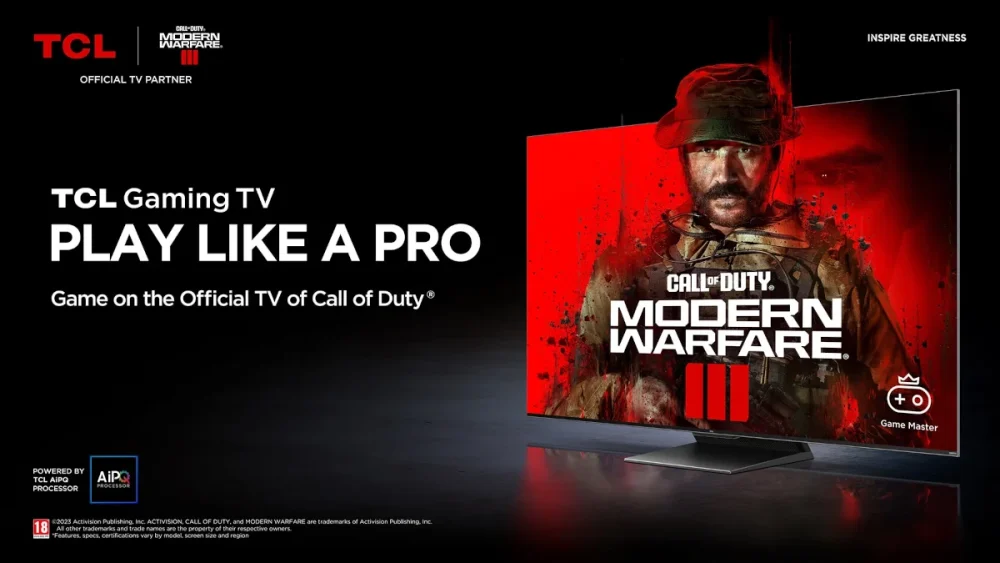
This means that every command is executed instantly, providing a significant advantage in fast-paced, competitive scenarios. In Call of Duty, where split-second decisions can mean the difference between victory and defeat, this level of responsiveness is crucial. Gamers will experience fluid motion and immediate reactions, allowing them to outmanoeuvre opponents and stay one step ahead at all times.
TCL’s commitment to an immersive gaming experience extends to the audio realm. The ONKYO speakers and Dolby Atmos support integrated into TCL QLED TVs deliver an exceptional soundscape that surrounds the player. With multidimensional audio, every sound in Call of Duty — from the subtle rustle of movement in the distance to the explosive impact of a grenade — can be heard with stunning clarity and accuracy.
This not only enhances the overall excitement and realism but also provides players with a strategic advantage. By accurately detecting the direction and intensity of sounds, players can anticipate enemy movements and respond effectively, making the audio experience as crucial as the visual in the heat of battle.
In addition to the superior gaming features, TCL’s advanced technology offers a range of smart functionalities that elevate the convenience and versatility of the gaming setup. With Google TV integration, players have access to a wide array of apps, streaming services, and personalised content recommendations.
The hands-free voice control with Google Assistant allows gamers to navigate and control the TV using simple voice commands, making it easy to switch between games, adjust settings, or explore new content without interrupting the flow of the game. This smart ecosystem transforms TCL QLED TVs into an all-in-one entertainment hub, making them the ideal choice for gamers who seek both performance and versatility in their home entertainment systems. TCL’s advanced technology is not just about enhancing the gaming experience; it’s about creating a seamless and immersive environment where every aspect of the game is brought to life with unprecedented clarity, responsiveness and engagement.
For Call of Duty players looking to elevate their gameplay to new heights, TCL provides the ultimate platform to experience the game as it was meant to be played. For more information on how TCL’s QLED TVs can transform your Call of Duty experience, visit https://www.tcl.com/southafrica/en
About TCL Electronics
TCL Electronics is a leading consumer electronics brand and leader in the global television industry, which now operates in more than 160 markets around the world. The company specialises in the research, development and manufacturing of consumer electronics products ranging from TVs, audio, home appliances, mobile devices, smart glasses, commercial displays and more. Visit the TCL website at https://www.tcl.com/southafrica/en
Submit and get free exposure here: Showcase Your Business | Advertise Your Special Offers.