
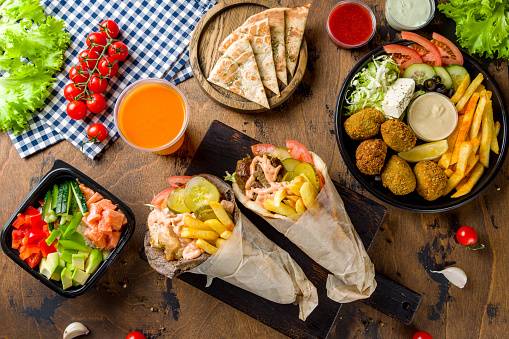
Good food speaks for itself on the streets and along the alleyways of Istanbul. Or rather it needs no person or thing to speak for it. Garnish, dressings, unnatural flavourings … these are foreign concepts to the Turk stoking the fires of his drum grill
These meals are simple – in the absolute best interpretation of the word. Meals that hinge their fates on the freshness and tastiness of their core ingredients. They are also some of the best meals you can expect off the cobblestones of the historic city.
Street food can be a meaningless term in a world saturated with Netflix documentaries on the idea. But today let’s agree that it is anything served either out of a cart or from a grab-and-go hole-in-the-wall. Food you can enjoy on a stroll.
There are, broadly speaking, three types of the former in Istanbul. The ubiquitous pretzel stands offer their wares plain and seeded, or decked with Nutella. Dessert men serve Halka Tatlisi – a syrupy sin best described as the offspring of an illicit affair between a South African koeksister and Mexican churro. There are stalls on every block that roast chestnuts and corn on the cob.
The true feast, however, lies in the innumerable kebab spots littered around the city. You can find them on any walk you take, marked by towers of glistening, turning meat. The cook will attack them with a long carving knife, adroitly slicing off crispy shavings. How you enjoy them – perhaps in a shawarma or mixed in with chips – is up to you.
Some bistros are a little more eclectic in their menu. Boiled tongue, it turns out, is delicious when served in what effectively amounts to a grilled cheese sandwich. As are Islak burgers – tomato-soaked steamed buns.
Pide can be found wherever there is a hot oven. These oval pizzas, with their cheese still bubbling, epitomise the city’s tradition of serving everything piping hot. And yes, there is no shame in enjoying a pide for breakfast.
Market stores, meanwhile, are havens for seafood. Corridors become gauntlets as the smell of freshly grilled fish, plucked from the Bospherous, assaults the senses from every angle. Mussels are gloriously plentiful too. They can be savoured full shelled with a wedge of lemon, or deep fried on a stick.
Good food in Istanbul is best discovered organically and spontaneously. But there are prizes worth hunting for.
Dürümzade’s reputation precedes it. In Western circles at least that is thanks to Anthony Bourdain, who visited the corner spot during a tour for No Reservations. The owners are exceptionally proud of this fact and have postered his image over the ruddy exterior walls. Inside, framed pictures capture his languid finger spilling over the outside stools as he enjoys a post-kebab Coke. Any tourist who has been will know what you’re talking about when you bring up “the Bourdain joint”.
But what so enamoured the man in the first place seemingly hasn’t changed. The squat seating and plastic tables dot the cramped, minimalist hollow. The open grill (hot coals instead of a rotisserie) is barely a wingspan’s length away from the cooldrink fridge on the other side of the room. This is the humble lair of what many, even savvy locals, believe to be the best durum in the region.
A durum is what we would call a wrap: toasted flatbread swaddling doner kebab. Lamb was the protein of choice in this case; joined only by roasted tomato, onion, and parsley in its crispy confines. The result is a first bite that pierces the inner cheeks. Still-sizzling fat travels the span of the tongue, swirled back and forth by the slightest of vegetable juices. The Turkish tortilla is a marvel all on its own, giving the perfect chew to counterbalance the satiation of the meat.
For as plentiful as these authentic eateries are, it would be a mistake to believe they are easy to find. The road to bliss is treacherous and laden with tourist traps; sub-par, overpriced restaurants that target poor palettes and easy dollars. You can recognise them by their portfolio menus at the door, promising not just local cuisine but an encyclopaedia of Western fast-food: from pasta and pizza, to burgers and chicken wings.
In some ways this challenge makes the culinary experience more satisfying. To live authentically the traveller has no choice but to immerse themselves at ground level; to embrace the sights and smells that lie around the corner; to educate themselves on local culture. Respect Istanbul and she will reward you exponentially.
– The Mail & Guardian One MOVIE, one Take: The origin of sneaker culture in ‘Air’:
In a basketball world dominated by Converse and Adidas shoes, before Nike brought the world its famous silhouette, there was a relatively unknown university-level basketball player whose name and likeness would go down in history — Michael Jordan.
The plot of Air is not a completely unknown tale, but a contextual tale of how the Air Jordan became one of the most successful — and controversial — shoes of all time, setting up sneaker culture as we know it today.
Nike’s cocksure co-founder Phil Knight (Ben Affleck) knew it and Nike’s marketing head Rob Strasser (Jason Bateman) knew it — Nike was in trouble, trailing far behind other basketball sneakers and in danger of being relegated to being only a running brand.
With half a million dollars budgeted to endorse a young, up-and-coming basketball athlete, Nike heads to the 1984 National Basketball Association (NBA) draft in search of a new star.
One must remember that Air is a biopic (unlike the 2020 docu-series The Last Dance, which follows Jordan’s career) and some dramatic liberties are taken. At the end of the day, Air is all about the business decisions behind the deal between Nike and the rookie player Jordan (Damian Young).
Affleck, who also directs the movie, combs through, confirms or dispels some of the many myths surrounding Air Jordan sneakers.
Nike rebels against the NBA’s “51% rule”, which forced shoes worn on the court to be primarily white. This was part of why the red, black and white Air Jordans stood out, earning the brand regular $ 5 000 fines per game. Although it’s debatable how often Jordan actually wore the shoes during official games, it makes for great marketing.
Air also reveals to audiences Jordan’s preference for signing with Adidas over Nike and his desire for a shiny car as part of the deal with the latter.
However, marketing executive Sonny Vaccaro’s (Matt Damon) willingness to bet his entire career on a single athlete and his visit to the Jordan household are the film’s creative licence.
Air dispels the widely believed story that Nike’s superstar shoe designer, the late Peter Moore, coined the name Air Jordan. Although Moore designed the sneakers’ iconic silhouette, Air shows us that Jordan’s short-tempered agent David Falk (Chris Messina) came up with the name, inspired by the way the player soared through the air.
Although we as the viewers still live in the shadow of the rise of the mighty Air Jordan, there is something about the rookie-to-hero true story of Jordan and his signature black, red and white sneakers that feeds our appetites to know more.
The film is fast-paced, like a basketball game, with quick back-and-forth dialogues and swishy 1980s montages throughout the many stages of the deal.
But where is Jordan when said deals are going down?
Even though he is at the centre of Nike’s pursuit of basketball greatness, his presence — or lack thereof — in Air shows him to be an inconsequential figure, instead of a future basketball GOAT.
Air is the story of two forces who come together but it favours Nike’s inner world over Michael Jordan’s agency and his own decision-making.
Viola Davis’s MVP performance as Jordan’s mother Deloris shows us it’s not just the shoe that made the star but the person who wore them. However, her portrayal makes it seem as if Nike had to jump through hoops to access her son, and she did talked on his behalf.
At the end of the day, the film has set a precedent for films about (relatively niche) shoes. Its formula is 80% fact, back-and-forth business deals and the relentless pursuit of something great.
Air exudes a sort of contagious hustle in Nike’s pursuit of Jordan’s “royal airness” which would eventually lead to the Air Jordan brand having a value of $ 5.2 billion last year.
What would be great is if Air could be a catalyst for more movies about iconic footwear, such as Vans, Converse (which Nike owns today), Doc Martens and maybe even Crocs, because every shoe has the ability to be a vehicle for storytelling of a larger subculture.
Air is available for streaming on Amazon Prime.
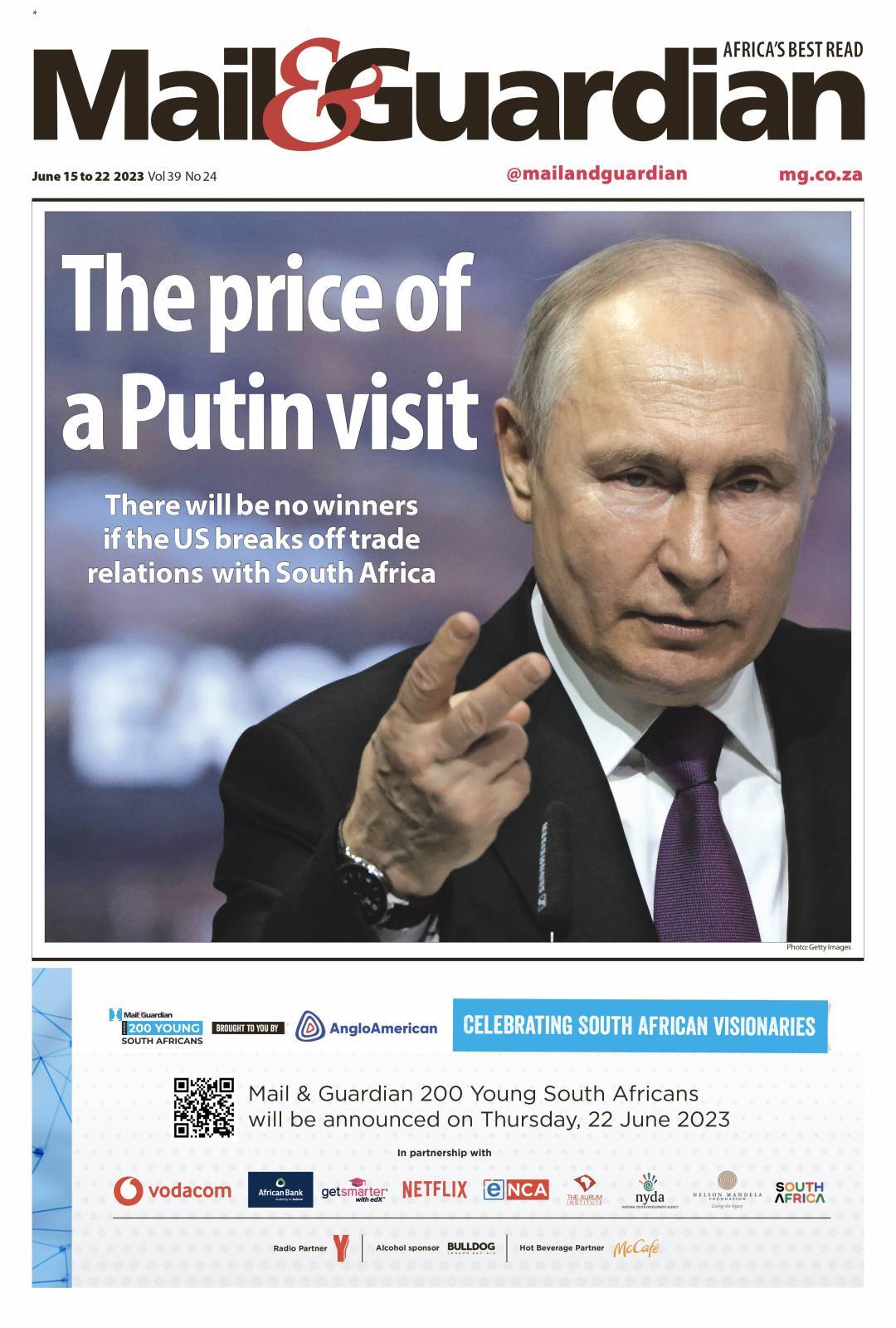
– The Mail & Guardian 15 June 2023:
The Digital Edition is an exclusive product available to our subscribers
The Digital Editions are an online version of our weekly print newspaper. In order to access them you’ll need to take out a subscription to the Mail & Guardian.
[tnc-pdf-viewer-image file=”https://mg.co.za/wp-content/uploads/2023/06/edition-2023-06-15.pdf” target=”_parent” download=”false” print=”false” fullscreen=”true” share=”false” zoom=”true” open=”false” pagenav=”true” logo=”false” find=”true” current_view=”true” rotate=”true” handtool=”true” doc_prop=”false” toggle_menu=”true” language=”en-US” class=”” page=”” default_zoom=”auto” pagemode=”thumbs”]
 [/tnc-pdf-viewer-image]
