Fort Hare VC condemns law enforcement inaction:
Three weeks after a devastating arson attack and violent unrest crippled the historic University of Fort Hare, Vice-Chancellor Professor Sakhela Buhlungu has issued a scathing rebuke of law enforcement’s failure to act decisively.
The university, whose alums include Nelson Mandela, Oliver Tambo, and Robert Mugabe, suffered extensive damage, estimated at between R300 million and R500 million.
Several key buildings, including the main administrative and student affairs offices on the Alice Campus, were petrol-bombed, leaving the institution reeling.
“Buildings were torched, documents burnt. Given the scale of the destruction, I expected far more support,” Buhlungu told University World News.
“Instead, the parliamentary committee tried to shift blame onto management. It’s preposterous.”
Buhlungu, who survived an assassination attempt in January 2023 that claimed the life of his bodyguard, believes the recent violence was “nationally orchestrated” by a coalition of politicians, taxi operators, and local government officials, using students as proxies.
He has led the university since 2017 and has been a vocal opponent of corruption.
While avoiding direct accusations, Buhlungu suggested that individuals currently under investigation or facing disciplinary hearings exploited the unrest to retaliate.
“No one imagined they’d stoop to such desperation — destroying buildings, documents, and irreplaceable assets. This criminality knows no bounds.”
Despite the severity of the incident, Buhlungu said police have yet to interview him or his colleagues. He called for a thorough investigation to uncover the motives behind the attacks.
“This is criminal. Yet, there’s been no meaningful engagement from law enforcement.”
Calm has since returned to the campus, and preparations are underway for examinations to begin on 6 November 2025.
“I’m in my office. The campus is calm and peaceful. Behind me are buildings that were petrol-bombed and lie in ruins,” he said.
Buhlungu contrasted the current inaction with the robust response following his 2023 appeal to President Cyril Ramaphosa. That intervention led to a 19-member task force dispatched to campus, 11 arrests related to killings, and 17 linked to fraud.
“This time, there’s been no such urgency,” he lamented.
Responding to claims that he is clinging to power, Buhlungu confirmed his intention to step down at the end of next year, having completed two five-year terms.
“There have been manufactured, ridiculous claims. I’ve reached retirement age and will leave having fulfilled my mandate. Right now, I’m focused on restoring stability and helping to rebuild the university.”
National support and academic solidarity
On 5 November 2025, a letter signed by 415 academics, a former minister, and former vice-chancellors from across South Africa was sent to the Higher Education and Training Minister, Buti Manamela.
The letter described Fort Hare as a “national treasure”— a cornerstone of education, liberation, and decolonisation in southern Africa.
The signatories warned that increased administrative scrutiny would be counterproductive, draining resources from teaching and learning and undermining efforts to rebuild.
“Given what appears to be a manufactured crisis by a nefarious network, such scrutiny could be seen as conceding to those seeking to destabilise the university’s anti-corruption efforts,” the letter stated.
Instead, they called for a national administration willing to confront the deep structural challenges facing Fort Hare and other universities.
Government response and expert commentary
On 11 October, Manamela said the destruction and violence that have engulfed the University of Fort Hare in recent days are deeply tragic, adding that a university should be a space of learning, hope, and progress, not one of fear and destruction.
“The burning of buildings, the intimidation of staff, and the disruption of teaching and learning cannot and will never be justified,” Manamela said.
“ What has happened at Fort Hare is not a protest; it is criminal. It destroys opportunity, erodes confidence, and undermines the dreams of thousands of young people who look to education as their only chance for a better life.”
He said the ministry was working closely with the South African Police Service, the Eastern Cape government, and the university’s security teams to restore calm and protect students and staff.
Amid talks that an administrator may be appointed, Manamela’s spokesperson, Matshepo Seedat, said that the minister was still weighing up the matter.
Ahmed Essop, an independent consultant and research associate at the Ali Mazrui Centre for Higher Education Studies, noted Fort Hare’s unique legacy, as it was the only institution historically accessible to black students in South Africa and across the continent.
He said that since the appointment of Buhlungu, Fort Hare has been building up a strong academic profile, improving its research outputs, and so on, but more importantly, the vice chancellor has taken firm action to deal with corruption, both academic and financial, and the institution has been relatively stable until the recent vandalism.
Essop said Fort Hare has been relatively stable in recent times, with the real problem being “interference from outside”, exacerbated by the vice-chancellor’s crackdown on academic fraud involving the province’s premier and others, which may not have come to light.
He said political action was needed to bring those behind the destruction to book.
He praised Buhlungu’s leadership in strengthening academic output and tackling corruption, but warned that external interference — particularly linked to fraud investigations involving provincial leaders — has destabilised the university.
Respected civil society voice, Neeshan Balton, the Head of Ahmed Kathrada Foundation, said the fact that the Special Investigating Unit may be close to completing its long-running investigation into corruption at Fort Hare may have caused the eruption on campus.
He said the presidency should have been vocal in setting an example that such conduct and wanton destruction would not be tolerated in any institution of learning.
In a statement, the Phakama Eastern Cape Civic Movement condemned the destruction of the university and urged the Department of Higher Education and Training to intervene swiftly.
Pedro Tabensky, founding director of the Allan Gray Centre for Leadership Ethics at Rhodes University, said the events at Fort Hare reflect the broader infiltration of organised crime into government institutions.
“This needs to stop,” he said.
This was published on the University World News Africa site.
Constitutional Court upholds landmark ruling on GMO decision-making:
The Constitutional Court has upheld a landmark ruling on decision-making regarding genetically modified organisms (GMOs), marking the end of a decade-long legal battle mounted by the African Centre for Biodiversity (ACB) against the government and multinational seed giant Monsanto, now Bayer.
In its decision on 4 November, the 11 judges of the country’s highest court dismissed, with costs, an application for leave to appeal by the minister of agriculture, forestry and fisheries, the director-general of the department, the executive council for genetically modified organisms, and the GMO appeal board.
“The Constitutional Court has considered the application for leave to appeal. It has concluded that the application should be dismissed with costs as it bears no reasonable prospects of success,” the court said in its brief ruling.
The ruling means that the groundbreaking judgment of the Supreme Court of Appeal (SCA) in October last year, which set aside the commercial approval of a drought-tolerant genetically modified maize variety, MON87460, now stands as final.
The SCA’s decision, handed down by a full bench of five judges, overturned several layers of government approvals for Monsanto’s application to release MON87460 commercially.
The court found that the executive council established under the GMO Act had failed to follow mandatory legal procedures, particularly in assessing whether an environmental impact assessment was required before approving. It ruled that the executive council’s decision — along with subsequent appeals and ministerial confirmations — was unlawful.
As a result, the SCA ordered that Monsanto/Bayer’s application be remitted to the executive council for proper reconsideration in accordance with the country’s environmental and biosafety laws.
The litigation was launched by the ACB, a research and advocacy non-profit, represented by Legal Aid South Africa.
The ACB challenged the legality of decisions made between 2015 and 2016 approving the release of genetically modified maize. Judge Ronel Tolmay initially dismissed the ACB’s case in the high court in June 2023, but she granted leave to appeal — paving the way for the SCA’s ruling in October 2024.
While the government and its statutory bodies sought to overturn the SCA’s judgment through their Constitutional Court application for leave to appeal, the latest decision closes the matter.
“The original judgment of the Supreme Court of Appeal on 22 October 2024, in the ACB’s case against Monsanto/Bayer and the state, stands,” the ACB said.
“This historic decision was challenged by the minister of agriculture et al., seeking to overturn a first-ever judicial ruling regarding GMO decision-making in South Africa.”
The ACB welcomed the Constitutional Court’s decision with “great relief”, as it put to rest a decade-long saga and represents a significant step forward in protecting South Africa’s agricultural future, biodiversity, and the rule of law.
“The findings and decisions of both the SCA and the Constitutional Court — the highest court in the country — are precedent-setting in South Africa concerning GMO decision-making processes and will bind the state regarding future decision-making concerning the environmental release of GMOs,” the ACB said.
The ruling will help end the “rubber-stamping” of GMO approvals and ensure that environmental impact assessments are considered adequately before genetically modified crops are released into the environment.
The non-profit expressed gratitude to Legal Aid South Africa for “working tirelessly on the matter over these long years”.
The decision by uMkhonto weSizwe(MK) president Jacob Zuma to suspend his deputy and the party’s parliamentary leader John Hlophe has added to the dramatic leadership battles and factionalism in the party
Hlophe has been suspended from both his roles pending a full investigation into his conduct.
He was suspended on Wednesday evening following his decision on Tuesday evening to remove Parliamentary Chief Whip Colleen Makhubelele from her position and replacing her with Des Van Rooyen.
On Tuesday evening party spokesperson Nhalmulo Ndhlela announced that they were confident that under Van Rooyen’s stewardship as Chief Whip, the Parliamentary Caucus would be strengthened, disciplined and more strategically aligned with the party’s historic mission of completing the total liberation of the South African people, adding: “We thank Comrade Colleen Makhubele the former Chief Whip for her service in this role.”
Zuma was in Burkina Faso when Hlophe took this decision.
In a statement on Wednesday, the party’s head of presidency Magasela Mzobe said upon Zuma’s return from Burkina Faso, he met the MK party’s national officials and received a briefing about changes effected at the National Assembly without a collective consultation.
“This decision is meant to affirm and send a strong message and the principle of collective leadership across all structures within the uMkhonto weSizwe Party. Consequently, the decision taken by Dr. Hlophe to remove Cde Collen Makhubele and appoint Cde Des Van Rooyen is therefore nullified,” Mzobe said in a statement.
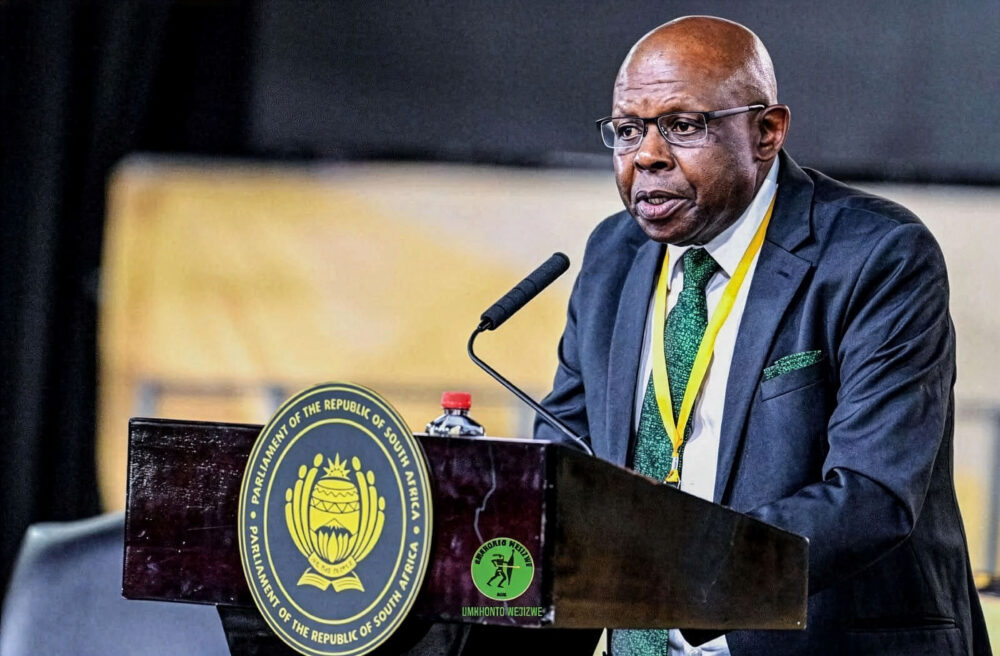
“The leadership of the MK Party remains firmly united and committed to upholding the principles of discipline, accountability and collective decision-making as enshrined in the Party Constitution. This decision should be viewed as a demonstration of the Party’s unwavering commitment to internal party discipline and collective leadership,” he added.
Mzobe added that the party remains stable, focused and steadfast.
Submit and get free exposure here: Showcase Your Business | Advertise Your Special Offers.