
Freedom Day in a fractured nation: Who are we becoming?:
A man was shot and killed inside Wynberg magistrate’s court recently. He was a taxi driver appearing on charges of murder. A life ended inside a building meant to represent law, order and justice. On the eve of Freedom Day, the symbolism is chilling.
We are a country caught in between. Not yet what we hoped to become. No longer who we once were. As Victor Turner, author of The Ritual Process: Structure and Anti-Structure, suggests we are living in a liminal space “betwixt and between” where identity, morality and meaning are blurred.
The murder at Wynberg court is not an isolated tragedy. It is part of a pattern of violence that is becoming banal. It mirrors the unchecked rise in gender-based violence. It echoes in the divisive speech of public figures from Economic Freedom Fighters leader Julius Malema’s defiant provocations to AfriForum’s nostalgic nationalism. Our politics are less about building bridges and more about burning them.
Freedom Day should prompt us to ask difficult questions, not repeat comfortable slogans.
- Are we truly free when safety is a privilege, not a right?
- Can we celebrate freedom while fear stalks courtrooms and classrooms alike?
The promise of freedom has always been about more than the vote. It was about dignity. Opportunity. Care. Moral maturity is not only about justice but about our responsibility to one another. And yet, across government, business and civil society, we are seeing a retreat into self-interest.
Political leaders who once embraced reconciliation now traffic in division. The government of national unity, hailed as a post-election compromise, already appears fragile, more coalition than conviction. The erosion of political goodwill is not just bad optics; it signals a breakdown of shared purpose.
What future are we preparing for our children?
Our education system is not producing the critical thinkers this moment demands. We teach compliance, not courage. Rote repetition, not reflection. How can our youth lead tomorrow if they cannot question today?
More than 60% of young South Africans, individuals aged 15 to 24, are unemployed and with a broader perspective, the unemployment rate among young individuals aged 15 to 34 years has recently been reported at 45.5%. These figures underscore the significant challenges faced by South Africa’s youth in securing employment, highlighting the urgency for targeted interventions to address this pressing issue.
Economic freedom is not just delayed, it is being denied. And so, we must confront the myth that we are all equally free. The Constitution might grant rights, but rights without resources mean little.
Identity is always forged in relationship to others. Yet we live in a time where connection is weakness and division is strength. There is a growing absence of empathy in how we speak, act and govern. The care we owe each other, especially the most vulnerable, is being outsourced or ignored altogether.
We are becoming a country that sees violence as inevitable.
Corruption as normal.
Polarisation as power.
But we can choose differently.
We can reimagine freedom not as something given to us once, but something we make together daily, deliberately. That requires an ethic of care in our institutions. It requires leaders who prioritise reconciliation over retaliation. It requires all of us to resist the temptation of cynicism and speak with moral clarity.
So this Freedom Day, I ask:
- What does your freedom cost others?
- How do your actions — your silence, your choices — shape the next 30 years?
- Are we preparing our children to inherit a society of inclusion or exclusion?
Freedom is not a destination we reached in 1994. It is a road we are still building. And right now, it is full of potholes, dead ends and danger signs.
We must be bold enough to stop and ask: “Who are we becoming?”
If we are serious about freedom, we must also be serious about justice, safety, care and equity. It is time to turn inward — and outward. To rebuild the moral imagination this democracy was founded on.
Not with slogans. With action.
Dr Armand Bam is Head of Social Impact at Stellenbosch Business School.
In the Shadow of the Gallery: Art, power and the fight for Johannesburg’s soul:
Earlier this year, the Mail & Guardian carried a story saying that the neglect of the Johannesburg Art Gallery (JAG) reflected widespread public and media sentiment that it, once a cultural jewel, had become an embarrassing symbol of institutional failure amid a flourishing creative economy.
Then, days ago, on April Fool’s Day no less, Currency published an article headlined: “‘The war has started’ — Gayton McKenzie.” It reads like political theatre, casting the minister of sport, arts and culture as a crusader for the ruined gallery’s restoration, fighting a slow, bureaucratic system, with Vuyisile Mshudulu, the city’s director of arts, culture and heritage, framed as a villain.
On 27 March, a “JAG stakeholder engagement” meeting was held with artists, heritage organisations, and civic bodies. The Johannesburg Development Agency (JDA) presented its plan, led by Riaan Hollenbach of Lamela Consulting, in what felt more like a public perception management exercise than genuine consultation. The JDA will oversee the execution of urban development projects, including logistics, compliance and resources, and Lamela has reportedly been tasked with initiating renovations. The patchwork plan to revive the deteriorating gallery in crime-ridden Joubert Park included a temporary relocation of the JAG collection to Ditsong, the Standard Bank and Absa buildings, or Newtown, amid ongoing wrangling.
The timeline for this seems as wobbly as the building itself, with regulatory approvals and site preparation set for September, followed by infrastructure upgrades, and an operational launch in November next year.
The Johannesburg Development Agency detailed its planned process for relocating JAG’s important collection and restoring the historic Joubert Park precinct. It outlined the roles of national and provincial bodies and its own team of heritage experts who are tasked with balancing preservation and innovation.
But achieving this balance is apparently easier said than done.
A century-old institution, JAG is facing an existential crisis. Protected under the National Heritage Act, and home to a priceless collection, it is a national treasure and cultural pillar — central to the city’s artistic identity — yet also under constant threat from theft, neglect and decay, due to ongoing mismanagement.
Many institutions, including Friends of JAG and the Johannesburg Heritage Foundation, consider themselves stakeholders in its fate. But while parts of the proposed future seem promising, it is precisely because of the long-standing failures that the gallery’s troubled past can’t simply be brushed aside.
One afternoon, as Khwezi Gule, JAG’s curator, drove me around the surrounding precinct, he shared his thoughts on the interconnectedness of the gallery’s history with the city’s ongoing struggles.
“The weight of history is a burden I carry every day when I step into these spaces,” Gule revealed, visibly wounded by his own words.
“How do you reconcile with these objects — some deeply offensive — and yet, I’m the one tasked with their care and preservation?” he pondered.
This, for Gule, isn’t just a job, it’s a daily negotiation with history.
For him, the challenge for institutions like JAG lies in undoing centuries of oppression embedded in both the architecture and the artifacts.
“To completely transform these spaces, to tear them down and rebuild them anew, is something people aren’t ready to entertain,” he explains.
As we drove on, ducking taxis and swerving to avoid jaywalkers, Gule’s frustration became palpable.
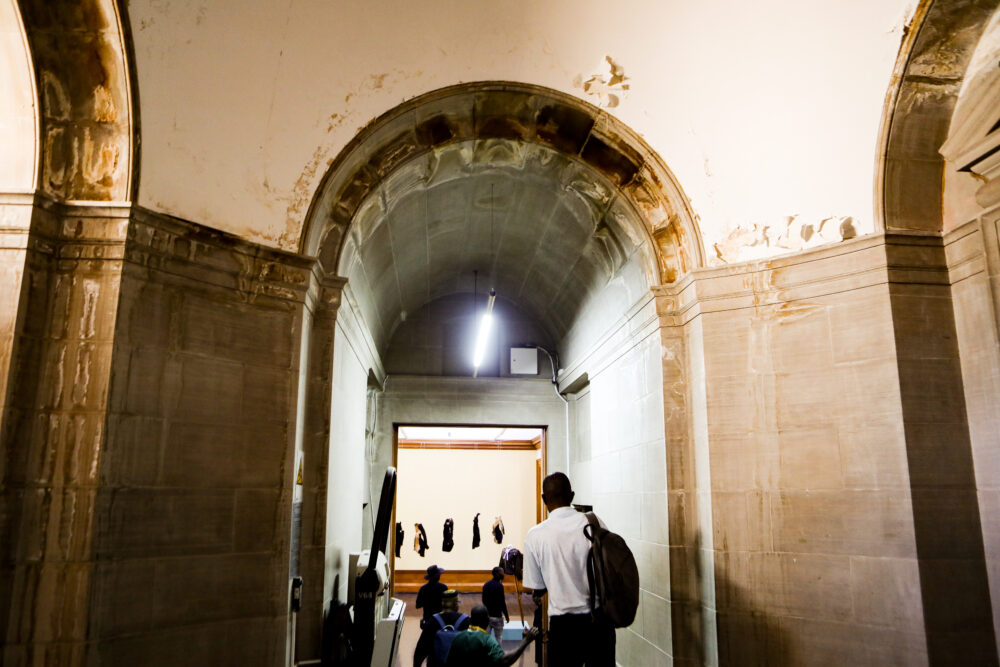
“These spaces were not made for us, and yet we are made to occupy them,” he said, pointing out the fundamental contradiction of working in spaces designed to exclude the very people who are tasked with reshaping them.
As we spoke, it became clear that the true decolonisation of these spaces cannot simply be about representation or inclusion. It requires a complete rethinking of how art is produced, consumed and interpreted.
Many of the works in JAG’s collection were acquired under colonial rule and they reflect a history of exploitation. “These objects come from a time of violence,” Gule reflects, “and yet, they remain with us.” For him, as curator, this presents a paradox: “How do you reconcile with that, when these objects continue to represent a violent history, yet you’re responsible for them?”
The dilemma of what to do with them is tangled up in the broader conversation on reparations, because this isn’t just about restoring buildings or returning looted treasures, it’s about confronting the economic and social injustices that still stem from colonial violence.
Step outside JAG, and you’re hit with the raw, unvarnished reality of Johannesburg. Joubert Park, once a space for privileged white people, is a broken, neglected corner of the city.
It was never meant for black people, but after decades of disinvestment, it’s a shadow of what it could have been — a stark reminder of the failures of urban planning and justice.
The city’s plans for JAG’s restoration might raise questions but the vision is clear — rejuvenation, not just for the building, but for the surrounding area too.
“This is an opportunity to redefine what it means to have a truly public cultural institution in Johannesburg,” said Lamela Consulting’s Hollenbach, who was not afraid to admit the renovation team was working on gentrification.
As Gule warned, the true test will lie in whether these changes uplift local communities or simply maintain the status quo.
The restoration is an arduous and complex project that, despite the challenges, including frustrations over mismanagement and the slow progress, has managed to hold the public’s interest and a mood of cautious optimism.
This is why it would have been great if there had been more transparency and inclusivity in the consultation process. As one participant at the meeting stated, “We want a gallery that doesn’t just exist but thrives — and that can only happen if everyone who lives and works in this city is genuinely part of its future.”
Throughout the meeting, participants kept stressing the need for a radical rethinking, not only of the gallery’s physical structure but the value of its precious collection and its function within broader society.
“Each of these must be temporarily separated and reimagined independently before they can be brought together to serve future generations,” one speaker emphasised.
As Gule had similarly noted in our conversation days prior, “We are not just curators of art; we are curators of histories, legacies and futures.”
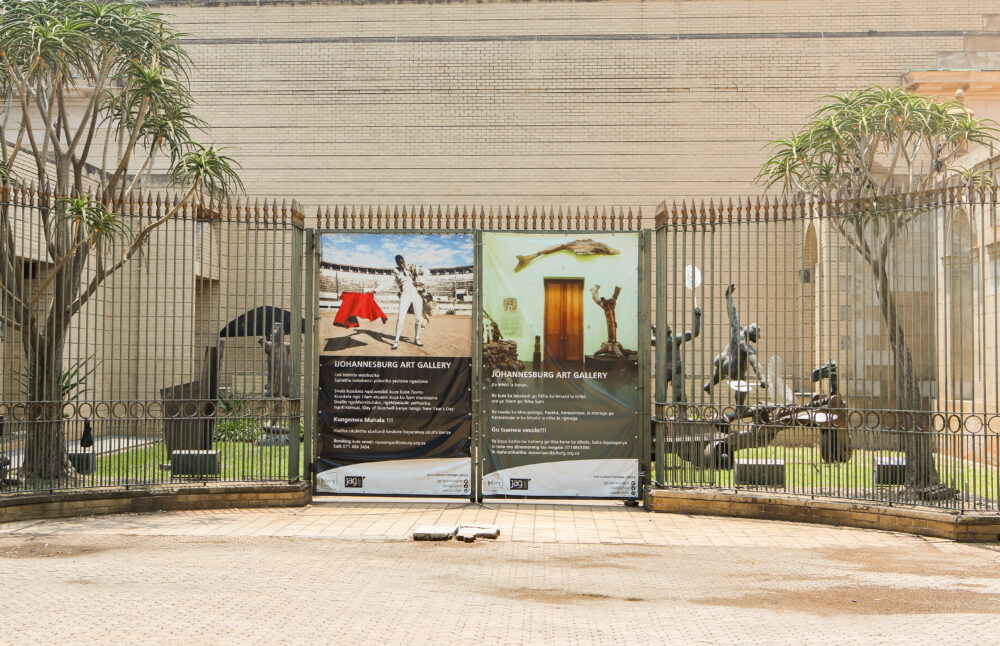
Despite a rather impressive presentation, questions about the project’s inclusivity, particularly regarding the involvement of younger artists in the process, were not fully addressed. The lack of younger voices at the meeting was palpable, with many of the attendees established figures in the arts.
A more transgenerational and transdisciplinary dialogue might be key to ensuring the success of the project, with one stakeholder remarking, “We need to make sure we don’t push out the very community we are trying to build this gallery for.”
Digital innovation, from a new archive to hybrid programming, was pitched as a way to extend JAG’s reach beyond its physical walls.
While that felt timely, some ideas — like promoting gentrification — missed the mark. Even when the “African Phoenix” idea emerged, it lacked the self-awareness that, to rise from the ashes, it first has to burn.
This is the weight of the work at hand. JAG’s future, rooted in South Africa’s history of urban erasure and systemic inequalities, lies at the intersection of reclamation and the persistent harshness of the present.
In Gule’s words, “Decolonisation isn’t about undoing history, it’s about constructing something that truly reflects and serves the people who’ve always been left behind.”
JAG’s restoration is about more than just reviving a colonial building. It’s about manifesting a vision for a future where African cultural production is reshaped to serve those whose voices have been silenced for too long.
The test is whether the leadership can transform lofty promises into something tangible or if it will remain another hollow hallucination.
Hell is others: Sarajevo and the tragedy of intimacy:
“Only the dead have seen the end of war.” Plato’s observation is blisteringly true. War is humankind’s perpetual default mode, the most intimate sign of its intrinsic cruelty.
“History hurts,” writes American philosopher Fredric Jameson.
As for our subjection to violence or our imagined immunity — the presumption that war occurs elsewhere? The truth is, war is everywhere. Immunity is delusion. Suffering is the defining condition. Joy, or redemption, achieved only when one has travelled through a strait.
Sarajevo, a stage-play written by and starring Aimee Mica Komorowsky and directed by Kayli Elit Smith, raises these gnawing questions regarding violence, ethnic hatred, the brutalisation of women and the monstrousness of men.
Set during the Bosnian War, which started on 6 April 1992 and ended on 14 December 1995, it is an intimate examination of sexual discrimination and abuse, illicit love across an ethnic divide and a dissection of male power.
In addition to Komorowsky there are three men on stage: a South African war photographer and two Serbian soldiers of different rank. Komorowsky plays a Bosnian.
If the monstrousness of ethnic cleansing is a core theme, Sarajevo at no point allows itself to become a mouthpiece for ideological perversity.
Never dogmatic, always deeply implicated in interpersonal stresses and strains, the play allows one to enter a raw human condition and understand how vulnerability emerges, why misunderstanding is the root of dispassion and cruelty, how resolution — the predictive arc of conventional storytelling — might be obscene.
For one is not gratified at the end of Sarajevo. The fact that the rape scene occurs at the penultimate moment reinforces the fact that “history hurts”, that resolution is a fantasy in the midst of war and violence.
The male protagonists — Ivan Nedeljkovic and Alistair Moulton Black as the soldiers and Duane Behrens as the photographer — provide a strikingly varied counterpoint to the central woman protagonist.
Two desire her love, which remains unreciprocated. The other, in the throes of personal torment, becomes a rapist. This spectrum, between love and hate, fantasy and obscenity, spans a one-act play which, paradoxically, is fortifying in the middle of its brutality.
This is because the writer and director never lose sight of a raw mortality. There are no digressions, no ellipses — despite scene changes — because the director, Elit Smith, never wavers or veers away from the instinctive and immediate passions that impel the drama.
Staged in Johannesburg’s Holocaust Museum, a fitting site of mourning, the production is lean.
Composed of cardboard boxes — stacked as bombed sites, a table, seats — the composition conjures derelict building blocks as substantive as they are flimsy, for nothing is immune to destruction.
The lighting is as economical and deftly deployed. It is the soundtrack that proves to be the most potent theatrical weapon — an engulfing staggered and broken aria to the mania of war.
Amid this continuous din, the actors hold their own. One is never freed from the fact of war and the psychological damage it incurs.
Each character has their own demon, each is ensnared in the other. As Jean-Paul Sartre remarked, “Hell is others” — this is the trap which the playwright, Komorowsky, has set.
If war is all-consuming, then what of peace? Are we ever truly freed from the burden of history? Is reprieve only ever momentary?
What of Komorowsky’s script, which surely is the star of the play? It is her words, pithily direct and uninflected, wrought within and wracked by the moment in which they were conceived, in which, bodily, emotively, all of human pain and yearning seem distilled, which, when uttered by gifted actors, thrusts the audience into a shattered and shattering maw.
But then, this is a play and, as such, an artistic rendition of what is often silenced in war. If, therefore, I have emphasised the words written and then spoken, it is because, without words, even more than photographic images, we cannot know the truth about despair and hopelessness, of ongoing horror.
This is why truth and reconciliation is vital but also why they are also ever-elusive. That Komorowsky has refused to write an account, to explain, or explain away, the horror, is all the more salutary.
While the playwright-actress knows, with Margaret Atwood, that “War is what happens when language fails,” she also profoundly understands the importance of words and their utterance in and through ruined and desolate bodies. This, then, is her Sarajevo.
Sarajevo will be staged again at the Johannesburg Holocaust and Genocide Centre on 19 and 25 May.
Submit and get free exposure here: Showcase Your Business | Advertise Your Special Offers.
