
From Kenya to South Africa: A solar-powered electric motorcycle adventure:
An electric motorcycle, designed and built in Africa and powered by the sun, began its 6000km journey from Nairobi in Kenya to Stellenbosch in the Western Cape, on Sunday.
Researchers from the faculty of engineering at Stellenbosch University have joined forces with Roam, a company in Nairobi, to test the Roam Air, an electric motorcycle used in urban settings.
“It’s exciting for me that what we’re doing is that we are supporting African collaboration and ingenuity,” said Thinus Booysen, founder of the university’s Electric Mobility Lab, which will be launched on 18 October.
“It’s a weird thing to do I think — to drive from Nairobi to Cape Town — but what we’re trying to do is to send a message that electric mobility is something that’s feasible and it’s feasible to be done with green energy.”
His concern is that Africa is lagging behind the rest of the world and increasingly importing vehicles from China.
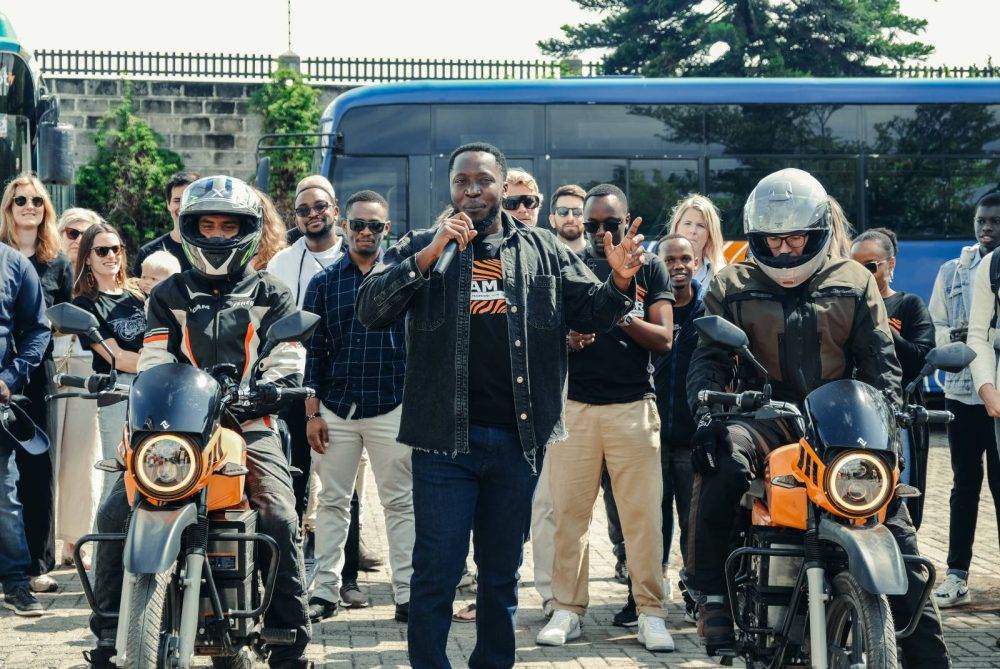
“We’re importing vehicles that are not made for our terrain; vehicles that don’t necessarily meet our expectations and if we keep on importing vehicles, we’re going to lose local jobs. So, this is us trying to say ‘Hey, hang on, there is an alternative way to do this and to do it with green energy,’ so that we don’t kill our grids and so that we’re not dependent on dirty energy as it were.”
The electric motorcycle, accompanied by two support vehicles, is expected to arrive in Stellenbosch on 18 October, in time for the university’s Electric Mobility Day celebration. The expedition is partly to observe Transport Month in South Africa.
Roam donated two of its electric motorcycles to the lab for research and testing. “We cannot think of a better way to kickstart our research collaboration than testing the motorcycle overland,” Booysen said. “To do this within the African fraternity of ingenuity is an enormous privilege.”
Together, the university and Roam intend to develop and apply research on electric vehicles and the supporting ecosystem, including electric vehicle powertrains, local manufacturing and digital pilots for planning for electric urban mobility.
“This journey shows Kenya’s ability to design and locally manufacture world-class electric vehicles for African conditions,” said Masa Kituyi, electric motorcycles product owner at Roam, in a statement. “It’s a testament to local innovation, leading the way in sustainable mobility solutions.”
Kituyi and PhD candidate and co-researcher on the project, Stephan Lacock, are riding the motorcycle. “The emphasis is not on whether such a trip can be done, as there have been other similar journeys in the world, but rather to showcase African ingenuity and collaboration between Stellenbosch University and Roam to overcome African conditions with green solar energy,” Lacock said.
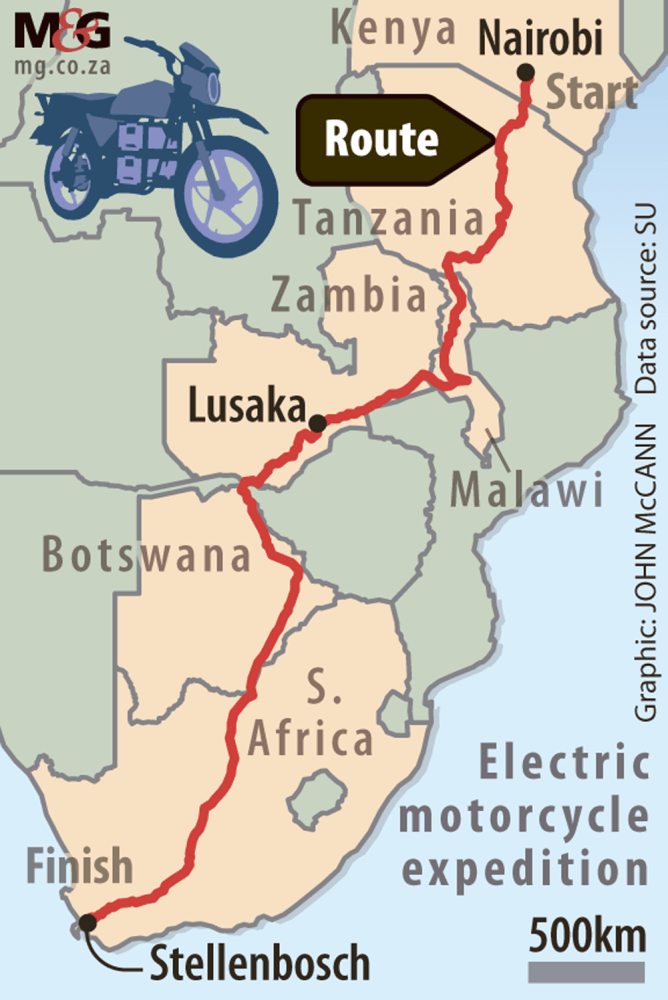
Of the journey from Nairobi Booysen said: “They are loving it and it’s extremely exciting and nerve-racking at the same time. But the route is definitely safe. They’ve actually told me they never felt this safe, ever since they left the South African border. They’re sleeping next to the road. And it’s so beautiful … The most nerve-racking part is crossing the borders with expensive equipment.”
Stellenbosch University’s research team is also interested in seeing the performance of the drivetrain and swappable batteries, as well as the efficacy of the solar recharging solution.
Booysen said electric motorbikes are taking off in Africa. “South Africa is actually way behind. There are tens of thousands of electric motorbikes in most of the big African cities. We’re talking Benin, Togo, we’re talking Nigeria, Kampala and Kigali.”
He recalled driving around Nairobi on Sunday where the streets were filled with electric vehicles. “These things have been doing thousands of kilometres. It’s definitely taking over because people are realising the benefits, obviously the cost benefits to the drivers.
“But the part that nobody talks about is the pollution benefit. I’m not talking about the climate change benefit; I’m talking about particulate matter and the health consequences of inhaling that particulate matter in our African cities.”
These cities are extremely polluted and people die annually, he said. “From an African perspective, our greenhouse gas emissions are not nearly as high as the rest of the world … but in terms of pollution, we’re facing a big challenge … That, for me, is one of the key benefits of going electric.”
South Africa is stuck in the slow lane road to electric mobility, Booysed said. I think we’ve kind of dropped the ball because we were talking about electricity and load-shedding and those types of challenges. We kind of lost a policy plot on moving to electric mobility and getting manufacturing ready.”
More than 450 000 jobs in South Africa rely on the vehicle production sector. “That should have set a red flag as soon as countries [we export to] said, ‘we don’t want petrol and diesel vehicles anymore’.”
Booysen said the country is lagging behind because of poor policy and of being led by people “without vision and without political will”.
“You can see the political will is also not there in [other] African countries but they’re not as regulation-bound. People are taking up the opportunities because it’s loosely regulated,” he said.
The trip from Nairobi to Stellenbosch is supported by Scatec, Balancell, Voetspore, Tracks for Africa, Bush Lapa, South African National Energy Development Institute through the LEAP-RE project and Charlie’s Travel.
South Africa risks missing out on gold price surge due to structural challenges in mining sector:
Gold prices have surged by more than 30% in 2024, repeatedly hitting record highs as global economic uncertainty drives demand for the precious metal.
Despite the boom, South Africa’s mining sector is struggling to fully capitalise on the gains due to deep-rooted structural challenges, including unreliable power supply and rising operational costs.
According to Bianca Botes, director at Citadel Global, even though the price of gold has been increasing since 2018, 2024 had seen record highs.
“Year-on-year gold prices have surged 33% to top record highs repeatedly throughout 2024,” Botes told the Mail & Guardian.
“The demand for gold is significant in what it tells us about the global economic landscape, as well as the central banks’ demand for it,” she said.
Gold is considered a safe-haven asset that retains its value over time, and investors and central banks around the world turn to it in times of economic uncertainty, leading to higher prices.
“A culmination of events has seen the gold price rally this year, ranging from haven-seeking on the back of geopolitical tensions and economic uncertainties to the anticipation of rate cuts by the Fed [US Federal Reserve], and other central banks, to central banks bolstering their gold reserves.”
According to FNB, the recent surge in the price has also increased the demand for Krugerrands.
In a statement released in June, the bank said it had helped facilitate the delivery of over 2 200 gold Krugerrand coins on its trading platforms over the last year, as more consumers sought to diversify their investment portfolios.
“Krugerrands are highly liquid in the South African market, making them a preferred choice among seasoned investors and collectors alike, and are considered legal tender in South Africa, but their real value lies in their gold content,” the head of Share Investing at FNB Wealth and Investment, Sebastian Pillay, said.
South Africa ranks 12th for gold production according to the World Gold Council.
Botes said the country has a lot to gain from the price surge in terms of trade but she added that full capitalisation on the benefits was being “hamstrung by structural issues in the mining sector”.
The Minerals Council of South Africa has said that, while gold production in South Africa is slowing, it is benefitting from the current surge.
“The rising gold prices have enabled South African gold producers to maintain production
levels by sustaining marginal deposits for longer. Given this, South African gold production marginally increased by 0.2% to around 96.6 tonnes in 2023,” the council’s head of communications, Allan Seccombe, told the M&G.
He said gold production in the country had been falling by 5.8% annually since 1994.
South Africa went from producing 580 tonnes of gold a year in 1994 to less than 97 tonnes in 2023.
The unreliable electricity supply, illegal mining, theft and other crime and heightened input costs were significant constraints on production.
“The effects of electricity supply constraints are seen in gold export and local sale volumes, which decreased by 1.9% and 17.1%, respectively, as smelters were unable to keep up with the refining of gold ore for the local and export market.
“Despite the drop in volumes, and given the strong gold price, total gold sales in rand terms increased by 18.8% year-on-year in 2023 with sales up 49.3% compared to pre-pandemic levels,” Seccombe added.
Seccombe said electricity prices for large industrial users and manufacturers, which included mining companies, had increased more than sixfold since 2007, which added to cost pressures at marginal gold mines and shortened their lifespans.
Low employment in the gold mining sector was also affecting output, he said, adding that jobs in the sector had plunged from 392 000 in 1994 to fewer than 94 000 in 2023.
“Mines have become deeper and working areas are further away from shafts, meaning
employee travel times to and from the stope is longer, resulting in less time drilling and
clearing blasted rock. This feeds into declining production.”
The Witwatersrand Basin in Johannesburg is the largest gold resource in the country, and there are 44 active gold mines in Gauteng alone, according to the City of Johannesburg, but the prospects for more mines are few.
“There are no new gold mines in South Africa, with companies focusing on existing operations to extend lives of mines by going deeper or tapping into resources further from the shaft infrastructure,” said Seccombe.
If the country improved its terms of trade, it could benefit from better export earnings which would result in higher profits for mining companies, which in turn could assist in job creation and economic growth, said Botes.
How AI is accelerating Africa’s pursuit of the Sustainable Development Goals:
Google is working with GABI Circle members to accelerate a prosperous future for Africa
With Unstoppable Africa 2024, the Global Africa Business Initiative’s (GABI) flagship event being held this week, there is no better time to take a look at African nations’ progress towards achieving the UN’s Sustainable Development Goals (SDGs).
While much remains to be done globally in accelerating progress against the SDGs, Africa, as a continent rich with potential, is starting to embrace the transformative power of artificial intelligence (AI) that will help it achieve the SDGs. To bolster these fledgling efforts, two things are needed: collaboration between stakeholders, and access to the necessary skilling and infrastructure.
As a GABI Circle member, we are thrilled to see how AI-driven initiatives from a wide variety of players are supporting countries on the African continent in their quest to reach the SDGs.
AI’s role in Africa
The opportunities inherent in the use of AI in Africa can be viewed from several perspectives; the first of which is the role it will play in bringing cutting-edge healthcare to people who previously did not have access to these. In addition to our own solutions, Google is also teaming up with local organisations such as Jacaranda Health in Kenya, and OnTime Consortium in Nigeria, which use AI to give access to life-saving information. This not only supports SDG 3 but also empowers women to take control of their maternal and child health through AI-driven solutions that help monitor pregnancies and predict complications, allowing for timely interventions that save lives.
AI’s role also extends to advancing food security, and addressing environmental and climate-related challenges affecting agricultural productivity and livelihoods. By predicting flood zones and alerting residents in advance, Google’s AI-enabled flood forecasting system directly contributes to increasing disaster preparedness by providing flood forecasts and alerts up to seven days in advance. Since its launch last year in two countries, the service has been expanded to 80 countries, 23 of which are in Africa.
Secondly, AI has the potential to help power economic growth. What makes this even more exciting is that it is not just an opportunity for big businesses; it also creates incredible opportunities for startups and entrepreneurs. The AI Startups Mapping in Africa report by AfriLabs reveals that Africa’s AI readiness index is at an average of 26.91, emphasising the need for greater investment in AI infrastructure.
Initiatives such as the recently adopted Africa Union Startup Model Law Framework set out guiding principles, a common vision and key recommendations for Member States in developing their national startup legislative and regulatory systems and capabilities to derive maximal value from the innovation ecosystem. The private sector is a vital player in this ecosystem and Google, alongside other partners, continue demonstrating our commitment to fostering a thriving startup environment through initiatives like the Google Startup Accelerator for Africa, the Hustle Academy that has empowered more than 10 000 graduates to date, and Google’s $ 50 million Africa Investment Fund underscore the private sector’s dedication to supporting African startups.
Thirdly, strategic partnerships between African governments and the private sector are crucial to harness AI effectively. By investing in infrastructure such as connectivity and data centres and providing educational frameworks to empower Africa’s next generation of AI-savvy users, the continent can position itself for inclusive growth and development.
Unlocking opportunities and breaking barriers
While global progress has been slow in many areas, AI presents a unique opportunity for African nations to overcome challenges and achieve these goals.
AI isn’t just another technology; it is an enabler, reducing the barriers that stand in the way of realising Africa’s potential. There’s been a lot of talk about the fundamental importance of skills like STEM and coding, which create a vital foundation for understanding the digital world. These are still essential, and when augmented with AI, access to learning and using these technologies becomes even easier.
How Africa can catch on to the AI train
For Africa to catch up in the global AI race, a multi-faceted approach is required. This involves not only investment in infrastructure and education but also cultivating a culture of learning, innovation and entrepreneurship among the civil service, which is core to the transformation of the continent.
Governments should work toward creating clear policies and regulatory frameworks that encourage AI innovation while ensuring ethical standards and data privacy. At GABI, Google will share an AI blueprint, that has been months of research and inquiry, that highlights model laws and strategies governments and institutions in Africa can adopt in order to gain this AI opportunity. And to complement this, with partners, we´ll kick off an AI Sprinters course offering the “Foundations of AI and Cloud policy making in Africa” for policymakers and policy implementers on the continent.
Africa’s AI journey does not have to be travelled alone. Collaborative efforts between African countries can accelerate the adoption of AI across the continent. Regional and local organisations, for example, could play a role in coordinating AI strategies across African countries, sharing best practices, and facilitating cross-border AI projects.
Africa must also continue to build partnerships with global tech leaders and AI pioneers. These partnerships can provide African innovators with access to the latest AI research, technologies and expertise.
Finally, Africa needs to promote a culture of innovation, where entrepreneurs and innovators feel empowered to explore AI-driven solutions. This involves providing the necessary resources and highlighting many success stories.
Strategic partnerships and infrastructure development are key to success
Strategic partnerships between African governments and the private sector are crucial to harness AI effectively. By investing in infrastructure such as connectivity and data centres and providing educational frameworks to empower Africa’s next generation of AI-savvy users, the continent can position itself for inclusive growth and development.
The journey toward achieving the SDGs is complex, but with AI as a catalyst, Africa can make significant strides. At Google, we are excited to be part of this transformative journey, working alongside GABI Circle members to accelerate progress toward a sustainable and prosperous future for Africa.
Alex Okosi is Google SSA Managing Director
Submit and get free exposure here: Showcase Your Business | Advertise Your Special Offers.
