
From Land Politics to Friendship: ARIFF’s Films Mirror a Changing Continent:
One thing Johannesburg film lovers cannot say they’re without is a space to congregate with fellow cinephiles. With film markets, creative hubs, watch parties, and film festivals abounding, it is only a matter of going out in search of them.
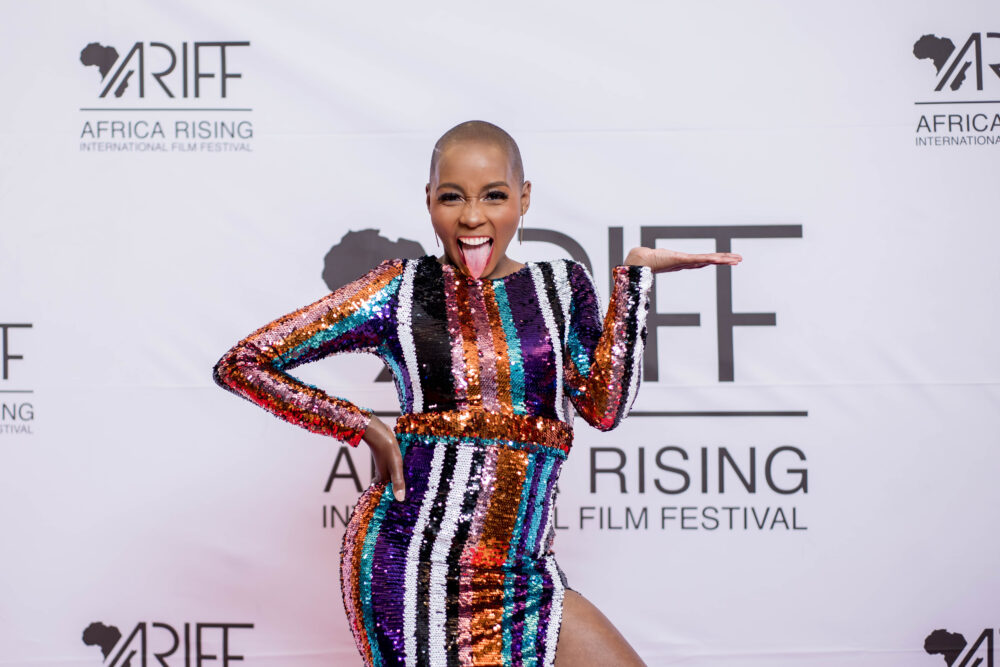
The Africa Rising International Film Festival (ARIFF) is one of those spaces–an annual weekend where lovers of film, and emerging and established filmmakers get together to watch films, attend panels, and engage in thought-provoking and character-building conversations around the state of our media industry.
“From its inception, ARIFF was founded as a people’s festival,” Felicia Naiwa Sithebe, the festival manager, tells me. “It’s a space intentionally created for the film community to gather, engage, learn from one another, and celebrate shared achievements.”
Over the past eight years since it was co-founded by Lala Tuku, SABC’s Head of Content, and Ayanda Sithebe, the founder of Actor Spaces, this vision has been consistently actualised through programming that prioritises access and inclusivity, audience development, and platforming emerging and established filmmakers on the greater African film and media network.
Karabo Mokoena, a young writer/researcher/all-out storyteller, who has grown within ARIFF from volunteer to programmer, shapes this year’s selection with a focus on story above all else.
With a criteria rooted in relevance and what resonates beyond the technical: films that speak to the current social climate, echo local and global anxieties, and present experiences that audiences can deeply connect with. Whether interrogating land politics, navigating friendship, or reflecting on identity, the slated films mirror the world’s tensions while highlighting the nuances of African life.
A part of her curation process was ensuring that, inasmuch as the films were technically and creatively accomplished, as well as able to entertain and prompt engagement, they also needed to tell a story within their respective packages. There needed to be some kind of conversation.
With different packages like After We Fall, Ties That Bind, Bound & Becoming, and Moments & Encounters, to name but a few, the programmer highlighted themes that resonated with resilience and recovery, that confronted realities that hold us together even when we’re going through the most, and stories that capture the fleeting and profound moments that shape who we are and the journeys we take.
What came from this was a blend of narrative and documentary short films from different countries like Tanzania, Nigeria, Burundi, Tunisia, and South Africa, among others. A beautiful display of the interconnectedness of experiences within the African community.
Audiences can expect special screenings of feature films like Godisang Khunou’s Black Women and Sex, and Carissa directed by Jason Jacobs and Devon Delma. Mokoena mentions Tsogo Kupa’s Mathonga Elizwe and Nqanawe Cebolenkosi Shangase’s Ubani Lore? as one of many standout submissions for how they use powerful yet accessible storytelling means.
She recalls watching the Amathonga Elizwe documentary for the first time at the Johannesburg Film Festival earlier this year, and appreciating how it dealt with the conversations on land. “While there’s nothing wrong with intellectualising a subject matter,” she explains, “I think it’s very important to create work that speaks back to the people that it’s meant to touch and whose story it is telling. The film gave the people of that area a means to voice out how this land ownership situation impacted their heritage and their history.”
Like their uprooting and loss of ancestral lands.
On Shangase’s Ubani Lore?: “Nqanawe has a way of writing dialogue that’s very, very smart. It takes something that appears simple and gives it great nuance. In Ubani Lore? three friends are basically looking for the origins of the film, The Matrix. A book. But the conversations they have around this book, their intentions… It’s a brilliant film, but the dialogue is amazing. Written quite beautifully.”
The festival also hosts a strong slate of panels, masterclasses and presentations – from a producing panel spotlighting young industry disruptors “who are making waves in their own individual ways” and are imparting others with skills and suggestions on how to navigate the precariousness of creating work and looking for funding, to Gcobisa Yoka’s Between Story and Strategy presentation that “talks about how she uses her background in Film and TV to create strategies for different brands—a great reminder that you are not limited to a linear or singular creative space,” to Lehlohonolo Masipa’s highly anticipated session on Breaking Down the Path.
These sessions are imperative in humanising the journey of being a filmmaker. In sharing nuggets and breaking down creative pathways, and empowering young filmmakers with practical, market-facing knowledge.
Beyond screenings, ARIFF expands its footprint with dynamic offerings like the Digital Hub, a space exploring the convergence of film, creativity and technology, and the introduction of a new segment called Buzz in the Creative Streets, a curated look at short-form digital content and the innovative ways young people are merging storytelling with brand strategy, design, new media, and cultural influence.
A big part of Karabo Mokoena’s research and planning process for this youth-centric programme was actively looking into what young people are doing, what they’re saying, and what they’re looking forward to. “And a lot of them are gravitating towards the digital space – creating reels and such, and finding creative ways to use short-form. That is what Buzz in the Creative Streets is about: spotlighting short-form content and the young people pushing it.”
As a free event, ARIFF invites artists and creatives, and exhibitors alike to showcase their work. It is a space that prioritises access and visibility. When asked about distribution processes, Naiwa Sithebe says that “While the festival doesn’t have a formal post-festival distribution model, we ensure that filmmakers are connected to the right networks, information, and opportunities that can support their distribution journey.”
One of these is a masterclass by Ster-Kinekor chief of content, Nicolette Scheepers, titled What Makes a Successful Theatrical Release. This session looks at unpacking audience behaviour, market realities and insights into what filmmakers should be aware of when planning to distribute their films – imperative information that may not be readily available out there.
Central to their mission is the creation of sustainable bridges with local and international partners, spotlighting and positioning young people as essential storytellers of our time, and highlighting their need for resources and support to propel our media and culture landscape forward.
Naiwa Sithebe explains: “As a people-focused festival, much of our strength comes from the dedication of our team and partners – individuals and organisations who join us with a genuine commitment to uplifting the industry.”
These relationships have been built and nurtured over many years, but there can never be enough funders for an endeavour like this that seeks to shape and reshape how our country interacts with others as a participant and contributor to cultural conversations.
“Strong financial support directly impacts our ability to build better infrastructure and ultimately enhance the experience for all attendees. The more stakeholders who believe in the vision, the greater the impact that can be made across different regions, and the more effectively we can address existing gaps within the industry.”
ARIFF takes place at Atlas Studios from November 28th to the 30th, with different screenings taking place between Atlas Studios, The Bioscope, and Ster-Kinekor Cinema Nouveau in Rosebank.
Tickets are currently sold out for all the sessions and screenings.
Drawing Change: How David Tshabalala and Sindiso Nyoni Turn Design into social power:
Graphic designers usually produce the visuals found on packaging, clothing, book covers, and transport vehicles. Yet, when their artistry is elevated to provoke thought, reflect society, or preserve cultural heritage, their creations achieve lasting significance.
Social commentary through digital design and artistry is what award-winning content creator, illustrator and graphic designer David Tshabalala knows well.
While he studied graphic design at the Central University of Technology in Bloemfontein, Tshabalala’s path was shaped during his early schooling years. His love for literature and drawing pictures gave him solace in being an above-average student who was one of the better artists in class.
After graduation, Tshabalala started his own branding and design company, Suketchi, with his former employer, Sarah-Jane Boden. He has worked with brands such as KFC, John Craig SA and The Courier Guy, among others. The turning point for Tshabalala in realising his work can have a social impact, came in 2014.
“That was a big year for me because I started to find my voice and unique style. So, I had an idea to host exhibitions,” he says.
He developed a series of exhibitions called Run The World. The exhibitions were inspired by women Tshabalala found inspiring.
“I grasped how to fuse my digital art and social media. I learned how to connect with people. So, for each day on Women’s Month; I illustrated portraits of women who inspire me on Instagram and I profiled who they are and what they do,” he adds.
Tshabalala has also done work inspired by some of our national current affairs topics to generate conversation. In a colourful country like South Africa, the digital maestro is never short of content.
“I think the state of our country is a minefield for content, satire and stories in general. I am an artist but I am also a problem-solver who uses design to find solutions in things by telling stories,” he says.
His work has not only been noticed by his many fans and followers who know him by his handle Slaying Goliath, but it has also achieved much industry recognition.
For instance, the Davetionary series, landed Tshabalala on the Mail & Guardian 200 Young South Africans list in 2015. The My How To Survive Cyril’s Economy series, offering satirical survival tips, won him a DSTV Content Creator Award for Social Commentary in 2022.
One of his highlights was when his tribute piece to honour the late South African rapper, AKA, led to an exhibition for the Kiernan Forbes Foundation. The sales of Tshabalala’s merchandise for the exhibition went to charities that the foundation supported thus amplifying his mission for social impact through his work.

Another graphic designer using his digital artistry for social commentary is Zimbabwean-born Sindiso Nyoni. At four years old in the 1980s, Nyoni was already being exposed to the abundant forms of art and popular culture in his home country.
“I was highly inspired by all these surroundings, and it was then that I developed a love for drawing. I haven’t stopped since,” says Nyoni, also known as R!OT.
This newfound love, Nyoni says, led to a limited series of handcrafted comics in primary school, right through to high school, where he took art classes at a Catholic High School in Bulawayo. It was during this period that he was introduced to the art of communication design by a retired graphic designer from St. Louis, who had relocated to the continent to teach art.
In 2005 Nyoni left Bulawayo for Johannesburg to pursue his tertiary studies. To fund his studies, he worked as a barman and freelance designer. In 2008, he graduated from the University of Johannesburg with a BTech degree in Graphic Design.
Nyoni’s work has been exhibited widely, including in platforms like the FNB Jo’burg Art Fair. He has exhibited in international venues such as MoMA in Mexico City, The Guggenheim Bilbao in Spain and The Vitra Design Museum in Germany.
Besides his illustrious commercial work for clients such as Netflix, NBA Africa, Nando’s and Hennessy, Nyoni’s activist-driven work has also given him prominence.
Nyoni uses a bold fusion of pencil, ink, pastels, and digital media to create a signature subversive street-art style. Through his work he explores urgent socio-political issues across Africa such as Afrophobia, tribalism, gender inequality, race and post-colonial power abuse.
“I use my work for social commentary by employing a distinctive activist poster style that combines illustration and graphic design to directly address pressing social and political issues in Africa,” says the multidisciplinary graphic artist.
In addition to seeing art as activism in a Black Panther newspaper at age nine, Nyoni says the activist poster aesthetic in his work was influenced by protest art from African liberation movements and artists like Emory Douglas.
The series of posters, self-portraits, and exhibitions he created during his university days solidified Nyoni’s understanding of the power of his work in addressing social issues.
“These experiences, combined with growing up in a turbulent Zimbabwe and a strong desire to represent the black narrative, led me to adopt the alias R!OT, a play on the Martin Luther King Jr. quote, “a riot is the voice of the unheard,” further defining my mission to give a voice to underrepresented issues through visual art.”
The main aspect of his commentary is to promote a positive and authentic African narrative. “I challenge Western-imposed stereotypes by creating imagery that resonates with African youth and highlights the richness of the continent’s cultural heritage. I also use my work to highlight historical and current injustices,” Nyoni affirms.

During their studies and early careers, Tshabalala and Nyoni were exposed to a variety of graphic design software before Artificial Intelligence (AI) was part of our daily lexicon. As the digital world keeps changing, I was curious to know how new technologies like AI impact their work.
Tshabalala says AI platforms like Midjourney and Chat GPT help him to create resources and references that aid his creative process.
He adds “I’ve used images generated from Midjourney for actual digital content that lives on various platforms. I do this as a last resort when I can’t find what I am looking for on stock imagery sites. With the way Midjourney is improving, it will be my go-to platform to source pictures.”
Nyoni says he still loves to maintain a human-centred and traditional approach to his art, while incorporating digital media.
“I prefer to use AI in separate, more tech-focused projects, often related to social activism or data analysis, while keeping my main illustration work personal and hand-made. My signature street-art style is a deliberate fusion of traditional and digital media,” Nyoni says.
Despite this balance, Nyoni argues that the focus on human touch and lived experience is a central tenet that distinguishes his art from the more formulaic outputs of AI.
The creative world is also changing as an influx of young creatives are establishing their own platforms and careers. For aspiring graphic designers who want to use their work for social commentary and activism, Tshabalala says they must find their own path first.
“Using my work to document social issues is what I do really well and I’ve made this a part of my signature offering. But I wouldn’t necessarily advise anyone to do the same thing to be successful. Find your light and do what works for you. It’s okay to create for yourself and it’s okay not to address any social issue.”
Nyoni has been involved in shaping design thinking in Africa through mentorship programs and juries including serving as a judge for the Loerie Awards. His tips include embracing social responsibility, authenticity and being adaptable through lifelong learning.
“The journey in the creative industry, especially when addressing challenging social issues, can be difficult. I would advise young creatives to not lose focus on the bigger goal and to treat failures as stepping stones to growth. To continuously hone your craft, be open to learning, and collaborate with other artists and organisations,” Nyoni advises.
Tshabalala’s parting shot is a fitting quote by Nina Simone: “An artist’s duty, as far as I’m concerned, is to reflect the times. I think that is true of painters, sculptors, poets, musicians. As far as I’m concerned, it’s their choice, but I choose to reflect the times and situations in which I find myself. That, to me, is my duty.”
These two gentle brothers have certainly chosen their duties well by crafting purpose-driven work dipped in social activism with supreme proficiency. Not only redefining how graphic design is seen, Tshabalala and Nyoni are immortalising themselves as pioneers visually documenting current African socio-politics and pop culture.
Diary: HughFest; Heineken® World Tour; and Ballito LIVE:
HughFest returns with Shekhinah, The Soul Brothers, Mi Casa and more at Nirox Sculpture Park
On Sunday, 30 November, HughFest returns to Nirox Sculpture Park for its fourth year at the venue, and its 12th edition as one of South Africa’s most beloved cultural celebrations. Honouring the legacy of Bra Hugh Masekela, the festival brings together artists who embody his spirit of musical excellence, cultural pride and creative fearlessness. This year’s lineup features Shekhinah, The Soul Brothers, Mi Casa, Madala Kunene & Sibusile Xaba, The Brother Moves On and iComplete.
More than a music festival, HughFest is a gathering grounded in intergenerational exchange, artistic heritage and the communal joy that Masekela championed throughout his life. Set against the natural beauty of Nirox, the event promises a day of reflection, rhythm and celebration; a living love letter to South Africa and the continent.
Heineken® World Tour brings Formula 1® fever to Cape Town

Cape Town is about to feel the full throttle rush of Formula 1® as the Heineken® World Tour lands at the DHL Stadium Precinct on 30 November. For one adrenaline-loaded afternoon, the city becomes a motorsport playground as Oracle Red Bull Racing’s RB8 hits Green Point with two high-octane F1 Racing Demos guaranteed to shake the asphalt.
Adding South African flair to the action, Sam Sam and crew bring a spinning showcase, while drifting pros light up the tarmac with tyre-screeching precision. The entertainment lineup is just as stacked, featuring Kamo Mphela, YoungstaCPT with the Cape Minstrels and brass band, Cassper, Themba, and DJ sets to keep the pulse racing. The day ends with a live big-screen viewing of the Qatar Grand Prix; the perfect finale for fans and thrill-seekers alike.
Tickets cost R495 for two via Howler.
Ballito LIVE brings sunshine, music and family fun to the North Coast

Wrap up the year with a full day of sun-soaked celebration as Ballito LIVE takes over The Lawns on 27 December from 3pm to 11pm. This family-friendly festival captures everything that makes KZN summers unforgettable: live music, warm evenings, shared laughter and the easy joy of being together.
Set against the coastal breeze of the North Coast, the event features performances by Jeremy Loops, Lady Zamar and Will Linley, offering a vibrant soundtrack for the holiday season. Between sets, festivalgoers can relax in dedicated chill-out zones, enjoy a variety of activities or simply soak in the festive atmosphere that feels like a homecoming.
Whether you’re looking to dance, unwind or create new memories with loved ones, Ballito LIVE promises a perfect summer escape for all ages.
Submit and get free exposure here: Showcase Your Business | Advertise Your Special Offers.
