G20 leaders can’t tackle the climate crisis without addressing information integrity:
Last year was the world’s warmest on record, leaving no uncertainty that we are feeling the effects of climate change worldwide. Yet, persistent doubts about its existence continue to undermine the effectiveness of policy measures aimed at reducing humanity’s impact on the climate.
These doubts do not spread organically based on citizens’ concerns, but are pushed by well-financed and coordinated disinformation campaigns. Global research on climate change disinformation confirms that this is a lucrative business. Challenges to information integrity are affecting climate change policies, as argued in the Forum on Information & Democracy’s policy brief, “Information integrity on climate change must be an integral pillar of the G20” published in the framework of the M20, an independent media initiative.
These issues are three-fold: coordinated, financed and targeted climate disinformation, orchestrated by vested interests, for example, the fossil fuel industry, that directly benefits from delaying climate action, spreads doubt about the existence of climate change or the effectiveness of certain measures. The campaigns exploit a polarised issue and target policy makers with the objective of hindering action. The attention-focused business model of online platforms facilitates their work and brings profits to platforms.
Second, attacks against journalists and the crisis of news media are further hampering access to reliable environmental information and investigative reporting on climate scandals. In the past 15 years, 44 environmental journalists around the world were killed and many more were victims of attacks and intimidation, according to the United Nations Educational, Scientific and Cultural Organisation’s (Unesco’s) statistics.
Natural resource extraction occurs to a great extent in countries with little press freedom, making investigations even more difficult. A worldwide economic crisis of the media exacerbates these problems. According to Reporters without Borders, the economic situation of journalism is at an unprecedented low, leading to the firing of journalists, closures and news deserts.
Finally, the media and science suffer from a lack of trust. Only 40% state that they trust the news media, according to the Reuters Institute Digital News Report 2025. And the distrusting minorities are managing to pollute the public discourse, spreading their doubts in science.
The climate crisis cannot be solved unless we solve the information integrity crisis. As long as the global information space is polluted with false information and doubts, and provides only challenging avenues for reliable climate reporting, it will be difficult to take the needed actions: both citizens and policy-makers will be impacted.
The G20 has started recognising the importance of the issue, notably during Brazil’s G20 presidency in 2024. The Global Initiative on Information Integrity on Climate Change launched by the government of Brazil, the UN and Unesco aims to contribute to research, communication campaigns and coordinated actions. The South African presidency should follow in these footsteps and encourage all related negotiation groups to recognise the issue and commit to taking action. Their priorities — solidarity, equality, sustainability — cannot be achieved without addressing the global information space and its harmful effect on public debate.
In particular, the Sherpa Tracks Environment and Climate Sustainability Working Group and Just Energy Transitions Workstream are well-positioned to discuss the issues and make information integrity an integral part of policy debates on climate and the environment.
G20 actions must investigate and develop solutions to assess the risk of climate and environmental disinformation on policy-making and the policy debate. Particularly in Global South countries, research is insufficient.
The G20 should also look into solutions to co-regulate and regulate the digital space, ensuring that platforms’ business models do not continue to exacerbate the crisis but contribute to a healthy public debate based on access to reliable information.
Moreover, the G20 must address the attacks against environmental journalists and the sustainability crisis of the news media, providing solutions to protect journalists and journalism in the long run.
Finally, debates need to consider how to strengthen access to and trust in reliable information on environmental and climate issues.
We therefore recommend that the G20 Heads of States’ Declaration includes the following statement in their final declaration:
“We recognise the importance of access to reliable, independent and pluralistic information sources on climate change and environmental issues and will bolster our efforts to ensure the safety of environmental journalists, access to scientific and fact-based information online and to address the root causes of climate disinformation and climate change denialism.”
The G20 Summit in South Africa could be an important moment to further the protection of information integrity on climate issues. But efforts need to go beyond the G20. Information integrity needs to become an integral part of all climate negotiations, starting with the forthcoming COP30. Only by addressing the information integrity crisis can we establish a global information ecosystem that contributes to a fact-based and healthy debate on climate policy.
Katharina Zuegel is the policy director at the Forum on Information & Democracy, and lead author of the M20’s third policy brief. The M20 is an independent parallel media initiative to ensure issues relating to media integrity and healthy ecosystems are reflected in the policy agenda of the G20.
The garden that eats Frantz Fanon:
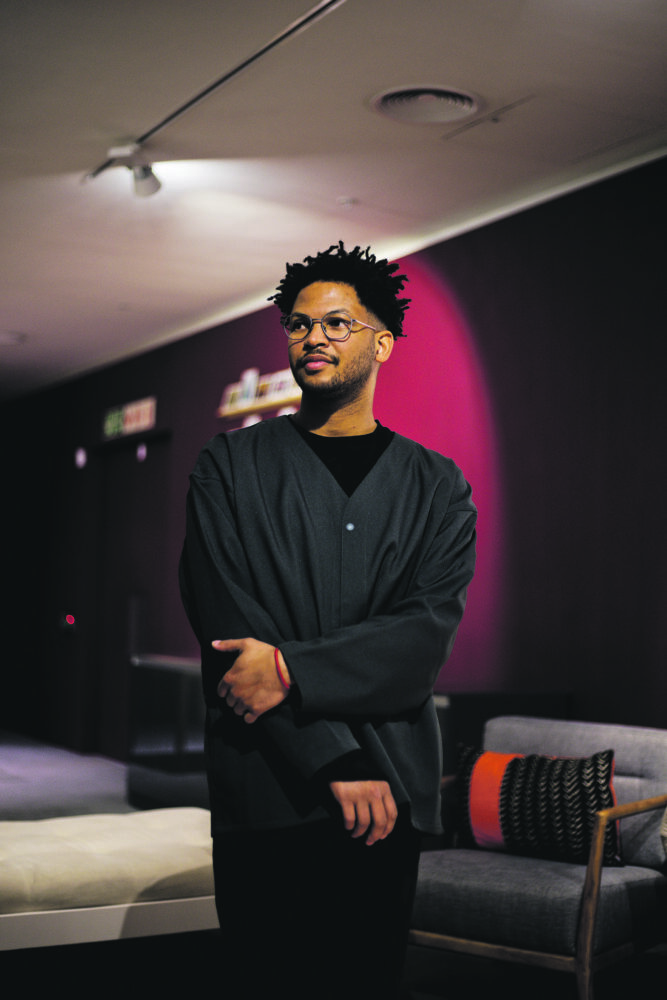
Ferreirasdorp, in the Joburg inner city, is not for the faint hearted, but approaching Nolan Oswald Dennis’s studio, the chaos peeled away. The security guard offered a subtle smile as he swung the gate open, gesturing towards the central block.
As I entered the large sunlit space, eyes flickered up from slick screens, which, like the walls, were neatly scattered with works in progress or works that might have been. Dennis led me into a separate studio with even more stillness and even more light, where I had to lean in just to catch his words with my well-worn ears.
Nolan Oswald Dennis began his career as a student of architecture at the University of the Witwatersrand but grew critical of its narrow focus on fixed structures. “I became an artist through working with other people,” he says, finding the art world offered “more space to think and to work in meaningful ways”.
Puncturing the art space were makers such as Rangoato Hlasane of Keleketla! Library and Jamal Nxedlana of CUSS Group.
“There was a sense of urgency,” he says as he recalls Johannesburg’s interdisciplinary hive between 2010 and 2016.
Dennis’s trajectory was shaped by his 2012–13 collaboration Social Landscape Project: Transition and Show Us Our Land with Molemo Moiloa at Market Photo Workshop.
In 2015, he co-founded the creative agency NTU with Bogosi Sekhukhuni and Tabita Rezaire and, early on, Dennis began to learn about the art world’s flawed value systems.
He recalls Sekhukhuni’s words, “He said, ‘These people don’t understand how important what I’m doing is.’ And I couldn’t understand at first — he didn’t say ‘good’ or ‘impressive’, he said ‘important’.”
In 2016, Dennis had a solo exhibition at Goodman Gallery, which earned him the FNB Art Prize.
After studying at the Massachusetts Institute of Technology in the US from 2018 to 2020, he returned to Joburg. By then, his work was internationally renowned, appearing in major biennales, including Berlin, Dakar, Liverpool and Shanghai, plus the Front International Cleveland Triennial in the US.
Now represented by Goodman, he’s also exhibited at the Swiss Institute (New York) and Gasworks (London), won the 2023 Sesc_Videobrasil Jury Prize and had a monograph published with Zeitz MOCAA and Koenig.
I returned to the question of importance, asking Dennis about what mattered during those early “Joburg hustle days”, compared to now, when he is ostensibly the golden boy of the art world. I mention the recent FNB Art Prize ceremony, where Thato Toeba was crowned artist of the year and Dennis’s name was dropped in multiple speeches.
“Importance on its own terms is not necessarily the measure because, sometimes, being important or valued in institutional spaces can mean you’re useful to them, which isn’t necessarily where you want to find your value.”
Herein lies my fascination with this artist’s radical unravelling of what’s important. Dennis’s garden for fanon, first shown in conditions (2021) at Goodman Gallery, animates the very notion of importance.
Glass globes are filled with soil and earthworms that slowly consume Franz Fanon’s The Wretched of the Earth, transforming its pages into nutrient-rich earth.
The installation balances scientific precision with organic chaos as shifting light bathes the piece in a ritual glow — an unlikely alchemy that breathes and grows.
While it began in 2021, which marked 60 years since The Wretched of the Earth was written, Dennis’s garden for fanon has been exhibited numerous times, now part of the Re:Fuse-Ability exhibition at University of Johannesburg’s FADA Gallery, until 6 September.
Dennis admits the limitations, noting how his own relationship with Fanon was far from academic. While he acknowledges the show as “a place where people can meet with the work”, he critiques how institutions “tend to prioritise objects”, when “it should be about engagement, not just display”.
According to him, the institutional treatment of Fanon is “so analytical, so academic”, while his own intervention asks: “Where’s the earth in this text?”
His piece clocks the gap between academic and organic knowledge systems as he insists, “I learned Fanon through other people. For me, it was never about the text itself, it was about what the text does.
“The first time I encountered Fanon was in a collection of books my grandmother gave me. I had to ask people, talk to people to understand the book. It was never just about sitting with the text.”
I resist collapsing too neatly into Dennis’s critique of the art world, an institution that, for better or worse, has held space for us both. Instead, I follow what he calls a “game of meaning”, where play and precision hold equal weight. His work dances between legibility and refusal, spectacle and sincerity.
“The art world thrives on making people conventional, legible,” he warns, “but for me, everything, to some extent, arrives with humour.”
Beneath the wit is intention: “two material languages”— clinical glass and homely clay — never reconciled, always in tension.
Dennis recalls familiar critiques: “Why is your work so white? Why is it so cold? Why are you trying to be a scientist?” These reveal discomfort with hybridity. He admits, “It’s a colonial form, that laboratory aesthetic … These questions are a bit cringe but I get where they’re coming from.”
When he brings in “African” aesthetics, some see tradition or tourism, others ritual or spirituality. For Dennis, these aren’t fixed but overlapping “libraries” of meaning. He embraces this friction as generative: “That tension is a hypothesis … I’m interested in those intersections.”
Dennis’ invocation of Fanon is neither nostalgic nor critical: “We want to love Fanon by resisting all the shit done to his legacy.” I press him about exactly how he resists and he answers, “Taking seriously the things that I love … and trying to align my work with those things.”
I probed further, asking specifically about love, a question that appeared to produce a degree of reciprocal pleasure. His current literary love, a sci-fi series by Jeff VanderMeer, starting with Annihilation (2014), now followed by Absolution (2025), the fourth book in the “trilogy”.
As our chat came to its natural end, we lingered on love, geeking out about having been brought up in KwaZulu-Natal. “It’s crazy, so much weird stuff comes out of that space,” he says with a hearty grin.
We bonded over our somewhat predictable predilection towards the gqom genre, and with a balmic chuckle, he accurately professed, “It’s good stuff.”
Just before he was whisked away, I pried out one last tidbit: Lately, he’s been interested in rocks, recently touring the UJ Mining Simulation, haunted by its humidity, heat and hammering. Hold onto your helmets.
How South Africa’s Lesotho water project costs ballooned by R45bn:
The cost of the second phase of the Lesotho Highlands Water Project to deliver water to South Africa’s industrial heartland and generate hydropower for Lesotho has increased by R45 billion.
In 2008, phase two was projected to cost R8 billion. By 2022, this had ballooned to R42 billion. It now stands at R53 billion, raising questions about governance, oversight and accountability.
“Despite Minister [Pemmy Majodina]’s public acknowledgement that a probe into the escalating costs of phase two of the [Lesotho Highlands Water Project] would be conducted, no further details have been shared with parliament or the public,” Democratic Alliance deputy spokesperson on water and sanitation Stephen Moore said last week.
Moore has filed a Promotion of Access to Information Act application to the department of water and sanitation. This follows two unanswered letters, the first sent on 8 May.
The department’s spokesperson Wisane Mavasa said the May letter had not been sent directly to the minister or director general. “Unfortunately, the letter was not acted upon by the officials that it was sent to,” she said, adding that the minister would respond “shortly”.
The department says the escalation is the result of various factors, including years of delays, treaty complications and market fluctuations.
Oversight gaps
South Africa’s portfolio committee on water and sanitation raised concerns about the cost of the project with the auditor general at a sitting on 6 May.
The meeting flagged weaknesses in governance created by the dual-implementation model between the Trans-Caledon Tunnel Authority and the Lesotho Highlands Development Authority (LHDA).
Delays have pushed completion from 2019 to 2028, affecting the delivery schedule and future phases of the project.
The committee also noted constraints stemming from the 1986 treaty preventing the auditor general from auditing the LHDA directly, “leaving South Africa reliant on Lesotho’s audit structures”.
But, says Mavasa, the Lesotho Highlands Water Commission (LHWC) has equal representation from both governments, had “full access to the cost records of the LHDA” and had received detailed information about the delays.
The committee also criticised the royalty arrangement, which it said obliges South Africa to continue payments to Lesotho even when water deliveries are interrupted.
Other concerns included limited local procurement, dominance of foreign contractors and opaque financial flows. Some MPs went as far as calling for an immediate funding suspension, citing mismanagement and treaty flaws.
However, the auditor general cautioned against such a drastic move, warning of legal consequences. It recommended treaty reforms, including joint audits, instead.
Mavasa says South Africa and Lesotho have agreed to review the treaty, but the “matters for review” have yet to be decided.
Lesotho’s Finance Minister Retselisitsoe Matlanyane told parliament in February that the government intended to pursue “the overdue review of the treaty” to negotiate a better deal for Lesotho.
From R8 billion to R53 billion
Mavasa outlined the project’s financial journey in detail. The original 2008 feasibility study produced a preliminary R8 billion estimate — excluding inflation, currency shifts, contingency allowances and modern environmental and social safeguards.
Construction of the main works was expected to start in 2013 and deliver water to Gauteng by 2019. However, she said, the main contracts were only awarded in 2022 because negotiations with Lesotho took longer than expected. The situation had worsened with years of administrative and procedural delays.
“The phase two agreement was signed in August 2011. It then took 14 months for the [South African] parliament to ratify the phase two agreement and a further seven months for the Lesotho parliament to ratify the agreement after the ratification by the SA parliament,” Mavasa said.
After Lesotho’s 2013 change of government, the agreement was subjected to fresh scrutiny, adding further delays, according to Mavasa, who also pointed out that, between 2013 and 2022, the department of water and sanitation had five different ministers and 11 directors general, which slowed decision-making.
There were also financing complications. Funders raised concerns over procurement processes for the main contracts and requested they be tendered afresh. The Covid pandemic also disrupted preparatory work.
In October 2022, the LHDA projected a R42 billion completion cost — incorporating contract prices; social and environmental programmes; foreign exchange effects and administrative costs.
More than R20 billion in extra costs was due to inflation linked to the delays, Mavasa said.
In October, the figure rose to R53 billion. The department attributed this to:
•?R4.2 billion from boosting the contingency provision in line with international good practice from R3.3 billion in 2022 to R7.5 billion last year
•?R5.4 billion for additional social obligations requested by Lesotho, such as rural water supply and road infrastructure
•?R1.7 billion in price escalations, design changes and contractor claims linked to delays, including work-permit issues.
Governance fixes and audits
According to Mavasa, the project costs and time overruns have been a major concern for the department of water and sanitation and Minister Majodina. She said the Lesotho Highlands Development Authority has developed a plan to minimise any further delays and cost overruns.
The LHWC would appoint a multidisciplinary team of experts to conduct management audits of contracts.
Although the project is about half completed, she said two primary contracts are behind schedule.
“However, the LHDA is executing a turnaround plan to avoid further delays and recover lost time.”
Last year, Mavasa said the department had established a governance committee comprising the department, the Trans-Caledon Tunnel Authority and the South African delegation to the LHWC, which meets monthly to review progress.
The director general of the department of water and sanitation and the principal secretary of the relevant department in Lesotho held ad hoc and quarterly meetings to address issues arising from the project. Unresolved issues were escalated to the ministers.
Lesotho’s Minister of Natural Resources Mohlomi Moleko said he could only respond next week as he was outside the country.
This story was first published by GroundUp
Submit and get free exposure here: Showcase Your Business | Advertise Your Special Offers.