God edition: Hindu nationalism clangs temple bells:
Everyone in the neighbourhood was making a fuss about this new, big temple that was being inaugurated, but we could only watch it on television because it is in India.
The Ram Mandir was built in Ayodhya, in the north Indian state of Uttar Pradesh.
In Hindu scripture and mythology, Ayodhya is a sacred site, said to be the birthplace of the Hindu god Lord Rama. It’s something any Hindu does not question, but simply accepts.
That’s probably the case with most religions: we don’t question faith and we don’t question religion. Maybe it’s fear of the higher power, maybe we don’t want to be disrespectful or perhaps we don’t have evidence to argue with scripts that were written hundreds of years ago.
But that’s changing.
I didn’t pay much attention to the inauguration, even though Hindu organisations in South Africa hosted events to celebrate it. Some people lit lamps in their homes. I didn’t participate in any of these activities, not out of cynicism but because I just didn’t connect with it. But I watched as Bollywood celebrities descended on the site.
My interest was piqued when I heard there was controversy over the site of the Hindu temple.
According to reports, the temple was built on the site of the 16th-century Babri Masjid that Hindu far-right nationalists demolished in 1992. It triggered nationwide riots between Hindus and Muslims, which led to the deaths of more than 2??000 people, mostly Muslims.
The site was subsequently closed to the public, and in 2019 India’s supreme court ruled in favour of Hindus, saying the land should be handed over to a trust that would oversee the construction of a Hindu temple. Construction kicked off in 2020.
The law decided it.
It’s a land issue underpinned by religion. The court ruled in favour of the Hindus so it might be right, but was it okay for Hindus to claim the site, stand on top of the mosque and violently demolish it?
I don’t think so.
I also don’t think it’s okay for Israel to colonise land and demolish anything (and anyone) on it.
The principles are similar; and I learnt that I should take the side of humanity.
Not religion, but humanity. Isn’t that what everyone is preaching amid Israel’s war on Gaza?
Am I allowed to question my religion when it’s wrong? Surely it doesn’t make me any less of a Hindu?
Then amid all the noise, information from 2019 resurfaced: there was a grand temple below the Babri Mosque, according to archaeological evidence that was presented to the supreme court.
That information came from a Muslim archaeologist, KK Muhammed. He was the only Muslim on the team of archaeologists that had carried out the first excavation at the site in 1976-77. The second one was carried out in 2003 after the mosque was destroyed, and the archaeologists found more remains of a temple that was apparently razed in the 16th century.
According to an article in the Times of India: “The structure discovered was a temple below the Babri Mosque and dated back to the 12th century CE.”
Science determined it.
But there was an inner conflict about how we, as Hindus in South Africa, could look past the politics of it so easily and see it as our own victory and celebrate it at temples in South Africa.
The consecration of the Ram Mandir signals India’s Prime Minister Narendra Modi’s Hindu nationalist politics and could pave the way for his reelection campaign in general elections scheduled for later this year.
It is a political thing.
I sense concern from the South African Muslim community about what this means for the Muslims and minorities in India. It is heightened by what is happening in Gaza.
I have never been a fan of Modi because of his Hindu nationalist leanings — it goes against my beliefs of choosing humanity.
I am more upset that Hinduism is at the centre of it and it forced me to reckon with the faults in my religion that enabled the “othering” of non-Hindus.
I realise that my religion was okay, but the politics was not.
Hindus in South Africa can celebrate their religion in India, and the Muslims in South Africa can express their solidarity with Muslim people there, while we coexist peacefully in this country (which we do).
But we should recognise the politics behind our religion, and be bold enough to question it and even go against it when it’s used to drive a political agenda.
God edition: Where is God in the Gaza war?:
Edward Said had a short, rationalist answer as to the legitimacy of Israel’s appeal to a divine right to Holy Land as justification for war. “There’s no convincing way to assert special claims whose origins are divine,” he said in 2003.
In recent months many have returned to his writing in search of the comfort of moral clarity as the retaliation visited on Gaza extends to mass starvation or a compass, at least clues, to a way out of destructive tribalistic division.
If Said’s work reads as though it was written yesterday, Moustafa Bayoumi wrote in The Guardian, his relevance endures partly because Israelis and Palestinians remain stuck in a replay of the past two decades after his death.
“In truth, it’s not that Said was prescient — it’s that Palestinian dispossession continues, that the Israeli occupation remains, that justice for Palestinians is as elusive as ever. If anything has changed, it’s the scale of the violence, but not the violence itself.”
It is here, in the extent of the violence, that the present has overtaken Said’s pronouncements in his critique of Israel’s attachment to indiscriminate retaliation as defence and security as the only failsafe protection against future genocidal attempts on the Jewish people.
French philosopher Bernard Henri-Levy’s reading of the Hamas attacks of 7 October as the start of a new pogrom on Jews, and his defence of Israeli retaliation as just, suggests that it is stronger than ever.
In describing Palestinians as the victims of the victims of the Holocaust in a schema that is harmful to both sides, Said said: “Short of genocide, I cannot think of a single human right that has not been violated in Gaza.”
In October last year, United Nations special rapporteurs warned that the people of Gaza were at risk of genocide. In January, the International Court of Justice (ICJ) heard an application by South Africa in which it accused Israel of actions that are “genocidal in nature” in response to the massacre of 1??200 people in southern Israel, arguing that it had created conditions in Gaza aimed at ensuring the eradication of its population.
Papers filed by South Africa’s counsel cited, verbatim over eight pages, instances where Israeli officials either expressed intent to annihilate all those who live in Gaza or incited the military or the public to commit genocide. The call to reduce Gaza to lifeless rubble emerges as a refrain, and so does religious rhetoric.
Prime Minister Benyamin Netanyahu invoked the Crusades to describe the onslaught on Gaza as a “a battle of civilisation against barbarism” and the Book of Samuel as a battle cry: “You must remember what Amalek has done to you, says our Holy Bible. And we do remember.”
He returned to the same passage in a message to the military. “Now go, attack Amalek, and proscribe all that belongs to him. Spare no one, but kill alike men and women, infants and sucklings, oxen and sheep, camels and asses.”
Weeks into the campaign in Gaza, Haaretz contributor Anshel Pfeffer reiterated that anybody who hoped to help end the Israeli-Palestinian conflict must accept that it never was a secular territorial struggle, but a religious-nationalist quest.
The international community’s failure to do so was central to the failure to find a settlement, he argues, because Western brokers cannot fathom a conflict that cannot be reduced to ethnic oppression.
It is a divisive argument at a time when seeing the Palestinian struggle for self-determination as one against Zionist colonialism is no longer a marginal view and one that Pfeffer — who rejects this discourse as a fashion started on foreign campuses by Said and others — has been making for a decade.
“Theodor Herzl may have been born into an assimilated Viennese family, and David Ben-Gurion along with his fellow pioneers ditched religious stricture, but they still used the Bible as their deed of ownership to the ancient homeland,” he wrote 10 years ago. “For a few decades, while various forms of nationalism and socialism remained popular among Arabs and Jews alike, both sides could claim that they were secular liberation movements and that their battle was over disputed territory. But they could not keep the charade up for long.”
The growing political influence of Israel’s hardline settler movement over decades and the accord reached by Hamas and Fatah in 2014 made religion an overt driving force.
Netanyahu, then in his third term as prime minister, and Palestinian President Mahmoud Abbas were speaking the language of holy war with fundamentalists to shore up their flagging support bases. Being clear-eyed about what informs the conflict, Pfeffer argued, would be a necessary start to holding both leaders to account for encouraging the extremists in their respective camps.
French historian Stéphanie Laithier takes the opposite view. Writing in Le Monde, she warned that advocating for a religious reading of the war was a revisionist exercise that risked putting peace further beyond reach.
“To propose a religious interpretation of this conflict amounts to adopting the fundamentalists’ point of view,” she said. “It prevents any understanding or acceptable solution. Siding with such an approach contributes to blocking any path toward peace.”
Laithier said it was vital not to forget that both sides long ago integrated their religious identity into a far broader ideological framework.
“Those who meddle in these issues, be they politicians, intellectuals or religious leaders, would be well advised to take a closer look at the history of the two national movements, in order to fully understand their responsibility in adopting discourse that falls within the realm of fundamentalism.
“These were two movements based on a secularised conception of the nation, with religious remembrance above all serving the desire for national standardisation.”
Religious interpretations gained currency after Israel captured the Golan Heights, the Gaza Strip and West Bank in the Six-Day War in 1967, as Arab nationalism waned and Islamic radicalism entrenched itself.
For their proponents, Laithier said, “the defence of the nation and the territory attached to it now falls within the exclusive sphere of the religious; it relies on a sacralised legitimacy and asserts its own temporality, different from that of history”.
The result, she said, is that the only conceivable political action becomes that which brings historical reality into line with the prescriptions laid down by religious doctrine.
Commonality becomes an impossibility when religious difference drives conflict, as does compromise because sacred wars have always been zero-sum games of conquest.
The concept was rejected centuries before Israel was born by the historians and philosophers of the Renaissance and the Enlightenment who, in reckoning with the bloody legacy of mediaeval religious dogma and warfare in a new era of tolerance, reasoned that just war could only be sanctioned in law.
The just war theory had been evolving over centuries, muddled in its early form by the thin line between church and state, before it was codified by Hugo Grotius in De Jure Belli ad Pacus.
By grounding it in principles of natural justice that he argued applied to all nations so that consensus could contain conflict, Grotius foreshadowed international law as it is now being invoked to halt the war in Gaza.
But there is a deep field of study and debate about the binding authority of international law and its power to compel political actors to alter their behaviour. It has become less abstract as Israel continues to ignore the order the ICJ handed down on 24??January to take measures to prevent Palestinian genocide.
Advocate Tembeka Ngcukaitobi SC, who was part of the legal team that prepared South Africa’s application, said in a lecture last week that for all the significance of the ruling Israel’s refusal to abide by it has left open the wider questions on international adjudication. “It is being asked whether law is an antidote to war.”
Ngcukaitobi said he would submit that the court has confirmed its legal and moral authority, but added: “We should also recall that law is not an end.
“It is part of a larger political repertoire. Law does not replace popular struggles for freedom, but supports and supplements them.”
If that speaks of the purposeful activism of his lawyering, there is a school of thought that says the measure of international law lies in its persuasive power to create a new consensus around norms of conduct.
When emerging legal norms are perceived to be legitimate, because they are rational and resonate morally, “they generate adherence and serve to persuade”, professors Stephen Toope and Jutta Brunnée have written.
“When a regime can generate thick acceptance of emerging legal norms through the particular strength of legal rationality, this contributes to regime change and reconstitution.”
Nissan X-Trail: More of a marathon than a sprint:
Once is a coincidence, twice is a pattern. What am I on about? When Nissan launched its latest Qashqai, it proved to be a considerable departure from its predecessor.
It is, simply put, a phenomenal product. Expecting the same lofty result for the new X-Trail, the third-gen of which was nothing to write home about, might be unrealistic.
Take a moment to consider that the company that squashed the local love affair with the GT-R isn’t bringing its 400Z here anytime in the foreseeable future and its biggest ambitions for speed within its local lineup extends to the Patrol V8.
Begrudging commentary directed towards the GT-R aside (because I’ve never driven one), the X-Trail’s biggest performance ambition is the chequered-flag toggle on the centre tunnel, which is supposed to sports things up. It doesn’t.
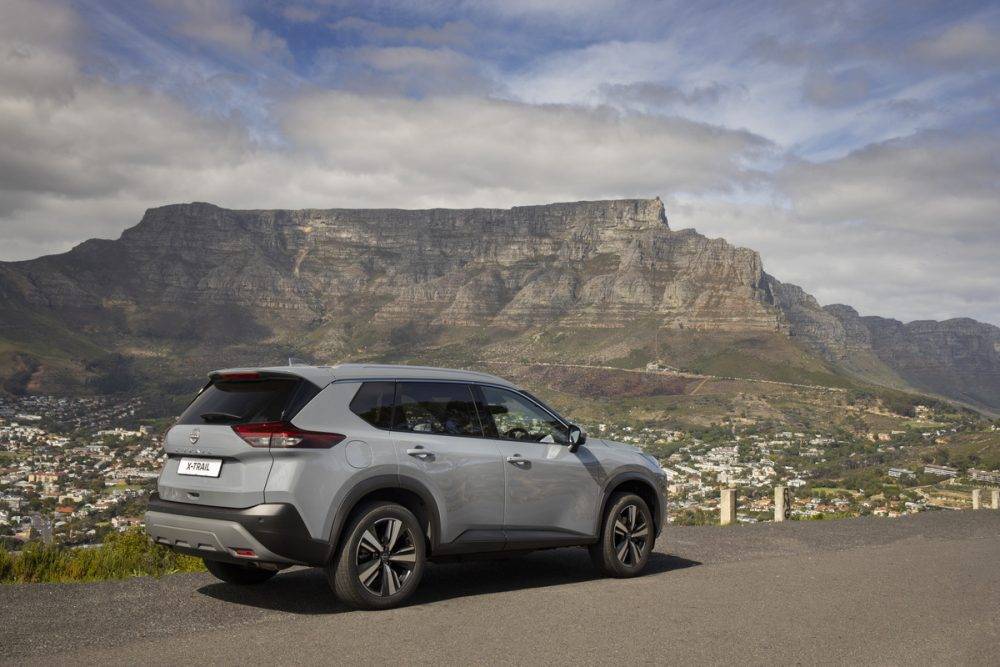
But that’s not what the X-Trail is all about. Instead, it’s geared towards a lifestyle of white picket fences — or gated security complexes in the South African context — and school runs, with Nissan even calling it a “family icon”.
If that’s where your buying priorities lie, and the word “practicality” piques your interest, you’ll be pleased to know that the X-Trail features seven seats with a boot space that’s rated at 485 litres, with all seven seats up, while the usable space extends to 651 litres with the third row down. That equates to a sizable boot — you can take my word for it. Not exactly surprising from a family icon.
How about the fit, finish and look of the X-Trail’s cabin?
Well, the Acenta Plus proved to be a pleasant surprise, with a solid build quality that also happens to be aesthetically pleasing.
It’s a rare combination of factors these days, with carmakers increasingly fitting clumps of hard, unsightly plastic in interiors and then marketing them as “family-proof cabin spaces”.
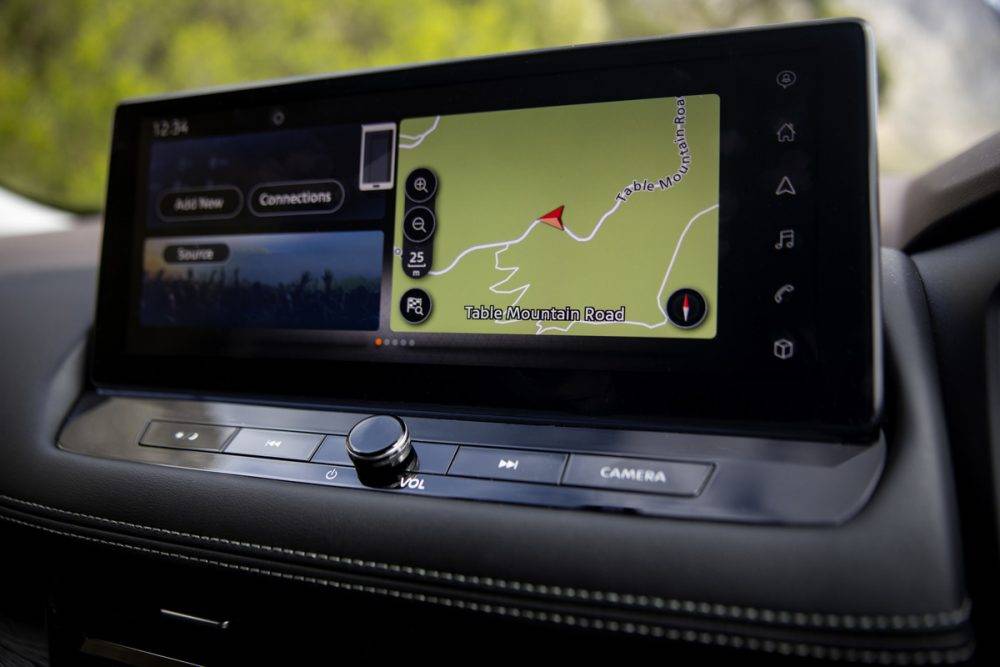
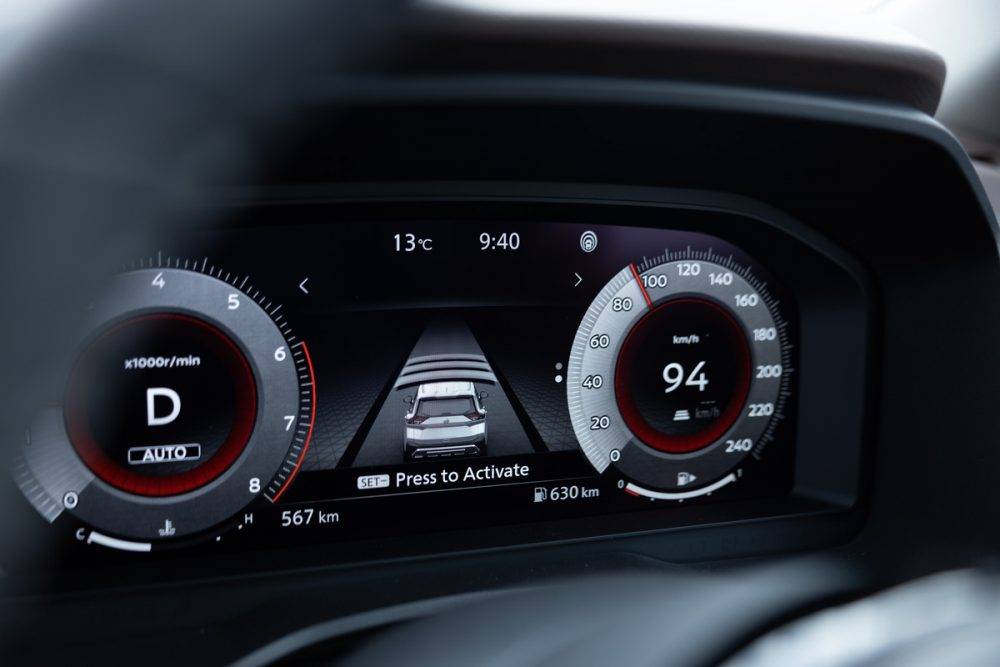
Not Nissan, and considering the R810?900 asking price, it feels relatively premium. This price tag also buys a large layer of digitisation with a 12.3-inch instrument and driving information display and a similar size infotainment screen.
The infotainment system is exceptionally easy to operate and comes with all the bells and whistles you’d expect, such as Android Auto and Apple CarPlay.
It also serves as the output feed for the top-down and reverse cameras.
To reduce clutter, Nissan has restricted the button configurations to only the most frequently used features, such as requesting a camera overlay, skipping or replaying music, drive modes, volume adjustment and the (familiar) climate interface.
Given Nissan’s reputation for speed, you’d expect some get-up-and-go — besides the toggle that promises pep, that is. Don’t.
The X-Trail went to the manners academy and, as such, it offers a polished driving experience, if a bit drab and uninspired on the powertrain front.
It’s powered by the familiar 2.5?litre naturally aspirated engine, which does duty in other models within the Renault-Nissan-Mitsubishi alliance, paired with an unimaginative CVT gearbox.
The unit has been tinkered with to produce 135kW and 244Nm of torque, an over-the-board increase of 9kW and 11Nm over its predecessor.
For the price, which happens to be an interest hike short of a bar when financing, you’d expect Nissan to go the route of turbocharging (it works wonders with the Qashqai’s CVT) or even adopting mild-hybrid systems similar to some EU-spec models.
The torque, sadly, is too sparse for this relatively large SUV and the gearbox heaves as it tries to make meaningful forward progress.
Did I mention that it’s an exceptionally comfortable cruiser when the going is easy?
In closing, Nissan managed to elevate its smaller Qashqai to a level where I’m comfortable calling it class-leading adjacent. I am not sure I can say the same of the X-Trail, especially as far as the drivetrain is concerned. It raises questions as to its competence with seven passengers in tow — I only managed to borrow three to be test subjects.
The styling and overall fit, assembly, quality of workmanship and ergonomics within the cabin get two thumbs up from me, even if the third row of seats can only comfortably fit short-legged passengers.
I can’t get over the fact that this new generation of X-Trail is more déjà vu than brand-new chapter.
Still, despite its shortcomings, Nissan’s family icon remains a solid choice for those looking to take the whole family with them, even if it’s more of a leisurely drive than, say, a sprint to the chequered flag.
Submit and get free exposure here: Showcase Your Business | Advertise Your Special Offers.