Godongwana returns to work next week:
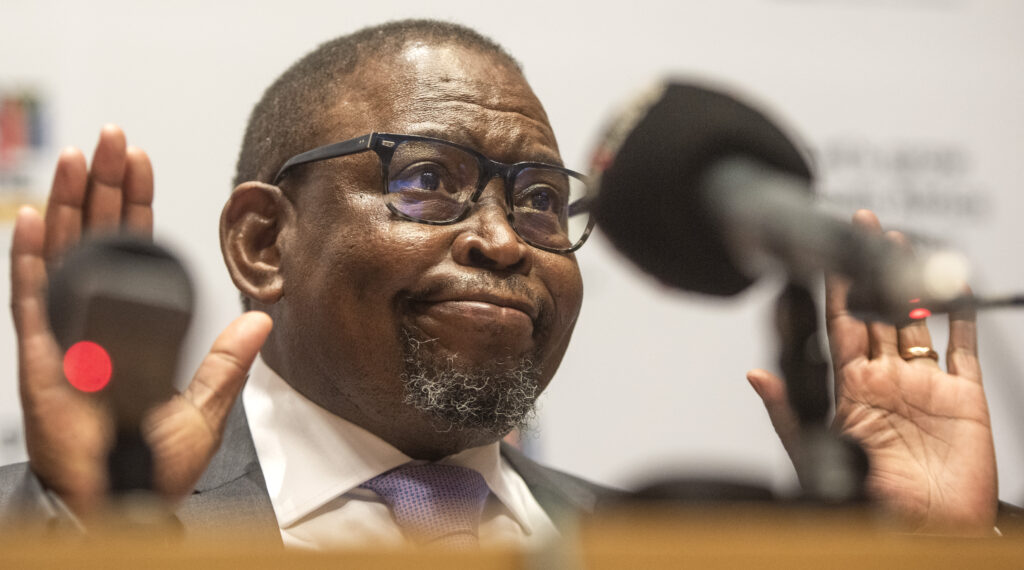
The National Treasury on Wednesday downplayed concern over finance minister Enoch Godongwana’s health, saying he underwent a routine medical test before taking leave and would return to work next week.
“The minister underwent a routine medical checkup in hospital last week and thereafter decided to take some time to rest following a very busy period leading up to the Medium-Term Budget Policy Statement, which he tabled on 1 November 2023,” the treasury said.
“There was nothing out of the ordinary about the decision,” it added.
“It is normal for the minister, like any other employee of any other organisation, to exercise his right to a break from the demands of working life.”
Godongwana will travel to Berlin for the G20 Compact with Africa conference.
The presidency confirmed on Tuesday that electricity minister Kgosientsho Ramokgopa was acting as finance minister while Godongwana was on leave. He is officially standing in for him until next Wednesday, according to the treasury.
It is reliably understood that Godongwana has been battling ill health for some time.
However, the treasury dismissed reports in this regard as inaccurate.
The post Godongwana returns to work next week appeared first on The Mail & Guardian.
Meyiwa trial: State witness contradicts own testimony:

Police officer Vusimuzi Mogane on Wednesday contradicted his earlier testimony in the Senzo Meyiwa murder trial when he spoke about making stops while driving with a suspect in 2020 because the car had mechanical problems.
Mogane had told the Pretoria high court the previous day that the vehicle had been recently serviced.
Mogane has been giving evidence, with the aid of automatic vehicle location (AVL) recordings, on the routes that were taken and stops made while transporting accused number two, Bongani Ntanzi, from the Pretoria North police station to the Moroka police station to make a confession, and then on to his residence in Rustenburg.
During cross-examination on Wednesday, defence advocate Thulani Mngomezulu, representing Ntanzi, noted that the AVL information showed that the ignition was off while the vehicle was at the Protea Industrial Park along the N12 in Johannesburg.
Mogane responded that he was checking the tyres. Mngomezulu pressed the police officer further on the frequent stops indicated on the AVL report and Mogane said this was because there were problems with the car.
This was contrary to Mogane’s testimony on Tuesday when, after being quizzed by Mngomezulu about speed violations indicated on the report, he said this was because the car had just been serviced, and was in good condition, which made it easy to drive fast.
Mngomezulu asked why the car had stopped for 22 minutes at one point.
Mogane responded: “I went into a petrol station to check my tyres. As we passed the Glen Mall, I felt that the motor vehicle was not balanced.
“I proceeded and, when I joined the N3, I felt there was a smell of smoke and the vehicle was losing its power. I forced the vehicle to proceed and that is when I contacted [fellow officer Bongani] Gininda and went into the filling station.”
Referring to the AVL report, Mngomezulu said it showed that while driving on the N3, Mogane had taken an off-ramp at Grey Avenue near a garage. He said Ntanzi’s version of events was that he had been assaulted in an open area next to a garage during that drive.
“What you are telling me is consistent with what accused number two said — he said there was a garage or petrol station where he was assaulted close to the road,” Mngomezulu said.
In response, Mogane said that when he arrived at the garage, he had realised that the car had more problems.
“When I opened the bonnet, I saw that the oil was low. As I had oil at all times, I filled up the engine with oil and ignited the vehicle again and I tried driving the vehicle again. The wheels were stiff. That is where you see I switched it off for a while to cool off. The streets you are referring to are around the garage,” he said.
He further told the court that an independent mechanic had been called: “The mechanic said there is air that needs to be removed from the brakes. As you see the vehicle idling for some time, it was when we were trying to move the car around to see if it could proceed.”
Mngomezulu reminded Mogane about his earlier testimony that the car had been recently serviced.
“From Pretoria to Carletonville you never encountered any problems and the condition aggravated when you approached the N3?” the defence lawyer asked.
“A vehicle is like a human being, it has its own illnesses,” Mogane responded.
Ntanzi is one of five men accused of killing the Bafana Bafana captain at the home of his girlfriend, singer Kelly Khumalo, in Vosloorus, Gauteng on 26 October 2014.
They have all pleaded not guilty to charges of premeditated murder, attempted murder, armed robbery, illegal possession of a firearm and the illegal possession of ammunition.
The post Meyiwa trial: State witness contradicts own testimony appeared first on The Mail & Guardian.
Government complicit in crime at Eskom, brigadier says:

The government is undoubtedly complicit in rampant corruption at Eskom, a retired police brigadier, who served as the liaison point on intelligence operations initiated by former chief executive Andre de Ruyter, said on Wednesday.
“There is direct police involvement,” Jaap Burger told parliament’s standing committee on public accounts (Scopa).
“Don’t underestimate the amount of support and contamination that there is in the government sector from the organised crime syndicates. You will be amazed, okay,” he said.
“It is not merely a position of arrogance. It is a position of, ‘We know what is going on and how contaminated we are.’”
Burger said one should ask how the national police commissioner was dealing with lapses in stemming the corruption that De Ruyter suggested cost the company, at a conservative estimate, R1 billion a month.
“Because that is where policy direction should be coming from, if there is a failure on the operational level to deal with it,” Burger said.
Responding to questions from MPs, he said it would be a mistake to believe that state capture belonged to the past.
“Typically, everybody sort of assumes that state capture is a legacy state that we are in,” he said.
“It is not. It is not. Many of the organs have not been ‘uncaptured’. Their integrity has not been restored … We have not cleaned out.”
The above comments came in reply to questions from Democratic Alliance MP Benedicta van Minnen on whether the tendency to deal with corruption at Eskom at “docket level”, rather than targeting syndicates, was deliberate.
“We are working against resistance,” he said.
Burger added that the response to organised crime is so fractured as to amount to little more than finger-pointing between the various state agencies mandated to combat it. He said, in his view, the police alone would not, at the moment, be able to deal with the amplitude of corruption within Eskom and the energy sector.
“Where is the collective?” he asked, adding that he had raised this with national security adviser Sydney Mufamadi.
“To put it bluntly, the processes of government are not working.”
He said when he first had a meeting with De Ruyter, he pointedly asked whether the State Security Agency had discussed the security risks to Eskom.
“There was no product or support from the State Security Agency … which is supposed to go to an entity of such importance.”
It raised a question as to whether state security was doing what it should to protect vital institutions.
“What I found is, no,” he said
De Ruyter handed intelligence files on Eskom to Burger in the middle of last year.
Burger was subpoenaed by the watchdog committee after initially refusing to appear before it, on the basis that it lacked a mandate to investigate corruption at the power utility. He suggested that the matter instead belonged before the joint standing committee on intelligence.
De Ruyter resigned from Eskom on 12 December last year.
He was released by the board before the end of his three-month notice period after an explosive television interview in which he agreed with the premise that the power utility served as a “feeding trough” for the ruling ANC.
In an appearance before Scopa in April, he denied that he had gone public with allegations about the scope of corruption at Eskom rather than hand relevant information to law enforcement agencies.
De Ruyter said he had given the police far more information, over the course of many months, than that which he divulged in the interview.
Whether he had cover for calling in private investigators, and whether he had made sure that law enforcement agencies, the Eskom board and the shareholders were briefed on their findings, has been a point of bitter dispute in recent months. Much of this war of words has played out in Scopa meetings.
Former Eskom acting chairperson Malegapuru Makgoba told Scopa that Public Enterprises Minister Pravin Gordhan had encouraged De Ruyter to mount an intelligence-gathering exercise.
But Gordhan vehemently denied this, telling MPs that Makgoba was “misleading and misinforming Scopa and the public”.
The Special Investigating Unit (SIU) told Scopa neither it nor the Hawks were aware of the operation and that De Ruyter had moreover initiated it without the authority of the Eskom board. It pointed to “a measure of maladministration”, SIU head Andy Mothibi charges.
The post Government complicit in crime at Eskom, brigadier says appeared first on The Mail & Guardian.
Submit and get free exposure here: Showcase Your Business | Advertise Your Special Offers.