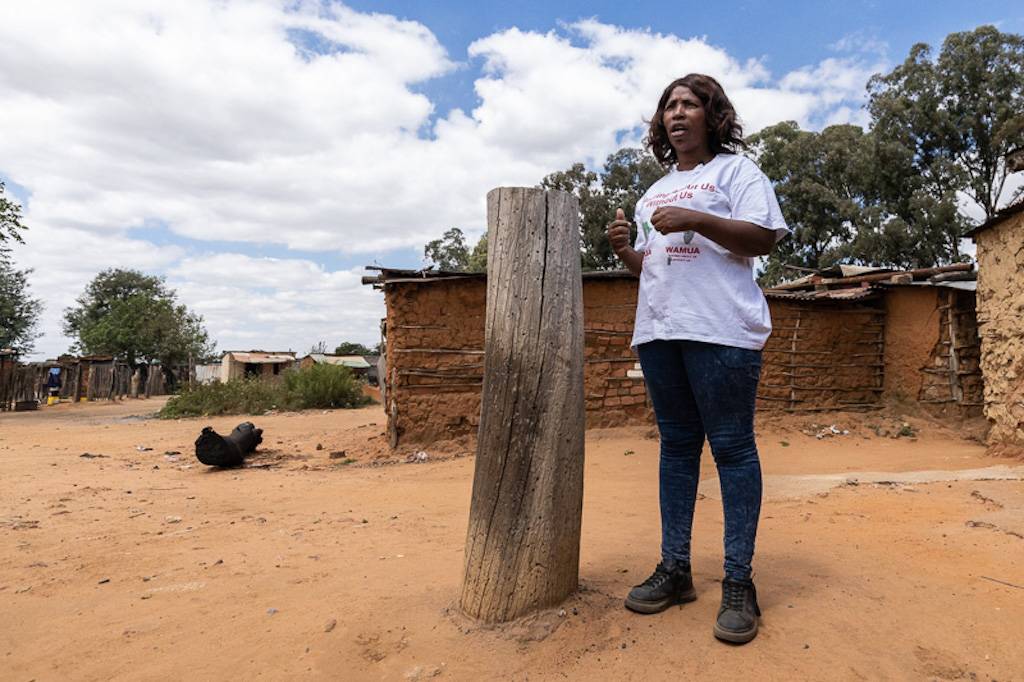
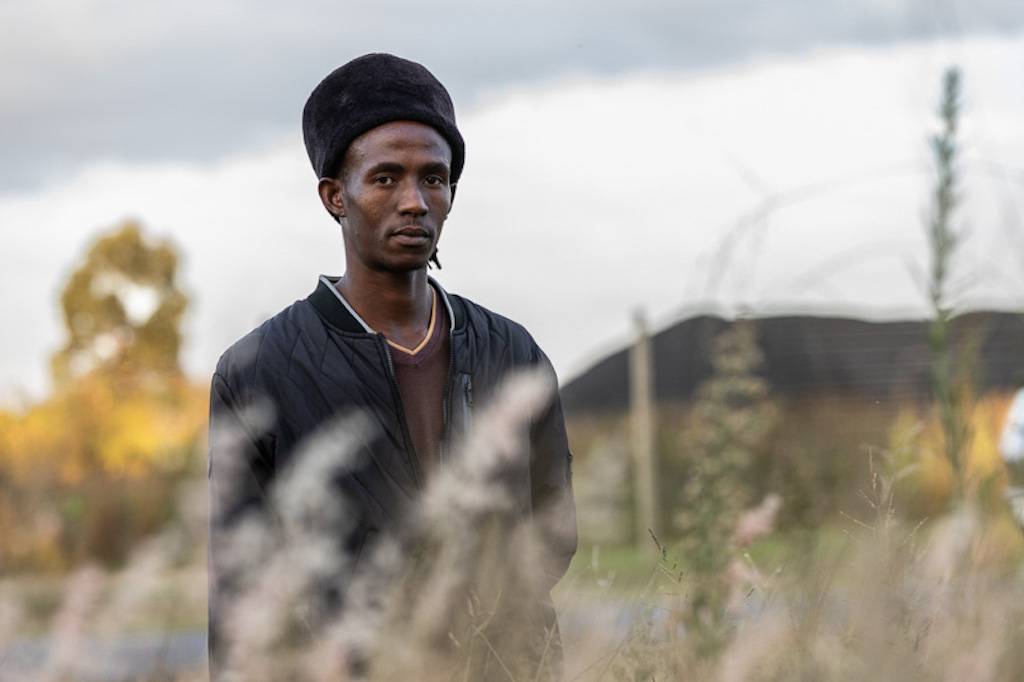
For workers in the coal industry such as Nelly Sigudla (above), the transition to green energy sources in Mpumalanga is difficult to welcome. Photo: Ashraf Hendricks
Nelly Sigudla, 41, a qualified fire watcher and part-time control room operator at Duvha power station in Mpumalanga, South Africa’s energy capital, worries for her future when her main source of income gets unplugged.
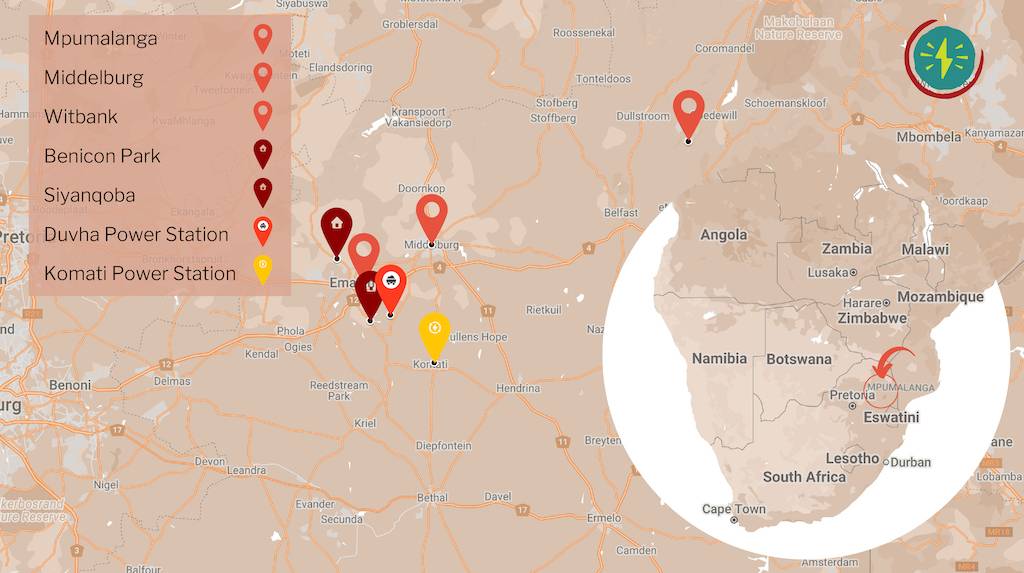
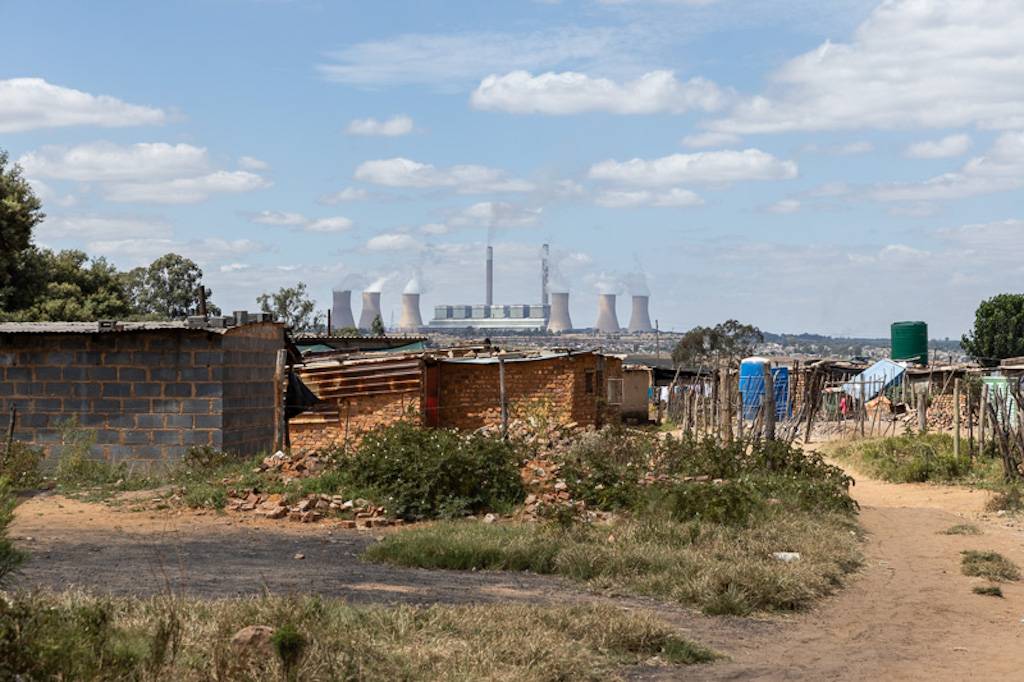
The mother of four lives in Benicon Park, an informal settlement next to the coal-fired power station that is scheduled to be decommissioned by Eskom between 2031 and 2034.
Like many employees in the coal-mining industry, Sigudla fears her qualifications won’t be enough in the near future when renewables take over from coal as South Africa’s primary source of new energy, and that she will be unemployable as a result.
The country, which depends on coal for about 85% of its electricity, is home to one of the largest energy experiments in the world — an $ 8.5 billion deal with a group of nations including the US, the UK and EU members — to transition towards renewable energy.
South Africa will have to redirect coal workers into new jobs in the renewable energy sector, such as construction, electrical engineering and information technology (IT).
An investigation by Oxpeckers Investigative Environmental Journalism and Climate Home News found a major skills gap in coal-reliant communities and a lack of clarity on how funds for reskilling will be implemented.
Sigudla said the transition to green energy sources in Mpumalanga was difficult to welcome as it could bring even more poverty. The region has a soaring unemployment rate of 38%, and more than 100 000 jobs depend on coal.
“When the renewable sector kicks in, what fire am I going to watch?” Sigudha asks. “No one has come to the communities to tell us about new skills programmes that we can follow to acquire skills that will be needed in the future.”
Reskilling programmes
The Just Energy Transition Investment Plan (JET-IP), a document that is guiding South Africa’s move to renewables, includes an investment of nearly R2.7 billion for reskilling programmes across the country.
In Mpumalanga, R750 million is allocated to “investing in youth” — including education, training, work experience and placements — and R5.6 billion to “caring for coal workers”, which includes re-skilling, redeployment, placement and temporary income support. Funds would not only come from the JET partnership, but also from government budgets, venture capital and multilateral banks.
According to the JET-IP, the government plans to set up a national skills hub to advise on reskilling needs, and R1,6 billion will be allocated to creating pilot training centres known as “skills development zones” in Mpumalanga, Eastern Cape and Northern Cape provinces.
These pilot zones will be run by technical colleges and support the development of new skills and courses, aiming to “ enhance the employability of graduates”, says the JET-IP.
One proposal to set up facilities for the training centres is to use old decommissioned coal plants. This was one of the options for the Komati power station, the first to shut down in October 2022, according to a report by the environmental justice organisation GroundWork.
Details about how these training centres would become operational are scarce.
Development zones
Blessing Manale, spokesperson for the Presidential Climate Commission (PCC), an independent multi-stakeholder body established by President Cyril Ramaphosa to oversee the country’s transition, was unable to indicate when the skills development zones will start operations.
Additionally, he acknowledged that skills development is severely under-prioritised, adding that “all stakeholder groups have raised this as a fundamental weakness in the JET-IP”.
“In the PCC’s view, much work needs to be done, both to quantify the needs for skills development and to upskill the workforce and new entrants — in particular youth and young women,” Manale said.
It will also require a deep transformation of the adult basic education system, artisanal skills development and curriculum revision in the tertiary education system.
“The transformation of the technical and vocational education and training (TVET) colleges, as well as the sector education and training authorities (Setas), is fundamental,” Manale said.
The PCC in partnership with the department of higher education and training, and the energy and water Seta are rolling out a programme around skills capacity and human capital required for a just transition, he said.
But there needs to be more clarity on what types of skills will be prioritised during the planned repurposing of coal-fired plants in Mpumalanga, not just in relation to labour retraining but also skills needed to deliver transition projects.
“This gives rise to questions around who will provide the training required for upskilling workers in the coal value chain, design curricula for educational institutions where skills development will take place, and how this can be funded,” Manale told Oxpeckers.
Benicon Park is an informal settlement situated next to the Duvha coal-fired power station in South Africa’s Mpumalanga province
Vocational training
Mpumalanga has three technical and vocational education and training (TVET) colleges that fall under the department of higher education and training (DHET). They focus on “preparing students to become functional workers in a skilled trade”.
These colleges, based in Ehlanzeni, Gert Sibande and Nkangala districts, provide practical skills training for the mining and fossil fuel industries, among other courses. At the start of the year, the department reported that more than 500 000 students had enrolled at TVET colleges countrywide.
During the Mpumalanga 2023 state of the province address, it was announced that the province had“partnered with various Setas in diverse trades. Setas encourage skills development in various economic sectors, including construction as well as energy and water.
Oxpeckers emailed the three TVET colleges, the DHET and several other tertiary institutions in the province to ask how skills development courses currently on offer could be applicable to the green energy sector. They were asked about the types of programmes offered, how many students are registered for these and whether there was any government funding to help improve access to professional skills development programmes in the renewables sector.
Similar questions were also sent to Eskom’s Academy of Learning and the South African Renewable Energy Technology Centre. Despite numerous follow-up phone calls, no responses were received at the time of publication.
The curricula of the TVET colleges and other educational facilities need to change to achieve the energy transition, said Professor Victor Munnik, co-author of the “Contested Transition” report released by GroundWork.
Training and reskilling for renewables must be “fit for purpose”, he said. “It should be aimed at a society that lives on renewable energy and understands how it works. There are specific specialised skills involved; for example, for the grid to become a smart grid it has to integrate many technologies.”
Changes in the education system need to include school curricula “to prepare young people not just to work in the new economy but to actively shape it and be part of it”, Munnik said.
Wendy Poulton, secretary general of the South African National Energy Association, added that there is a scarcity of specialist technical and managerial skills in the renewable energy sector. “This will require the education, training and upskilling of engineers and technicians to shift into renewables,” she said.
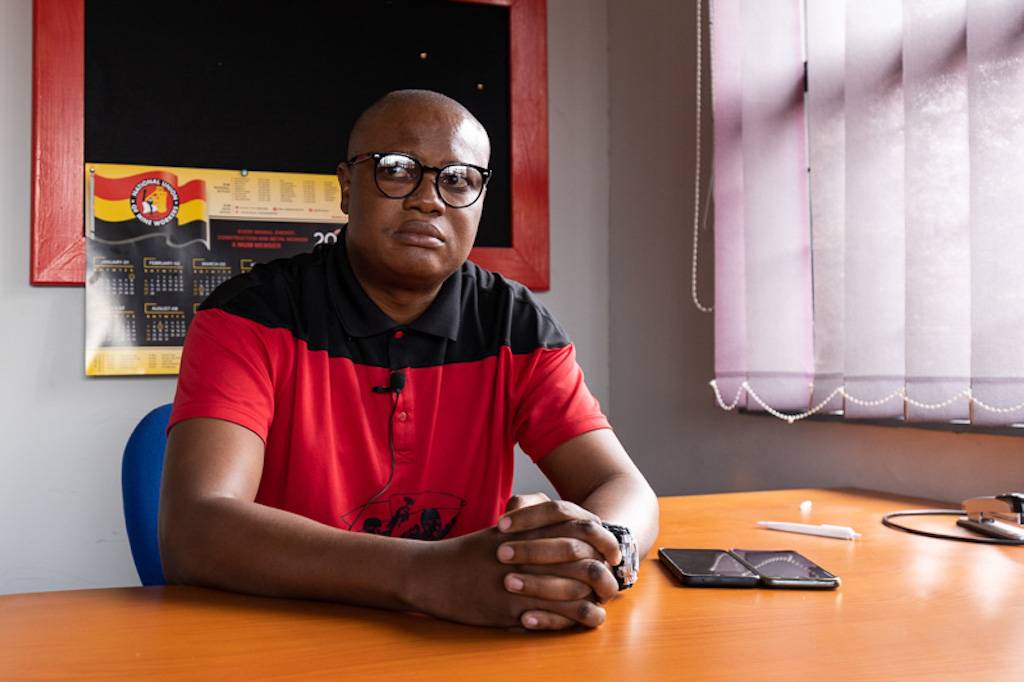
Happy Sithole, NUM health and safety chairperson in the Highveld region and an Eskom shop stewart, says he has no knowledge of skills development zones in Mpumalanga. Photo: Ashraf Hendricks
Union concerns
The regional chairperson of the National Union of Mineworkers (NUM) in the Mpumalanga Highveld region, Malekutu Motubatse, is concerned that the courses offered at TVET colleges and other education facilities still produce learners that will be unemployed in the near future.
“Next to each power station, there is a coal mine that is used for the purpose of providing coal to the power station,” he said. “So the reskilling should be a reskilling of everyone. If the government is talking about reskilling, who is going to be reskilled, Eskom employees or mine employees? Let’s assume that it talks to Eskom employees, then where does it leave the coal mine workers?”
Happy Sithole, NUM health and safety chairperson in the Highveld region and an Eskom shop steward, believes not many artisanal coal miners will be employed in the renewables sector.
“We are talking about artisans, a job that pays well. If you change from coal to renewables, what’s going to happen to them?”
Sithole said he has no knowledge of skills development zones in Mpumalanga.
“We find ourselves trying to understand what this is, because as NUM we have not seen any development.”
NUM was also unaware of a training facility that is supposed to be set up at Komati power station as a model for repurposing, Sithole said.
“We have not heard of Komati becoming a training facility. All we know about Komati is that there is intent to demolish it. There’s a lot of information that needs to be cleared up, and it’s difficult to get answers,” he said.
Gaylor Montmasson-Clair, a senior economist at Trade & Industrial Policy Strategies (TIPS), an economic research institution, said Eskom’s skilled workforce has a higher chance of finding alternative jobs in other industries, such as electricians, for example.
But coal miners might not have the same luck.
“To be blunt, we must stop the delusion that the bulk of people who are employed in coal mining are going to be employed in renewable energy. That narrative just makes no sense,” Montmasson-Clair said.
Benicon Park silhouettes Duvha power station, scheduled to be decommissioned by Eskom between 2031 and 2034. Photo: Ashraf Hendricks
Construction jobs
Peter Venn, chief executive of Seriti Green, said the transition will create more jobs in the construction sector in the coming years.
“We see a positive job growth in the renewable space for the next 10 years through the construction period,” he said.
Seriti Green is an offshoot of a mining company and will soon begin construction on South Africa’s largest wind farm in Mpumalanga, with power supply due to come online by 2025.
With Seriti being on both sides of the transition from coal mining to renewable energy supply, Venn emphasises the importance of training programmes for the skills required in the renewable sector.
“The Cape Peninsula University has partnered with Komati power station and Eskom to deliver skills in Mpumalanga. And there are other organisations offering significant renewable energy skills,” he said.
“Renewables require across-the-spectrum skills. All the back-office skills are required, civil and electrical skills are required; it goes into IT, security, data analytics, preventative maintenance,” Venn said.
Middelburg resident Emanuel Marutle: ‘The current education system is not even able to provide skills for learners to work in the coal-mining sector, so how will it equip people with the skills needed in the renewables sector?’ Photo: Ashraf Hendricks
Young workers
According to the PCC, workers in the coal-mining sector are relatively young, with a median age of 38 years. About 90% of those employed in Mpumalanga are semi-skilled (74%), or low-skilled (17%) workers.
The urgency for the skills they will need to diversify is heightened by the fact that transition planning is developing in the context of already high unemployment, poverty and inequality, the PCC says.
“These dynamics make skills diversification more complex as the just transition ought to manage job losses and create employment opportunities in a country with an unemployment rate of 33.9%,” said Manale.
Emanuel Marutle, a resident among the coal fields in Middelburg, told Oxpeckers he is worried the education system in Mpumalanga doesn’t have the resources to help affected workers gain practical skills to weather the transition.
“The education system is not even able to provide skills for learners to work in the coal-mining sector, so how will it equip people with the skills needed in the renewables sector?”
Marutle said during a community consultation about the transition held “by government people from Johannesburg” in 2022, locals were promised that people from their municipality would be taken to undergo training for the renewable sector. This has not happened, he said.
Given Masina, another resident and a member of the Khuthala environmental care group, said he hasn’t heard anything about any reskilling, training, or skills development in Mpumalanga.
“Our kids are studying in the fields of coal, but coal is dying. People will be left without knowing what they can do,” he said. “If people are skilled, they can transfer skills to other people in the communities so that they have chances of being employed.”
This investigation by Oxpeckers Investigative Environmental Journalism in partnership with Climate Home News, was produced with the support of the Pulitzer Center.
The Oxpeckers #PowerTracker project is supported by the African Climate Foundation’s New Economy Campaigns Hub.
In perilous times a decision we make to go right or to go left can result in a choice between life or death. Many people live with a sense of hopelessness and despair, feeling powerless to effect change either in their own lives or in society. Given the breakdown in the systems and infrastructure that support civic life, some are choosing to leave the more broken parts of the country or to leave the country. South Africa is ailing.
And where to flee? All around the world people are experiencing the extraordinary outcomes of the climate crisis, run-away inflation, pandemic-induced suffering and illness, increasing levels of hunger and poverty and watch as world leaders seemingly play around with potentially annihilating humanity with nuclear weapons.
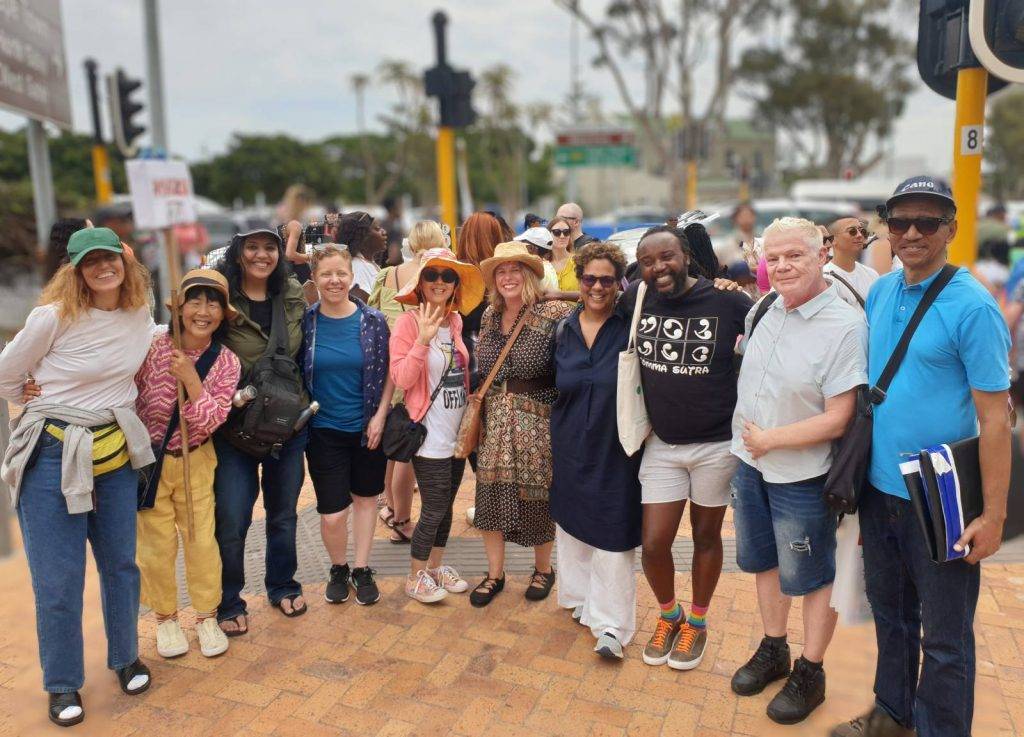
And every day, the Buddhist community of the Soka Gakkai International (SGI) South Africa pray with gratitude and commitment for peace in the country. For our own sakes and for the sake of others, we pray for all to develop the strength, wisdom and compassion to heal ourselves and to heal our land.
One of the most important writings of Nichiren Daishonin, the founder of the form of Buddhism we practise, is entitled On Establishing the Correct Teaching for the Peace of the Land. It was a passionate cry to secure the peace and happiness of the people. His prime motivation is a wrenching sense of empathy for the people’s plight and his vow to awaken and empower people to challenge their own destiny.
In it he wrote: “If you care anything about your personal security, you should first of all pray for order and tranquillity throughout the four quarters of the land, should you not?”
We pray for the many kind, humble, fierce, nurturing, wise, artistic, open-hearted, radiant people of South Africa who strive to maintain their dignity under inhumane conditions, most of whom have been alienated from the heritage of their land, their treasure mountains of gold, diamonds, platinum, water and abundant harvests.
We pray using words, not silent meditation. Nichiren Daishonin established the practice of chanting Nam-myoho-renge-kyo, the Mystic Law of Life as the means for all people to immediately open the deepest levels of their consciousness, their Buddha nature. A Buddha is not a superhuman being; a Buddha continues to experience problems, suffering and pain, and is still subject to illness and to temptation by devilish forces. A Buddha is a person of courage, tenacity and continuous action who struggles ceaselessly against devilish functions.
The “myo” of the Nam-myoho-renge-kyo has three meanings. It signifies that the law is “perfectly endowed” and can “open” or manifest in all forms of life, even the tiniest existence in the universe, an aspect of its mystic nature. This law has the power to heal the wounds sustained by all living beings, including those of nature, who undergo great suffering. Myo has the power to “revive”. Any single being is an inseparable part of the whole and is capable of manifesting as microcosm the whole of the macrocosm. No separation. Whole not hierarchy. The law embraces all forms of life in all its unique and beautiful diversity.
Our prayers are a dialogue with the universe. We fuse with the eternal source of power which transcends our limited finite selves so that we can we wholly activate the all-encompassing eternal power that inherently exists in our own lives. We chant daily to develop the strength necessary to change the conditions we face. By strengthening our life force through prayer and dialogue we can overcome our own attachment to differences and break the grip of arrogance, dogma and prejudice within.
The current value systems dominant in the world and in South Africa promote a paradigm of win/lose that encourages one to denigrate the dignity of another and to lay waste to the environment in a bid to get to the top. Value systems designed to extract the maximum possible value from the largest number of people creates maximum profit for the very few. Winning in such a system of individualised merit and pleasure means amassing wealth that would be sufficient to impress others. This way of life is the unsustainable trajectory of a civilization built on hard, coercive power that does not attribute equal value to life.
The current operating system is desensitising us to our own power. Despite the negative programming and discouraging images constantly being flashed before our eyes, we can each choose to live with integrity. Those who are determined to rebuild South Africa must be firmly resolved and not swayed by the destructive choices and behaviour of others.
We live in a time requiring endurance and resolve. Our democracy was earned after a long, hard struggle. Political liberation was achieved through a never give up spirit despite torture, assassination, intense suffering and trauma. Nearly 30 years later, the wounds have not healed.
We must each step firmly into our own sovereignty and take action from our own sense of responsibility and belonging. Just by being ourselves in our daily lives we can be an inspiration to others, sending ripples of hope, courage and inspiration into the environment. Through transforming our own inner states, we can transform our families, communities and even our nation.
A new era in South Africa will not come about naturally, but will require the united and courageous effort of people in the face of powerful resistance from those who benefit from systems of hard power, war and extraction. To triumph over the combined forces of evil, people of good must become strong. They must unite.
Now is the time to be brave and fight for justice right where we are. We each have a valuable contribution to make in our own unique way. Now is the time to be counted. The challenge starts within. By winning over the negative aspects of ourselves and becoming clear in our hearts at this unprecedented moment in time.
The power of community, of local community in global solidarity, opens the direct path to the creation of a culture of good in which we spark inspiration in each other so that all might live with the joy of being alive.
Creating a new human civilisation based on these values is up to the passion and power of youth across the globe. It’s the mission of youth and youthful people to create this new era. Youth who are trained, guided, and inspired by worthy mentors are the protagonists whose dynamic actions will change the destiny of humankind. For the SGI, 2023 is the year of youth and triumph. We look to the youth to take up the banner. The passion, the power, the creative artistry of our youth is South Africa’s greatest treasure.
The country has a great mission to be a creative force in shaping the new human civilisation that must be brought into being. May a solid corps of mentored and supported South African youth take flight. We respect you. We trust you. We will learn from you. With prayer, we search the skies for you. In 2023, may youth arise.
The views expressed are those of the author and do not necessarily reflect the official policy or position of the Mail & Guardian.
Cooperative governance (Cogta) minister Thembi Nkandimeng is expected to announce the termination of the energy state of disaster on Wednesday, after the government discovered it had made blunders in its regulations, sources have told the Mail & Guardian.
According to insiders, the government has been advised that court challenges it was facing as a result of its disaster management plans around Eskom would have led to “serious embarrassment”.
One insider said that there were still questions over what the government would do to exempt businesses and hospitals from load-shedding.
“With Solidarity and Outa going to court, there [are a] lot of loopholes which they have uncovered, and they could win against us. So in anticipation of that, we are terminating it. We were in great trouble and there was no other way around it,” the high-ranking government official said.
In a social media post early on Wednesday, Outa said its legal team was informed about the government’s decision to withdraw the state of disaster and revoke the regulations.
Another insider said that the government was expected to gazette the termination by 11am on Wednesday.
A legal letter sent by the state attorney to Solidarity and Outa lawyers, said that Nkadimeng and the head of the national disaster management centre would implement the decisions on Wednesday, via publication of the relevant notices in the government gazette.
“There is no live controversy for determination. We invite the applicants to withdraw their applications.”
The state attorney letter, seen by the M&G, said that the state respondents do not intend filing an answering affidavit addressing the merits of either application.
“We propose that the parties address a joint letter to the deputy Judge president to inform him of these developments and, if necessary, to cancel the meeting scheduled for 12 April 2023.”
Shortly after President Cyril Ramaphosa announced the energy state of disaster, Solidarity released a statement saying that it would take the government to court.
Its chief executive, Dirk Hermann, said that disaster legislation was not intended to be a means of circumventing government failure.
Solidarity said that if another legislative instrument was available to deal with the state of exception, it must be used.
Solidarity also confirmed via social media that it had received a legal letter, saying the government would withdraw the energy state of disaster on Wednesday, and that it had been asked to withdraw its case.
During a prior interview with the M&G, Electricity Minister Kgosientsho Ramokgopa said that the government would only invoke the provisions of the Disaster Management Act in relation to Eskom if existing solutions failed.
Ramaphosa announced a state of national disaster in February in response to the unrelenting energy crisis, while also announcing he would appoint a dedicated electricity minister within the presidency.
He said the state of disaster would enable the government to pursue practical measures needed to support businesses in the food production, storage and retail supply chain, including the rollout of generators, solar panels and uninterrupted power supplies.
The need for a state of disaster had been questioned, including by government advisers, but Ramaphosa said it was necessary for the “strong central coordination and decisive action” needed to stem the energy crisis.
“We don’t start by invoking the provisions of the Disaster Management Act,” Ramokgopa said in the prior interview with M&G. “We start by exploring what is possible within the existing framework. If that which is present does not allow us to act with speed, then let’s invoke it.”