
High tariffs stifle Africa’s trade potential, warns Isuzu CEO:
As tariffs bite across the continent, Isuzu Motors South Africa (IMSAf) chief executive Billy Tom, used the company’s 2026 IMSAf address on Wednesday to highlight Africa’s untapped potential and the urgent need to improve intra-continental trade.
“On the question of tariffs, our business is around the African continent,” said Tom. “And, the continent is quite big enough. There is a huge opportunity to grow the continent and we’ve set our business around that.”
While global markets offer opportunities, high tariffs and cross-border logistics costs continue to constrain African trade. In some cases, he said, exporting vehicles beyond the continent is cheaper than shipping them between neighbouring African countries.
“The continent poses a huge opportunity but the continent has not been geared to trade with itself. It’s quite expensive to do business on the continent. Sometimes it’s easier to export a vehicle to the Middle East and take it to another African country. The inter-part is proving to be difficult.
Tom noted that these challenges highlighted the urgency of fully implementing the African Continental Free Trade Area, which promises to reduce trade barriers and harmonise trade rules, even as tangible progress has remained limited. “We’ve got to find solutions to making it cheaper to do business.”
Despite these obstacles, Isuzu has continued to expand its footprint across Africa. In 2025, IMSAf exported 5 371 vehicles to continental markets, a 4.5% increase compared to 2024 while domestic sales rose 12.2% to just over 26 000 vehicles.
Tom said this growth shows the company’s role as a regional manufacturing and export hub. “Our manufacturing base in the Eastern Cape goes beyond being just an asset for Isuzu Motors Limited. It plays a meaningful role in supporting jobs, skills development, and economic resilience in the region.”
He said that Isuzu’s approach is to focus on its core competency in commercial and life-commercial vehicles, rather than competing across all segments. The bulk of its operations are business-to-business, supplying fleets and commercial operators, with growing consumer sales often stemming from exposure through business use.
“Someone experiences our product in the business, then they want to take it for themselves,” Tom said.
The company also emphasises total cost of ownership over upfront discounts, particularly for fleet operators. Tom warned that cheap vehicles with high maintenance costs and poor resale value can ultimately cost more than they save.
“You can buy this thing close to nothing, but then it costs you a fortune to maintain it. Then it goes down a lot. Then you lose more than that discount,” he said.
Craig Uren, the executive vice president of revenue generation at IMSAf, said the company’s success is built on consistency and reliability.
“Our strength has always been consistency – driving continuity and delivering reliability. Customers choose Isuzu because they know exactly what to expect: vehicles that are reliable, durable, and built for the realities of African operating conditions,” Uren said.
“What has changed is how we continue to innovate on that foundation, ensuring we remain relevant in a rapidly shifting market.”
IMSAf retained its position as South Africa’s number one truck brand in the combined medium and heavy commercial vehicle segments for the 13th consecutive year, supported by growth in the heavy commercial segment.
Strong passenger vehicle performance also contributed, with ISUZU D-MAX sales increasing 11.7% and ISUZU MU-X volumes rising 45.4%, reflecting strong market uptake of the new model.
In his presentation, Uren confirmed the upcoming launch of the new ISUZU D-MAX and next-generation truck range, signalling the company’s continued investment in products tailored to African conditions.
“As we introduce new products and technologies, that commitment remains unchanged – to deliver solutions our customers can trust, today and into the future,” he said.
Komane Pitso, the senior vice president for commercial operations, said that while tariffs and logistics costs remain a constraint, Africa alone offers enough opportunity to sustain growth provided trade across the continent becomes simpler and more affordable.
“Logistics is what makes us sometimes competitive,” he said. “We can manage production costs, but we cannot control the cost of moving a product across borders. To grow Africa, we need solutions that make intra-continental trade cheaper and faster.”
Pitso added that by positioning itself as a regional hub and prioritising reliability, total cost of ownership and sector expertise, Isuzu is navigating a complex environment of tariffs, fragmented trade and logistical bottlenecks while continuing to expand its footprint and influence across Africa.
Welcome to the only South Africanised weekly cryptic crossword.
* World class – and from our perspective, not that of the UK or USA.
* Multilingual – every crossword has one Afrikaans and one isiXhosa word.
* Fresh & unique – compiled weekly especially for the Mail & Guardian.
* Lots of fun – access our archive of over 500 cryptic crosswords.
Clue of the week: 4 20 – 0 (9)
[crossword]
The ten new entrepreneurs backed by Metropolitan’s collective shapers programme:
Four months ago, the fourth edition of the Metropolitan Collective Shapers (MCS) youth entrepreneurs’ programme was the first to be implemented nationwide, with a specific focus on the logistics and agricultural sectors, chosen for having the greatest potential for job creation.
These two critical sectors are important for South Africa’s economic future and whose stability shapes the country’s long-term prospects. Agriculture spans more than 96-million hectares and supports SA’s role as a leading exporter, yet deep structural barriers hold back its full potential. Recently released data from Statistics SA showed that agriculture had a 1.1% rise in the third quarter of 2025 and its annual contribution to SA’s GDP in 2024 was 2.8%. Logistics, which contributes 10% to 12% of GDP, moves the goods that keep the economy functioning, though inefficiencies continue to undermine its competitiveness.
Drawn from a total of 373 national entries, the top ten finalists have been announced.
The MCS programme seeks to empower small business owners, assisting them to become leaders whose success will ultimately have a direct impact on their communities. Qualifying criteria for entry included an age restriction of business owners between 18 and 35 who reside permanently in South Africa. Their businesses had to be 100% youth owned by historically disadvantaged or disabled persons and had to have been operational for not less than 12 months. Applicants had to be dedicated full time to the business and not running it as a side hustle. To derive maximum benefit from participation, applicants also had to be available for the full duration of the MCS programme from October 2025 to March 2026.
During the first month of the programme, all selected participants took part in a series of online soft skills training sessions, designed to build resilience and leadership. The second phase saw 20 finalists progress to a further four weeks of sector specific training, and phase 3 was the selection of the top 10.
Collective Shapers focuses on small business development, meaning that all 150 of the young entrepreneurs that entered the programme retain access to Metropolitan’s online resources, networks and ongoing support – ensuring the journey doesn’t end at the programme’s close in February 2026.
Through the programme, the top 10 gain access to personal branding and leadership training, business coaching designed to turn plans into profits, market access and national exposure, mentorship from industry experts, and opportunities to network with other like-minded entrepreneurs, all aimed at supporting the growth and long-term sustainability of the selected small businesses.
The top 10 participants have been selected to receive a range of prizes, including a cash injection, media training, branding, enhanced business visibility, and membership to the MyDough platform, which unlocks market access opportunities.
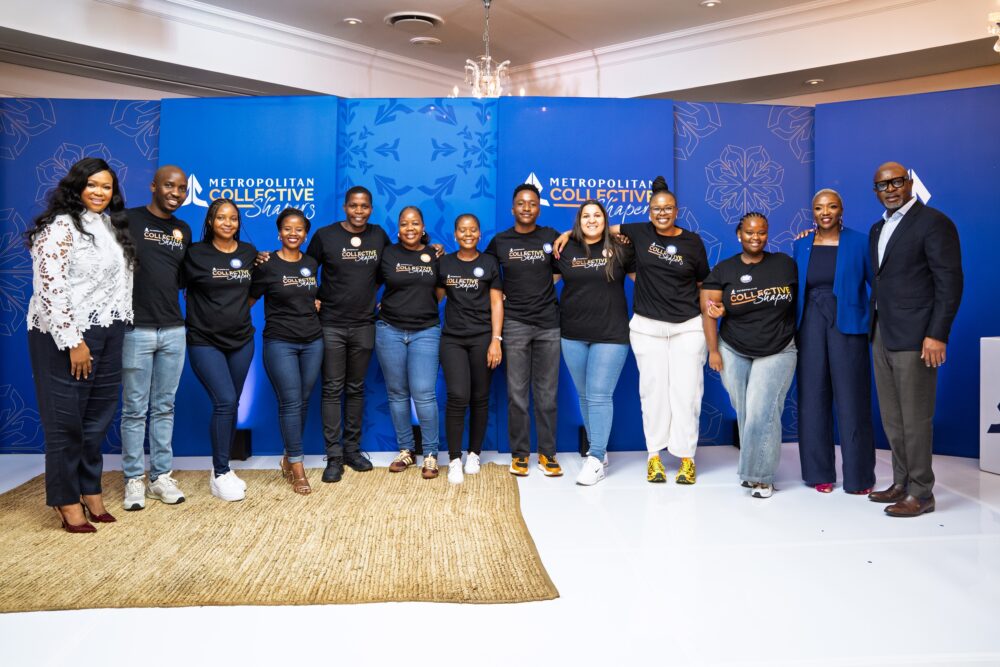
The ten finalists are:
- Aphelele Ndamase – Balilethu Livestock – KZN, Underberg
Originally from the Eastern Cape, Aphelele now runs his livestock and poultry industry, specialising in sourcing and supplying quality animals to farmers and small-scale producers, in KZN. A self-taught farmer, Aphelele is supporting both emerging and established farmers by providing reliable livestock including a range of sheep, cows and broiler chicks, in addition to promoting sustainable farming practices, and contributing to improved food security and economic growth within local rural communities.
- Approved Mache – TAP Group (Pty) Ltd, WC
With bases in Cape Town and Pretoria, TAP Group is a road freight logistics company specialising in long-distance transportation of palletised goods using superlink tautliners. Approved is from an entrepreneurial family, but qualified as a Professional Engineering Technologist, before starting his own business. Through TAP, he aims to build generational wealth and change the story of where he came from.
- Thobani Zungu – NGI4 Xpress, KZN
Based in Durban, NGI4 Xpress provides express courier services, last-mile delivery, and business-to-business (B2B) logistics support. Thobani was inspired by a gap in the logistics industry where businesses were looking for a delivery partner that was consistent, transparent, and committed. Thobani is building a company that solves real problems, creates opportunities, and delivers a high standard of service. His dream is to make NGI4 Xpress one of the leading black-owned logistics companies in Africa.
- Mikhaela Brown – K2020714247 South Africa, WC, Cape Town
Mikhaela’s logistics business grew out of her desire for greater financial independence and the necessity of providing support to her mother during her recovery from a motorcycle accident. The company operates nationally and internationally, specialising in air, road and sea freight, providing local, export and import services. Mikhaela’s dream is to build a holistic ecosystem that not only offers services but also actively invests in the community that fuels it.
- SIPHESIHLE SANGWENI – Kate-Mkhipheni (Pty) Ltd, KZN, Mtubaba
Kate-Mkhipheni Pty Ltd transports raw materials including coal, chrome and anthracite, targeting clients in mining and construction. Siphesihle has been running her business since she was in matric and shares her directorship of the company with her two siblings. Based in Mtubatuba, the business has always hired young community members who are certified professionals – from drivers to mechanics – but who are unemployed. Siphesihle aims to empower other young people to start their businesses, contributing to the country’s economy.
- Mokgadi Ramatladi (MPR Med Pharmacy), MPR Med Pharmacy, Limpopo
A qualified pharmacist, Mokgadi comes from come from a village hospital pharmacy background with over 10 years’ experience. Her company MPR-Med pharmacy provides prescription services, over the counter medication, chronic medication support and community health education, targeting elderly people, families, children and chronic patients in surrounding villages who often struggle with transport and access to reliable healthcare. Mokgadi is driven by the desire to change the narrative of rural healthcare and to serve people with compassion and love.
- Bokamoso Dhlamini (BB Agricultural Produce), GP, Soweto
Bokamoso is currently studying Primary Agriculture while trying to balance school and running a crops and poultry business at the same time. Bokamoso is working to shape the future of the community by using technology, innovation, and collaboration to drive growth, create opportunities, and improve food security. For BB Agric Produce, this means expanding agricultural operations through modern farming techniques, increasing productivity, and creating employment for local people.
- Bongiwe Nyawo (Nyawo Zendalo Air), KZN, Richards Bay
Bongiwe has a drone and remote pilot’s licence as well as a restricted radiotelephony licence and is operating a sustainable Agri-drone service in KZN. Services include precision farming ranging from crop management and aerial inspections for data driven decision making, aerial data capture and fertilisation and pesticide applications. Bongiwe is passionate about her contribution, through advanced AI and drone technology, to the UN Sustainable Development Goals of zero emissions and food security.
- Mokgadi Mpya (Ditlou M Investments), Limpopo
Ditlou M Investmenbts operates in Limpopo where agriculture is not just a practice, it is a way of life and a source of hope. For Mokgadi, uncertainty is a daily companion, and her patience, resilience and faith are constantly tested in her quest to supply fresh affordable high-quality vegetables to her customers. Trained by Agri Seta in plant and poultry production, Mokgadi took a long route to where she is now, going on after school to study mechanical engineering, then into hospitality, running her own catering company, before finding her passion in farming.
- Zwivhuya Mudau (Vhadau Premium Piggery), Limpopo
Faced with limited job opportunities, Zwivhuya decided to create jobs rather than wait for one. In a field traditionally dominated by men, she turned her vision into reality with Vhadau Premium Piggery, starting with just six pigs. Now, in addition to livestock, the company provides essential farming equipment and products to support its clients. By offering both piglets and practical tools, they ensure that farmers can manage their herds efficiently and professionally, helping them grow their businesses confidently while contributing to local food security.
The finalists represent the Western Cape, Limpopo, KwaZulu Natal and Gauteng.
This phase marks the final stage of the programme, with the ten finalists moving forward after what has already been a transformative experience for many in what has already been a transformative experience for many. Thobani Zungu said of his journey thus far, “I have learned that sustainable growth comes from structure, planning, and clarity – not just effort. I also learned the value of community, partnering, collaborating, and that asking for help accelerates progress.”
Aphelele Ndamase echoed this sentiment, adding that their sessions have been transformative, provided practical tools, inspiration and a supportive environment that has contributed directly to her personal improvement and that of the business.
Said Mokgadi Mpya, “Through the programme I learned that every small step I take, whether its learning about regulations, improving my farm management or building better networks, brings me closer to the bigger vision I have for my business.”
Metropolitan’s Chief Marketing Officer, Lindiwe Gumede said, “The Metropolitan brand is all about the power of the collective and about being an impactful member of the communities we serve. This programme is a manifestation and commitment to those values.”
She added: “When entrepreneurs change what’s possible for themselves, they rewrite what’s possible for everyone who comes after them. The true impact is not only what they achieve today, but the legacies they are rewriting in real time. We wish the ten finalists’ good luck in this final stage of the competition.”
Submit and get free exposure here: Showcase Your Business | Advertise Your Special Offers.
