
Honda’s CR-V veers into premium segment:
Since the late 1990s, the Honda CR-V has become ever more common in shopping malls and school parking lots.
It’s a small SUV that has, over the years, proved to be practical, reasonably priced and dependable.
However, the new generation of CR-V has aimed to raise the bar, resulting in a R1 million vehicle. There is a level of expectation that comes with a price tag of this size and, well, I think it’s nearly — but not quite — there.
The most noticeable change to the CR-V is the increase in size and, while it has seven seats, it is a good-looking SUV.
Although the addition of a detachable shelf helps optimise the boot space, the presence of a third row of rear seats reduces the cargo area.
As for seating space, a regular trump card for the CR-V, the middle row has a good amount of legroom and is a comfortable place to sit for long trips.
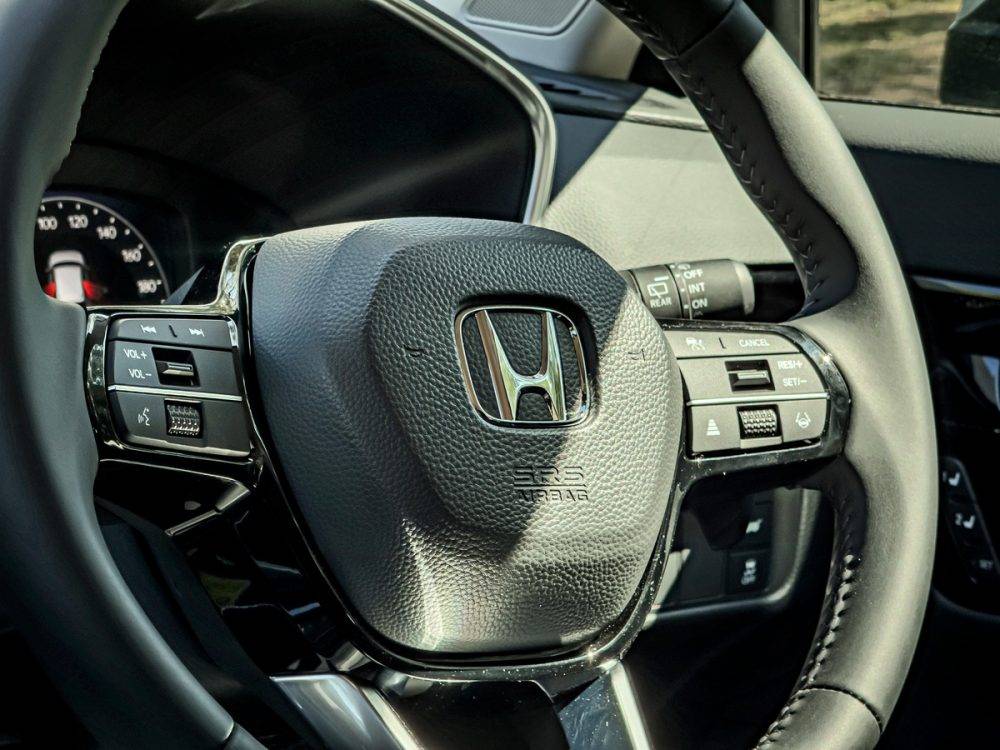
But the real highlight is the cabin experience, with its high-tech atmosphere that reflects a more premium experience. The CR-V boasts a 9-inch infotainment system with Apple CarPlay and Android Auto, which is straightforward to use, overall.
The digital instrument cluster is easy to interpret and provides a simple yet pleasant aesthetic when reading your speed, revs and getting other driving information.
There are less-than-premium plastics scattered around the cabin, which is off-putting, and the overall ambiance is dark — but this might appeal to some buyers.
There are a few things to consider when it comes to the driving characteristics of a family SUV, one of the more essential being the power figures and whether it can handle a full load and possibly a trailer.
Unfortunately, the CR-V could do with a little more shove, especially considering the price.
It comes with a 1.5-litre turbocharged petrol engine, which produces 140kW and 240Nm of torque.It’s bolted to a CVT transmission, and this is where the question marks start to appear.

For one, the CR-V isn’t compact by any means. If you are alone or have only a couple of passengers, the power is adequate, but it needs revs to harness maximum output. Luckily, this is not too big an ask since this CVT is quite rev-happy.
Its tendency to be noisy under acceleration — and not in the pops and bangs kind of way that we tend to enjoy — is definitely a drawback.
It takes a while to get going once you bury the accelerator and we’re confident that a hybrid-electric variation would address these issues with a bit more torque. The hybrid CR-V is out there but, unfortunately, it’s not available in SA just yet.
The CR-V offers a claimed consumption of 7.4l/100km, which isn’t bad considering its size, but at Gauteng altitude, it does creep into the 8.0 l/100km range.
Good ride quality and ground clearance are also important in an SUV. I’m pleased to report the CR-V is a compliant bump absorber and it’s especially evident on rougher surfaces. With ample clearance for speed bumps and potholes, it provides a calm, comfortable driving experience.
Honda’s CR-V is a good car and one I’d easily recommend — if it weren’t for the price.

The CR-V comes in two model grades in South Africa, starting with the Executive at R959?900. The model we drove is the top-spec Exclusive and comes in at R1?039?900. This places the CR-V up against cars such as the Kia Sorento, which is a well-rounded product with more torque and better fuel consumption.
All things considered, it’s a good representation of Honda’s potential within the more premium segment. As much as this CR-V is largely an improvement over the previous model, a bigger, more powerful motor would do the price some justice.
CR-V has a beautiful design, particularly from the front, and a cabin that contributes to a more premium experience. It is spacious, with plenty of entertainment and safety systems.
A larger motor, or even a hybrid-electric model, would be a more tempting offer, but the price at the moment is a little on the steep side, even for the modern market.
At least your kids will be lugged around in something that looks trendy enough to be bragged about at school.
The Gospel according to St Geordie:
Like millions of Christians around the world, I’m eagerly awaiting Easter Sunday, one of the highlights of the religion’s calendar and the day on which they believe Jesus Christ rose from the dead.
Easter is a time when redemption — and more particularly the need to seek it — is foremost in my mind.
Spending two Easters locked up in the police cells awaiting a bail hearing on the day after Easter Monday will do that, even 40 years later.
There’s nothing like three days thinking about one’s pending court appearance to put the fear of God into one — and to remind one of the need to repent, to return to the straight and narrow.
Not quite what the Nazarene went through, but bad enough, a life-altering experience with its own stigmata — and choices between damnation and redemption — a lifetime later.
I also blame my thoughts turning to redemption at Easter on my maternal grandfather, Geordie Scott.
Geordie filled the first nine years of my life with threats of fire and brimstone, hell and damnation, should I not repent and seek the forgiveness of the Lord.
Geordie was a Presbyterian preacher and a street-sweeper in Belfast — until he set off a pipe bomb with his broom and ended up deaf and with a disability grant.
That left him with all the time in the world to focus on God’s work, which included recording sermons in the kitchen of my Granny Edie’s house in Joseph Street, which he distributed among sailors whose ships had docked in Belfast harbour.
Geordie was a hard-core Brethren type, a real thou-shalt-not kind of a guy — except when it came to his own gluttony at the dinner table — who followed a less than forgiving God.
His God thrived on fear and handed out horrible punishments to those who didn’t see the light and get themselves onside ahead of Judgment Day, which was very definitely coming.
Most things were sinful in Geordie’s book, especially over Easter.
Dancing, television, female Sunday school teachers, the demon drink, any music except that found in a hymn book: anything that might resemble normality — God forbid, fun — was taboo, the work of the devil.
Geordie didn’t preach about Jesus much, or His good works and the feeding of the 5?000 and His other acts of humanity.
Geordie didn’t do “God is love” vibes, focusing more on the blood and gore side of the Bible.
Geordie preached punitive: smitings, plagues and pestilences and turning into pillars of salt from the Old Testament that befell those who did not walk the straight and narrow.
He spent most of his life trying to get sinners to repent — among them Edie, my dad Gerald and my nine-year-old self — or face eternity in the fires of hell.
Needless to say, Geordie’s recorded sermons were terrifying: vivid, ferocious exhortations to the seafarers he pressed them on during his visits to the docks.
Repent now or face eternal damnation; seek redemption or be cast into the pit — forever.
A number of the recordings included Edie’s shouted demands from the washing stand in the back yard that he “turn that fucking thing off and put the tea on”.
After he swept the pipe bomb, Geordie couldn’t hear a thing when he played the tapes back, so his floating congregation must have had a laugh or two at his expense in the middle of the North Atlantic.
It is thanks to Geordie that while Christians await the marking of the resurrection of Christ after three days in the tomb on Sunday, I’m anticipating, somewhat eagerly, the return to premier league football by the Arsenal Football Club, an institution that holds more than religious significance in my life.
There will be a rolling away of the stone of a different kind come Sunday whenMikel Arteta’s team end the footballing Lent that has been imposed upon us by the recent international break.
While Christians will be commemorating Jesus Christ rising from the dead, I’ll hopefully be celebrating Gabriel Jesus banging in a couple against his old team, Manchester City, resurrecting not just his own career but the Gunners’ title challenge after the wobble over Christmas.
That would be an act of vengeance of Biblical proportions — unJesus-like but fitting — if Pep Guardiola’s unwanted son were to return to the Emptyhad and put them to the sword.
Thrown in a goal or two from the Angels Gabriel (Magalhães and Martinelli) — or the Yoruba god called Bukayo Saka and there’s the making of a footballing redemption song worthy of one of Geordie’s Easter sermons come Sunday.
Togo MPs adopt new Constitution:
Togolese members of parliament adopted a new Constitution on Monday, moving the country from a presidential to a parliamentary system and giving parliament the power to elect the president of the West African country.
The president will be chosen “without debate” by MPs “for a single six-year term”, and not by the public, according to the new text.
The vote comes less than a month before the next legislative elections in Togo, but it is not yet known when the change — which was approved with 89 votes in favour, one against and one abstention — will come into force.
Currently the president can serve a maximum of two five-year terms.
The change to the Constitution, proposed by a group of MPs mostly from the Union for the Republic ruling party, was adopted almost unanimously.
The country’s opposition, which boycotted the last legislative elections in 2018 and denounced “irregularities” in the electoral census, is poorly represented in the National Assembly.
The new Constitution also introduces the position of “president of the council of ministers” with “full authority and power to manage the affairs of the government and to be held accountable accordingly”. The president of the council of ministers is “the leader of the party or the leader of the majority coalition of parties following the legislative elections. The position will be held for a six-year term,” according to the text.
“The head of state is practically divested of his powers in favour of the president of the council of ministers, who becomes the person who represents the Togolese Republic abroad, and who effectively leads the country in its day-to-day management,” said Tchitchao Tchalim, chairperson of the National Assembly’s committee on constitutional laws, legislation and general administration.
The new text will mark Togo’s entry into its fifth republic, with the last major constitutional change dating back to 1992.
It comes less than a month before the next legislative elections, due to be held on 20 April at the same time as regional elections, in which the opposition has announced its participation.
In 2019, MPs revised the Constitution to limit presidential terms to two, but it did not apply retrospectively, leaving President Faure Gnassingbé free to stand for the next two elections.
Gnassingbé — in power since 2005 — succeeded his father, General Gnassingbé Eyadema, who seized power in a coup more than 50 years ago. — AFP
Submit and get free exposure here: Showcase Your Business | Advertise Your Special Offers.
