How Forex trading automation is changing retail trading habits:
Retail forex trading used to revolve around screen time, instinct, and the constant urge to react. A setup would form, price would move a little too fast, and discipline would often give way to impulse. That pattern shaped retail behavior for a long time. Many traders built their routines around watching charts for hours, second-guessing entries, and managing trades through emotion as much as analysis.
Automation is changing that rhythm.
The shift is bigger than convenience. It is altering how traders think about structure, execution, and even what it means to participate in the market. Automated tools now allow retail traders to translate ideas into repeatable processes. That changes habits at the deepest level. Instead of asking whether a trade feels right in the moment, more traders now ask whether the trade meets a tested rule set. That is a meaningful change, because habits define performance long before results show up in an account history.
Reliable Automation Tools Shape Better Trading Behavior
The first real change starts with tool quality. Traders who use weak systems often build weak habits around them. They override signals too often, doubt execution, or spend too much time fixing technical issues. A reliable automation setup creates the opposite effect. It supports consistency, and consistency changes behavior over time.
That is why the choice of tools matters so much. High-quality forex trading automation bots can help traders move away from random execution and toward a more stable process. When the bot is built around clear logic, dependable execution, and proper risk parameters, the trader begins to think differently. The focus shifts from chasing every move to refining the framework behind the move.
This affects habit formation in a practical way. A trader using a reliable automation tool is more likely to review system behavior, evaluate risk exposure, and improve trade filters. A trader using unreliable software often falls into reactive mode. That difference matters because retail performance often depends less on market knowledge and more on behavioral consistency.
Good automation also creates accountability. Every action comes from a rule. Every result can be traced back to the system. That makes it harder to hide from bad decisions and easier to improve the process.
Automation Is Replacing Emotional Execution With Process-Based Trading
Emotion has always been one of the biggest pressure points in retail forex. Fear closes trades too early. Greed stretches targets beyond reason. Frustration creates revenge trades. Even experienced traders know that technical skill alone does not solve those problems.
Automation reduces the number of moments where emotion can interfere.
That does not mean the emotional element disappears. It simply moves. Instead of showing up during order execution, it appears during system design, risk selection, and performance review. This is a healthier place for it to live. A trader is far more likely to make sound decisions before the market opens than during a fast move in a volatile session.
This shift is changing daily routines. Traders who once hovered over every candle now spend more time checking whether market conditions still suit their model. They look at execution quality. They study whether slippage, spread behavior, or session timing affects the strategy. That is a more mature habit set, and it reflects a more professional way of thinking.
In practice, automation encourages traders to ask better questions:
- Does this setup still have an edge in current conditions?
- Is the risk model aligned with actual drawdown behavior?
Those questions lead to better decisions than asking whether the price feels ready to move.
Strategy Development Has Become More Structured
Another major shift is happening in how retail traders build strategies. Manual traders often develop systems through observation and personal experience. That approach can produce useful insights, but it also leaves room for bias. Automation pushes traders to define rules with more precision.
A vague idea cannot be automated well. The market, which is projected to reach US$ 1.4 trillion by 2030, either meets the condition or it does not. That simple fact forces clarity.
As a result, many retail traders are becoming more methodical. They write entry logic more carefully. They think harder about exit behavior. They test how one variable affects the rest of the system. This process strengthens strategy design because it exposes weak logic early. If a rule cannot survive testing, it probably cannot survive live execution either.
This is also changing how traders view indicators and signals. Instead of piling tools onto a chart, experienced retail traders are learning to value interaction between variables. They want logic that behaves well under different market states. They want systems that can handle trend, compression, or sudden expansion without falling apart.
That mindset represents a major behavioral upgrade. It turns trading from constant reaction into system engineering.
Retail Participation Is Becoming More Selective
Automation is also changing who participates and how often they trade. In the past, retail traders often felt pressure to stay active. More screen time seemed to equal more opportunity. Automation is making many traders more selective because it rewards patience.
A bot does not need excitement. It needs valid conditions.
That seems simple, but it changes the culture of participation. Traders become more comfortable with inactivity when inactivity is part of the edge. They stop forcing trades just to feel involved. They start respecting session quality, market structure, and execution context with more discipline.
This has another effect as well. Retail traders can now operate with a broader time perspective. Some monitor multiple pairs without becoming overwhelmed. Some run separate systems for different conditions. Others use automation for execution while keeping the analysis manual. These hybrid models are especially important because they reflect a realistic future for retail forex. Full automation is one path. Assisted decision-making is another. Both are shaping better habits when used with discipline.
Tiny birds, vast journeys: Inside SA’s first shorebird tracking project:
A groundbreaking new research initiative is set to uncover the remarkable journeys of migratory shorebirds by deploying satellite tracking devices on species such as the Curlew sandpiper and Grey plover — marking a first for South Africa.
Led by BirdLife South Africa, the project focuses on tagging, colour-ringing and monitoring birds at key coastal sites, including the Berg River estuary, to better understand their movements along the Africa–Eurasian Flyway, a major migratory route covering Europe, Asia and Africa. The aim is to identify critical habitats and inform conservation efforts that stretch across continents.
The organisation describes the initiative as a major milestone for southern Africa, where the migratory routes, stopover sites and breeding grounds of local shorebird populations have long remained poorly understood.
“While tracking studies have been conducted elsewhere along the flyway, few tagged birds have reached South Africa, leaving the migratory routes, stopover sites and breeding areas of South African populations poorly understood,” said BirdLife South Africa.
“This is the first time long-distance Palearctic migratory shorebirds, in this case the Curlew Sandpiper and Grey Plover specifically, have been fitted with tracking devices in South Africa.”
For Jessica Wilmot, the flyway and migrants project manager, the project builds on years of work along the country’s west coast while expanding its reach far beyond national borders.
“BirdLife South Africa has worked along the West Coast for many years and this project builds on that foundation, showing not only how landscapes are connected within South Africa but how shorebirds link us to critical wetlands across the continent,” she said.
“Following the recent Ramsar Conference of the Parties 15 in Victoria Falls, it’s a timely reminder of how important these ecosystems are.”
Rebuilding a lost research capacity
Wilmot said efforts to track migratory shorebirds in southern Africa had historically been constrained by cost, capacity and technology.
Tracking devices remained expensive and, until recently, many were too large for small-bodied species such as Curlew sandpipers, she said. Globally, most tracking research had focused on Europe, where relatively few birds travelled as far south as Africa.
At the same time, South Africa had experienced a decline in wader ringing and trapping expertise. Decades ago, the country played a leading role in flyway research through Safring, the South African Bird Ringing Unit, but reduced funding and capacity made large-scale wader work, which required specialised teams and coordinated field efforts, increasingly difficult to sustain.
What had changed, Wilmot said, was a renewed focus on flyway-scale conservation combined with advances in lightweight tracking technology that now made it possible to safely monitor smaller species.
Crucially, the project had been enabled through international collaboration. Partnerships with the department of ornithology at Max Planck Institute for Biological Intelligence and Wetlands International had provided both the technical expertise and the tracking devices themselves. Long-term funding support from the Royal Society for the Protection of Birds and the Ecological Restoration Fund had also been central.
Together, the developments mark what Wilmot described as an important step in rebuilding regional capacity, demonstrating the power of collaboration in advancing conservation across an interconnected flyway system.
Global shift in conservation thinking
The project is unfolding against a broader shift in how migratory species are understood and protected globally.
At a recent meeting of the Convention on Migratory Species (CMS), governments formally recognised “marine flyways” for the first time — a landmark development in ocean conservation.
The framework identifies vast migration highways used by more than 150 seabird species across 54 countries, highlighting how threats such as climate change, invasive species and overfishing operate across entire ocean basins.
While the CMS decision focuses on seabirds, conservationists say the principle applies equally to shorebirds moving along continental routes such as the Africa–Eurasian Flyway — reinforcing the need for coordinated, cross-border conservation.
Complex, unpredictable journeys
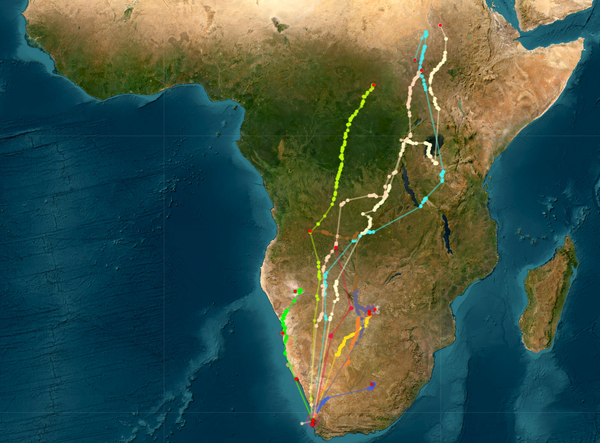
Early tracking data from the South African project is revealing how complex and variable the migrations can be.
“This variation in movement patterns is one of the most exciting — and least understood — findings,” Wilmot said.
The birds appeared to travel in loose flocks, with their routes shaped by a mix of external factors such as wind and weather systems and internal dynamics including experience and the possible role of “leader” individuals.
“There also appears to be a degree of flexibility and decision-making along the way,” she said. “Some individuals have already shown unexpected behaviour, including backtracking or deviating from anticipated routes.
“Understanding these dynamics is exactly why this research is needed. Migration is far more complex and adaptive than we previously assumed.”
Rethinking conservation priorities
Early results show that many birds are using sites recognised as important, including the Makgadikgadi Pans, which are designated as key Biodiversity Areas.
“This reinforces the importance of these landscapes and strengthens the case for their continued protection and management,” Wilmot said.
At the same time, the tracking data was beginning to highlight how birds used areas beyond the boundaries of recognised conservation sites — and in some cases, entirely new locations. “As the dataset grows, this information can inform the expansion of protected area boundaries or the identification of additional priority sites,” she said.
“Ultimately, effective conservation depends on understanding the full network of habitats these birds rely on. Without tracking data, we simply don’t know whether the current system of protected areas is sufficient to support them throughout their migration.”
Critical estuary under pressure
One of the focal sites of the project, the Berg River estuary, is among South Africa’s most important coastal wetlands but also one under increasing strain.
Wilmot said the system had been shaped by historical and ongoing changes, including altered river flows, infrastructure development and the expansion of agriculture and urban areas.
Reduced freshwater inflow because of upstream abstraction, declining water quality and disturbance from recreational activities and overfishing were degrading critical habitats such as saltmarsh.
More recently, prolonged drought had intensified the pressures, leading to hypersaline conditions, vegetation die-off and further destabilisation of the ecosystem.
More broadly, she warned that estuaries remained under-protected in South Africa despite their importance for biodiversity, ecosystem services and climate regulation through “blue carbon” storage.
“The loss and degradation of these systems not only threaten waterbirds, but also reduce their capacity to buffer climate change, impacting both biodiversity and the communities that depend on them for their livelihoods,” Wilmot added.
The Lab joins the Sentinel Ocean Alliance Camps Bay beach cleanup:
More than 90 volunteers joined Sentinel Ocean Alliance and The Lab at Camps Bay for a community beach cleanup and ocean stewardship event.
On 7 March, Sentinel Ocean Alliance hosted a community beach cleanup at Camps Bay, bringing together more than 90 volunteers committed to protecting the coastline. The event was supported by The Lab, who provided products and prizes for participants.
Community Action for the Coast
Volunteers from across Cape Town joined the cleanup, working together to remove litter and microplastics from the beach and surrounding areas. Partners, including Sociable, also supported the event by providing prizes for participants.
The cleanup also included 27 participants from Sentinel Ocean Alliance’s youth leadership programme. The three-year programme supports young people who have progressed through Sentinel’s ocean education initiatives, helping them deepen their understanding of marine ecosystems while building leadership and environmental advocacy skills.

“Community cleanups are powerful because they bring people into direct relationship with the ocean,” says Jethro Perry, Coastal Cleanup Coordinator at Sentinel Ocean Alliance. “When people spend time caring for these spaces together, they begin to see how their actions can make a real difference.”
More Than a Cleanup
After the cleanup, volunteers gathered on the grass near the tidal pool to share lunch and swim together. Moments like these reinforce the deeper purpose behind the work: building a community of people who feel connected to the ocean and motivated to protect it.

Through initiatives like these, Sentinel Ocean Alliance continues to bring communities together to care for the coastline and inspire the next generation of ocean stewards. For The Lab, the decision to keep coming back is simple. The brand was built on the idea that looking after what you own changes the way you see the world around you. When people clean, protect, and extend the life of the things they wear, they move differently through the spaces they occupy too.
The same instinct applies here: if you value the places you spend time in, you should take responsibility for them.
Submit and get free exposure here: Showcase Your Business | Advertise Your Special Offers.