How I became a rockstar in four months:
For as long as I can remember, I’ve been in love with music. I’ve carried it and moved with it in every facet of my life. Music has always made its presence known to me.
Hearing certain songs takes me down memory lane to a specific time in my life — birthday parties to funerals, road trips, a Sunday service at church — and even just the time teenage me spent in my celebrity-poster-filled bedroom, eagerly learning the choreography from a favourite artist’s video seen on MTV, back when it was actually about music.
Naturally, my love for music piqued an interest in singing. The first time I was captivated by the concept of “singing” I must have been around the age of five or six. My mom had just purchased the much-anticipated video cassette of South African gospel singer Rebecca Malope’s Live at The State Theatre 1996 concert.
The release marked a historic moment in South Africa’s music industry as Malope, dubbed the Queen of Gospel, was the first black musician invited to perform at the State Theatre, just two years into the new democratic South Africa.
It was sold out and in attendance were various ministers and high-ranking officials of the newly elected government of the ANC.
The concert was co-produced by Hugh Masekela, who also made a special appearance.
Little me would play that video cassette of Malope for hours on end, repeating the lyrics and learning the choreography of the energy-filled dance moves.
The Queen of Gospel isn’t your average singer. She is a performer in every sense and her performance during the concert was exquisite.
But one moment that stood out for me was when she performed the hit ‘Umoya Wam’, where she and fellow gospel artist Vuyo Mokoena (who died in 2008) jumped high into the air repeatedly before dancing around in a circle. The audience erupted.
To this day, I occasionally watch the video on YouTube to get that nostalgic feeling.
Malope started the show wearing a black dress and, as fate would have it, I had a similar, kid-friendly black dress. You couldn’t tell me I wasn’t Malope. I would wear that dress every single time I watched that video cassette, with a VCR remote in my hand, pretending I was holding a microphone, performing on that very stage.
What little me admired most about the Queen of Gospel was how she completely let her heart out on that stage. She gave everything and then some. That’s what set her apart from the ordinary. That’s why she got the call inviting her to become a part of history.
Little me, who was mesmerised by the performer that Malope was, decided at that moment that she wanted to become a singer even though she didn’t have “performer” in her vocabulary.
It explains why I’ve always gravitated towards performers such as Beyoncé, Boom Shaka and Michael Jackson. It all began with Malope.
After I matriculated, I wanted to pursue the arts — singing and acting — however, my parents suggested I study something that would give me a “more stable career”.
Given the state of South Africa’s entertainment industry, and the many stories of struggling professionals in both acting and music, a part of me thanks them.
I decided to pursue journalism instead and, although I have worked in the industry for nine years, the singing and acting itch just kept coming back.
Having done part-time acting training at The Market Theatre Laboratory, I decided that this would be the year I would focus on music.
While I’ve had two private vocal coaches in the past, I felt I needed more. The School of Rock Parktown North, which opened its doors in November, became that “more”.
What made it especially appealing was the fact that, not only do they offer weekly one-on-one lessons with a voice teacher, they offer once-a-week band rehearsals.
“Wow! Singing with a whole band,” I thought to myself. Now, that’s something I hadn’t done before.
After a trial with the school — which I went into pegging myself as a beginner — they concluded I was at the advanced singing level. It was a no-brainer for me to join and that is the programme I enrolled in.
Although I listen to the likes of Paramore and Coldplay, I certainly wouldn’t call myself a rock fan. It was for this very reason that I felt a little bit intimidated. However, that quickly turned into a realisation that this was an opportunity to step out of my comfort zone. Also, despite its name, the School of Rock Parktown North doesn’t exclusively focus on rock. Students are welcome to explore other genres of music.
Asked what makes the School of Rock different from more traditional music schools in South Africa, general manager Jarred Rosenberg,replies: “Performance.”
“We don’t just teach music, so you can eventually perform on stage, we put you on stage from the start and teach you through real performances,” he continues.
“Our ‘song-first’ approach, combined with our unique methodology and method app, gives students weekly private lessons and group rehearsals. Every three months, students perform in a full rock concert as part of a real band. That experience — working together, having fun and sharing the thrill of a live show — changes everything.”

Vocal teacher Phumla Ndlovu helped impart knowledge about the instrument I have within.
Her first impression: “What a big voice — that can convey confidence and self-assurance, making you sound authoritative. The moment you started singing, I listened.”
She said that the biggest challenge we had to work on was my articulation, as this prevented her from hearing the lyrics.
The techniques Ndlovu helped me with included complex scales to challenge my vocal range and help me control my voice as well as to transition smoothly between registers.
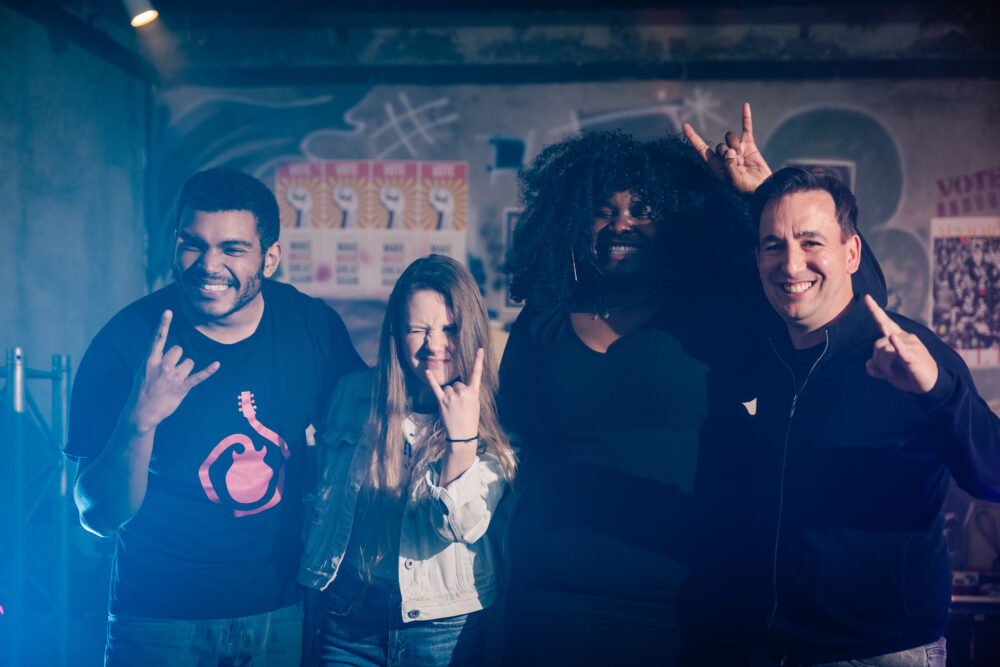
My band Unresolved consists of me (vocals), Ayla Gelbart (drums), Victor Germeshuizen (electric guitar) and Jericho Hendricks (keyboard and bass guitar).
Creating chemistry between students who have never played together before is not as tricky as one would think.
Hendricks, who is the school’s music director, says: “I don’t force it. I always create room for the awkward silences, the missed cues, the weird energy. Then I throw them into the deep end.
“Chemistry doesn’t form when it’s comfortable. It happens when they realise they need each other to make the music work. That’s when they stop playing as individuals and start listening to each other.”
The songs chosen by the school and our band included Sisters Are Doin’ It For Themselves by Eurythmics and Aretha Franklin; Carry On Wayward Son by Kansas and Joker and the Thief by Wolfmother.
On deciding what students are going to perform, Rosenberg says each season’s theme and song selection is “thoughtfully chosen to both challenge and excite our students, while supporting their growth according to our methodology and skill levels”.
I had been battling a cold for about two weeks in the lead-up to the Saturday morning of our grand performance. I was a bit concerned that my voice would not be at the level it needed to be to pull off a performance I would be proud of.
I had been nursing my voice and taking rest. Practising that morning, my voice sounded like itself again.
My brothers and friends would see me on stage with a band for the first time ever.
After arriving at the Democracy Bar in Illovo, I remembered everything I had been taught that season but the one thing that stuck in my head was: “Have fun on stage!”
I also remembered little Busi from the Nineties and activated the performer within me for her.
I remembered how Malope made me feel when she performed and hoped to have the same effect on the people that came out to watch us.
As I got on stage with my band, I said a silent prayer. It was showtime. But I need not have worried — my band and I completely rocked the stage! We set it on fire! It was electric! It was fun! We had enormous fun! For the first time in a long time I felt like I belonged.
I have grown in many ways since signing on at the school. Coach Ndlovu says she has seen a big improvement in my articulation, as well as my range, which has enabled me to sing high-pitched songs.
“You have also mastered how to effectively use your different vocal registers. Your stage presence and your ability to connect with the crowd is exceptional,” she says.
Reflecting on the performance, I realised I had made my inner child proud. I felt like I had made my parents, who are no longer with us, proud. Most importantly, I felt I had made God proud, because I was finally doing something with the talent he blessed me with.
After the performance, multiple people approached me. I was particularly moved by two young children who ran up and gave me the biggest hug, telling me how much they enjoyed our performance.
Again, I was reminded of little me and how she was now making little humans fall in love with music, just like Malope made her feel all those years ago.
And that was probably one of the most fulfilling moments of my life.
Busi Lethole is a multimedia journalist with the Mail & Guardian.
Is South Africa sleepwalking towards prolonged violent upheaval?:
Like many South Africans, I have come to terms with the fact that I unconsciously subscribe to the seductive myth of South African exceptionalism — the belief that our nation, having miraculously navigated a bloodless transition in 1994, is immune to the violent upheavals that have plagued other post-colonial states.
Yet undeniable cracks are emerging, which include failing institutions, deepening inequality and a festering disillusionment. The question is no longer whether South Africa is immune, but whether we will wake up before it consumes us.
Recent events have laid bare the fragility of our political and economic order. Last month, reports surfaced that the presidency had received intelligence warnings of potential coup d’état risks — an unthinkable notion in post-1994 South Africa. Then came General Nhlanhla Mkhwanazi’s damning allegations about the rot in the police and the judiciary.
This month, the rift between the executive and the military deepened when the state publicly reprimanded the head of the South African National Defence Force, General Rudzani Maphwanya for his apparently pro-Iran remarks during an official visit to Tehran.
Insecurity, it seems, marches forward unyielding, corrosive, and far from its peak.
But let us not leap into premature conclusions. History shows clear patterns behind violent upheavals. Four quintessential elements form the necessary conditions:
• Severe elite fracturing;
• Mass grievance mobilisation;
• Prolonged and multiple economic crises; and
• Complete state institutional collapse.
The presence of these elements in South Africa’s reality demands clear-eyed assessment.
With regard to elite fracturing, undeniably the government demonstrates instability with little tangible progress, yet its leadership — including volatile factions such as the uMkhonto weSizwe (MK) party and the Economic Freedom Fighters — still uphold democratic virtues.
Militarily, although policy disagreements and bureaucratic tensions exist, no evidence suggests the armed forces perceive a power vacuum to exploit.
And, despite turbulence, the business sector remains aligned in its economic recovery efforts and overall national development project.
As for mass mobilisation, although South Africa has not witnessed such, growing social instability signals risks. According to police data, the country has so far recorded 27 protests a day in 2025, predominantly over service delivery failures, a telling indicator of eroding public trust. Industry experts argue, however, that this number could be much higher.
By-election data for 2025 shows that urban voter turnout has taken a nosedive, with rural participation seeing a marked increase. This signals a crisis of public trust among urban populations.
KwaZulu-Natal presents unique concerns, with its social cohesion deteriorating faster than other provinces. The region, site of the deadly 2021 riots, now shows worrying signs of ethnic mobilisation. The MK party’s emergence as a potential unifying opposition force, amplified by its narrative of political persecution against figures like Jacob Zuma, adds volatility. Yet, it remains premature to declare mass mobilisation inevitable.
A core worrying sign, however, is the country’s economic fragility, with unemployment at 33% — and 46.1% for youth. This could create fertile ground for mass discontent. Weak growth projections of 0.9% to 1.5% threaten to trigger a destructive cycle of job losses, rising inflation, collapsed consumer demand, worsening inequality and productivity declines — a situation that makes economic crisis increasingly inevitable.
As for our institutions, while South Africa’s state apparatus shows deepening fractures, complete collapse remains unlikely. Critical institutions of the state such as the judiciary demonstrate enduring resilience and maintain rule of law.
The rot, however, runs deep elsewhere — rampant corruption (the South Africa’s Global Corruption Perception Index shows a decline), eroding oversight and systemic service delivery failures plague national, provincial and local governments. These institutional cracks widen under the weight of non-transparency, but the core framework of governance still stands.
Overall, this assessment indicates that although there exists no imminent threat of violent upheaval in South Africa’s mid-term future, we cannot mistake this relative stability for safety. Without immediate course correction and tangible reform, the spectre of large-scale violence grows increasingly tangible.
The true peril lies not in some predetermined fate, but in the price of complacency. Each day of inaction narrows our opportunities, making future conflicts more likely and more brutal.
Siseko Maposa is the director of Surgetower Associates management consultancy. The views expressed are of his own opinion.
Reframe views of fraught places like Westbury and Cloetesville:
While I was away for my graduation in Johannesburg, I found myself in conversation with a group of friends. Our discussion turned to Westbury, a neighbourhood in Johannesburg associated with crime, frequent gun violence and entrenched gang activity. In an effort to present the community in a more positive light, someone remarked that they had watched a video in which someone said; “Westbury is a good place if you look beyond the crime, the gunshots,and the insecurity.”
I remember responding with a quiet irony: it is precisely those very conditions — those we are asked to “look beyond” — that have shaped the perception of Westbury as unsafe and burdened with a negative reputation.
I did not appreciate the implications of that exchange. On reflection, the same observation can be made about Cloetesville, in the Stellenbosch area, which has similarly become associated with robberies and gang-related violence, and consequently has a troubled reputation.
The words of the person who urged us to “look beyond” the crime and gang-related issues of Westbury have begun to acquire new meaning for me as I navigate life in Cloetesville. My reflections began with the family I live with, who consistently ensure my safety. They not only watch over my comings and goings but also introduce me to members of the local community with the assurance that, should I ever find myself in distress, I would have people to call upon for assistance. Their care extends to advising me on which routes to use at certain times of the day and, on occasion, even offering to drive me to my destination to minimise risk.
I have also had countless acts of kindness from strangers. People I had never met offered me a ride when they realised we were headed in the same direction. I recall one instance where a person went out of their way to ensure I arrived safely at my residence, only for me to later discover that they were distantly related to the family with whom I live. Equally striking are the many moments when community members cautioned me to safeguard my phone while walking, urging me to either hold it more firmly or tuck it away to avoid theft.
To this sense of community must also be added the “tribe” I have found at my university, to borrow the words of my supervisor. My colleagues and mentors have played a vital role in easing my transition into both academic and social life at Stellenbosch. Their support has been invaluable, and I remain deeply grateful for their continued guidance.
All these experiences point to a deeper lesson: that when we take the time to look beyond the visible “ills” of communities often dismissed as unsafe or crime-ridden, we begin to see the humanity that persists within them. We encounter people who, despite the circumstances they have inherited, continue to strive toward dignity, resilience and honest livelihoods. These are people who, in the midst of systemic problems and structural neglect still embody a profound ethic of care — for themselves, their families and their neighbours. Such recognition calls for a shift in perspective: from viewing these places solely through the lens of their struggles to acknowledging the networks of solidarity, generosity and perseverance that sustain them.
This reflection also draws my attention to a broader human reality: that at times we become trapped in our own thoughts, feeling isolated and convinced that no one cares about us. In such moments, we carry our burdens in silence, assuming that our struggles are ours alone to bear. If there is one lesson I have drawn from the kindness of strangers in Cloetesville, it is that there are always people — often unseen — who are quietly willing to help in whatever way they can. We may not always recognise who they are, but their presence becomes evident when we take the courage to speak up and seek assistance.
This insight resonates strongly with recent social reflections, such as the recognition of men’s mental health awareness last month and the celebration of women this month. Both highlight the urgent need to create communities that do not silence pain but encourage dialogue, compassion and mutual care. If we are to counteract the pervasive ills that too often define our neighbourhoods in negative terms, we must cultivate spaces where people feel safe to voice their struggles, to seek support and to recognise that, even in places marked by hardship, there exists a willingness to help and a capacity for solidarity.
In the end, my encounters — from Westbury’s troubled reputation to my lived reality of Cloetesville — have taught me that communities cannot be understood solely through the lens of their visible struggles.
Crime, violence and systemic neglect are real, but they do not exhaust the truth of these places. Beneath the surface is a resilient ethic of care, embodied in countless small acts of generosity, solidarity and concern for others. To recognise this is to acknowledge that human dignity persists even under difficult conditions, and that genuine community is built not only through the absence of struggle but through the shared commitment to endure and support one another in the midst of it.
Perhaps the challenge for us is not simply to condemn communities by their scars but to nurture spaces where compassion and dialogue can thrive — spaces where burdens may be shared, resilience affirmed and hope continually renewed.
Emmanuel Anoghena Oboh is a PhD student of philosophy at the Centre of Applied Ethics, Stellenbosch University.
Submit and get free exposure here: Showcase Your Business | Advertise Your Special Offers.