
How sports shape society and the unpredictable currents of public life:
When the Stadium Becomes a Mirror of the Street
Public life rarely moves in straight lines. A city can feel calm for weeks, then one match, one march, one headline changes the mood in a single evening. That is one reason sport matters beyond trophies and league tables. It gives people a common language for pressure, loyalty, disappointment, and release. Few cultural forces can bring strangers into the same rhythm as quickly as a major game, a derby, or a national team run.
That does not make sport innocent. It can soften tensions or sharpen them. It can create belonging or expose who feels left out. But that instability is exactly why sport remains such a powerful lens on public life. It does not sit outside society and comment from a safe distance. It absorbs the mood of the street, then throws it back with floodlights on.
Why sport keeps escaping the sports pages
The old idea that sport belongs in a separate section now feels quaint. Clubs are brands, stadiums are civic stages, and athletes carry political and cultural meaning whether they want to or not. A banner in the stands can become a headline before halftime. A player’s gesture can travel farther than a minister’s speech. Even ordinary conversation borrows sports language because it helps people describe power in motion.
That crossover happens for practical reasons too. Sport is one of the few mass experiences that still unfolds live, with millions watching the same uncertainty at the same time. People do not just consume it. They rehearse their own beliefs inside it: who deserves support, what fairness looks like, how institutions behave under stress.
The civic rituals hidden inside fandom
Fans often describe loyalty as a private matter. In reality, it is public theater. Scarves, chants, watch parties, commuter debates, group chats, neighborhood screens: these rituals turn individual feeling into something visible. A title win becomes attached to a street or a season of someone’s life. A collapse becomes a collective scar. That is culture in its raw form.
Three things make sports rituals unusually powerful:
- They repeat often enough to shape habit.
- They connect emotion to place, not just to content.
- They let people disagree while remaining within a single shared event.
In a time when public life often feels fragmented into algorithmic tribes, sport still creates moments when people argue inside a common frame. The argument can be fierce, but the frame is shared. That alone gives sport unusual civic weight.
Big developments almost never arrive neatly
Social change loves to pretend it was obvious from the start. It almost never is. Large shifts in public feeling usually look confusing while they are happening. A team that seemed stable suddenly feels fragile. A coach who looked untouchable begins to seem temporary. A city that treated sport as weekend entertainment wakes up and realizes the club badge has become part of its political vocabulary.
That unpredictability is not a flaw in the system. It is the system. Crowds are volatile. Institutions overreact. Media narratives speed up and then break apart. Emotion enters first; analysis catches up later. Sport teaches that lesson better than most fields because it compresses it into a match, a series, or a final over.
Where uncertainty meets the odds board
The same uncertainty that shapes public moods also explains why sports betting keeps attracting fans who live inside the details. They study injuries, line movement, scheduling fatigue, crowd energy, and coaching habits because prediction feels meaningful when the ground is unstable. That is where MelBet Zambia fits naturally into the wider sports conversation. A platform with live markets, broad event coverage, and quick access to statistics turns uncertainty into a form of active reading rather than passive watching. The wager is only part of the appeal; the deeper pull is testing your interpretation of a public event before the event settles into history.
Media does not report the feeling; it amplifies it
Modern sports coverage no longer waits for the final whistle. The build-up is content. The rumor is content. A tactical thread, a clip, a quote, a shaky crowd video from the concourse: each can influence the emotional weather around a club or a match. That feedback loop matters because public life now works the same way. Attention moves fast, and interpretation becomes part of the event itself.
This is why sports influence feels larger than the scoreboard. Media systems reward emotion, tension, and narrative reversal. Sport provides them in concentrated form. Once that content leaves the stadium, it blends with conversations about identity, class, money, policing, nationalism, celebrity, and local pride.
What sport reveals about the societies watching it
If you want to understand a society, watch what its fans celebrate and what they refuse to excuse. Listen to the jokes after a defeat. Watch what happens when a star leaves, when a referee loses control, when a governing body speaks in polished language after a chaotic night. These moments expose public standards more honestly than many official statements do.
Sport does not solve the pressures of modern life. It does something trickier. It stages them. It gives them color, sound, sequence, villains, heroes, and a clock. That is why its influence continues to spread into politics, culture, and daily conversation. Not because games are more important than everything else, but because they often show everything else in motion.
Fatoumata Diawara channels ancestry and activism in Cape Town:
It’s a warm Saturday afternoon in Cape Town. Music lovers are beginning to trickle into the CTICC hosting the Cape Town International Jazz Festival (CTIJF). I’m in the media centre, excited for my next interview of the day.
In walks Fatoumata Diawara, the artist I have been looking forward to speaking to.
She immediately greets everyone, then turns to look at me and says: “I love your hair.” I’m donning my Afro curled-wig. Surprised with a big smile on my face, I respond with a “Thank you!”
As the Malian singer-songwriter and actress takes a seat, I notice the four traditional white dots painted down her forehead. She is wearing traditional beads around her neck. I notice the white bead headpiece beginning from her forehead to the top of her head.
I notice that her hands and fingers are a different colour than that of her skin tone. They seem to be painted in a brownish/maroonish colour.
Diawara is in tune with her Malian heritage, so she is known to use artistic, visual and symbolic elements on her body.
The artist deeply connects with ancestral energy. This is evident in the type of music she makes — one that blends traditional Malian sounds.
Arriving in South Africa for the second time, the musician felt a powerful ancestral presence. As she set out to perform for the first time in the Mother City at CTIJF, for her, the ancestral energy was palpable.
“Being here, the energy is so strong in a good way. And the first thing that I really feel. It’s my second time now in South Africa, I feel the ancestors. That’s strange. In the hotel, I feel a lot of dead people,” she says.
“Sorry for telling you about the crazy part of my life,” she giggles.
“It happens to me only in South Africa, not even in Mali, so strongly, I don’t know. When I get out, I wonder if people in here feel the same energy. That’s my questioning.
“It’s like I look at people and say: ‘Okay, they know about this, that it’s so strong, you know, and that the ancestors are still with us, even if they’re from a different period of time.’ And that’s one thing.
“And the second thing is that I feel people are very calm and very peaceful. You see a lot of love coming from them. You know, you get this connection with people that is incredible. I feel at home.”
Remaining rooted in her African musical identity while speaking to an international audience is effortless for the artist. She makes the balance look easy, maintaining a fierce loyalty to her Malian roots.
“How to be still in touch with our connection, between us and our ancestors and our roots? It’s quite easy in Mali because there we have many artists before me, like Toumani Diabaté, Salif Keita, Ali Farka Touré,” she explains.
“They won the Grammy as traditional artists. So for us, they are our example. We don’t see other people as an example. So we start with the experience first, then we open the same experience to the rest of
the world.
“But we can always combine the traditional with the modern, you know, contemporary music. But we need to keep their roots because in Mali it’s the way it is and we grew up like that. They did it all. They’ve been famous for being themselves.
“For us, it’s totally normal to sing in our native language. There is no doubt. For me, it’s normal because the native language has a lot of energies that the world needs to feel.
“Every word that I will be speaking tonight to my audience, for sure, it will take them, their soul to another place. And that’s what music’s about also. The diversity. The native language is stronger and beautiful.”
During her energetic performance at the CTIJF, filled with high-notes and dancing, Diawara honoured her ancestral roots.
She donned a mask which she typically wears when performing. The mask-wearing segment of her performances has become a much-anticipated moment for her fans. The singer wears the mask towards the end of her performances, specifically the Gouro Zaouli mask from Côte d’Ivoire, as a way to embody her African artistic expression while celebrating ancestral history.
The mask also serves as a way in which she merges West African tradition with an electric, contemporary edge.
At the heart of Diawara’s craft is a commitment to storytelling and activism.
She is intentional in using her platform as a form of activism and her work often carries strong messages around identity, women’s rights and social justice.

Diawara is a prominent activist against female genital mutilation (FGM). Having survived the procedure herself as a child, she uses her music to shed light on the inhumane and harmful practice.
“Being this way is like … that was normal. When I started to sing, I decided to share my own story,” she says. “And it wasn’t that easy. It’s never easy. You live with your past. It will stay. You adapt yourself on how to live with it.
“My aim … the fact that I was an actress at the beginning and when I started to introduce myself to the music industry, I said: ‘Okay, you come with your truth, then you will save time. Don’t try to pretend. Be yourself. Then you will catch up with people right away.’ And the best way for me to be myself was to open my spirit to the people.”
The musician addresses the harms of FGM in her music. Her song Sete and its accompanying video serve as a stark, necessary indictment of FGM, emphasising her belief that breaking the silence is the first step towards healing and reform.
For Diawara, storytelling is not just an artistic choice but a lifelong process of reckoning. She speaks about her experiences with a quiet resolve, framing them as fragments of a much larger narrative unfolding.
“The best way was to tell my little experience as a woman from Africa coming from a very strong tradition and how I could struggle,” she says, situating her journey alongside those of other FGM survivors.
It is not a story she treats as finite or resolved but one that continues to evolve in real time. “Like tonight, I’m still fighting … It’s like telling my story. It’s gonna be forever because every year is a new story to share.”
She likens this process to writing a book. Each performance, each song adding another page. Through that lens, her music becomes both archive and testimony, a space where personal memory meets collective experience.
When she turns to the issue of FGM, her tone sharpens. She challenges the framing of the practice as inherently African, pushing back against narratives that obscure its complexity and origins. For Diawara, confronting FGM through music is not optional; it’s a responsibility.
“Those kinds of sensitisations … through the music, I think it is our duty to bring the change,” she says, positioning art as both a cultural mirror and a tool for reform.
That sense of purpose extends to how she understands music. For Diawara, it exists far beyond entertainment. It is spiritual, communal and deeply political. She speaks of it as “the voice of God”, a universal language capable of carrying difficult truths across borders
and generations.
In her view, the weight of the stories she tells is not an act of complaint but of affirmation. By sharing them, she hopes to reframe how African narratives are understood, not as deficit but as depth and richness. “We are not poor people … we are even too rich,” she says, reframing struggle within a broader context of cultural abundance.
Ultimately, her work circles back to a call for dialogue. One that is both introspective and collective.
She advocates for a careful balance: preserving what is meaningful within tradition while interrogating what is harmful.
“It’s good to keep some stuff … the respect between each other and many things that our ancestors have been building for us,” she reflects.
She is equally clear about what must be left behind. Practices such as FGM, violence against women
and arranged marriages, she insists, have no place in the future she is helping to shape.
“Those kinds of things that our generation doesn’t name,” she says. “We don’t need those things.”
Six decades In, Goodman Gallery reflects on its role in art and society:
On a weekday afternoon in Johannesburg, the doors of Goodman Gallery are open in the way they have been for decades. Inside, a new exhibition by Hank Willis Thomas fills the space. For Liza Essers, it is a familiar kind of milestone.
“He’s actually the first artist that I took on when I took over the gallery,” she tells me. “We’ve been working together for about 17 years.”
There’s something fitting about that continuity. As Goodman Gallery approaches its 60th anniversary, the story is not only about longevity but about the accumulation of relationships, decisions and positions taken over time. These relationships have shaped what the gallery has become six decades into its existence.
Founded in 1966, amid apartheid, Goodman Gallery opened at a time when South Africa’s cultural institutions were largely segregated.
From the beginning, it refused that logic, exhibiting artists of all races and creating a space that challenged the exclusions of the moment. Over time, it became associated with artists who would come to define 20th-century South African art.
The history anchors the gallery today, even as its footprint has expanded far beyond Johannesburg.

For Essers, who took over the gallery in 2008, the legacy was something she encountered first as an outsider. “It was this amazing space to imagine, a space to dream, a space to learn, a space to grow,” she says, recalling her early visits. “Every time I walked into the gallery and had the privilege of seeing a show, it transformed me in that moment in a way that I had never experienced from anything else.”
What followed was less a gradual extension of that experience outward. If the gallery had once been primarily focused on South African artists, Essers’ tenure has been marked by a deliberate broadening of its scope geographically, intellectually and commercially.
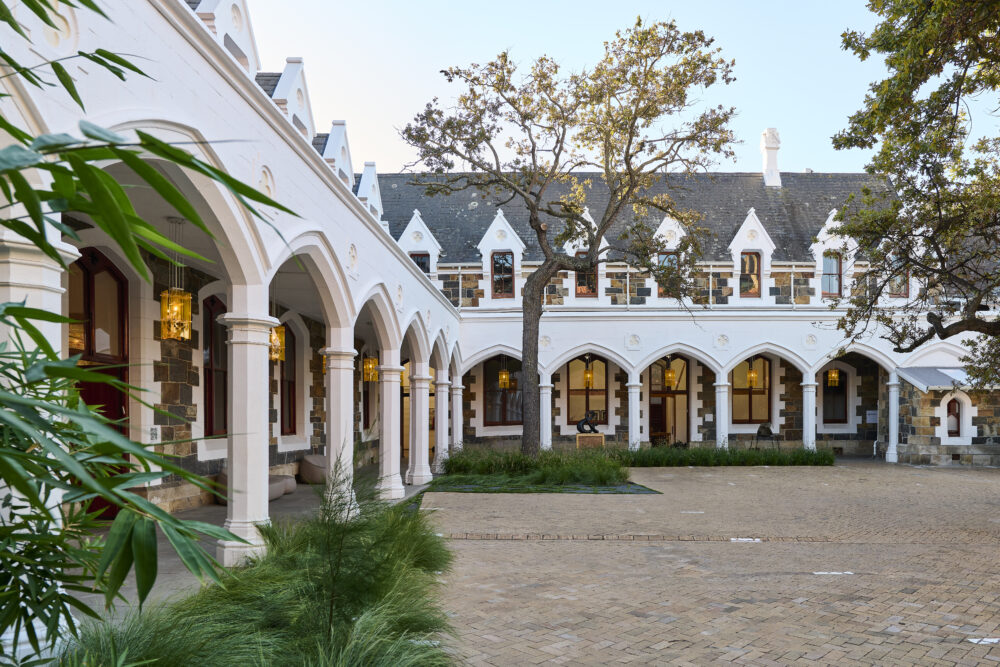
Today, Goodman Gallery operates across Johannesburg, Cape Town, London and New York. Its programme includes artists from across Africa and the wider Global South, alongside established international figures. The shift, however, was not simply about scale.
“It was about opening the conversations,” Essers says. “Allowing the space to open for broader conversations.”
The conversations have been structured, in part, through three long-running curatorial initiatives that shape the gallery’s programming.
The first, Working Title, functions as an incubator for emerging artists, offering a platform without necessarily folding them into the gallery’s commercial roster. It is, in many ways, an attempt to preserve something of the gallery’s earlier identity as a cultural institution rather than a purely market-driven entity.
“It’s a space for young artists to maybe have their first shows and to springboard them into the international art world,” Essers explains.
The results are visible in the trajectories of artists who have passed through the programme, some of whom have gone on to exhibit internationally, including at major biennales. The emphasis here is less on immediate return and more on long-term development; a slower, less predictable kind of investment.
If Working Title looks forward, the South South initiative looks laterally, connecting artists and ideas across regions that share postcolonial histories. “It’s been my life’s ambition to open the conversation of the Global South,” Essers says.
“Not just the South African art world or the Brazilian art world but to really think about the broader conversation around shared histories and narratives.”
The third initiative, In Context, turns inward, focusing on the dynamics of place. How identity, geography and history intersect. Previous exhibitions under this banner have explored themes of diaspora, belonging and race, often through collaborations that extend beyond a single location.
Together, the strands form the intellectual backbone of the gallery’s programme but they also reflect a broader tension that has defined Goodman’s evolution: how to expand globally without losing a sense
of grounding.
“I don’t know what an African perspective is per se,” Essers says. “But I think it’s a broader global majority perspective.”
That framing is deliberate. While Johannesburg remains the gallery’s base, its programme resists being confined to a single national identity. Instead, it situates itself within a network of artists and ideas that move across borders, shaped by shared conditions rather than fixed geographies. The expansion into international markets, including London in 2019 and New York in 2023, has been part of that strategy but it has not been without risk.
“It’s very risky, financially. But it felt important that we brought our artists into the main conversation of where art history is being written.”
That “main conversation” tends to be centred on Western institutions, a reality that continues to shape the global art market. For galleries based in the Global South, participation often requires a physical presence in those centres, even as they seek to challenge their dominance.
Goodman’s approach has been gradual, growing “as we’ve been able to self-grow”, as Essers puts it, rather than through rapid expansion.
If the gallery’s outward growth has been measured, its internal relationships have been notably enduring. Alongside newer names, it maintains long-standing ties with artists such as William Kentridge and Sue Williamson, as well as the estates of figures like David Koloane and David Goldblatt.
“They really are partnerships,” Essers says. “Long-term relationships and friendships.”
Sustaining the relationships involves building careers over time, connecting artists with curators, institutions and collectors, ensuring that their work enters public collections and critical discourse.
“It takes a big team, a lot of effort from the gallery to push those careers forward,” she says.
That work, largely invisible to the public, is what underpins the gallery’s presence in major exhibitions and museum shows across the world. At any given moment, multiple Goodman artists are exhibiting internationally, a reflection of both the gallery’s reach and its network.
Yet the gallery’s role is not only to promote artists but to hold a certain kind of space. One that has, at times, placed it in tension with political and social pressures. In 2012, Goodman Gallery resisted calls to censor an exhibition, a moment that Essers frames less as a dramatic stand and more as an application of principle.
“We do not believe in censorship,” she says. “Freedom of expression is fundamental to our constitution and for a democracy.”
The position extends to the artists. Whether engaging with political issues directly or indirectly, they are afforded the autonomy to take their own stances, even when the positions are contested. “The gallery is not a political platform,” Essers notes. “But we provide the space for many different perspectives.”
This distinction, between platform and position, is central to how Goodman navigates its role in relation to social change. Rather than advocating a singular viewpoint, it facilitates dialogue through exhibitions, talks and collaborations.
Over the years, that has included conversations on topics ranging from migration and identity to environmental concerns and public health.
Parallel to this, the gallery and its artists have supported various social initiatives, including healthcare projects and infrastructure development in underserved communities.
The efforts, while not always visible within the gallery walls, form part of a broader understanding of what it means to operate as a cultural institution in South Africa.
As Goodman approaches its 60th anniversary, the multiple threads including historical, commercial and cultural are being drawn together through a series of projects that look both backward and forward.
An archival timeline, set to launch this year, will map key moments in the gallery’s history, offering a way to navigate six decades of exhibitions, collaborations and milestones.
A new digital platform reflects a shift in how audiences engage
with art.
“The art world has shifted significantly,” Essers says. “People are consuming things very quickly, online.”
The challenge, she suggests, is to create digital spaces that retain some of the depth and immersion of physical exhibitions. To “bring back the space to imagine and the space to think” even through a screen.
At the centre of the anniversary programme will be a major exhibition later in the year, spanning the gallery’s various locations. Details are limited for now but Essers describes its guiding idea simply: A gathering. “It’s about coming together,” she says. “Shared voices, shared perspectives.”
It’s a modest description for what is, in effect, a summation of the gallery’s trajectory from a single space in apartheid-era Johannesburg to a networked institution operating across continents. And yet, for all the expansion, the core ambition remains relatively unchanged.
“I hope that we will continue to be a site of assembly, a catalyst, a collaborator,” Essers says. “A socially conscious platform.”
In a cultural landscape increasingly shaped by speed, scale and visibility, that kind of continuity can be difficult to maintain. Institutions evolve, markets shift, audiences change. What remains are the choices made along the way about what to show, who to support, when to speak and when to hold space.
Sixty years in, Goodman Gallery’s history is not a single narrative but a collection of these decisions, layered over time. Some were shaped by circumstance, others by conviction. Together, they form a record not only of an institution but of the contexts in which it has operated. And the conversations it has chosen to enter.
The anniversary, then, is less a conclusion than a pause. A moment to look back, to take stock and to consider what it means to continue.
Submit and get free exposure here: Showcase Your Business | Advertise Your Special Offers.
