
How to make your annual report design more impactful:
An annual report is an excellent opportunity to visually portray your brand’s story and articulate your strategic vision
Using the core principles of professional annual report design, you can create impactful publications that showcase your organisation’s achievements and vision for the future.
Our guide will walk you through the essential elements of creating engaging annual report designs that captivate your readers.
What is an annual report?
An annual report is a comprehensive publication that provides insights into an organisation’s financial position and operational activities from the previous year. It typically includes detailed financial statements, such as the balance sheet, income statement, and cash flow statement, along with notes and explanations.
Additionally, annual reports often feature:
- A message from the CEO or chairman
- An overview of the organisation’s strategy
- An analysis of market conditions
- Performance highlights
- Visuals highlighting recent accomplishments
- Information on corporate governance and social responsibility initiatives
- Forecasts about future performance
An annual report provides stakeholders and other relevant parties with information about the organisation, which they can analyse to make informed decisions and investments.
In most countries, annual reports are mandatory for certain companies.
Why design really matters for your annual report
Many view annual reports as compliance documents with financials, statistics, and other dry details. But in truth, an annual report is an excellent opportunity to visually portray your brand’s story, create brand awareness, highlight your achievements, share information, and articulate your strategic vision.
Here’s why the design aspect of your annual report design is so important:
- First, looks matter. A visually appealing report grabs your readers’ attention — people are more likely to read a well-designed annual report than one that looks dull, cluttered and uninspiring.
- In our data-overloaded world, we have a small window to engage readers and an even shorter window to keep them from being distracted.
- Second, your annual report is an opportunity to reinforce brand identity and set your organisation apart from competitors. An annual report is a public document that should visually demonstrate your brand’s values, personality, and mission. Potential investors will view your annual report with interest, so there is a marketing component to annual report designs as well.
- Third, design helps you communicate information effectively. Persuasive visuals engage your readers, making them feel more involved in the narrative.
- Lastly, the design of a great annual report makes complex information more accessible by breaking it down into clear, digestible visual sections and infographics.
In short, the design of your annual report isn’t just about aesthetics. It’s a crucial tool for effective communication.
Understand your audience
Great design meets the needs of its viewers. Before designing your annual report, think about your audience. Who will read it? Shareholders, clients, customers, or employees? Each group has different expectations and preferences. Tailoring your design to meet these needs is essential.
For example, an annual report with interactive features might be great for a young, tech-savvy audience. However, a more traditional design might be better if your audience prefers printed materials. Consider age, skills, interests, and reading habits to choose the best design elements.
A design that matches your audience’s preferences makes the information you’re presenting achieve a more significant impact.
Storytelling through design
Effective annual reports don’t tell; they show — visual storytelling is about engaging imagery. An impactful visual narrative combines the big-picture story of your report with detailed insights, guiding readers through your organisation’s journey over the year.
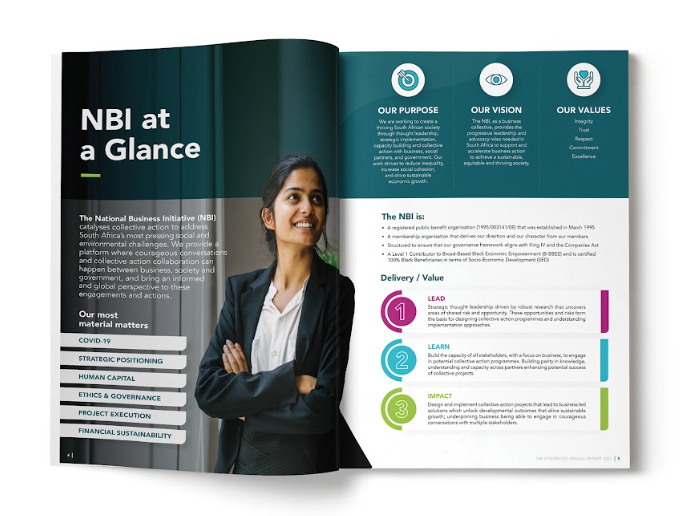
Take a look at The Ethical Agency’s 2022 Annual Report for The National Business Initiative (NBI). We used visuals to blend brand narrative seamlessly — each section builds upon the last, creating a unified story across visuals and text.
Remember: every design choice, from layout to visuals, influences how readers interact with your report. Focus on thoughtful design that seamlessly leads readers through each section.
- A good story has a clear beginning, middle, and end with chapters that weave a logical narrative—e.g., character, setting, conflict, plot, and theme. Map your story(s) with such structure.
- A classical story contains a problem and a solution, i.e. complications, a crisis, a climax and a resolution.
- Good storytelling involves people, communities and emotion.
Use a visual design hierarchy
Visual hierarchy is about arranging design elements to guide attention effectively. It helps contrast vital information in your annual report, even if readers are skimming content.
Colour also plays a significant role; bold colours highlight key areas, while softer colours provide focus to text or graphs. Typography matters, too. Different fonts and text sizes change how information feels and flows. Large fonts work well for headings and big idea statements, while smaller fonts suit supporting details and body copy.
Mixing font styles adds variety and space. Good spacing guides readers effortlessly through your report, separating sections for a spacious, calm, and comfortable reading experience.
These are all elements of visual hierarchy. When undertaken well, visual hierarchy ensures your core points are communicated effectively.
Focus on readability
A great annual report design doesn’t just look good — it also reads well. Readability is about making it simple for your readers to understand your text.
Here are a few pointers:
- Start with clear, easy-to-read fonts. Stick to 9-12 point sizes for main body copy text. Headings should be significantly larger and distinctive.
- Leave enough space. Use wide margins, generous paragraph spacing, and clear headings. This will provide readers with visual content breaks and make information easier to digest. Don’t cram too much content into too few pages. Consider your page layouts — don’t be afraid to dedicate entire pages to an image/photograph.
- Clean design. A clean design and layout help readers focus on the content. Don’t fill every inch of space — space balances your layout and reduces distractions.
- Use imagery and photography to balance out the text – a picture paints a thousand words — the more imagery used, the less the content will feel like walls of text.
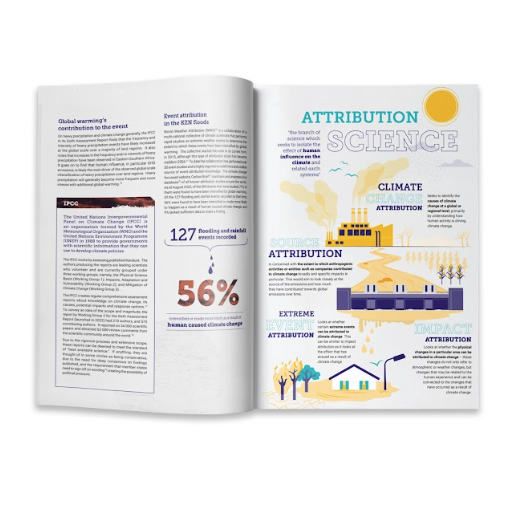
- Balance text with infographics and diagrams. Diagrams, charts, and infographics make complex information simpler and more engaging.
Always find the right balance between aesthetics and readability — readers will thank you!

Incorporate infographics and visualisations
One of the most impactful ways to present data effectively in an annual report is through infographics and visualisation. Malcolm Gladwell once said: “The key to good decision-making is not knowledge. It is understanding.”
Infographics and data visualisations provide just that, transforming dense information into clear, easy-to-understand visuals that improve comprehension and recall.
Here are some valuable tips:
- Simplicity is key: Keep your design simple and focused. An overloaded infographic or visualisation can distract your readers, defeating its purpose. Use minimalistic designs that convey only one idea at a time.
- Use appropriate charts: Different types of data call for different charts. For example, a bar graph might be more effective for comparing data, while a pie chart can represent proportions. Choose the chart type that accurately describes the data you are communicating.
- Aim for a story: Using infographics and visualisations reinforces your overarching story. Ensure visual aids adhere to your overall report design theme.
- Consider size and scale: Ensure graphics are proportional to their message. Misleading scales can distort data representation and lead to inaccuracies.
- Use pull quotes and statistics: Use pull quotes and key statistics from your content, and articulate them with infographics and large typography to drive key messaging.
- Annotations help: Use text sparingly to add context or draw attention to critical information.
Think digital in your annual report
In the digital age, interactive elements may be needed to captivate busy readers, making your annual report engaging and dynamic while elevating reader investment.
Interactivity comes in many forms, from embedded videos and interactive charts to clickable links leading to related content or different sections in your annual report or website.
For interactive features to work, your annual report needs to be exported as a PDF.
One interesting annual report design tactic is to create a shorter annual report where the reader can be directed to specific pages on your website if they are interested in the most up-to-date information.
Here are some straightforward steps:
- Identify opportunities: Determine which part of your annual report can benefit from an interactive feature. It could be a complex infographic simplified with hover effects, a case study shown through a video, or a long section navigated through anchor links.
- Create quality content: Simply adding interactive elements will only work if your content is compelling. Ensure videos, graphs, and additional linked content provide value, enhance comprehension, and align to reinforce the overall objective of your report.
- Test: Before publishing, do a dry run to ensure interactive features work seamlessly across multiple devices. You wouldn’t want to annoy or lose your audience because of non-functioning features.
Adding interactivity as a design element in your annual report can enrich the reader experience by bridging the gap between traditional reporting and immersive experiences, as well as keeping up with modern times
Design captivating report covers
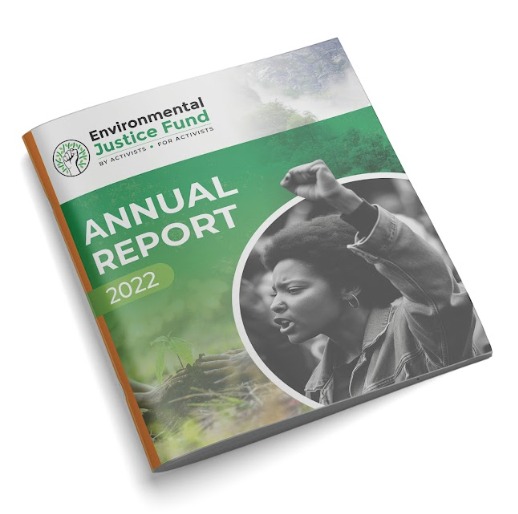
First impressions matter. And it all begins with your cover design.
Effective cover designs combine compelling visual elements, creative conceptual design, and a distinct aesthetic quality that complements your brand voice—like a handshake or a first hello.
Covers should prime your readers’ minds and set the tone for what lies within.
Wrapping up
Our guide has shed some light on the significance of considered design in crafting impactful annual reports.
Here are the main points:
- Understanding your audience is key and should guide design decisions.
- Visual storytelling maintains engagement throughout the report, with every element contributing to your brand’s narrative.
- Visual hierarchy further enhances effectiveness by guiding readers to crucial messages.
- Readability relies on balancing text and visual aids.
- Infographics and visualisations simplify complex information.
- Interactive elements like videos and animations add engagement, transforming static reports into dynamic experiences.
- Don’t underestimate the power of a striking cover.
Whether you go the DIY route of working with your in-house design team or hire a professional annual report design partner, ensure your annual report has personality and “life”, reflects your brand identity and resonates with your audience.
Contact The Ethical Agency for your annual report design needs.
On 24 May, the European Union passed the Corporate Sustainability Due Diligence Directive (CSDDD) law, requiring big businesses to identify and address negative human rights and environmental impacts in supply chains regardless of whether the harm occurs in or outside the EU. It will apply to businesses with more than 1,000 employees on average and a net worldwide turnover of more than €450 million.
This follows a compromise led by the French government that effectively narrowed the scope of the directive when states such as Germany and Italy expressed reservations about the effect the directive would have on the EU investment climate.
The directive will also apply to non-EU based companies with a turnover of more than €450 million in the bloc. EU member states will have two years to adopt the directive into national legislation. The directive creates a deterrent for violations such as child and forced labour and goes even further to include pollution and emissions, deforestation and damage to ecosystems in their supply chain. This is done mainly through the use of human rights and environmental due diligence in relation to their own operations, those of their subsidiaries, and their direct and indirect business partners throughout their chains of activities.
In the absence of binding international regulation of supply chains, the CSDDD marks a significant advance in the regulation of human and environmental impacts of business. More so, in implementing such a standard in the world’s biggest single market, the EU has a sizable control of supply chains, including mining supply chains.
The implication is that South African companies will be indirectly affected by the implementation of the directive. This is an important moment for corporate accountability and human rights in a much contested arena between self-regulation and binding mechanisms for companies, especially those who operate transnationally. But, from a Global South perspective, inclusive of many producer countries in the supply chain who are privy to the direct effects of mining on people and the environment, there are some crucial elements which the CSDDD does not adequately address.
While the directive has managed to achieve a wide consensus for its adoption, several compromises had to be made, significantly watering it down. The CSDDD exempts financial institutions, arms manufacturers and companies producing other products subject to export controls such as surveillance technology. The exclusion of financial institutions leaves a gap in the regulation of supply chains especially from an African perspective.
In 2016 and 2021, $ 132.3 billion in fossil fuel finance was injected into Africa by public and private financiers. JP-Morgan Chase, Barclays and Standard Chartered are among the top five fossil fuel financiers, with some headquartered in Europe. While the CSDDD represents one of the most progressive standards to include obligations for environmental impacts through its climate transition plan, in line with the Paris Agreement and the EU’s objective of achieving climate neutrality by 2050, excluding the finance sector is a missed opportunity to address their role in achieving sustainability across the supply chain.
The “Dash for Gas in Africa” is one such example — the significant uptake of gas projects on the continent financed by Global North institutions. In the context of the Russia-Ukraine war and subsequent sanctions imposed on Russia, the demand for gas by Global North states including the EU has risen.
This comes at a time where the EU parliament also passed a rule labelling investments in gas and nuclear projects as climate-friendly. This is despite mounting uncertainty about the role of gas for decarbonisation efforts and backlash from many civil society actors. In 2022, German Chancellor Olaf Scholtz visited Senegal on his first African tour in pursuit of the development of a gas field. This was welcomed by the then president, Macky Sall, forecasting Senegal’s gas output reaching 10 million tonnes by 2030.
In addition, finance for fossil fuel projects takes away from much needed scaling up of renewable energy technology. For African countries however, the long-term risk is a “fossil fuel lock-in” infrastructural path. In addition, supplying gas to Europe could reinforce export-led economies and also lead to the stranding of assets in light of Europe’s climate neutrality goals for 2040 that would drive down the demand for gas.
South Africa is no exception for the dash for gas. A Shell oil and gas seismic survey in the Wild Coast was halted in 2022 and remains upheld by the Supreme Court of Appeal following the judgment earlier this month.
In 2022, the Makhanda High Court held that Shell’s due diligence process was substantially flawed, failing to take into account the livelihoods of subsistence and small scale fishers — an important element that should be considered for many current offshore gas projects across the continent including the Nigeria-Morrocco gas pipeline built primarily to export gas to Europe. In addition, the environmental impacts of oil and gas seismic surveys has been subject to much environmental contestation with more research indicating that they threaten long-term loss of marine mammal biodiversity.
Furthermore, as an instrument that has been developed without broader consultation with Global South states but one that will affect these states albeit indirectly on some crucial issues, the CSDDD has implications for the ability of these communities to achieve remedy for harm caused by EU-based companies. The issue of attaining EU courts is one such an example. For the purposes of accessing justice, allowing victims to choose a court can have a significant effect on the outcomes of the case.
In 2011, Leigh Day filed more than 2,000 claims against Anglo American South Africa, as a subsidiary of Anglo American Group and where the central administration is based in the United Kingdom. The court first had to grapple with the question of whether the UK High Court was the appropriate court to hear the case.
The case was dismissed in 2013 by the high court and referred to the UK court of appeal. But, because of the risk of having the prescription period expiring (statute of limitations) while deliberations over jurisdiction continue, the claim was instead filed in South Africa. Anglo’s African unit had assets of nearly $ 15 billion and, as a parent company, should have been held liable for not having properly “controlled and advised its mines with regard to prevention of dust exposure and silicosis”. The victims interest in claiming in the UK was driven by the possibility of obtaining higher damages and speedier court procedures, and because the “success fees” would have been paid by the company rather than being deducted from claimants’ compensation.
This case highlights the potential challenges that victims can face regarding questions about an appropriate court — potentially even putting their entire case at risk because of the stringent timeframes that govern courts. For many South African mining affected communities and workers, the CSDDD does not provide answers to some of these lingering and relevant questions.
It does not contain provisions governing jurisdiction to deal with such questions and in this case, other EU laws apply. While it is clearer for those companies headquartered in the EU, the governance of companies headquartered elsewhere but with a turnover of €450 million would fall under the national laws of member states, making the determination of the appropriate court a more complex issue.
The development of human rights standards such as the CSDDD can be attributed to the widely accepted voluntary international frameworks such as United Guiding Principles on Business and Human Rights (UNGPs), known as the “Ruggie Principles”. These have, however, proved to be ineffective in closing the international gaps that persist such as issues on jurisdiction.
Developing standards that will resonate with mining affected communities requires negotiation at the United Nations level with the development of instruments such as the Binding Treaty on Business and Human Rights to govern global supply chains. While states such as South Africa are constructive participants in the process to develop such a mechanism, the EU has not yet developed a mandate to negotiate.
In the run-up to the 2024 negotiations, African states should continue to call for the development of a human rights standard in the regulation of supply chains that resonates with mining affected communities on the ground. While the CSDDD can fill some of these gaps in the interim, it is still not enough. The diplomacy of African governments should also be centred on developing a binding international standard, especially in the context of a rush for Africa’s critical minerals and a “dash for gas in Africa”.
Sikho Luthango is a programme manager and mineral resource governance researcher at the Rosa Luxemburg Stiftung. She was also a research fellow at the German Institute for International and Security Affairs and part of the Transnational Governance of Sustainable Commodity Supply Chains team. Her research focus is on Business and Human Rights and the Just Energy transition.
Intrigue and action in a spy thriller set in Eastern Europe
Ben Malloy is a former CIA European Station Chief whose world comes crumbling down after his wife, Farrah, a former operative, dies in a terrible accident. But after receiving clues that his wife’s death might not have been an accident, Ben heads back to Eastern Europe where his investigation takes him to Hungary. The timing works well since Ben’s son, Nick, is in Croatia and the two had earlier planned to meet up in Paris. Upon arriving in Budapest, Ben reaches out to John Branca, the newly minted European Chief of Station, a man that Ben mentored and trained. Ben reveals to Branca that Farrah may have been murdered, but when Branca tells him there’s very little he can do, Ben takes matters into his own hands.
Ben first meets Hitchens, a shadowy British weapons dealer and information broker, who provides materials and a hint that Evgeny Maltsev, a Russian FSB Officer, may have played a role in the death of Ben’s wife. Ben confronts Evgeny and his men in a cabaret where things quickly spiral out of control. When one of Evgeny’s lieutenants attacks, Ben defeats him and fights his way through the cabaret where he confronts Evgeny, only to be taken hostage by the Russians.
Spirited off to a forgotten warehouse, Ben’s interrogated by Evgeny who professes his innocence. He claims he had nothing to do with Farrah’s death, but that he might know who did. Before he can reveal what he knows, Evgeny and Ben are ambushed by a group of hired killers who shoot down most of the Russians as Ben runs for cover. Sprinting through the warehouse, Ben manages to call John Branca, who shows up just in the nick of time.
Realising that something terrible is afoot, Branca agrees to safeguard Ben and Nick until he can figure out exactly what’s happening. Ben’s taken to a boat on the Danube, a floating CIA safehouse. Once aboard, Branca reveals that Nick has been picked up by his team … father and son will soon be reunited.
In a twist however, it’s revealed that Branca was involved in the death of Ben’s wife. Along with a Deputy CIA Director, Branca is part of a rogue CIA element involved in all manner of illegal activity … that was about to be exposed by Ben’s wife before she was murdered. Ben’s taken into an interrogation room to be tortured by a Chechen hitman, only to be saved by Krystyna Kowerski, a Polish intelligence operative who once worked with Ben’s wife.
Ben and Krystyna fight their way off the CIA safehouse boat. Once on shore, Krystyna provides Ben with information that leads to a storage unit where Ben’s wife kept a stash of weapons and the evidence she collected on Branca and the rogue CIA element. The only problem is that Branca now has Ben’s son. If Ben wants to see his son alive again, he’s going to have to give Branca all of the evidence Farrah collected.
Ben agrees to swap the evidence for his son on a deserted mountain road, but when Branca tries to double-cross him, Ben turns the tables, rescuing Nick as the pair, along with Krystyna, fight back.
The trio defeat Branca and his men and then receive information on the whereabouts of the corrupt CIA Deputy Director. Ben confronts the CIA Deputy Director and forces him to admit that Ben’s wife was murdered because she was about to reveal their corruption. The conspiracy unravelled and his wife’s good name restored, Ben and Nick head off to Paris where Ben hopes to regain his post as a new Chief of Station.

Aaron Eckhart
Aaron Edward Eckhart is an American actor. Born in Cupertino, California, Eckhart moved to the United Kingdom at an early age. During his time in the United Kingdom, Eckhart attended American Community School, where he was first introduced to acting, starring in school plays. Later, Eckhart moved to Australia and settled in Sydney, where he attended American International School of Sydney for his high school senior year and further developed his acting skills in school productions. He left high school without graduating, but later earned his diploma through a professional education course, and then graduated from Brigham Young University (BYU) in Utah, US, in 1994 with a Bachelor of Fine Arts degree in film. He also studied acting at the William Esper Studio.
As an undergraduate at BYU, Eckhart met director and writer Neil LaBute, who cast Eckhart in several of LaBute’s original plays. Five years later Eckhart made a debut as an unctuous, sociopathic womaniser in LaBute’s black comedy film In the Company of Men (1997), followed by appearances in three more of the director’s films.
Eckhart gained wide recognition as George in Erin Brockovich (2000), and, in 2006, he received a Golden Globe nomination for his portrayal of Nick Naylor in Thank You for Smoking. In 2008 he played a major role in Christopher Nolan’s blockbuster Batman film The Dark Knight as District Attorney Harvey Dent/Two-Face.
He has gone on to appear in many films such as Love Happens, Battle: Los Angeles, The Rum Diary, Olympus Has Fallen and its sequel, Midway.

Olga Kurylenko
Olga Kurylenko is a Ukrainian and French actress and former model. Born and raised in Berdyansk, Ukraine, her mother and father divorced soon after her birth, and young Olga was brought up by her mother and her grandmother. During her youth, Olga had the humbling experience of living in poverty; she had no choice but to wear rags and had to darn the holes on her sweater. During her years in Ukraine, she studied art and languages and spent seven years studying piano at a local school of music in Berdyansk. She also studied ballet until 13.
At age 13 Olga and her mother made a trip to Moscow. There she was spotted by an agent, who approached her at a subway station and offered her a job as a model. Initially Olga’s mother was suspicious, but she checked the agent’s credentials and eventually allowed Olga to accept training as a model in Moscow, which turned out to be a good career choice.
By age 16 she was ready for the next step. She moved to Paris, learned French in six months and was signed by the Madison agency. At age 18 she appeared on the cover of Glamour, and in short order graced the covers of Elle, Madame Figaro, Marie Claire, and Vogue. She also became the face of Lejaby lingerie, Bebe clothing, Clarins and Helena Rubinstein cosmetic companies.
After starting her acting career in 2004, Kurylenko had her breakthrough film role in the action-thriller Hitman (2007). She gained recognition as Bond girl Camille Montes in the James Bond film Quantum of Solace (2008) and as Taskmaster in the Marvel superhero film Black Widow (2021).
She has also starred in Terrence Malick’s To the Wonder (2012), Martin McDonagh’s dark comedy Seven Psychopaths (2012), the science fiction film Oblivion (2013), Armando Lannucci’s political satire The Death of Stalin (2017), Terry Gilliam’s The Man Who Killed Don Quixote (2018), the Netflix miniseries Treason (2022), and the action film Extraction 2 (2023).

Alexander Richard Pettyfer
Alexander Richard Pettyfer was born in Hertfordshire and raised in Windsor. His mother is an interior designer. His father, Richard Pettyfer, is a fellow actor.
At age seven, Alex started modelling for Gap’s children range. He also appeared in TV commercials for other brands. When he was older, he modelled for Burberry to fund his travelling adventures.
Alex attended various private schools. During this time, he enjoyed performing in school plays.
At age13, he auditioned and won a role in the TV movie Tom Brown’s Schooldays (2005). At age 15, he went to Los Angeles and was cast as Alex Rider, the main character in Stormbreaker (2006). This was his breakthrough role, and he was nominated for a Young Artist Award and an Empire Award for this role.
Pettyfer has starred in a number of other films, including I Am Number Four, Beastly, and Magic Mike. He starred as Brody in the Netflix science fiction miniseries The I-Land.

Jesse V Johnson – director
Jesse V. Johnson is a British film director, screenwriter and stunt coordinator, born on November 29, 1971, in Winchester, England.
Johnson has directed several notable action films, most of which have been commercial successes across the world. He is known for creating detailed action sequences with a mix of practical stunts, martial arts, and visual effects.
Some of his recent credits include: White Elephant (2022), Hell Hath No Fury (2021) Debt Collectors (2020) Avengement (2019) and Triple Threat (2019).
Chief of Station opens in cinemas on 21 June.
Submit and get free exposure here: Showcase Your Business | Advertise Your Special Offers.
