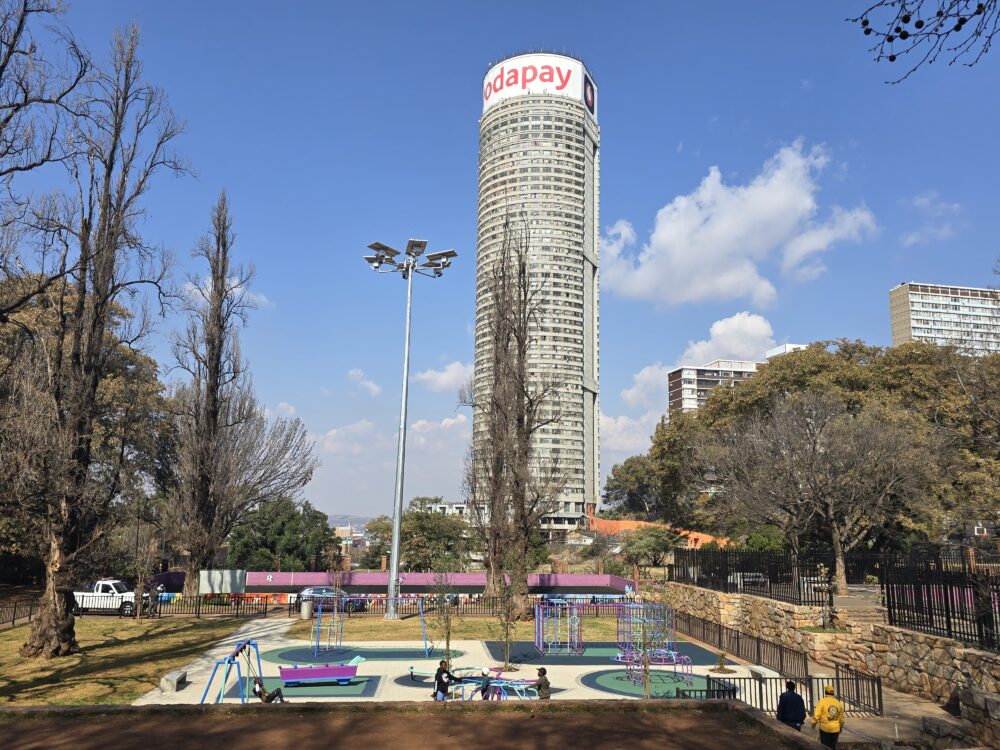
I finally took a tour of Ponte:

Ponte City’s grand opening was in 1975. Standing at 54 storeys and 173m, she was the tallest building in Africa for 48 years straight. She was beaten by a skyscraper in Egypt, measuring a mere 5m taller.
Her fall from grace to grimy led her to being declared the first vertical slum in Africa. The original occupancy rate of this building was 1 000 people. When it was declared a slum, 8 000 people lived in Ponte City without running water or electricity.
Witness accounts describe a time when the 11th and 12th floors were used to house a large brothel, along with one of the parking levels. And many can’t forget the images of garbage piled up to the 14th floor. The tower of rubbish took three years to clean. Twenty-three bodies were found inside.
Trucks could not access the area, so all the garbage was removed by a team of workers. Since 2014, the internal windows have been welded shut.
The building underwent a revamp right before the 2010 World Cup. Today it is home to more than 2 000 residents.
I have driven past and written about the building for many years and finally getting inside to see the interiors for myself was a full-circle moment for me.
When writing about Ponte, I have to be honest but I also have to be kind.
When I entered the site, my tour guide told me not to worry if I heard a loud bang because residents sometimes threw nappies and rubbish out the windows.
When we walked inside, I was pleasantly surprised by the security and biometric setup. They’ve also installed 480 cameras inside and around the building, with 24-hour security.
I signed in. On the other side of the turnstiles was a box with keys on the floor. A simple system for schoolchildren to pick up their keys and get into their homes if their parents are at work.
We then took a ride up to what was once a prized penthouse suite. Today, it’s been converted into an entertainment room with a bar for residents to use. Plenty of engagements, baby showers and after-work get-togethers are held here.
The view from the top is bittersweet. To think that back in the ’90s, you could rent the penthouse I was standing in for R800 a month. It would include: four beds, two lounges, a braai area, sauna and jacuzzi. It would also be fully furnished.
While Ponte’s story is productive, her surroundings remain in shambles. Bless Berea because she has a long way to go.
We also viewed the community centre. Teachers volunteer to support children with their homework after school. It’s a colourful classroom where children can learn.
On the ground floor, there is convenience retail for the residents. I visited the fruit and veg seller, fast food and takeaway shop, meat shop, tailor and pizza shop.
Then it was time to visit the infamous core of Ponte. Built on a slanted hill, the circular core design was essential for the terrain. Walking down the cold metal staircase to get to the eerie, dark centre, you immediately feel a veil of murk move over you. Finally, you stand on the rock in the centre of Ponte.
Suddenly, a bang.
Someone threw an entire bag of garbage into the middle of where we were standing. The tour guide assured me that someone would clean that; they clean up every day.
Remember when my tour guide told me not to worry if I hear a loud bang, since residents sometimes threw nappies and rubbish out the windows? While standing there, one of the residents on the lower levels (without sealed windows) did.
There’s only one message I can take away from that: If you can’t respect your own place of residence, what chance do we have as a society?
Standing inside the hollow core of Ponte felt strangely symbolic of what has happened to the Johannesburg CBD over the past few decades. A place that was once ambitious, modern and proud, hollowed out by neglect, mismanagement and people who stopped believing that the space belonged to them.
And yet, at the same time, Ponte refuses to die.
The building was recently put up for auction and received multiple offers. The highest non-suspensive offer received was R170 million. There were higher offers of around R250m but the building remains unsold, which means the seller probably wants more.
The tour ends where it began, in the underground parking lot. Here you find a cluster of resident cars, many of them abandoned. Some have been standing there for years. The owners left the city, left the country or never came back.
One car in particular caught my eye. It had been stripped of everything — engine gone, interior gone and windows smashed. Just a shell occupying its parking bay as if someone might return for it one day.
That image stayed with me longer than anything else I saw in the building. Because Ponte is full of shells. Shells of flats that were once luxury homes. Shells of businesses that once served a thriving neighbourhood.
Shells of systems that were supposed to protect the city but slowly stopped working.
But it is also full of people who are trying. Children who are collecting their house keys after school. Teaching volunteers are helping with homework in the community centre. Residents are hosting baby showers in what used to be a penthouse. And security guards are watching hundreds of cameras to keep order inside a building that once had none.
Ponte is not just a story about urban decay. It is a story about what happens when a city loses control and what it takes to build that control back.
The difference between a skyscraper and a slum is not height, design or money. It’s whether the people inside care what happens to it.
Walking out of Ponte that day, I couldn’t stop thinking that Johannesburg and Ponte City have something in common.
Both were once symbols of possibility and both went through years that nearly broke them.
And yet, both are standing, waiting to see whether the people inside are ready to rebuild.
Jozi My Jozi: How civic action is restoring pride in Joburg:
On most mornings, the pavements of Marshalltown fill gradually. Office workers slip between heritage buildings, students move in lively clusters and pedestrians hurry along their commutes.
Coffee shops hum. Security guards stand posted on corners, ready to offer directions to a lost soul.
It is here, in a part of the inner city that still carries a quiet dignity, where Innocent Mabusela, the chief executive of Jozi My Jozi, works and thinks daily about how to stitch Johannesburg back together.
When he first walked into a meeting about Jozi My Jozi, he thought he was signing up for modest volunteer work. He imagined clean-ups and small-scale charity projects, the kind of civic contribution that fits neatly into a few spare days each month.
What he encountered instead was something more ambitious, a platform attempting to mobilise business, civil society and residents around a shared idea of restoring pride in the city.
“I came in thinking Jozi My Jozi was just a small organisation doing charitable work in the inner city,” he said. “Clean-ups, working with NGOs such as MES and Child Welfare. Then I realised it was more than that.”
Mabusela was raised in Orlando West, Soweto and remembers weekend trips into town as a teenager. The Kine Centre cinemas opposite the Carlton Centre formed part of that ritual, a reminder that the city centre once felt expansive and full
of possibility.
Later, during his time at Anglo American working on economic development initiatives for Kimberley in the Northern Cape, a meeting with Jozi My Jozi’s leadership shifted his trajectory.
The conversation moved beyond charity to coordination, beyond isolated acts to systemic collaboration. “As a person who grew up within the city and seeing how it is, I really want to play a role,” he said. “We can’t just leave.”
After leaving the mining industry in 2024, he offered three days a week to the organisation. The intention was to balance civic engagement with a slower personal rhythm.
That plan did not last long. Three days became five. The volunteer became CEO.
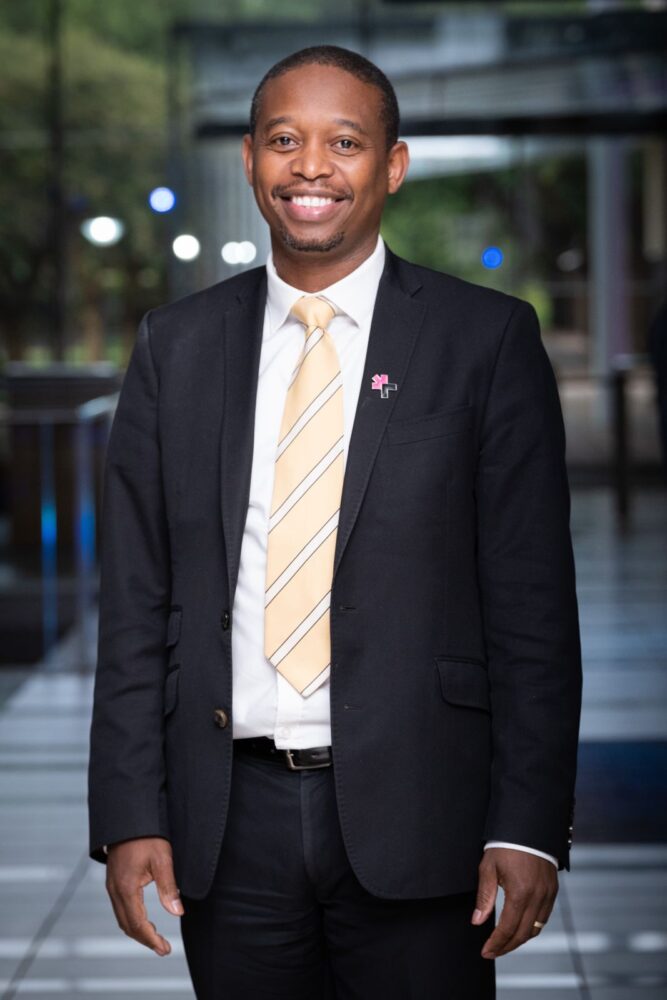
“I thought I’d have time to learn golf,” he said, smiling. “That didn’t happen.”
Today, Jozi My Jozi counts about 140 partners across corporates, civil society and education institutions. It operates in the space between municipal constraint and public frustration, convening stakeholders, aligning funding and coordinating visible projects.
At the centre of its philosophy is what Mabusela calls “story doing”. In a city long accustomed to plans and pronouncements, he argues that credibility must be earned through visible action.
“Rather than going out there and telling people what you are going to do and making promises, focus should be on how you actually do,” he said. “That translates into a story people can see from your actions.”
The organisation’s mission is framed simply: inspire hope and restore pride. That ambition plays out through targeted interventions. The rehabilitation of the Nelson Mandela Bridge was positioned as a signal – a beacon of hope and pride – at one of 13 identified gateways into the inner city.
Solar street lights are being rolled out in priority corridors. Integrated emergency response centres are in development to coordinate police, private security and emergency services more effectively.
“It’s not only about CCTV cameras, response is also critical,” Mabusela said.
This is also an election year. Campaign posters will soon multiply across the city. Political rhetoric thickens the air with promises of revival and renewal. Some of it sounds persuasive.
Some of it sounds like bull jive. Against that noise, Jozi My Jozi presents itself as deliberately practical, less interested in slogans than in pavements.
Through its Babize Bonke campaign, the organisation profiles inner city champions in the arts, social development and business. The focus is on individuals who continue
building despite deteriorating infrastructure and economic pressure. Mass participation events, from races to civic activations, draw thousands into the central business district, reframing the area as a site of possibility rather than abandonment.
“After these events, people contact us and say, how can I help? That shows people want to do good,” he said.
Mabusela is realistic about the scale of the challenge. Behavioural change around littering and maintenance requires repetition.
University chapters at the University of the Witwatersrand and the University of Johannesburg — and soon at Maharishi Invincibility Institute — encourage students to engage in civic projects early.
Smaller initiatives help informal playgroups formalise as registered early childhood development centres, while digital hubs focused on coding and robotics introduce young people to new skills pathways.
“We shouldn’t think that by speaking to people once, we can change their thinking,” Mabusela added. “We need to continue storytelling. We need to continue implementing projects. Gradually, that will help us drive change.”
Plans are under way to replicate aspects of the model in other metros and cities through a national vehicle referred to as Newco, with Bea Swanepoel moving into the role of its CEO.
But for now, Mabusela’s focus remains on Johannesburg, strengthening governance structures and embedding systems that can outlast individual personalities.
“One of the greatest things for me is seeing the appreciation from our beneficiaries, when you can see your work materialise,” he said. “We are trying to develop a movement of the people, by the people, doing work on the ground.”
In a city often narrated through its crises, Jozi My Jozi is advancing a steadier argument.
Change, it suggests, is cumulative.
It is built in partnerships, in maintained bridges, in corridors that feel safer than they did before. It might not shout as loudly as campaign speeches but it is visible to anyone paying attention.
Justice cannot be optional: Why access to justice for women and girls is the foundation of equality:
At the 70th session of the Commission on the Status of Women (CSW70), South Africa joined the global call to make access to justice a lived reality for all women and girls — not a distant promise captured in declarations.
Justice is not abstract. It is the difference between safety and fear; between economic inclusion and generational poverty; and between constitutional guarantees and the daily reality of discrimination. Around the world, women continue to face structural barriers in accessing justice systems that are often expensive, complex, slow and, at times, retraumatising. For poor and rural women, women with disabilities, migrant women and survivors of violence, these barriers are compounded.
South Africa speaks from lived experience.
Our constitutional democracy, grounded in the values of equality and human dignity, has made significant progress in reforming discriminatory laws. Yet we also confront harsh realities — high levels of gender-based violence and femicide, economic exclusion and unequal access to resources. Legal reform alone is insufficient without effective implementation and survivor-centred institutions.
At CSW70, we have called for three urgent global priorities.
First, inclusive and equitable legal systems.
Justice systems must be accessible, gender-responsive and people-centred. This means strengthening legal aid, expanding survivor-friendly courts, investing in forensic capacity, ensuring disability access and providing language services so that no woman is silenced by procedure.
Second, the elimination of discriminatory laws and practices.
Across many jurisdictions, outdated statutory and customary frameworks still undermine women’s rights — particularly in inheritance, land ownership, nationality and family law. Reform must be deliberate and monitored. Equality must be enforceable.
Third, dismantling structural barriers.
Justice cannot be separated from economic power. A woman without income, transport, digital access or childcare cannot easily pursue her rights. Gender-responsive budgeting, social protection and economic empowerment are not secondary interventions — they are justice interventions.
The global community adopted the sustainable development goals through the United Nations, recognising that goal 5 (gender equality) and goal 16 (peace, justice and strong institutions) are inseparable. Without justice, equality is hollow. Without equality, justice is incomplete.
South Africa’s message at CSW70 is clear: access to justice is a prerequisite for sustainable development, peace and inclusive growth.
We call for stronger accountability mechanisms, measurable targets and investment in justice infrastructure. We call for partnerships between governments, civil society, the judiciary and the private sector. And we call for centering the voices of women themselves when designing solutions.
Justice must not depend on geography, income or social status. It must not depend on whether a woman lives in an urban centre or a rural village. It must not depend on whether she can afford legal representation. The test of our democracies is simple: when a woman’s rights are violated, can she obtain redress swiftly, safely and fairly?
At CSW70, South Africa affirms that the answer must be yes — for every woman and every girl.
Cassius Selala is the director of communication at the Department of Women, Youth and Persons with Disabilities.
Submit and get free exposure here: Showcase Your Business | Advertise Your Special Offers.