
IEC: More than 560 000 people register as first-time voters:

A total of 568 374 first-time voters registered for next year’s national and provincial election when the Electoral Commission of South Africa (IEC) launched its first registration drive over the past weekend.
Speaking during a media briefing on Monday, IEC chairperson Sy Mamabolo said the commission interacted with 2.9 million voters, with 2.7 million voters physically visiting voting stations to register or to update their details. A total of 196 511 voters used the online portal to do the same.
Eligible citizens lodged their details at 23 296 stations across the country.
Mamabolo said the newly registered voters account for 19.57% of total registration activity, with 445 089 (78.31% ) of the 568 374 new voters aged 16 to 29 years.
The IEC has in the past raised concern over poor registration turnout of the younger voters. Political parties have also taken on the task of improving the young voter demographic.
About 63.3% of South Africa’s population are people in the 15 to 34 age category, Statistic South Africa noted in 2020.
“The commission’s continued focus on young persons is producing a good yield. The commission will persist with efforts to improve the registration levels of the youth,” Mamabolo said.
He added that 1.4 million voters re-registered in the same voting district, and those who re-registered in a different voting district numbered 929 564.
The update comes after the IEC on Saturday said it had broken its previous record for its highest registration activity on a single day, with more than 26 000 voters registering for next year’s general elections.
On Monday, Mamabolo said the voters’ roll now stands at 26.8 million voters, an increase from 26.3 million before the registration weekend.
“Gauteng continues to be inhabited by the majority of the country’s population, as well as being the largest voting block at 6.2 million registered voters.”
He said that Gauteng, KwaZulu-Natal and the Eastern Cape recorded the most registrations, with Gauteng at 610 948 , KwaZulu-Natal at 559 933 and Eastern Cape at 516 547.
Political parties have zeroed in on Gauteng and KwaZulu-Natal, with the governing ANC predicted to take a knock in its numbers in the two most populous provinces.
Mamabolo said: “The well-entrenched trend of there being more females on the voters’ roll continues. Of the new registrations, 298 500, or 52.52%, were female.”
He added that since its inception in July 2021, the online registration portal has proven to be a success.
Mamabolo attributed the IEC’s success in this registration to the innovation and efficiencies introduced by the Voter Management Device (VMD) which has
increased the speed at which voter registration applications are processed.
“With the VMD, particulars of voters who attended voting stations over the weekend have now been processed and address details captured onto the voter’s roll.
“Before the introduction of the VMD, it would have taken months to capture address details of voters following a registration event,” he said.
He added that the VMD processed 834 474 live transactions, while 1 872 352 transactions were captured and later processed. “This is a testament to the soundness of providing a mode that enables the VMD to operate in varied connectivity environments.”
The IEC is waiting for President Cyril Ramaphosa to announce the election date, which is expected to take place some time from May to August next year.
The National Assembly and the nine provincial legislatures’ terms of office would conclude in the middle of May 2024. The seventh parliament of the democratic era must be elected within 90 days of that date, he said.
During his visit to voting stations on Saturday, Ramaphosa said he would meet all the stakeholders, including the IEC, to decide on the date.
The post IEC: More than 560 000 people register as first-time voters appeared first on The Mail & Guardian.
EFF MPs walk out of parliament’s disciplinary hearing citing an unfair process:

Six members of the Economic Freedom Fighters (EFF) charged with contempt of parliament laws for their actions during President Cyril Ramaphosa’s State of the Nation address in February will be taking their fight for fair disciplinary procedures to the Western Cape high court.
This comes after the MPs staged a walkout from a disciplinary hearing on Monday condemning it as a “kangaroo court”, after the committee declined their request for a postponement to finalise their defence.
The EFF senior leaders who have been hauled in for disciplinary action include its president Julius Malema, his deputy Floyd Shivambu, secretary general Marshall Dlamini, spokesperson Sinawo Tambo and former spokespersons Vuyani Pambo and Mbuyiseni Ndlozi.
Malema said the EFF would not be subjected to the ruling which he said was unfair towards them.
“It’s a problem, this thing; that you hire minorities when you are targeting Africans. You did that with the public protector [Busisiwe Mkhwebane], now you bring a white man here,” he said.
Malema’s reference to a white man was to the initiator prosecutor, Anton Katz.
“You brought this white man to come and prosecute us and you know that every white man will come for the blood of the EFF.
“I don’t care if my legal counsel says he has respect for him — I don’t have any respect for him; he is a DA [Democratic Alliance] lawyer. No white man will persecute the EFF in this kangaroo court, because its outcome has been determined before by the DA and yourself,” Malema said.
The EFF recused its legal team and they left the meeting. The proceedings continued in their absence.
The hearing, which is meant to establish whether the MPs breached the Powers, Privileges and Immunities of Parliament and Provincial Legislatures Act, started in parliament on Monday and is set to continue until Wednesday.
During the State of the Nation address in February, EFF MPs raised several points of order, which led National Assembly speaker Nosiviwe Mapisa-Nqakula to ask that they be removed from the chamber.
As the MPs walked out, some of them stormed onto the stage where Ramaphosa was sitting.
EFF legal representative Tembeka Ngcukaitobi filed for a month-long postponement of the disciplinary proceedings to enable parliament to find an independent judge to preside over the matter, arguing bias against the EFF.
Ngcukaitobi said it was procedurally unfair for the ANC to lay the charges against EFF MPs and be witnesses to the case.
“The problem with this committee is that 61% of members are from the ANC. You are sitting in judgment of your political opponents — the EFF. The ANC, therefore, holds enormous power over their political opponents,” he said.
Ngcukaitobi questioned why parliament had taken 10 months to prosecute the members, arguing that it had not given them enough time to prepare themselves.
“There was undue delay by parliament to lay the charge, therefore, there should be no rush to prosecute the matter and the EFF members should be given enough time to consult and prepare their defence,” he said.
He argued that the case needed time to issue subpoenas to the speaker of parliament and Ramaphosa to confirm that a threat of intimidation could be added to the case because it is a “subjective charge”.
“Should Ramaphosa say he did not feel threatened that day, then the charges fall away, but we need time to do that, because we don’t want to place the committee in a position where they have to subpoena their leaders,” Ngcukaitobi said.
But Katz said that according to rule 155 of parliamentary law, the committee has been capacitated to act and decide on what disciplinary action should be taken.
He said the postponement should have been filed on time and not two days before the hearing.
He added that the committee should make its final recommendation, table it in the house, and then let whoever deems it appropriate challenge the validity.
“That is how these things are done,” Katz said. “If the accused are not happy with the verdict of the committee, then they can go to the high court.”
The committee is also investigating other incidents involving the EFF, which will be heard on 4 December in the high court.
Ngcukaitobi said the six accused members will also be joining next month’s hearing.
Malema said that whatever decision the committee took, the EFF would remain in parliament.
The post EFF MPs walk out of parliament’s disciplinary hearing citing an unfair process appeared first on The Mail & Guardian.
Meyiwa trial: Accused was on the verge of confessing, says state witness:
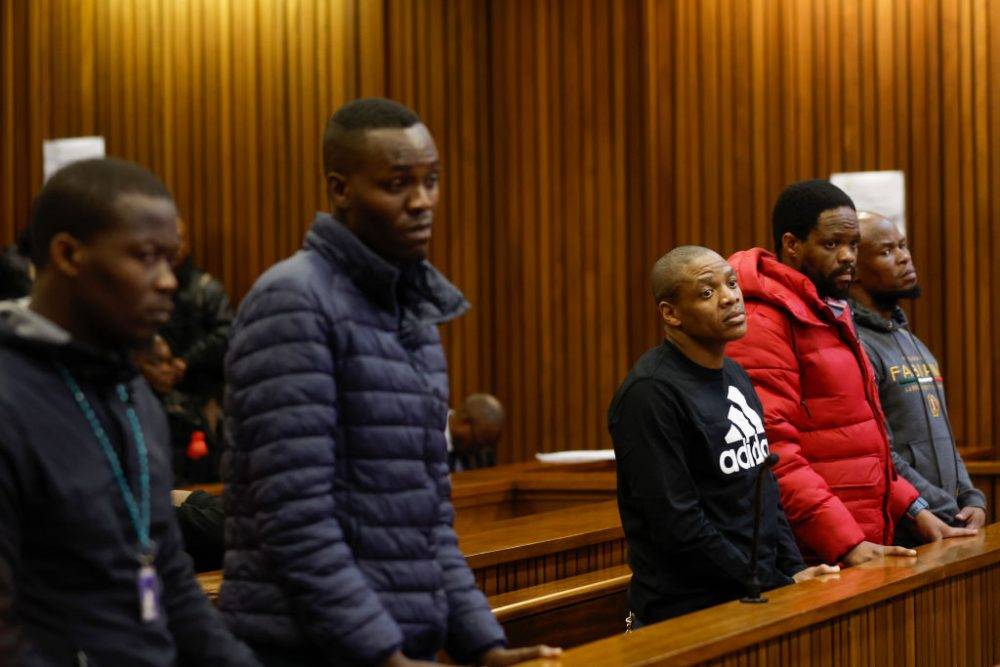
Police officer Batho Mogola, the latest state witness in the Senzo Meyiwa murder trial, said on Monday accused number one, Muzikawukhulelwa Sibiya, in 2020, came close to confessing to his involvement in the Bafana Bafana captain’s 2014 murder before she stopped him and read him his rights.
Mogola told the Pretoria high court that she had served the South African Police Service for about 18 years as a sergeant and was attached to the Cold Case investigation unit under Brigadier Bongani Gininda.
She said Sibiya had complained that, during his arrest, a Constable Sadiki — whose first name was not revealed in court — and Constable Jabulani Buthelezi had made him lie down. She said the suspect was anxious not to get the expensive pair of trousers he was wearing dirty, and did not want to be taken to jail in the pants because he feared other inmates would take them from him.
During his own testimony earlier this month, Buthelezi had told the court that he and Sadiki used authoritative language, or a “tactical takedown”, in their interaction with Sibiya to confuse him during his arrest.
Buthelezi said Sibiya did not show resistance when asked to lie down and that the officers had agreed to his request to be taken home to change. But Sibiya’s lawyer, advocate Thulani Mngomezulu, said his client had told him that he was made to change his trousers because he had been assaulted and tortured until he “messed” himself. Buthelezi denied this.
On Monday, Mogola said on arrival at Sibiya’s place of residence to change his pants and look for his identity document, the officers found nine rounds of live ammunition, a magazine, as well as the cleaning rod, all of which were in a black plastic bag.
“I asked him who the things belonged to and he confirmed they were his. I then asked him about the gun because, with the magazine and a cleaning rod, I could tell there was a gun involved. He then said the gun was at his friend’s place at the Vusumuzi hostel,” Mogola said.
She had asked Buthelezi and Sadiki to give her and Sibiya a moment alone, during which she read the suspect his rights and told him that she was going to question him about other cases.
“I then asked him if he was involved in the murder of Senzo Meyiwa. When he responded to the question, I could see that he was making admissions. I reminded him of his constitutional rights,” Mogola said.
She had asked Sibiya about other cases, not related to the Meyiwa murder, and asked him if he was comfortable communicating what he was telling her to her boss, Gininda. Sibiya responded that he did not have a problem with that.
Mogola said Gininda suggested that they meet at the Vosloorus police station because he wanted to question Sibiya himself.
“We then drove to the Vosloorus police station,” she told the court.
Sibiya is among the five men accused over Meyiwa’s murder at the home of his girlfriend, Kelly Khumalo, in Vosloorus, Gauteng. All have pleaded not guilty to charges of premeditated murder, attempted murder, armed robbery, illegal possession of a firearm and the illegal possession of ammunition.
The post Meyiwa trial: Accused was on the verge of confessing, says state witness appeared first on The Mail & Guardian.
Submit and get free exposure here: Showcase Your Business | Advertise Your Special Offers.
