
Income strain weighs on financial sector:
GDP data released by Statistics South Africa last week signalled the potential depth of the economic crunch that lies ahead this year, a year that is expected to endure the lowest growth since 2020’s pandemic-induced downturn.
Like the fourth quarter of last year, which saw the economy shrink by 1.3%, load-shedding will continue to weigh down growth, hampering any prospect of bringing down the country’s ultra-high unemployment rate.
Meanwhile, consumers have been left reeling from elevated inflation and higher interest rates.
One interesting characteristic of the GDP data was the revelation that financial services — the country’s largest economic sector — endured its deepest contraction since the second quarter of 2020. The sector, which shrunk 2.3%, was also the biggest drag on growth in the fourth quarter of last year, mainly on the back of lower economic activity in financial intermediation, pension funding and insurance.
Points of weakness in the sector expose the extent of the strain on businesses and consumers amid recent recessionary headwinds, which threaten to claw at the incomes of its strained clientele.
This week, Old Mutual became the latest insurer to flag the effects of a prolonged period of meagre growth and elevated inflation on its business.
Old Mutual’s headline earnings rose 10% to R7.9 billion for the year ended December 2022, according to the group’s financial results, released on Tuesday. But chief executive Iain Williamson pointed to tough economic conditions bearing down on its customers and the industry’s potential to grow.
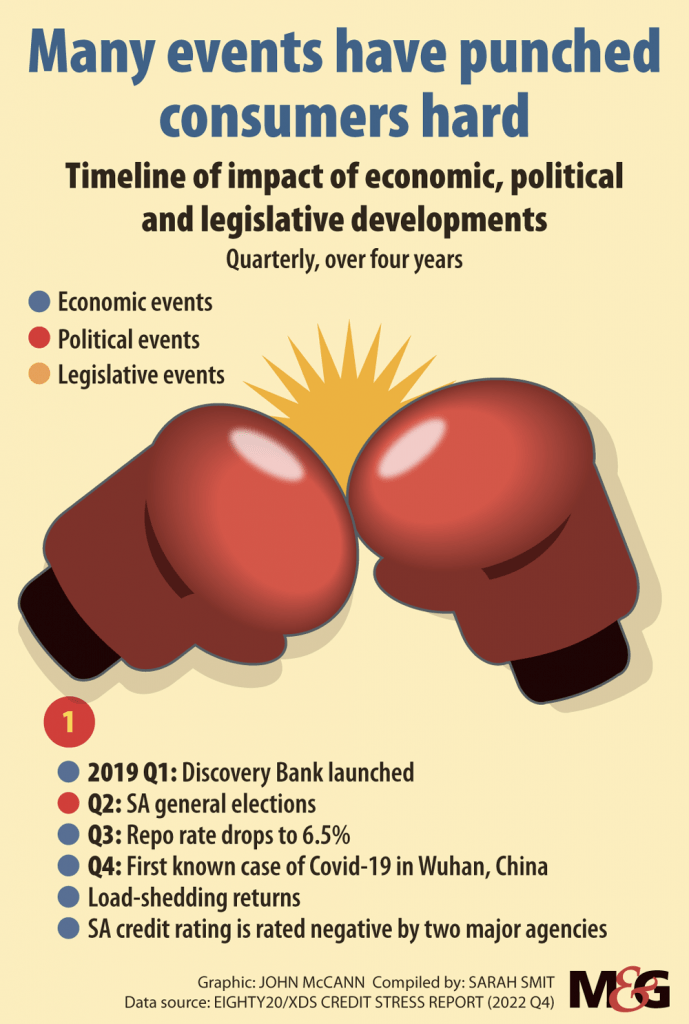
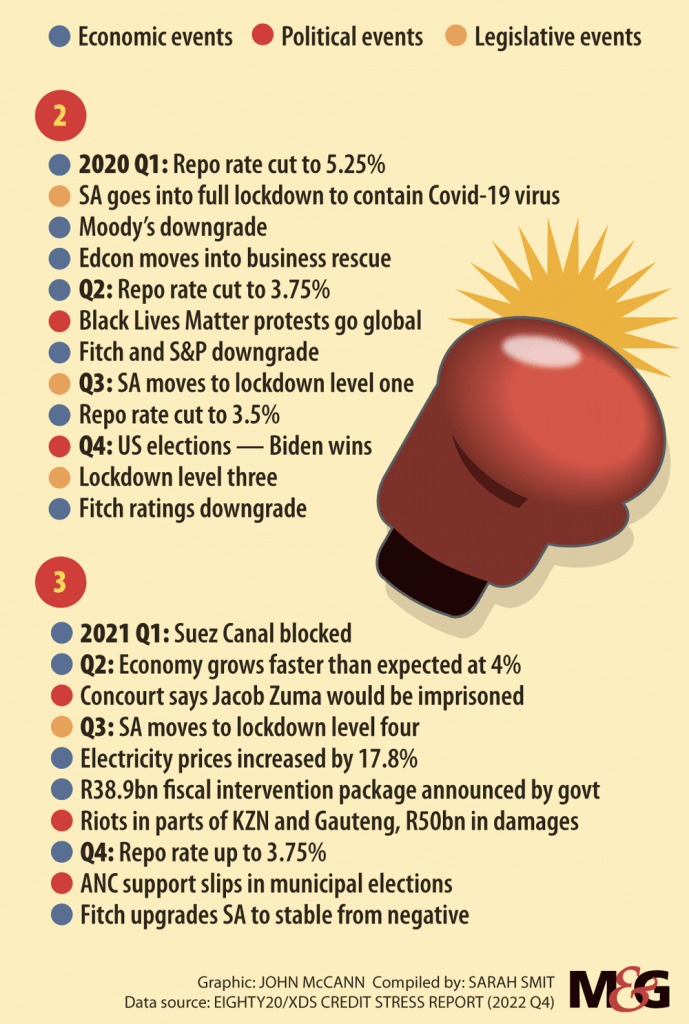
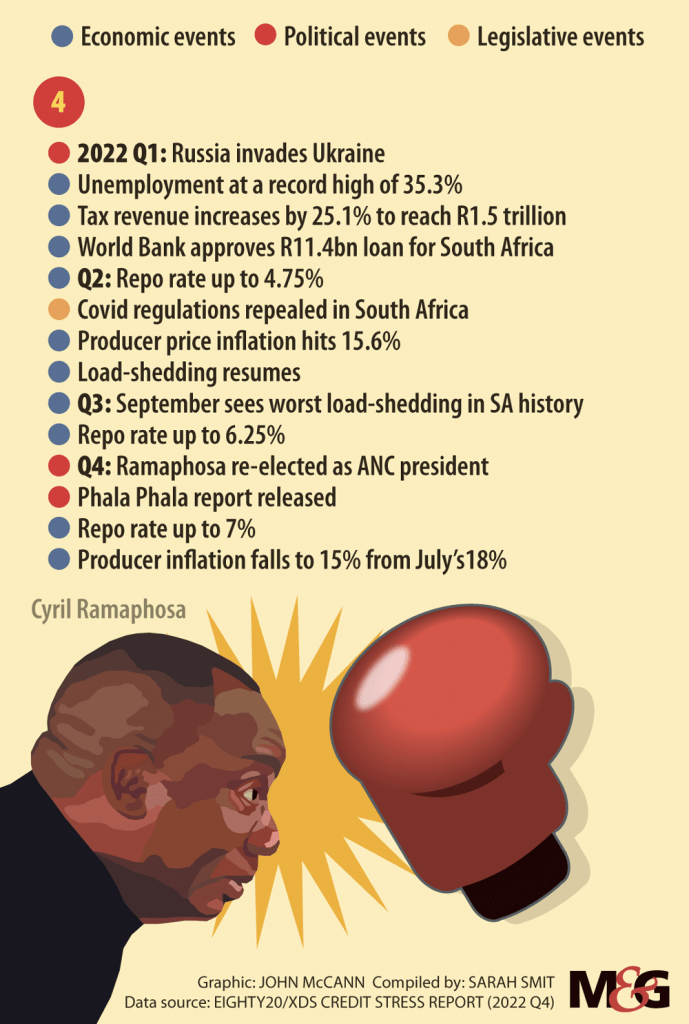
He outlined the many knocks the economy has endured since the Covid-19 pandemic hit, including the 2021 civil unrest, last year’s devastating floods in KwaZulu-Natal, elevated inflation, higher interest rates and severe load-shedding. These factors, including slow job recovery, have negatively affected real income growth, he noted.
“This downward pressure on disposable income growth, combined with depressed confidence, made it difficult for customers to maintain or increase their contributions to protection, savings and investment products.
“Our corporate customers’ growth and liquidity levels were also negatively impacted,” Williamson said.
Old Mutual’s personal finance and wealth management segment was seemingly worst affected, seeing the value of its new business plummet 47% last year compared to 2021.
“The continued effect of the macro-economic environment on our customers’ ability to maintain or increase protection, savings and investment products will remain a challenge in 2023,” Old Mutual’s results note. “We will continue to drive sales activity and the right mix in personal finance to accelerate market share growth.
“However, there is considerable uncertainty over whether the overall industry market will grow in the current economic environment.”
This statement by Old Mutual comes a week after Momentum Metropolitan’s interim results, which contained similar concerns about its ability to expand amid heavy economic headwinds.
The insurer reported a 46% jump in normalised headline earnings to R2.2 billion for the six months ended 31 December 2022 and its profit doubled to R1.9 billion during the period.
But the group’s growth was impaired by weakness in its investments and non-life-insurance businesses. Momentum Investments, according to the results, reported lower operating earnings, mainly because of reduced revenue on its Momentum Wealth platform, driven by lower new business volumes and weak market performance.
The group further reported the present value of new business premiums decreased to R33.3 billion, 10% lower than the prior period. Momentum Investments saw a 17% decline in its present value of new business premiums amid lower new business volumes on both its local and international wealth platforms.
“As a general trend, tough economic conditions seem to be impacting sales volumes negatively,” the results noted.
Recent pressure on sales volumes is a concern, the company added.
“Disposable income remains under pressure due to rising interest rates and high inflation, as well as the lack of economic growth in South Africa. This is likely to put ongoing affordability pressure on new business volumes, particularly on long-term savings and on protection business.”
Momentum Metropolitan chief executive Hillie Meyer signalled this crunch in the group’s integrated results last year, saying: “I am concerned about the socio-political situation facing the country and it will become increasingly difficult to further grow revenue in the absence of meaningful economic growth.”
It is difficult to reconcile the fourth quarter GDP numbers with the generally strong financial results reported by companies in the financial services sector, noted Patrice Rassou, chief investment officer at Ashburton Investments.
“So they are still growing … But where we see some strain is in the lower end of the market, the mass market. There are some signs of strain emerging, that’s quite clear. If you look at the insurers, the corporate sector has recovered and the upper end has recovered, which you can see in Discovery’s numbers,” Rassou said.
Discovery, which caters to the upper end of the market, reported a 15% jump in new business in the six months to 31 December.
“So, it is not uniform. You have to look at the segments to see what is really going on.”
The headwinds in the insurance industry are complex and include ongoing volatility in the investment market on the back of Russia’s war in Ukraine, said Nishen Bikhani, a partner at KPMG South Africa. Moreover, surging inflation and high energy prices have had a negative effect on already strained consumers.
Bikhani said there is a huge gap in South Africa between those who can afford protection insurance and those who cannot.
Recent data has shown the extent of the pressure on consumers amid tighter financial conditions. The so-called mass segment, according to Eighty20’s credit stress report for the fourth quarter of last year, saw their credit card balance balloon by R2.5 billion last year — indicating increasing reliance on credit for everyday purchases.
This segment’s average loan instalments took up more than a third of monthly incomes.
The middle class also faces increased pressure. The segment’s total average loan instalment-to-income ratio has increased by 7.4% over the last year and is now at 69.4%. This means more than two-thirds of the average middle-class salary goes to servicing debt, the data analytics firm noted.
KPMG’s Insurance CEO Outlook highlighted that insurers are actively strategising to respond to the pressures faced by consumers, according to Bikhani.
“Insurance CEOs are readying themselves and their organisations to weather the current economic and geopolitical challenges while exploring how they can mitigate recessionary impacts,” he said. For this reason, Bikhani believes that insurer performance will rally, although it could continue to see a hit in the short to medium term.
In November, the South African Reserve Bank flagged slow and inequitable economic growth as a risk to financial stability, noting that unemployment and low income dampen the demand for financial services, credit and access to finance.
Limited progress on implementing structural reforms leaves the economy vulnerable to an extended period of weak, inequitable growth, the Reserve Bank’s financial stability review noted.
In January, the Reserve Bank delivered a grim view of the country’s growth trajectory, forecasting growth of just 0.3% this year. Though the treasury’s forecast was slightly better, it still only forecasts 0.9% growth this year.
Inequitable growth also raises “the risk of populist policies and social instability, which in turn may have a negative impact on investor confidence, funding costs, insurance claims and operational costs”, the Reserve Bank said.
Police are ‘unprepared’ to stem violence linked to planned protests:
More corruption allegations have emerged within the police’s crime intelligence unit, amid claims the division is “unprepared” to prevent possible violence at the protests and strikes set to begin on Friday, leading into a national stayaway called by the EFF on Monday.
National spokesperson Brigadier Athlenda Mathe this week said police would not publicly “discuss operational plans” but that officers had been told to use “minimum force” to handle the action.
Several sources with knowledge of the police’s crime intelligence unit said infighting related to the mismanagement of the division’s resources, including the R54 million spyware corruption case that is before court, had preoccupied the unit so much it had not gathered information about possible instigators of the protests.
Brigadier Tiyani Hlungwani, the head of finance responsible for the contentious secret services account, accused crime intelligence head Lieutenant General Dumisani Khumalo of being part of a “cover-up” in the criminal case involving an alleged associate of Police Minister Bheki Cele, Inbanathan Kistiah.
The secret services account is used to, among other functions, pay and house police informants.
In his statement dated 3 March, Hlungwani claimed Khumalo was “persecuting him” for providing evidence against Kistiah, who faces fraud and corruption charges related to a R54.2 million December 2016 contract to provide spyware to monitor protesting students.
Former national commissioner Khomotso Phahlane; Lieutenant Colonel Godfrey Mahwayi, the suspended commander of crime intelligence’s IT section; Major General Maanda Nemutanzhela, who headed covert intelligence; and Major General Mankosana Makhele, Free State’s head of crime intelligence, have been charged alongside Kistiah.
“The reason why Lieutenant General Khumalo is pursuing me is that I have opened a number of criminal cases against [former crime intelligence head] Peter Jacobs, Mr Inban Kistiah and a number of other senior officers, and I have made a number of protected disclosures against Lieutenant General Jacobs that has an impact on Minister Hamilton Cele,” Hlubwani stated, in a document that has been seen by the Mail & Guardian.
At the time of going to print, the police ministry had not responded to questions about Cele’s alleged involvement with Khumalo in what Hlungwani claims to be a cover-up of corruption.
A well-placed source, who asked to remain anonymous, told the M&G this week infighting within crime intelligence has seen the division “not interact with its assets (informants) to get information about possible instigators of violence”.
This is more so, the source added, because the Economic Freedom Fighters (EFF) had not publicly announced what form its protest on Monday, which calls for the total shutdown of economic and social services across the country, will take.
“Crime intelligence does not even know where the EFF people will meet. It’s unusual because when there is a strike, we know where people will be picked up, and what the final destination is,” the source said.
“The constant fighting about corruption has definitely affected operational work and we’ll be reactive to any violence because of a lack of credible information.”
Mathe, speaking on behalf of national commissioner Fannie Masemola, said the police’s operational structure in charge of large gatherings, known as Natjoints, was aware of a “planned protest” on Monday and not a “national shutdown”.
“We assure all people in South Africa that we have measures in place to ensure the safety and security of everyone amid the planned protest. We do not discuss operational plans and decisions in the public domain,” Mathe said.
“Law enforcement agencies will execute their duties within the confines of the law. All law enforcement agencies will apply the minimum force that is reasonable and necessary, depending on the circumstances on the ground.”
In February last year, a report commissioned by President Cyril Ramaphosa into the July 2021 unrest found the country’s intelligence services were unprepared to preempt or prevent the unrest, which led to more than 340 deaths.
“The fact that none of the organisers or real instigators of the violence have been apprehended is a matter of concern. If there is such intelligence that has been shared by the intelligence services, the president should address any systemic weaknesses that may have caused such intelligence to escape his review,” reads the report.
Meanwhile, Hlungwani confirmed in his statement that he was a “witness” in the R54 million spyware case, which was investigated by the Independent Police Investigative Directorate.
In evidence before court, Brainwave, a company of which Kistiah is a director, received a more than R1.1 million monthly contract in December 2016 to supply spyware to monitor students protesting under the #FeesMustFall banner. The students were to be spied on for seven months.
A document dated August 2021 shows Brainwave ended up pocketing more than R54.2 million from just seven invoices, the lowest of which was for more than R3.6 million and the highest for more than R8.4 million.
The spy equipment would have been used “to monitor the social media activities” of students.
Toyota Gazoo GR Cup Race Series makes a splash:
Round one of the Toyota Gazoo Racing Cup at Zwartkops Raceway couldn’t have gone any better for team Association of South African Motoring Media.
The build-up to the race weekend was packed with introductions to the Toyota Gazoo Racing South Africa team, Fast Developments, who prepped the GR86s we’d be racing, and my fellow motoring scribes with whom I’d hopefully not be swapping paint work in the 2023 season.
The Citizen’s Mark Jones and BMW Car Club racer returns as a veteran of the 2022 season, Denis Droppa of TimesLive, Brendon Staniforth from Maroela Media, AutoTrader’s Chad Lückoff with a background in drifting, and freelance writer Reuben van Niekerk, representing Jumping Kids initiative, were selected to battle for the title of Fastest Motoring Journalist of 2023.
The new Toyota GR86 Automatic was selected to be campaigned by the motoring media while last year’s GR Yaris race cars, which Mail & Guardian motoring editor Lerato Matebese raced, were handed down to Toyota Karting Academy’s young graduates. Our GR 86 cars have been fitted with Dunlop Direzza 03G semi-slicks, Powerbrake four-piston big brakes up front, straight-through exhaust and a partially stripped interior where a roll cage has been bolted in. Both standard seats have been swapped for snug OMP racing bucket seats.
Pre-season testing and familiarisation with the car took place on the Monday before the race weekend, where my aim for the day was to overlay my simulated racing experience with the real world.
My lap times in Friday’s official race practice sessions suggested that the connection clicked and I found myself with the second quickest times behind Thomas Falkiner, who filled in for Droppa in this race. The heavens opened and turned the circuit into a skating rink, but the GR86’s relatively light weight, low centre of gravity and rear-wheel drive balance made for a communicative, intuitive and predictable racing platform.
Ominous clouds hovered over Zwartkops on Saturday but they didn’t unload any rain. I’d bettered my best practice lap time by a seven tenths to 01:14.6, only 0.4 seconds off of the previous day’s purple lap.
I made one more attempt to improve on that time but ended up overdriving the car. The timing sheets showed Falkiner had shaved another three tenths off of his practice time with a pole lap of 01:13.9, placing me 0.7 seconds behind and second on the starting grid.
An agonising wait for the first race to begin only worsened the nerves.
Falkiner began his charge into the distance. Staniforth filled my mirrors for a good three laps and forced an error that saw me brake too late and touch the gravel at the fifth turn. I closed the door into the turn six right-hander before Staniforth got any ideas. He made an error heading into the final corner. This eased off the pressure and I sailed on to a second place finish.
The second race met me with a much clearer head and a lot more confidence. I spent most of the lap watching a battle raging between Jones and Staniforth in my mirrors. I crossed the finish line, solidifying my double second place podium finish.
It was a fantastic outing. I will be flying high the Association of South African Motoring Media’s flag in round two of the GR Cup at Killarney Raceway in Cape Town this weekend.
Submit and get free exposure here: Showcase Your Business | Advertise Your Special Offers.
