Iran media says President Raisi died in helicopter crash:
Iranian state media said President Ebrahim Raisi died on Monday after his helicopter crashed in a mountainous region of the country.
The government has not yet issued a confirmation of the leader’s death.
Rescue teams had been scouring the area since Sunday afternoon after a helicopter carrying Raisi, the foreign minister and other officials had gone missing.
Early on Monday, relief workers located the missing helicopter, with state TV saying the president had died.
“The servant of Iranian nation, Ayatollah Ebrahim Raisi has achieved the highest level of martyrdom whilst serving the people,” state television said on Monday, with Mehr news agency also saying he was dead.
State television broadcast photos of Raisi, with the voice of a man reciting the Koran playing in the background.
Iran’s vice president for executive affairs Mohsen Mansouri posted on X a Koranic verse used to express condolences.
Ultraconservative
Fears had been growing for the 63-year-old ultraconservative after contact was lost with the helicopter carrying him as well as Foreign Minister Hossein Amir-Abdollahian and others in East Azerbaijan province on Sunday.
A total of nine people were on board the aircraft, according to Tasnim news agency.
Iran’s Red Crescent chief Pirhossein Koolivand said rescue teams headed towards the site of the crash after locating the aircraft.
“The helicopter has been found. Now, we are moving toward the helicopter,” said Koolivand. “We are seeing the helicopter. The situation is not good.”
“Upon finding the helicopter, there was no sign of the helicopter passengers being alive as of yet,” state TV reported about 15 hours after the aircraft went missing.
Iranian media including Fars news agency shared drone images of what appeared to be the wreckage of the helicopter.
State TV first reported on Sunday afternoon that “an accident happened to the helicopter carrying the president” in the Jolfa region of East Azerbaijan province.
Interior Minister Ahmad Vahidi said the helicopter “made a hard landing” in bad weather.
He urged people to get their information “only from state television”, and not listen to foreign media channels Iran deems hostile to the Islamic republic.
Raisi’s convoy had included three helicopters, and the other two had “reached their destination safely”, said the Tasnim news agency.
Supreme leader Ayatollah Ali Khamenei urged Iranians to “not worry” about the leadership of the Islamic republic, saying “there will be no disruption in the country’s work”.
Expressions of concern and offers of help came from abroad, including Iraq, Kuwait, Qatar, Saudi Arabia, Syria, Russia, China and Turkey, as well as from the European Union which activated its rapid response mapping service to aid in the search effort.
Massive search effort
Iran’s cabinet held an emergency meeting led by Vice President Mohammad Mokhber after the incident, the IRNA news agency reported.
Army, Revolutionary Guard and police officers were involved in the search, authorities said, as TV stations showed pictures of Red Crescent teams walking up a hill in the mist, while rows of emergency response vehicles waited.
Raisi had visited the northwestern province to inaugurate a dam project together with Azerbaijan’s President Ilham Aliyev, on their common border.
Aliyev said in a post on X that “we were profoundly troubled by the news of a helicopter carrying the top delegation crash-landing in Iran”.
Foreign countries were closely following the search at a time of high regional tensions over the Gaza war between Israel and Hamas since October 7 that has drawn in other armed groups in the Middle East.
A US State Department spokesman said: “We are closely following reports of a possible hard landing of a helicopter in Iran carrying the Iranian president and foreign minister”, adding that “we have no further comment at this time”.
US President Joe Biden has been briefed on the crash, an American official said on condition of anonymity.
‘Servant of the people’
Raisi has been president since 2021 when he succeeded the moderate Hassan Rouhani, at a time when the economy was battered by US sanctions over Iran’s contested nuclear programme.
Iran saw a wave of protests triggered by the death in custody of Iranian-Kurdish woman Mahsa Amini in September 2022 after her arrest for allegedly flouting dress rules for women.
In March 2023, regional rivals Iran and Saudi Arabia signed a surprise deal that restored diplomatic relations.
The Gaza war sent regional tensions soaring and a series of tit-for-tat escalations led to Tehran launching hundreds of missiles and rockets directly at Israel in April this year.
In a speech following Sunday’s dam inauguration, Raisi emphasised Iran’s support for Palestinians, a centrepiece of its foreign policy since the 1979 Islamic revolution.
“We believe that Palestine is the first issue of the Muslim world, and we are convinced that the people of Iran and Azerbaijan always support the people of Palestine and Gaza and hate the Zionist regime,” said Raisi.
Hamas, which the United States and European Union consider a terrorist group, said that “in this painful incident, we express our full solidarity with the Islamic Republic of Iran, its leadership, government and people”.
© Agence France-Presse
‘My art provides the catalyst’:
The White River Gallery in Mpumalanga is behind brick walls crawling with creepers, covered in dry autumn leaves.
It’s reminiscent of a Victorian garden — but with a South African charm, with curio shops tucked into the corner, while sculptures of steel and iron loom large.
The gallery is displaying the work of South African artist Majak Bredell, which is a feast for the eyes.
The colourful figures and geometric shapes on paper, mounted on the white walls, are enticing.
They raise questions about the artist’s interest in figures, especially the human form.
The work is symbolic and it’s interesting to view and contemplate.
“I am the catalyst — my artwork is the catalyst that opens the viewer to the thoughts and feelings that come up for yourself when you look at the art. To me, that is why I make art,” Bredell told the Mail & Guardian at a restaurant in Pretoria.
Her exhibition Interconnections is divided into two parts: Dialogues & Analogies and Levels & Layers.
At the centre of this intricate world of conversations and connections is the story of humankind and Earth, which has developed out of her previous works, which touched on similar themes.
“My earlier works worked on the idea of restoring a sacred mirror for women — where women can see themselves reflected by the sacred — and what is the sacred female? It’s Goddess. It’s not God with boobs.
“It’s a Goddess with a cunt and a womb. That’s really what’s at the bottom of my work — restoring that imbalance.”
Bredell said her new work celebrates the many levels and layers of interconnections and interdependencies between humanity and the earth that supports us. She echoes the theories of eco-feminism that regard the earth as a living organism but also speaks to its relationship with women.
Through themes of nature, she relays that we are not only products of the sky and the stars, but we are also bound to the earth — to Mother Earth — and through this analogy and understanding of the world, she suggests that, if we regard the earth as a mother body, we might feel the damage that we do to her as pain in our own bodies.
Although she is not intentionally speaking about the climate crisis, her work exemplifies this profoundly.
Speaking of her Dialogues & Analogies series, South African artist and curator Gordon Froud said she shows how animal forms are equal with humans, whether they are spirit animals or a symbol of our co-dependency as we co-exist on Mother Earth.
“What is particularly powerful about this body of work is that it is experienced or felt, rather than explained.
“Majak does not wield a stick of punishment or warning but suggests that we need to take better care of our earth mother, our planet, the animals, plants, each other and even the seemingly lifeless inanimate forms like rocks, mountains and landscapes,” he said.
“I suspect that she may suggest that they appear inanimate or lifeless but are in fact perhaps living and moving more slowly, and on a different vibrational level to us, and that we should acknowledge this.”
This collection contains 83 pieces and Bredell said it took her seven years of hard and consistent work in her studio in Limpopo to bring it to fruition.
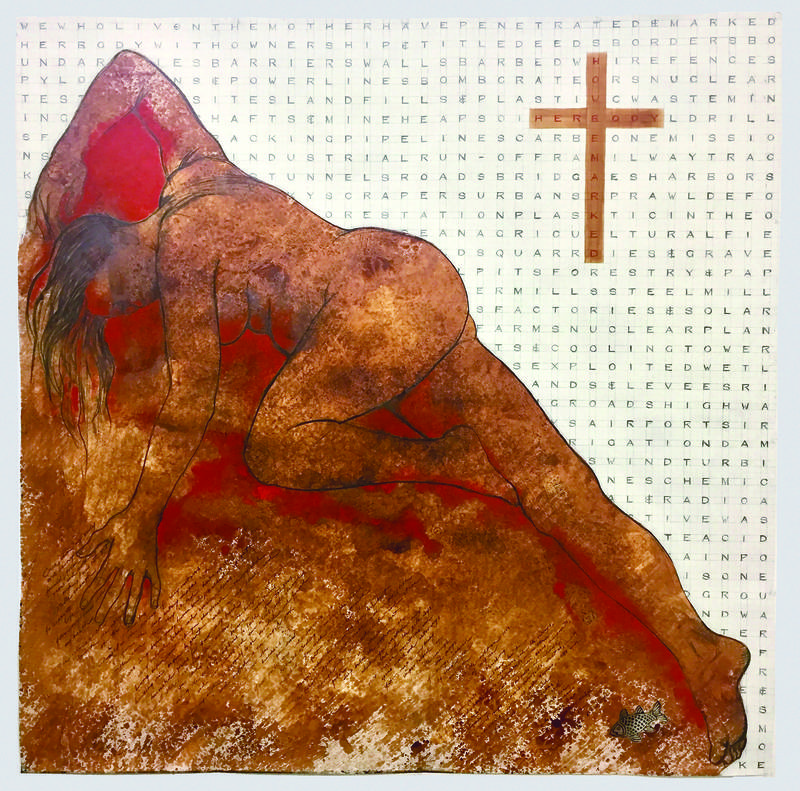
One piece stands out for her — How Her Body Be Marked.
In the work, in a grid above the figure that represents the Earth, she lists the ways in which we have damaged the planet: “Our Human Deeds … We who live on the Mother have penetrated & marked her body with ownership and title deeds, borders, boundaries, barrier walls, barbed wire fences, pylons & powerlines, bomb craters, nuclear test sites, landfills & plastic waste, mining shafts & mineheaps, oil drills, fracking, pipelines, carbon emissions, industrial run-off, railway tracks, tunnels, roads, bridges, harbours, skyscrapers, urban sprawl, deforestation, toxic emissions & plastic in the ocean, agricultural fields & grazing tracts, quarries & gravel pits, forestry & papermills, steel mills, wetland & levees, ring roads, highways, airports, irrigation dams, wind turbines, chemical & radioactive waste, acid rain, poisoned oceans & groundwater fire & smoke,” it says.
Below the figure, she scripted earth’s dark, primitive and mysterious voice: “Once when my body was being formed from gases and rock, I was not yet stable enough to support life from my bones and my breath. The oceans would in time demark the outlines of the continents and allow the journey of tiny creatures from the deep watery depths onto the shore where they started breathing air.
“That was long before you, humankind, walked upright along inland lakes and ocean shores. Long before most of you abandoned gathering and hunting and began to plant seeds in my flesh to harvest for your daily bread.
“In all this, I was there, your mother, the body on which you lived while you became industrious using the rocks of my bones to build your temples and your palaces and your cities, and claimed my earth as property to be divided and fenced and walled as you waged wars over the boundaries you drew…”
Bredell considers herself iconoclastic — someone who challenges the norm and the traditional ways and suggests open and freer ways of thinking about the world.
Upending and questioning the patriarchy is also a major theme in many of her works.
The artist said that this interest in challenging the male system of dominance stems from her Calvinist upbringing and the subsequent opening of her mind during the 22 years she has spent living in New York.
She says the patriarchal writers of Genesis expunged the female from creation. She is not even part of the created world and, growing up in the Dutch Reformed Church, “Men were like little gods on earth and what were women?”
She uses figures tumbling or upside down to convey a re-thinking of hierarchy.
“We’ve been taught to look to the sky,” she said. “God is somewhere up there in heaven. But the sacred is right down here and it’s what sustains our lives on earth.”
Seasoned artist and writer Annali Dempsey said of Bredell: “When I look at Majak’s work, I think of the archaeological layers of civilisation excavated in places like Bath in England or Toledo in Spain where Moors, Jews, Christians and Romans created layers of reality according to religion, state and legislature.
“But it is still above the real earth — these compacted levels of history.
“And we tend to dance over these layers and levels with dazzling smiles and digital cameras, capturing what we perceive as the manifestation of what it means to live on this planet.
“What we do not see is the bones of the ancestors, the destruction and pain embedded in each of these layers that separate us over the ages from the earth mother.”
This is something we should all be thinking about. And driving to White River to see.
Bredell’s exhibition Interconnections, on at the White River Gallery, closes on 2 June.
Diary: Gratrix in Jozi, Lady Skollie for the Mother City, Jokes and Jazz:
Georgina Gratrix solo exhibition in Joburg
The Stevenson Gallery in Johannesburg is presenting Between Two Palms: New Works from Durban by Georgina Gratrix, marking her debut solo exhibition. Born in Mexico City in 1982 and raised in Durban, Gratrix now lives in Cape Town,
but for this collection, she went to the place she most considers home, reconnecting with the community and space in which she first discovered painting.
Drawing inspiration from her formative years, Gratrix immerses herself in the environment of her first art teacher’s studio, infusing her pieces with the essence of Durban.
She pays homage to her surroundings, incorporating elements of local culture and landmarks, such as the iconic Berea Court and the city’s art deco architecture.
Blending still life with portraiture, Gratrix invites viewers into a world where home, community and creativity converge, celebrating the interconnectedness of place and artistic legacy.
The exhibition opens on Saturday 18 May.
Lady Skollie’s ‘Groot Gat’ comes to Cape Town
If you missed South African artist Lady Skollie’s Groot Gat exhibition that ran at the Standard Bank Gallery last year, you’re in luck — the Norval Foundation in Cape Town will show it later this month.
Lady Skollie was the recipient of the 2022 Standard Bank Young Artist award for visual art.
Opening its doors on 22 May, and running until 15 September, this showcase, curated by Tayla Hollamby and Standard Bank Gallery, delves into Skollie’s exploration of the intricate histories of the San, Khoi and Griqua communities.
Through her artistry, Skollie fearlessly confronts themes of identity and the complexities of reclaiming lost histories within the Cape coloured community.
Groot Gat serves as a poignant testament to Skollie’s impact as a cultural provocateur, using humour as a catalyst for societal transformation.
Humour and jazz meet on university campus
The Centre for Jazz and Popular Music at the University of KwaZulu-Natal has announced its comedy and jazz event, Jokes & Jazz. It will take place at 5.30pm on Tuesday 21 May, on the Howard College Campus.
The line-up consists of diverse talent within the local comedy scene. Leading the pack is Kwanda Radebe, a versatile 29-year-old model, actor and comedian with a repertoire spanning TV ads, online sketches and stand-up.
Joining him will be Charles Philani Mthethwa, a seasoned performer with a flair for comedy, acting and scriptwriting, and Cebo Mhlophe, who is known for his uproarious street videos and massive following on TikTok.
Simunye “Church Boy” Sikhakhane will add his clean, Christian-based comedy.
The musical backdrop will be provided by UKZN students, ensuring a harmonious blend of rhythm and comedy.
Tickets are R110, R80 for pensioners, and R50 for students.
— Compiled by Lesego Chepape
Submit and get free exposure here: Showcase Your Business | Advertise Your Special Offers.