
Iran war drives oil above 0, raising inflation risks for South Africa:
South Africa’s economic outlook is facing renewed uncertainty as the widening war involving Iran, Israel and the United States begins to ripple through global energy markets, raising concerns about fuel prices, inflation and the timing of potential interest rate cuts.
Oil markets reacted sharply as the conflict intensified. Brent crude surged past $ 100 a barrel for the first time in years, briefly approaching $ 120 as traders responded to fears that the war could disrupt energy supplies across the Middle East.
The spike underscores how quickly geopolitical shocks can reshape economic assumptions for countries heavily dependent on imported fuel.
For South Africa, which imports the vast majority of its crude oil and refined petroleum products, the consequences could be felt quickly through higher fuel prices that feed into transport costs, food prices and broader inflation.
Economists warn that sustained elevated oil prices could significantly alter the country’s economic trajectory, delaying the prospect of interest rate relief and placing renewed pressure on households already grappling with rising living costs.
Dr Elna Moolman, group head of South Africa macroeconomic research at Standard Bank, said the inflationary consequences of the war-driven surge in oil prices could postpone expected monetary easing.
“Interest rate cuts will likely be delayed given the inflationary impact of the war-induced spike in oil prices,” she said.
The South African Reserve Bank had been widely expected to begin gradually lowering borrowing costs during 2026 as inflation eased toward the midpoint of its 3% to 6% target range. The sudden jump in oil prices has complicated that outlook.
Fuel costs are one of the most direct channels through which global shocks reach the domestic economy. South Africa’s regulated fuel pricing system tracks international oil prices and the rand-dollar exchange rate, meaning global price increases are eventually reflected at the petrol pump.
Some analysts have warned that if oil prices remain above $ 100 a barrel for a sustained period, South Africa could face sharp fuel price increases in the coming months.
Higher fuel costs quickly spread through the economy. Transport becomes more expensive, production costs rise and retailers eventually pass those increases on to consumers.
The result is upward pressure on inflation at a time when policymakers had hoped price growth would begin moderating.
Despite the risks, Moolman said the broader inflation impact could remain manageable if the rand remains relatively stable.
“The inflationary impact of the Iran war for South Africa should remain relatively contained, as long as the rand remains reasonably resilient,” she said.
Currency stability plays an important role in cushioning external shocks. A stronger rand reduces the cost of imported fuel in local currency terms, softening the impact of higher oil prices.
The global environment may also support some of South Africa’s export sectors.
“The impact of higher oil prices on growth and the current account should be diluted by the rise in coal prices as well as spiking precious metals prices,” Moolman said.
Precious metals such as gold and platinum group metals often rise during periods of geopolitical instability as investors seek safe-haven assets. South Africa, as a major producer of these commodities, can benefit from those price increases.
Coal prices have also strengthened as energy markets respond to uncertainty in global oil and gas supplies.
These factors could provide a partial buffer for the economy even as fuel import costs rise.
Even so, the outlook for interest rates has become more uncertain.
“At this stage we pencil in the next interest rate cut at the May MPC meeting, though this depends on how the war unfolds as well as the trajectories of oil prices and the rand exchange rate,” Moolman said.
Oil markets remain on edge as the conflict continues.
Particular concern has focused on the Strait of Hormuz, a narrow maritime corridor between Iran and Oman that carries roughly a fifth of the world’s seaborne oil supply.
Any sustained disruption to shipping through the strait could send oil prices significantly higher.
Although global powers have historically sought to keep the waterway open, even the possibility of disruptions can trigger significant volatility in energy markets.
For energy-importing economies such as South Africa, those swings translate quickly into domestic price pressures.
Finance Minister Enoch Godongwana recently acknowledged that global shocks can rapidly disrupt economic planning, particularly when they affect fuel markets.
South Africa imports most of its oil and therefore absorbs movements in global energy prices.
Higher oil prices raise transport costs across supply chains, which in turn push up the cost of goods ranging from food to manufactured products.
For an economy already struggling with slow growth and high unemployment, the impact could be significant.
Rising fuel prices place pressure on household budgets while simultaneously raising the operating costs of businesses.
This combination creates a difficult policy environment.
Higher interest rates can help contain inflation but also slow economic growth. Lower rates support growth but risk fuelling price increases if inflation remains elevated.
The Reserve Bank therefore faces a delicate balancing act.
The war in the Middle East has added another layer of uncertainty to that equation.
For policymakers, the central question is whether the oil shock proves temporary or develops into a prolonged disruption of global energy markets.
If the conflict stabilises and oil prices retreat, the impact on South Africa’s inflation outlook may remain limited.
But if geopolitical tensions keep energy prices elevated, the consequences could ripple through the economy for months.
For many South Africans, the first sign of that global turmoil will likely appear in the price displayed at filling stations.
A war unfolding thousands of kilometres away is already beginning to shape the country’s economic outlook at home.
‘Ghost Elephants’ explores nature, myth and memory:
Sometimes the only way forward is to go back. That was my biggest takeaway from Ghost Elephants, a National Geographic documentary by acclaimed filmmaker Werner Herzog. True to Herzog’s reflective style, the film moves beyond the simple idea of a wildlife expedition and becomes something deeper, a meditation on knowledge, memory and humanity’s relationship with the natural world.
The documentary follows South African conservation biologist and National Geographic explorer Steve Boyes, who has spent years studying and protecting the fragile ecosystems connected to the Okavango Basin. This time, Boyes travels into the mist-covered highlands of Angola in search of a mysterious animal many believe exists somewhere between myth and reality: the ghost elephants of Lisima.
The elephants are believed to be unusually large and incredibly elusive. Stories about them have circulated for years, suggesting they could be descendants of some of the largest elephants recorded. Whether legend or scientific possibility, their existence has intrigued explorers, researchers and communities alike. For Boyes, the mystery is compelling enough to embark on another demanding journey into one of Africa’s most remote landscapes.

But Ghost Elephants quickly reveals that this is not just a story about searching for a rare animal. Instead, the film becomes an exploration of how we search and who holds the knowledge needed to find what we are looking for.
Despite years of exploration and access to modern technology, Boyes recognises that tracking the animals requires a return to something more fundamental. Enter Xui, Xui Dawid and Kobus, three KhoiSan master trackers whose skills transform the expedition. Their presence shifts the narrative from a conventional scientific quest into something far more fascinating.
Tracking, as the film demonstrates, is far more complex than simply following footprints. It is a practice that draws on all the senses. The trackers observe the smallest details in the environment such as a bent blade of grass, a disturbed patch of soil or the faint scent carried by the wind. Even the behaviour of birds and other animals becomes part of the story they read in the landscape.
What makes their work remarkable is the way they interpret the signs. Through observation, intuition and experience passed down through generations, they reconstruct the movements of animals across vast terrain. At times, they physically mimic how an animal might have walked or turned, using their bodies to imagine where it might have gone next. Watching them work feels almost spiritual, though they describe it simply as knowledge inherited from their ancestors.
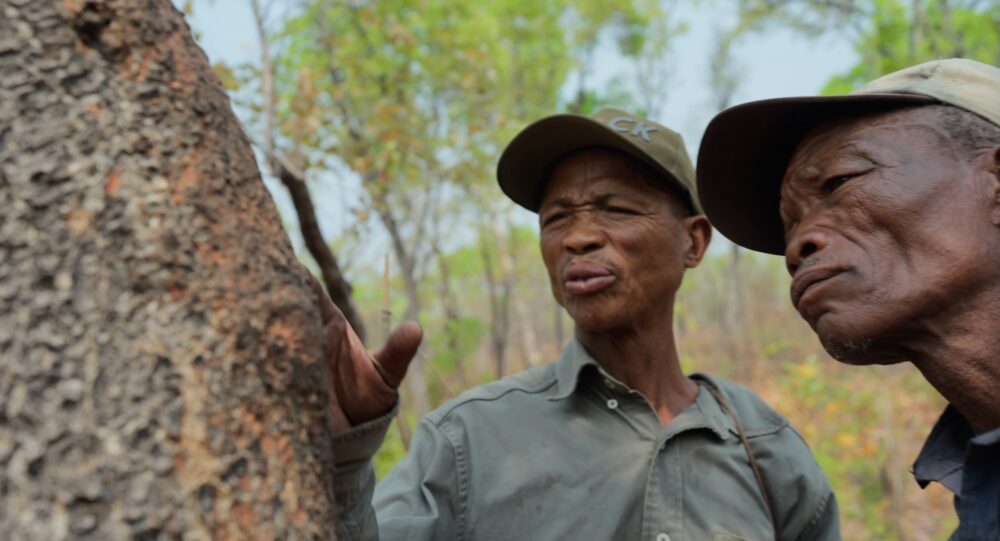
This is where the film finds its emotional centre. Herzog frames the trackers’ skills as a powerful reminder that some of humanity’s most sophisticated knowledge systems are not written in textbooks or stored in databases. Instead, they live within communities and traditions that have existed for centuries.
Visually, the documentary captures the haunting beauty of Angola’s highlands. Dense forests, winding rivers and mist-covered hills create an atmosphere that feels both mysterious and untouched. For decades, much of the region remained inaccessible due to war and political instability, which has allowed parts of the ecosystem to remain remarkably intact. The cinematography embraces the sense of isolation, showing landscapes that seem to guard their secrets carefully.
Yet beneath the beauty lies a quiet urgency. The film subtly raises questions about what happens when traditional knowledge systems disappear. The skills of trackers like Xui, Xui Dawid and Kobus are not easily documented or digitised. They are learnt through years of practice and close relationships with the land.
As modern life continues to reshape rural communities, there is a risk that the knowledge could fade with time. In that sense, the title Ghost Elephants carries a deeper meaning. It does not only refer to a mysterious animal hidden somewhere in Angola’s wilderness, but also to cultural wisdom that risks becoming invisible in the modern world.
Ultimately, Ghost Elephants is less concerned with delivering a dramatic discovery than it is with reflecting on the process of searching. By bringing together science, storytelling and indigenous knowledge, the film reminds us that progress does not always come from moving forward at full speed.
Sometimes, it begins by remembering what we have left behind.
GHOST ELEPHANTS premieres on National Geographic Wild, DStv 182 on Wednesday 11 March at 6pm (CAT) and is streaming on Disney+ in South Africa.
World-first privacy display on the Samsung Galaxy S26 Ultra is redefining mobile privacy:
With the recently launched Galaxy S26 series, Samsung unveiled a breakthrough feature that is set to change the way users experience privacy on their phones. Building on decades of display innovation, the AI(artificial intelligence)-powered Samsung Galaxy S26 Ultra introduces the mobile industry and world’s first built-in Privacy Display – a revolutionary technology that protects personal information at a pixel level.
As the slimmest Ultra yet, the Galaxy S26 Ultra is not just engineered for performance and design excellence. It is designed for real-life scenarios. In a country where mobile phones are the gateway to banking, business, healthcare, and connection, Privacy Display helps you keep what is yours private.
Privacy Display represents a fundamental shift in mobile display technology. By controlling how pixels disperse light, the screen remains bright, crisp, and comfortable for the user, while limiting what others can see from side viewing angles when activated.
Unlike traditional stick-on privacy filters that dim screens and degrade clarity, Samsung’s built-in solution endeavours to preserve full viewing quality. When activated, Privacy Display instantly reduces side-angle visibility without compromising brightness or colour accuracy. The protection works seamlessly in both portrait and landscape mode, adapting naturally to how people use their phones.

Built for South Africa’s Everyday Moments
From catching the Gautrain in Johannesburg to working remotely in a Cape Town café, people are constantly connected in shared spaces. Privacy Display is purpose-built for these everyday realities.
Imagine making an EFT while commuting on a packed bus in Sandton or in a crowded waiting room, checking sensitive work emails in a busy airport lounge at OR Tambo, or simply having a confidential WhatsApp conversation in a restaurant. This amazing feature gives you that personal digital bubble, even in the most public environments.
Privacy Display works hand-in-hand with Samsung’s software intelligence to give users complete control over when and how privacy protection activates.

Users can:
- Automatically activate Privacy Display when entering a PIN or password
- Trigger protection when opening specific apps such as banking, email or messaging
- Choose adjustable privacy levels
- Partial Screen Privacy to shield notification pop-ups
- Maximum Privacy Protection for enhanced side-view shielding
This means protection adapts to context. When you need it, it is there.
Privacy Display reinforces Samsung’s commitment to safeguarding personal information at every layer of the experience. With the introduction of this feature, Samsung is once again redefining what its flagship mobile phone can be, while ensuring that privacy travels with those on the move.
The Galaxy S26 series is available for pre-order now until 19 March 2026. Customers who pre-order can double their storage and save up to R5,000 in an exclusive limited-time offer.
The Galaxy S26 series comes in Cobalt Violet, White, Black and Sky Blue, and is available at these recommended retail prices:
- Galaxy S26 Ultra from R30,999
- Galaxy S26+ from R25,9993
- Galaxy S26 from R20,9993
The era of the AI phone has arrived. Pre-Order yours now!
Submit and get free exposure here: Showcase Your Business | Advertise Your Special Offers.
