Is Balwin Properties too bold for the SA market?:
A penthouse going for R80??million, and more than 5??000 apartments — all in one development. That’s a big price tag for Gauteng (and for South Africa in general). When it comes to some of the Balwin Properties developments, it makes me wonder who the buyers of these apartments and luxury penthouse are. Who lives in them?
Balwin Properties was established in 1996 and is the largest sectional title property developer in South Africa. In 2015, it went public and was listed on the JSE. The company has an impressive development pipeline, with more than 42??000 apartments planned over the next 15??years. While its development plans sound promising, the latest figures from its earnings report tell a different story.
Balwin Properties has made significant investments in Gauteng and other provinces such as the Western Cape and KwaZulu-Natal. On reviewing its interim financial results for the six months to end August 2024, it showed that profits had decreased by 57% and revenue was down by 28%.
Steve Brookes, chief executive of Balwin Properties, is the Sol Kerzner of sectional title development in South Africa. Previously a car salesperson in Johannesburg South, he has boomed the Balwin business over the years with his maverick moves in the sectional title real estate sector.
He attributed the decline in earnings and stock price to several factors, including the poor economy, rising living costs, high interest rates and other macroeconomic issues beyond the company’s control.
Customers value transparency, and property-related issues are relevant when explaining poor results. This includes details about occupancy rates, the rising costs of construction and negative rental reversions.
Waterfall City, in Midrand, is a smart city. Retail, commercial and residential real estate developments are located here, as is the Mall of Africa and the head office of big corporates such as PwC. Balwin Properties is known for its bold Munyaka development in Waterfall City, which will have more than 5??000 apartments once it is complete.
When the Munyaka development launched, people were excited about its unique amenities, such as the 30?000m2 lagoon monitored online 24/7 through the Crystal Lagoons control room in Miami. Other amenities include a padel court, cinema, running track, action sports field, playground, restaurant and lifestyle centre.
President Cyril Ramaphosa was present for the unveiling of this development circa 2020. At the time, Brookes said the company planned to achieve a market capitalisation of R10??billion within five years. It’s been almost five years, and Balwin Properties’ market capitalisation today is R1.3??billion.
He also said that they would build a development similar to Munyaka in the Paarl Winelands. While Paarl has been pumping with commercial and residential developments over the past five years, such a development is yet to materialise. It’s a big project for Waterfall, and it would be an even bigger project for a town like Paarl.
According to Balwin Properties’ website, Munyaka has a variety of apartment types — one, two and three bedrooms, villas and penthouses. Prices for a one-bedroom apartment (41m2–64m2) start at R1??034??910, while two-bedroom apartments (75m2–115m2) begin at R1??484??910. The prices for three-bedroom apartments (110m2–118m2) start from R1??799??910.
I viewed the floor plans for a six-bedroom, six-bathroom lagoon penthouse that measures 1??230m2 (with 695m2 under the roof and the rest consisting of a covered and uncovered patio, a butler’s suite and basement storage). Balwin Properties advertised the penthouse at a sale price of R80 million. That’s a lot of money for this location compared with other penthouses in Gauteng and Cape Town. In addition, other apartments in this development are advertised at much lower prices.
Koshiek Karan, a former investment banker with listed real estate deal experience, says that when interest rates were low, many people bought units in Balwin Properties developments. They barely qualified for these home loans, and when the cost of living went up, the interest rates went back up, and now they can’t afford the monthly payments of their real estate investment.
“Owning a property extends far beyond simple bond repayments. There is insurance, utilities, municipal rates, levies, maintenance, and more. Qualifying is different to affordability.”
This issue affects many property buyers in the country and points to the problem of poor financial literacy.
Balwin Properties generally builds its developments in working-class and middle-income areas where the cost of acquiring land is cheaper. A few years back, it launched a huge R1.6??billion affordable housing development called Wedgewood on a premium road in Sandton — it was cancelled. The building was going to be 20 storeys with 1340 apartments. The studio apartments were roughly 33m2 in size, with sale prices ranging from R799??000 to R1.49??million.
Regarding the Munyaka development, of the 5?020 apartments planned, 3?705 remain unsold. This raises concerns when it comes to the demand for apartments in these mass compound-style complexes.
The company certainly goes big when it comes to your home. Is it too big, though? There is a dire need for more affordable apartment offerings to come onto the market. One wonders if Balwin is oversupplying apartments in parts of Gauteng in relation to demand and if they are designed and priced correctly.
The number of apartments in most Balwin Properties developments is 1??000 to 3??500 units per development. That is an extraordinary scale compared with other sectional title developers in South Africa. If you browse the website, you can find many units still available for sale in most of the company’s developments.
Would you be able to live in a development of this scale? In a world where customers favour boutique brands, specialised expertise, product personalisation, and companies that focus on their niche, I wonder if these big-box offerings appeal to South Africans.
The question remains: who is the target market?
When I chatted to Nicholas Dakin, a global portfolio manager at Sasfin Wealth, about Balwin Properties’ balance sheet, he said that what stood out for him was the level of debt, which has been trending higher over time as it has taken on more debt to fuel its aggressive expansion plans.
While the group’s loan-to-value (LTV) ratio did decline marginally to 40.2% in its most recent interim results, it remains elevated. Property companies should try to keep their LTV ratio between 35% to 40%. Therefore, this is a fairly precarious situation, given that the company has a significant amount of unsold stock and high vacancies.
As a result, Balwin Properties did not declare a dividend in the last financial year in an attempt to reduce the group’s debt exposure. A solid and consistent dividend is one of the key reasons investors like to own property shares. Dakin believes this is the key reason for the weakness in the share price. But he also pointed out that the share price has recovered strongly since April, benefiting from government of national unity optimism.
The company has recently created a subsidiary called Balwin Rentals, reflecting the current times where rentals are in huge demand nationwide. In July this year, Balwin Properties announced expansion plans for its rental portfolio. Over the next decade, it plans to build close to 7??300 apartments dedicated solely to the rental market. I am a fan of this idea because the demand is there.
The rental portfolio will include one, two and three-bedroom apartments with a monthly rental rate of R6??000 to R13??000. Perhaps the plan is for the rental subsidiary business to generate some annuity income.
The company has also opened another subsidiary called Balwin Sport, which has padel courts in the developments.
Balwin Properties has other businesses in the pipeline to offer its apartment owners, such as solar power. Selling apartments provides the company with erratic income, so these annuity-income subsidiaries might be the solution to diversifying and generating a consistent cash flow.
That said, Balwin Properties has had its worst year on record. Perhaps it should reconsider whether it remains listed. Being listed means it must keep bringing products to the market and constructing more apartments.
The company is not a dividend payer. Balwin Properties’ current market capitalisation of R1.3??billion is small when compared to other listed property funds on the JSE. Growthpoint’s current market capitalisation is R45??billion (at one point, it was R70??billion) and is the largest listed property fund in South Africa.
I would say anything under R2.5??billion should be reconsidered when listing on the JSE because a company might not be liquid enough for institutions to buy into.
Since listing, the share price has decreased sharply, from about R10 a share in 2015 to R2.30 at the time of writing. But Balwin Properties is still pumping out loads of stock. So, do people believe in the product, or is the listing forcing it to build? I am excited to see the next results presentation and how the performance of the newly added annuity businesses, such as the rental portfolio, will help with the bottom line.
Ask Ash is a new column that examines South Africa’s property, architecture and living spaces. Continue the conversation with her on email (ash@askash.co.za) and X (@askashbroker).
Infrastructure issues affect tourism — and the repercussions are huge:
South Africa’s infrastructure problems don’t only affect the lives of the people who call it home. Issues with electricity, water, transport and waste infrastructure influence tourists’ decision-making and, as a result, the success of the tourism sector.
With many of South Africa’s infrastructure issues making international headlines, travellers are all too aware of the problems the country is facing. News about load-shedding and Day Zero (in both Cape Town and, more recently, Johannesburg) have been featured by major outlets from The New York Times to National Geographic and CNN. And although some tourists have certainly chosen to visit the country regardless, others have been hesitant.
The tourism industry is gradually recovering from the Covid-19 pandemic, with 8.5 million visitors in 2023, down from 10.2 million in 2019.
These problems also have a limiting effect on how the sector develops on the ground. Without reliable and consistent infrastructure in place, fledgling and established hotels and tourism operators battle to survive and the sector’s enormous job-creation potential starts to falter.
Failing to leverage these opportunities could have a severe knock-on effect on the country’s economy. Amid these complex circumstances, holistic infrastructure planning stands out as a critical solution.
We have to begin with power and water. The recent electricity crisis has been one of the country’s most serious issues. Tourists are aware that their travel plans, accommodation and activities are likely to be affected by hours-long power cuts and that when and how these occur can’t always be predicted.
While load-shedding has abated in 2024, many feel that this is not to be trusted — 2023’s debilitating disruptions are still fresh in many people’s minds.
Hand in hand with power comes water. In the last year, Johannesburg — the country’s largest city, an international transport hub and a key location for business tourism — has come close to Day Zero four times. Amid such an inconsistent supply, tourism and hospitality operators battle to clean their spaces properly, launder sheets, prepare meals and cater for even the basic needs of their guests.
The Tourism Business Council of South Africa is all too aware of this, having recently stated that, “South Africa’s energy crisis, water shortages, social uncertainty, ageing infrastructure and immigration frameworks need urgent attention if the sector is to meet its goal of securing 15.6 million arrivals to the country by 2030.”
For the sake not only of our residents and businesses, but for broader industries, such as tourism, which we are desperately seeking to grow, our electricity and water crises have to be resolved.
Another key infrastructure issue is transport. The poor condition of many roads, including dangerous potholes and an ongoing lack of maintenance, affects both tourist safety and accessibility to various attractions, particularly in rural areas. The Sani Pass in KwaZulu-Natal, for example, is in a terrible state of disrepair. Taxis brave sections of this road, only really viable in 4x4s, putting lives at risk and further damaging it.
South Africa’s once-popular long-distance passenger rail services, including tourist-oriented routes like the Blue Train, are also failing visitors. This leaves limited transport options for tourists and removes what was once a unique selling point for tourism.
In recent years, there have been numerous reports of sewage spills in popular coastal tourist destinations due to failing wastewater treatment infrastructure. The 2023 Green Drop Report found that about half of all wastewater treatment works aren’t treating sewage adequately and almost 40% are in a critical state.
These issues have led to beach closures and health concerns, with E. coli detected in the water off the KwaZulu-Natal and Eastern Cape coasts.
For hotels and restaurants operating on these beachfronts, this negative publicity has been “devastating”. Where tourists would once extend their visits to include Durban and Umhlanga after a period in the region’s national parks, tourism operators are finding that they either fly back to their home countries or go directly to the Western Cape.
This has a profound impact on business success in the area and on employment opportunities. Given South Africa’s severe unemployment rate, this isn’t a risk the country can afford.
There’s no one-size-fits-all solution to these challenges. Repairing and maintaining the country’s electricity, water, transport and waste infrastructure involves acknowledging the root causes of these problems, developing holistic and integrated solutions and sharing responsibility for their implementation.
The journey is complex and difficult, but considering the many lives who stand to benefit through our tourism industry alone, it’s nothing short of critical.
Bongani Mthombeni is the executive director at Royal HaskoningDHV in South Africa.
Hydrogen technology ‘key to sustainable steel industry’, analysis of ArcelorMittal’s roadmap finds:
South Africa’s steel industry can transition to zero-emission production, while addressing the environmental and social costs of its operations that are borne by local communities, according to a Vaal Triangle nonprofit’s policy brief.
The brief, recently released by the Vaal Environmental Justice Alliance (Veja), is a comprehensive analysis of the decarbonisation roadmap of ArcelorMittal South Africa (Amsa) and its implications for local communities.
ArcelorMittal intends to reduce greenhouse gas emissions from the operations of its Vanderbijlpark, Saldanha and Newcastle plants towards a net-zero goal by 2050.
It also intends to reduce emissions by 25% by 2030, according to its roadmap published in January last year.
“The aim is to reduce its direct emissions from coke, iron, and steel production plants, as well as indirect emissions embedded in the electricity that Amsa uses from Eskom fossil-fired generators,” the policy brief said, noting that the roadmap is in line with ArcelorMittal’s global plans.
Iron and steelmaking is a carbon-intensive process that produces about 8% of all greenhouse gas emissions worldwide.
Together with Hydrogen Watch (H2Watch), a loose civil society network, Veja said it called on ArcelorMittal to provide clarity on how it plans to compensate people for past environmental and health damage, prevent future harm and ensure meaningful discussions with those affected.
“Additionally, Veja seeks transparency on the potential social and economic impacts of ArcelorMittal South Africa’s transition, particularly regarding job security, skills development and community well-being,” said the nonprofit, which focuses on air quality, waste, water pollution and climate change in the Vaal Triangle, known for being one of the most polluted areas in the country.
For years, Veja and the Centre for Environmental Rights have argued that emissions from ArcelorMittal’s plants cause severe health effects in nearby communities and that greenhouse gases from the company’s current steel-production process contribute to global warming and climate change.
The policy brief highlights hydrogen direct reduction of iron (DRI) technology as a viable solution for sustainable steel production. It leverages South Africa’s rich iron ore deposits and renewable energy resources and “offers an opportunity to revive the struggling steel sector while reducing its carbon footprint”, Veja said
“We’ve hosted dialogues in Vaal communities about the policy brief and ArcelorMittal South Africa’s decarbonisation plan. These discussions revealed both hopes and fears, particularly regarding job security, the need for new skills and the protection of vital resources like water,” said Mduduzi Tshabalala, the programmes coordinator of Veja.
The company had not followed a public participation process in developing its decarbonisation roadmap, he said. “It’s quite difficult to trust the proposed plans because we don’t know how people are going to be affected in terms of the socio-economic benefits.”
He said Veja would continue to push for compliance with the National Environmental Management Act and “will continue monitoring ArcelorMittal South Africa’s environmental practices”.
Energy expert Hilton Trollip, who wrote the policy brief, highlighted the potential for South Africa to lead in zero-emission steel production by using hydrogen technology and renewable energy.
“Communities have long endured the environmental costs of steel production while depending on it for their livelihoods,” he said. “Now, they are taking an active role in shaping the future of the industry, demonstrating that local voices can influence major industrial decisions.”
Steel is the world’s most important metal and the policy brief said its widespread use in buildings, cars, trains, and household appliances makes it central to the “modern way of living”.
It said national governments, often “shield companies” from competition, as well as subsidising steel multinationals.
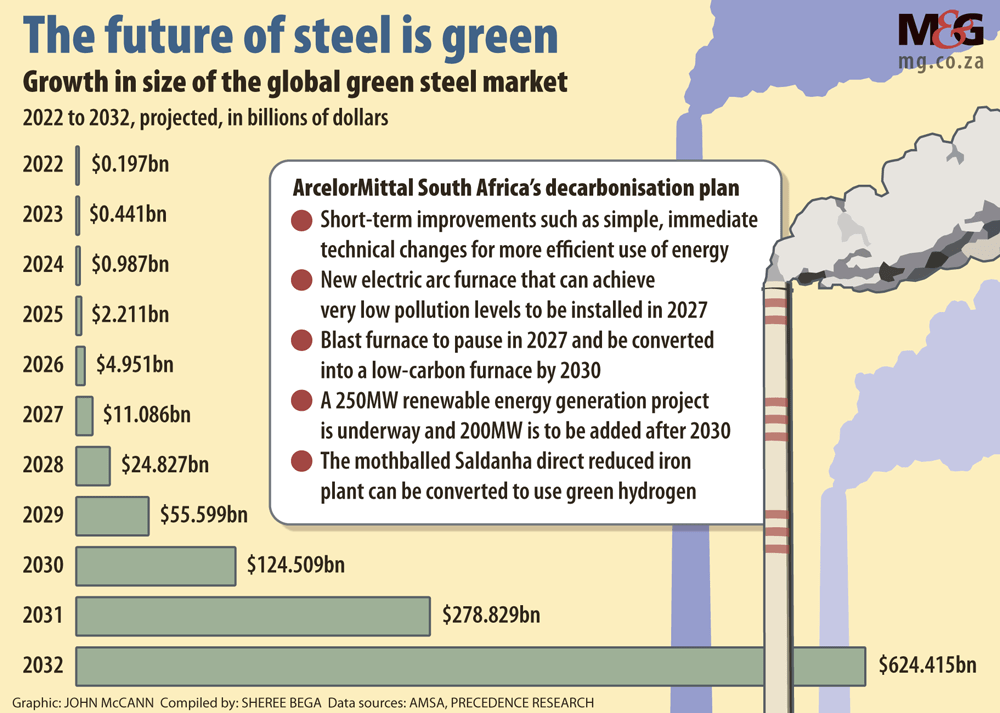
To phase out the use of fossil gas and coal in steelmaking, the global steel industry needs cooperative actions in the industry and between governments. “South Africa and individual steel companies cannot take these actions alone.”
The brief noted how, until now, making iron from iron ore has relied on fossil-gas or coal feedstock. Most carbon emissions result from these primary iron-making processes.
“Coal or gas are not only used as fuel, as the iron-making process needs the carbon in the coal or gas to react with the iron ore to transform it into raw iron. Primary steelmaking has thus been called a ‘hard-to-abate’ sector — an industry in which it is difficult to eliminate or significantly reduce greenhouse gas emissions,” it said.
Producing steel has historically emitted a lot of carbon dioxide (CO2), about 2.2 tonnes for every tonne of steel. “Green hydrogen can be used instead of coal or fossil gas to make iron from iron ore. When this hydrogen reacts with the iron ore, it produces iron and water, with no CO2.”
Green hydrogen is made by using renewable energy to split water into hydrogen and oxygen in an electrolyser.
Using renewable energy in the electric arc furnace to produce secondary steel can virtually eliminate carbon dioxide emissions, because they are mainly from the electricity used. In South Africa these emissions, primarily from burning coal in power stations on the Eskom grid, amount to about 0.5 tonnes of carbon dioxide per tonne of steel.
“Although the technology exists to reduce CO2 emissions from blast furnaces/basic oxygen furnaces by capturing the CO2 and either using it in industry or storing it, this technology remains to be proven in industry,” the document said.
“Also, as it is not possible to capture all emissions from blast furnaces/basic oxygen furnaces, they cannot be employed for zero-emissions primary steelmaking, whereas DRI furnaces can.”
It’s crucial “to recover, maintain and grow the South African iron and steel industry”, the brief said.
“Maintaining production at Amsa Vanderbijlpark is very economically beneficial but pollution levels and the potential for full decarbonisation are concerns. If the low-carbon blast furnace doesn’t work out, they may need to consider more DRI furnaces at Saldanha and/or electric arc furnaces at both Vanderbijlpark and Saldanha to maintain and increase South African steel production levels.”
Investing in direct iron reduction, electric arc furnaces, blast furnaces and renewable energy at the Saldanha and Vanderbijlpark plants can benefit frontline communities.
“Industries connected to steel production also have the potential to benefit frontline communities significantly. This includes industries making renewable energy equipment and fabricating metals (including structural metals), and the automobile industry.”
The new generation electric arc furnace may result in fewer jobs compared to blast furnaces, but
jobs in renewable energy will become more sustainable if components are locally manufactured, the document said, noting that Vanderbijlpark and Saldanha are suitable for manufacturing renewable energy equipment.
“Even if the government doesn’t incentivise this, it could be part of the company’s just transition efforts.”
There will be significant environmental benefits from replacing the blast furnace with an electric arc furnace, both at the blast furnace site and along the coal-supply chain. Green hydrogen direct iron reduction is the most promising technology (with minimal negative impact) for expanding primary iron manufacturing, and hence for primary steel and many linked industries, which “remain critical for South Africa’s development needs.”
“One of the things that Veja has been agitating for is the decarbonisation of Amsa so when Amsa announced its decarbonisation roadmap, we felt that it was important to commission the policy brief, which could be used as an educational tool by Veja in their engagements with ArcelorMittal,” said Dinga Sikwebu of H2Watch.
There are organisations in the civil society network that are highly critical of green hydrogen developments, he added. “They see this either as another form of greenwashing or extractivism, or that this is a way for the fossil-fuel industry to extend their lifespan. There are other groupings within H2Watch who feel that maybe there can be some role for the use of green hydrogen … in the so-called hard-to-abate sectors, such as steel, fertilisers and cement.”
“For those two reasons, we felt looking at Amsa’s decarbonisation roadmap may be a good thing, firstly to help an affiliate member of the network [Veja] but also to look at whether green hydrogen is an option to decarbonise.”
Jerry Dungu, ArcelorMittal’s principal specialist for product development, welcomed the opportunity to participate in the policy brief.
“This platform allowed diverse stakeholders to provide valuable feedback on our plans and we are grateful that this critical issue is being highlighted in broader conversations about the just transition,” he said in a statement.
Submit and get free exposure here: Showcase Your Business | Advertise Your Special Offers.