
Ithala faces liquidation amid insolvency concerns:
The Prudential Authority’s decision to file for the provisional liquidation of Ithala will result in the closure of the 257 000 depositors’ accounts while court processes are under way.
The authority, which is responsible for the prudential regulation of banks and insurance companies within the South African Reserve Bank, said that filing for provisional liquidation is in the best interests of Ithala’s depositors, because “the appointed liquidator will be able to utilise insolvency legislation to recover and distribute their funds to the extent possible”.
The papers were filed at the Pietermaritzburg high court on 16 January and comes after the Repayment Administrator, appointed by the Reserve Bank, established that Ithala is “technically and legally insolvent” and exposes depositors to potential loss of their deposits.
“Moreover, Ithala did not provide sufficient capital commitments or secure a legally binding renewal of the guarantee over its deposits from its shareholder, the provincial government of KwaZulu-Natal,” the Reserve Bank said in a statement.
Ithala was never granted a banking licence, but rather an exemption by the finance minister, Enoch Godongwana, to operate as an entity to receive deposits while it regularised its operations.
The exemption was temporary and subject to certain conditions. Ithala had to ultimately obtain a banking licence in terms of the Banks Act or cease all its deposit-taking activities.
In July 2022, the Prudential Authority issued a final exemption notice to Ithala to afford it a final opportunity to “regularise its deposit-taking activities, warning that non-compliance would lead to withdrawal of the exemption”.
“The final exemption notice lapsed on 15 December 2023, with Ithala failing to meet all the conditions outlined in it,” the Reserve Bank said.
Ithala was ordered to cooperate with the Repayment Administrator, which is responsible for Ithala’s deposits and appointed by the Reserve Bank, but failed to do so.
In response to the legal action, Ithala is calling on the government to “neutralise the actions of an arrogant and callous Repayment Administrator”.
In a statement issued on 17 January, Ithala said the Prudential Authority initiated the liquidation proceedings before any formal liquidation order was issued by the courts.
“The grounds for this action are fundamentally flawed, frivolous and based on erroneous calculations. Ithala is solvent with assets that far exceed its liabilities. Moreover, the Auditor General of South Africa has given Ithala a clean audit report for the year ended 31 March 2024 and confirmed its going concern status,” it said.
But from 31 March 2008 to 31 March 2024, Ithala’s losses amounted to R520 million. The Reserve Bank noted that capital injections were not able to absorb losses, and it hindered capital deployment to grow Ithala’s balance sheet. “Ithala has a high cost structure relative to its nature, size, complexity and risk profile,” the bank said.
Ithala said it had discussions with the Prudential Authority to secure its ability to continue operating, but that it will be taking immediate action against the appointed Repayment Administrator (RA).
“Our legal team will be filing an urgent interdict to contest the RA’s orders. In parallel, Ithala’s shareholder, the KwaZulu-Natal provincial government, has reached out to Minister of Finance Enoch Godongwana, advocating for a temporary solution that would allow deposit transfers to another bank until a permanent licensing framework is put in place for Ithala.”
Ithala cautioned that its closure would result in 400 job losses and affect vulnerable people who rely on it for essential financial services, including South African Social Security Agency grants.
The treasury assured depositors that their money will be protected by a government guarantee, subject to the conclusion of the necessary technical work. It advised depositors to “to urgently make alternative banking arrangements, they can be assured that we will endeavour to secure their funds as far as is possible”.
The KwaZulu-Natal treasury said it supports Ithala’s legal action to challenge the Repayment Administrator’s actions
ANC faces a tough 2025 as it tries to clean house ahead of local elections:
The ANC will spend this year renewing and rebuilding itself while its deployees in government attend to pressing areas of service delivery failure before next year’s municipal elections.
The party will focus on dealing with discipline, ethics and the collapse of its structures — and with internal pushback over its governance arrangement with the Democratic Alliance (DA) and other parties.
The ANC will have to manage the fallout from last month’s decision by the South African Communist Party to contest next year’s elections alone, and its relations with its other alliance partners, labour federation Cosatu and the South African National Civic Organisation.
At the same time, it will try to ease dealings with its partners in the government of national unity (GNU) — in particular the DA — ahead of the election campaign, partially through participation in the national dialogue announced by President Cyril Ramaphosa in his first state of the nation address as head of the GNU in July.
At the weekend, Ramaphosa outlined the ANC’s pared-down, six-point programme for the year in his address to the January 8 commemoration rally in Cape Town’s Khayelitsha township, a venue chosen by the party to both showcase DA governance failures and reconnect with its Western Cape constituency.
The address was a frank assessment of the “existential crisis” the has ANC found itself in after losing its electoral majority and of the “depth of dysfunction in our structures and among our members and leadership”, forcing it to seek coalition partners “under conditions not of our choosing”.
It also reinforced the reality that the ANC does not govern alone, not just through the analysis of the situation it is in, but also in the significantly reduced number of priorities it outlined for the 12 months ahead — and their lack of controversy.
Ramaphosa committed the ANC to “decisive action” on three urgent and inter-related fronts to try to regain the confidence of the voters it had lost over the years through poor governance, corruption and the party’s “damaged brand”.
These were improving the ability of the economy to create jobs; improved service delivery and governance and “decisive and visible steps” to rebuild public trust in the governing party.
This meant fixing local government and ensuring water and energy security; dealing with crime and corruption; creating the conditions for improved job creation; holding the national dialogue and rebuilding the ANC.
Ramaphosa said they would approach solving the water crisis in a similar way to how the security of the energy supply had been restored during the course of last year.
“We are confident that drawing on the lessons learned from dealing successfully with the seemingly intractable challenge of load-shedding, we will be able to deal with this crisis,” Ramaphosa said.
He outlined a series of urgent measures including renewal of municipal infrastructure by ring-fencing water revenue; a crackdown on water tanker mafias and illegal connections as well as a financing framework to allow private sector involvement in municipal-owned water assets.
These would be accompanied by the creation of an indigent register across municipalities to ease the burden on poor households, Ramaphosa said.
The government would focus on assisting high growth industries, including agriculture, manufacturing, mining, tourism, the emerging green economy and digital technologies to help create jobs.
It would also help improve the competitiveness of local industries; regulate labour migration and promote universal connectivity to promote the digital economy, while building industrial capacity and the ability to leverage the mineral sector, he said.
Ramaphosa pointed to the recruitment of 10?000 new police officers, interventions such as Operation Shanela, the crackdown on illegal mining and the creation of the Border Management Authority as positives in dealing with crime but called for further collective effort.
The government would move urgently to build a united front against crime, finalise the establishment of a national council on gender-based violence and mobilise society against criminality.
It would also act decisively against the employment of illegal and undocumented migrants and regulate and monitor spaza shops and food outlets to prevent deaths from food-borne illnesses.
Ramaphosa called on ANC deployees in government to deliver and “move with speed and confidently build strategic momentum” in doing their work, saying that this was “not the time to be tentative or doubtful but rather to be decisive”.
The governance priorities outlined by the ANC are aimed at dealing with some of the most pressing issues facing voters — water, municipal services, crime and unemployment — in the year and a half it has before municipal elections.
The party knows that it needs to fix some of the worst problems voters face at municipal level — or at least be seen to be on its way to dealing with them — if it is to avoid a repeat of the fiasco of the May 2024 elections in next year’s municipal poll.
A further loss of ground at municipal level in the middle of Ramaphosa’s presidential term would weaken the ANC even further going into the 2029 national and provincial elections — along with its chances of staying in power, even at the head of a coalition government.
The ANC’s priorities for government are also in areas that are likely to spark little or no resistance from its coalition partners — or from its own constituents.
They all fall firmly within the areas of focus agreed to in the statement of intent adopted by the parties in the GNU during the negotiations leading up to its formation — that are in line with the priorities adopted by Ramaphosa’s cabinet during the first five months of its existence.
Initiatives to improve water security, help create jobs and economic growth and reduce crime are not likely to add to disputes with the DA — including the National Health Insurance (NHI) — and are already on the agenda of the cabinet clearing house, having been carried over from last year.
Ramaphosa made it clear in his address the ANC would not be backing down on implementation of the NHI, despite having taken the “tactical decision” of forming the GNU and remaining “committed to forge national consensus on fundamental issues that affect our diverse nation”.
“While being flexible on tactics, we maintain firmness of principle in our determination to implement transformative laws and policies adopted by parliament, such as the Bela [Basic Education Laws Amendment] Act, NHI and other pieces of legislation,” he said.
The DA vehemently opposes the NHI Act, which was signed by the president in May, and had threatened legal action to halt its implementation. A crisis was averted in October when the matter was referred to cabinet committees for further discussion ahead of the first cabinet lekgotla of the year.
Ramaphosa presented the national dialogue as a continuation of the consultative tradition of the Congress movement but it was another reminder of the ANC’s changed stature and its understanding of the need to close the distance between itself and the rest of society.
The party has identified closing this distance as central to its survival, along with reorganising itself while improving the quality of membership — and of the leadership it is set to elect at the regional conferences it will hold in a number of provinces this year.
Ramaphosa said they had introduced a screening process to “rid the ANC of criminals” as part of the renewal process and that the party would be “tightening and enforcing the leadership election processes” at these conferences.
The election of new leaders would also have a bearing on who is selected to represent the ANC as its councillor candidates next year, Ramaphosa said.
The ANC’s most immediate task is dealing with dysfunction in what were once its strongest provinces — KwaZulu-Natal and Gauteng — to prevent further losses when South Africa votes again.
It has repeatedly deferred the decision on the fate of the provincial executive committees in Gauteng and KwaZulu-Natal after losing its majority in both provinces in May.
While there is a strong lobby for the outright disbandment of both provincial committees, the national executive committee is likely to endorse a decision to “augment” their leadership, which will leave the provincial committees in place while control of the province shifts to a team appointed by Luthuli House.
This decision is now set to be taken at the next national executive committee meeting.
Navigating the digital marketplace: how South African consumers are shaping e-commerce:
South Africa’s e-commerce landscape is undergoing a transformative shift. With smartphones now the primary tool for media consumption and shopping, consumers are embracing digital-first platforms to meet their needs. This evolution, accelerated by the rise of platforms like TikTok, is redefining how brands engage with audiences.
In 2025, e-commerce isn’t just a convenient alternative to brick-and-mortar retail—it’s the new frontier for growth, innovation, and connection. For brands, the challenge is clear: adapt to these changes or risk being left behind.
Consumer behaviour: the mobile-first revolution
South African consumers are increasingly turning to mobile-first platforms for shopping and entertainment. According to a recent study by Toluna:
- Mobile-first engagement has grown by 34%, while traditional TV consumption has declined by 4%.
- TikTok commands 84% undivided attention, making it a uniquely powerful space for product discovery.
- 2.4x more searches for retail and e-commerce content during the Golden Quarter signal a surge in consumer interest.
This shift reflects a broader trend: South African consumers now demand seamless, engaging, and personalised shopping experiences that align with their digital lifestyles.
Spending habits and e-commerce growth
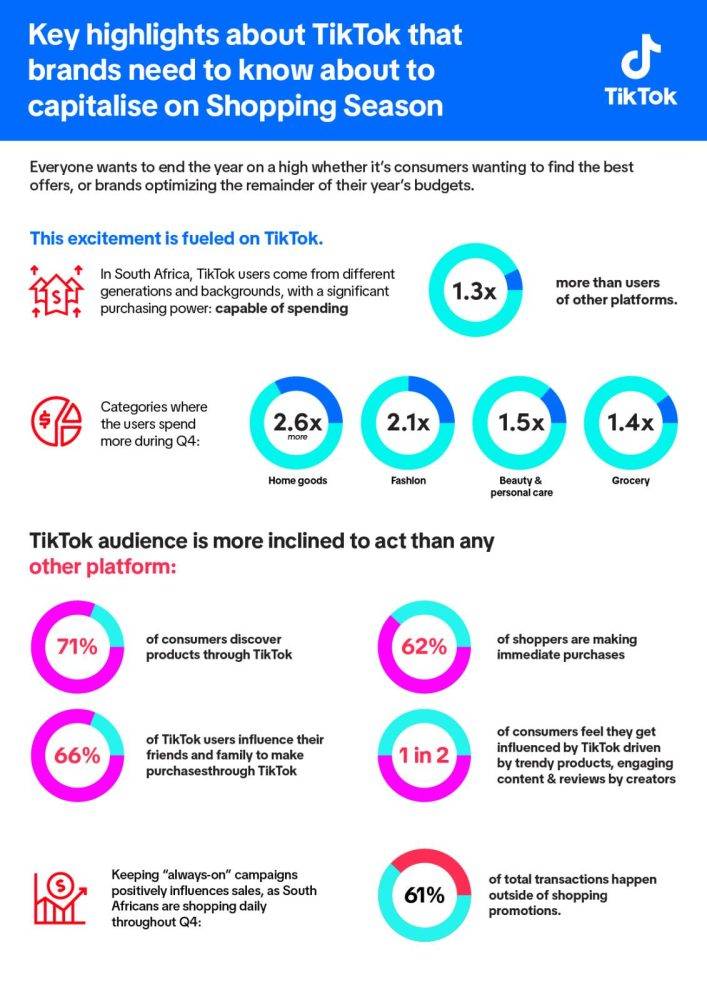
TikTok’s Shopping Season Report highlights significant changes in spending behaviour:
- South African TikTok users spend 1.3x more than users on other platforms, with increases in specific categories:
- 2x more on fashion and home goods.
- 1.5x more on beauty and personal care products.
- 1.4x more on groceries
For brands, these figures underline the importance of capturing attention on platforms where consumers are already engaged. Retail campaigns on TikTok have shown a 27% lower cost per action (CPA) during the Golden Quarter, reinforcing the platform’s cost-effectiveness.
Industry spotlights: TikTok’s impact across sectors
Fashion
Fashion brands are thriving on TikTok, leveraging its highly visual and trend-driven nature to connect with audiences. With South African TikTok users spending 2x more on fashion and home goods than users on other platforms, the demand for relatable and aspirational content is clear. By collaborating with creators to showcase styling tips or hosting live product demos, fashion brands can authentically engage audiences while driving sales. These interactive and visually compelling campaigns capture attention and inspire discovery, making fashion one of the most dynamic sectors on the platform.
Food & beverage
The Golden Quarter is a time of heightened engagement for food and beverage brands. Content consumption within this category increases by 2.1x, with a 1.2x rise in content creation during this period. Campaigns that feature recipes, product pairings, or humorous content tied to cultural moments resonate strongly with audiences. User-generated content (UGC) plays a pivotal role, with customers sharing unique recipes and product experiences that amplify reach and build trust. Food and beverage brands that embrace TikTok’s community-driven ethos are not only engaging consumers but also fostering loyalty through shared experiences.
Financial services
For a sector traditionally seen as complex, financial services brands are using TikTok to simplify offerings and engage audiences in meaningful ways. Searches for financial services on TikTok increased by 2.6x, and consumption grew by 1.6x during the Golden Quarter. Bite-sized videos explaining credit scores, budgeting tips, or loan options have proven effective in demystifying financial concepts.
By focusing on transparency and education, fintech companies are building trust with younger, digitally savvy audiences. The combination of relatability and actionable insights positions TikTok as an invaluable tool for financial services brands looking to connect with modern consumers.
Digital commerce trends: value, convenience and connection
Consumers’ motivations during the Golden Quarter reveal key insights for brands:
- 67% of users value free delivery.
- 65% prioritise high-quality products.
- 58% are motivated by rewards or loyalty programs.
These drivers reflect a desire for convenience and value, which brands can tap into through engaging and relevant content. On TikTok, this translates to campaigns that combine authenticity with innovation:
- User-generated content (UGC): Encouraging customers to share their experiences fosters trust and amplifies reach.
- Educational videos: Retail and financial brands alike can demystify their offerings through tutorials and behind-the-scenes insights.
- Interactive trends: Leveraging platform-specific trends allows brands to connect with audiences in real time, creating memorable touchpoints.
Economic and policy considerations
The rise of e-commerce brings both opportunities and challenges. For South Africa’s economy, digital retail offers the potential to boost GDP, create jobs, and drive urban development. However, it also requires robust policies to ensure sustainability:
- Infrastructure development: Expanding internet access and delivery networks is critical to supporting e-commerce growth in underserved areas.
- Consumer protection: Clear guidelines around data privacy and online transactions are essential to building trust.
- Small business support: Providing resources and training for SMBs to thrive in digital marketplaces will ensure inclusive growth.
The future of e-commerce in South Africa
As we move beyond the Golden Quarter, the lessons of this period offer a roadmap for sustained success. For brands, the focus must shift from fleeting sales moments to long-term engagement strategies that prioritise value, transparency and connection.
TikTok’s rise as a key player in South Africa’s digital ecosystem highlights the power of mobile-first platforms to reshape consumer behaviour. By embracing this shift and leveraging data-driven insights, brands can unlock new opportunities, drive growth and build lasting relationships with their audiences.
The tools to succeed in this evolving marketplace are already within reach. The question is: How will you use them?
Submit and get free exposure here: Showcase Your Business | Advertise Your Special Offers.
