Jazz in focus: Capturing a sound in image:
Jazz has to be seen live to be appreciated. That might sound like a platitude that could apply to any genre of music but, for me, it was a revelation. As a person whose ears were more finely attuned to rap and rock from a lifetime of listening, every attempt I made to listen to jazz in the privacy of my home ended in failure. Until I experienced it live.
Some of the best moments of my life have been seated in a dimly lit room in front of a big jazz band. Nothing compares to seeing a six- or seven-piece ensemble playing at the peak of their powers, with an audience congregated to witness the holy communion of drums, bass guitar, double bass, piano, sax and trumpet.
It was only once I had worshipped at the church of a sold-out jazz gig, and sat in the presence of the genre being created live and in the moment, that I was able to appreciate it.
I had this on my mind last weekend when I encountered the booth hosted by Cape Town gallery Peffers Fine Art at the RMB Latitudes Art Fair.
What I found was an exploration of South African jazz seen through the discerning eyes of legendary photographers. It was an encounter with a hard-to-describe beauty, an attempt to capture the ephemeral magic that makes this genre of music so special.
The booth, a selection from the larger Back of the Moon exhibition, was the brainchild of Ruarc Peffers, often working with Matthew Blackman of the publisher Blackman Rossouw. Theirs is a fascinating, almost informal collaboration, where Blackman delves into the historical depths, unearthing narratives and forgotten faces, and Peffers brings a curatorial vision to the surface.
The idea for this compelling booth began somewhat organically.
“Initially, it started with Ruarc representing the Alf Kumalo estate and then also working with the Baha Archives,” Blackman recounted.
A casual conversation about the Journey to Jazz Festival in Prince Albert led to the idea of an exhibition.
“I made an offhand comment that maybe we could do an exhibition of jazz photography with them,” Blackman shared.
This initial focus on Kumalo’s work gradually expanded: “As the project developed, we began to pull in all of the other photographers of that era. And then, you know, we finally pulled in the Ernest Cole photographs from the final chapter of the republished House of Bondage book.”
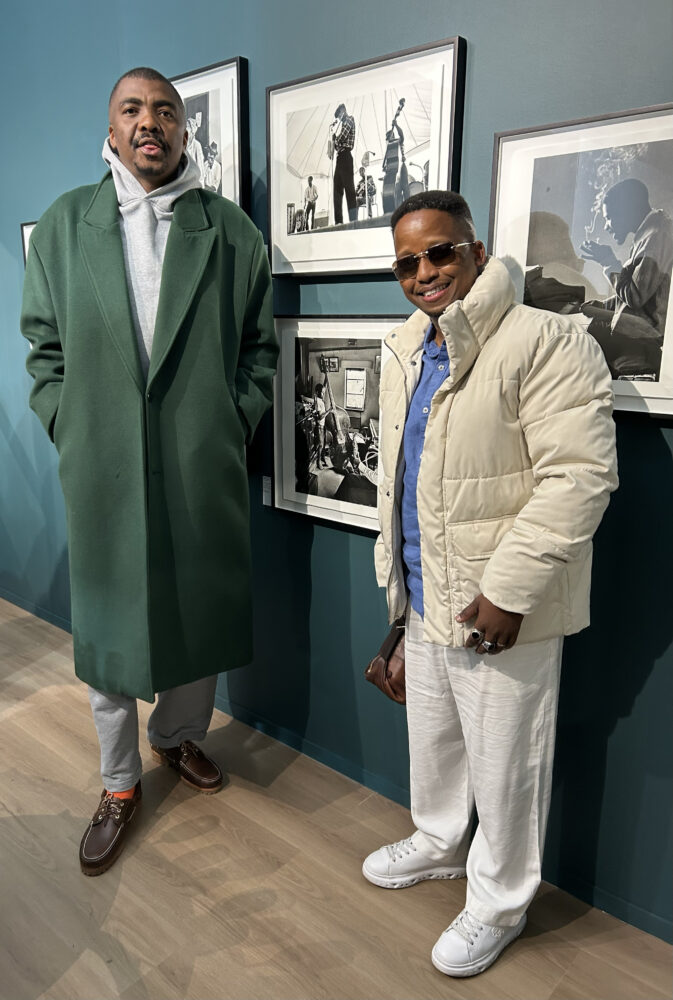
The Latitudes showing felt like a concentrated essence of that larger exploration, a collection of moments plucked from a rich and resonant past. The exhibition ultimately featured the work of not only Kumalo and Cole, but also Bob Gosani, GR Naidoo and Jürgen Schadeberg.
Walking through the booth, I was struck by the way these photographers, each with their distinct approach, managed to capture something beyond the mere visual representation of musicians.
There were the familiar giants, Hugh Masekela and Miriam Makeba, their images carrying the weight of their immense cultural impact.
But it was the glimpses of lesser-known figures that truly resonated.
Blackman’s research illuminated the story of Gideon Nxumalo, a jazz innovator whose contribution in the Sixties deserves far more recognition.
He found it interesting “how there are these forgotten figures in our jazz history and … how truly incredible they really were among them”.
To see Nxumalo captured at his piano by both Kumalo and Cole felt like witnessing a vital piece of history reclaiming its rightful place.
Similarly, the photographs of Philip Tabane and Julian Bahula, pioneers of the Malombo Jazz Men, spoke to a crucial shift in the South African jazz landscape, a move towards a more homegrown sound. Through the lenses of Cole and Kumalo, their revolutionary spirit was palpable.
This wasn’t just a random assortment of photos. It felt like a deliberate curation of narratives. Some images were instantly recognisable, having become ingrained in our collective memory through album covers and publications.
“There’s the famous Miriam Makeba by Jürgen Schadeberg, which was an obvious one,” Blackman noted.
But it was the discovery of previously unseen or misidentified photos, particularly from the Ernest Cole archive, that held a particular allure.
Blackman recounted the detective-like process of identifying subjects.
He found it “interesting that there’s so many photographs in our archives that are sort of unidentified”.
These rediscoveries underscored the depth and untapped potential in our photographic archives.
Even a seemingly simple image of Masekela with a trumpet-maker, unearthed and correctly identified, held a quiet power, a glimpse into the everyday life of a legend.
“That was actually the one, interestingly, that Hugh’s daughter had never seen before,” Blackman shared, highlighting the fresh perspective these discoveries brought.
What, then, makes a jazz photograph truly special? It’s a question I pondered as I moved from frame to frame. Jazz, at its core, is an improvisational, atmospheric art form.
How do you capture the fleeting beauty of a saxophone solo, the rhythmic pulse of the drums, in a static image? Blackman articulated this challenge beautifully: “Jazz, being music, is obviously an art form, which is one that is difficult to represent in written language … But a photo can capture the kind of poetry of that music because there’s movement and obviously atmosphere.”
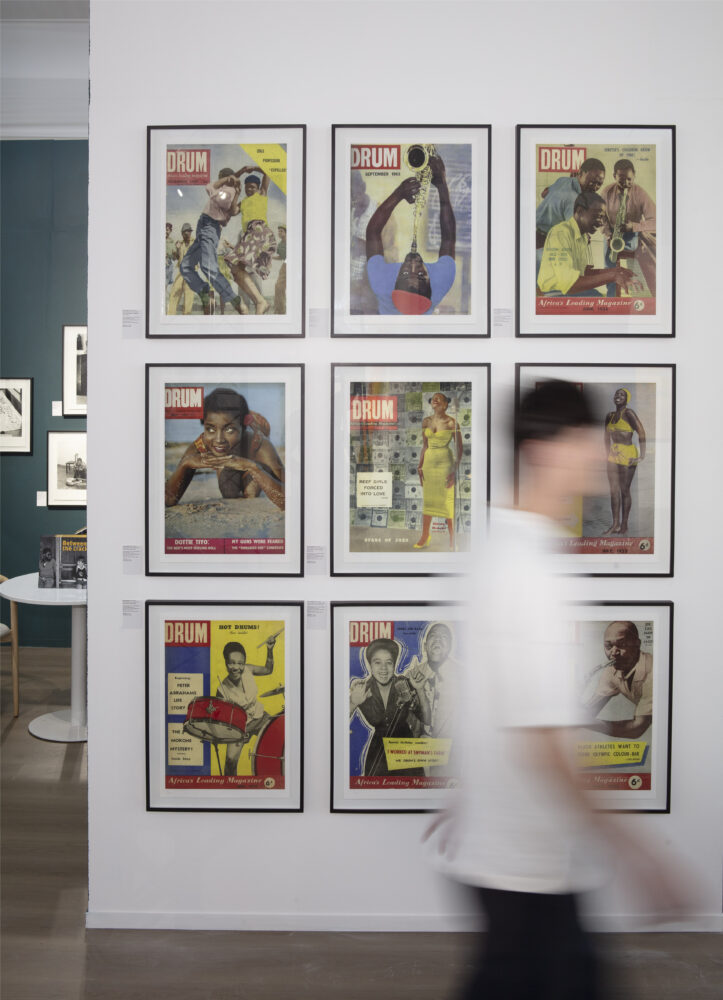
The most compelling jazz photographs are those that transcend mere documentation. They aren’t just about who was playing but about the feeling, the communication between the musicians, the sheer immersion in the act of creation.
Alf Kumalo’s image of Winston Mankunku, shrouded in cigarette smoke, his saxophone a conduit for something profound is an embodiment of a mood, an era, a feeling.
Blackman pointed out some were posed due to the limitations of the equipment. “Many of the early photographs are of jazz musicians posing as if they are in a jazz club rather than actually being in the jazz club.”
Yet, even in these staged moments, there’s an attempt to convey the spirit of the music. As technology evolved, photographers gained the ability to capture the raw energy of live performances.
But, regardless of the setting, the great photographs capture moments of intense focus, where the musician is utterly lost in their craft. They’re often not looking at the camera; they’re in conversation with their instruments, with the music.
There’s something inspiring, almost primal, about witnessing that level of dedication frozen in time.
“The key is it’s a photographer, who is an artist capturing somebody … making art themselves; there’s this beautiful symbiotic connection.”
The response to the booth was enthusiastic and culminated in it winning the audience choice award.
“I was really delighted to see how many young people were coming through, recognising who some of these jazz musicians were and taking selfies next to them,” Blackman said.
Leaving the booth felt strangely akin to leaving a jazz gig, my senses still ringing with the rhythm of what I’d just experienced, reluctant to return to the silence outside.
Just as it took witnessing jazz live for me to truly understand its power, it took standing face to face with these photographs to realise how deeply the genre’s energy lives beyond the music itself.
There, suspended in stillness, was the very essence I had first encountered in a crowded, low-lit room — the pulse, the presence, the communion.
These images didn’t just show me jazz. They made me feel it, again.
A movement against silencing: What the war in Palestine has taught us about journalism:
One of the most revealing takeaways from the genocide in Gaza has been the profound threat posed to journalism. Even in this era of artificial intelligence and disinformation, truth remains a powerful force. And the most brutal way to silence truth is to eliminate those who report it.
This has been the clear strategy adopted by Israel. A recent study found that more journalists have been killed since 7 October 2023 than in any other conflict in modern history — more than the total deaths combined in the U.S Civil War, World War I, World War II, The Korean War, Vietnam, Yugoslavia, and post 9/11 Afghanistan.
A Lancet report estimated that Palestinian deaths are 40% higher than figures provided by the Palestinian Ministry of Health. At the time of writing, the official toll stood at 54,056 but the actual number may be closer to 100,000. Similarly, the number of journalists killed continues to climb, reported at 232 deaths in April 2025 but has grown after several more targeted attacks since, hence we can estimate that death toll to be 250 by May 2025. In all likelihood, the actual figure is far higher.
On the Ground in South Africa
In 2022, I was approached by the Salt River Heritage Society in Cape Town to speak about the murals they had commissioned in their neighbourhood. Central among them was one depicting Shireen Abu Akleh, the Al Jazeera journalist assassinated by an Israeli sniper on 11 May 2022. Initially, Israeli authorities falsely blamed Palestinian militants. By the time her murder was verified, the media cycle had moved on. A full year later, on 12 May 2023, the Israeli Defence Force issued a hollow apology. Shireen’s killing epitomised a strategy of “killing the truth” — the deliberate targeting of journalists, a war crime under international humanitarian law.

Cape Town, more than any city in Southern Africa, has consistently demonstrated loud and visible support for Palestine. Since the genocide began, countless events — marches, murals, boycotts, motorcades, talks, exhibitions, concerts, interfaith gatherings, and vigils — have been held.
Just two weeks into the onslaught, on 22 October 2023, I was invited by the Palestinian Solidarity Committee (PSC) to speak at the first major protest for Gaza, again in Salt River, specifically to address the killing of journalists. At that point, 17 journalists had already been murdered. No one could have predicted the escalation that followed.
Since then, my commitment to this issue has only deepened. As an independent journalist and freelancer, I have had the privilege of speaking freely — at protests, on radio, television, and social media — during a time when many employed journalists feared for their jobs. I’ve used my voice with the hope that it might echo enough to spark accountability. So far, that hope remains unfulfilled.
Yet despite over 600 days of relentless bombardment and destruction, young journalists in Gaza persist. One of the most remarkable examples is nine-year-old Lama Jamous, who donned a press vest and began reporting from the ruins of her neighbourhood.
Perhaps the most meaningful solidarity effort in South Africa was the organisation of national vigils on 28 January 2024. Held in Cape Town, Johannesburg, KwaZulu-Natal, and Makhanda, these gatherings condemned the systematic murder of Palestinian journalists. Journalists across the country united to honour their colleagues abroad. In Cape Town, award-winning journalist Zubeida Jaffer spoke movingly about her experiences reporting during apartheid and covering the Rwandan genocide — drawing clear parallels with Gaza. Many veteran journalists agreed: the conditions Palestinians face today are even more brutal than those under South African apartheid.
From these vigils emerged a WhatsApp group called Journalists Against Apartheid, a platform for solidarity, awareness, and resistance among South African media workers.

A Divided Media
The genocide in Gaza has unmasked the stark divide in global journalism. Palestinian journalists have redefined what it means to do this work. Their commitment isn’t driven by money or recognition — it is a moral imperative. Despite losing homes, loved ones, and access to basic needs, they continue reporting. They’ve carried injured children into hospitals, buried colleagues, and dug survivors from rubble — all while documenting the unfolding horror. They appear on our screens, exhausted yet unwavering, embodying what it means to serve truth.
In contrast, Western media has disgraced itself. It has become a factory of bias, Islamophobia, and propaganda. One of the most damaging cases emerged on 14 October 2023 — the viral lie that Hamas had beheaded 40 babies. First shared by Israeli soldiers, the claim was repeated by then-U.S. President Joe Biden without evidence. The result? A white supremacist in Chicago murdered six-year-old Palestinian-American Wadea Alfayoumi in a hate crime — stabbing him 26 times. Only in May 2025 was the perpetrator charged. To date, Israel has not retracted or apologised for the lie that sparked the killing.
Western journalists have become cheerleaders of empire. Major networks like BBC and MSNBC fired journalists for supporting Palestine. Outlets like CNN and The New York Times led with fake headlines and unverified stories — many of which were later retracted, but not before irreparable harm was done.
Palestinian writer Mohamed El Kurd described this propaganda machine best:
“A claim is circulated without evidence; Western journalists spread it like wildfire; diplomats and politicians parrot it; a narrative is built; the general public believes it — and the damage is done.”
In response, citizen journalism has risen powerfully. Platforms like Instagram and TikTok have become vehicles for truth, elevating voices on the ground. Ordinary people, wearing “PRESS” vests, risk their lives to document reality. The use of mobile phones makes Israeli atrocities harder to conceal — though the regime has responded with censorship, shadowbanning, and algorithmic suppression.

A Commitment to Truth
In October 2024, Al Jazeera correspondent Youmna El Sayed visited South Africa. Hearing her firsthand account was life-changing. Younger than me, yet infinitely more brave, she described war from the perspective of a mother and journalist. Speaking in Cape Town’s Bo-Kaap, she recounted being given five minutes by Israeli forces to evacuate her home with her husband and four children.
“My 8-year-old daughter Sireen’s biggest fear was surviving alone,” she said.
“Every night she asked us to sleep close together and said, ‘Mom, if a rocket hits, let it kill us all so no one is left behind.’”
El Sayed spoke of displacement, the stench of decaying bodies, and the total dehumanisation they endured.

“Journalists in Gaza were targeted everywhere: in our homes, in the field, in our cars — with no mercy and no regard for humanitarian laws.”
“Israel barred international journalists from entering Gaza, hoping to hide its crimes. But it underestimated the resilience of Palestinian journalists — continuing to work with no food, no water, and bombed-out offices.”
We all remember the moment veteran journalist Wael Al-Dahdouh cradled the lifeless body of his son Hamza — also a journalist — killed while Wael was reporting. We remember 23-year-old Hossam Shabat, who wrote a letter before his death in April:
“Now I ask you, don’t stop talking about Gaza. Don’t let the world turn its eyes away. Keep fighting, keep telling our stories — until Palestine is free.”
The death toll among journalists will rise, as the genocide continues. But rather than deterring us, these deaths strengthen our resolve. We remain committed to ethical journalism, to truth-telling, and to bearing witness to injustice.
We will not be silenced. We owe that to those who gave their lives so the world could see.
*This article was first published in Media Review Network on 28 May 2025
Atiyyah Khan is a journalist, activist, cultural worker and archivist. For the past 17 years, she has documented the arts in South Africa. Common themes in her work focus on topics such as spatial injustice, untold stories of apartheid, jazz history and underground art movements.
Universities, revive Joburg’s hippest ’hood – Melville:
Melville, once declared one of the world’s hippest neighbourhoods, is in serious decline. The suburb is an important asset to our academic life and must be restored.
I often host students and faculty from universities in Europe and the US. For a long time, Melville was the automatic place for academic visitors, professors and students to visit and stay while passing through Johannesburg.
Located next to the University of the Witwatersrand, one of our two great universities, as well as the up-and-coming University of Johannesburg (UJ), Melville has long provided a convivial environment for academics and post-graduate visitors. In 2020, just five years ago, Time Out magazine ranked Melville as one of the 40 coolest neighbourhoods in the world.
Academic travel matters, and academics want to enjoy their experience of travel. For decades Melville, buzzing with coffee shops, restaurants, live music venues, galleries and a very good second-hand bookshop provided exactly what academics and post-graduate students needed to enjoy their time in Johannesburg.
The turn to Zoom during Covid has reduced academic travel quite a bit, but spending two days on Zoom rather than travelling for a conference is a painful and vastly less rewarding experience.
Melville was hit hard by the Covid lockdown though, and has been hit just as hard by the general collapse in the functioning of the Johannesburg municipality.
Many of the restaurants on the once world-famous 7th Street shut down during the lockdown and many of the buildings on the strip remain empty. If there had been some vision to support the strip, understanding it as a wider asset to the city, and the country, this could have been avoided.
Driving into Melville recently with a group of students and academics was a depressing experience. Coming up Main Road, which divides Melville and Westdene, is bleak.
There are three large holes, which are so big they cannot be described as potholes, on Main Road that have been left unattended for months — aside from placing a plastic barrier in front of them.
Some of the shopkeepers dump their refuse on the pavement next to the pedestrian litter bins rather than keeping it for the weekly refuse collection.
The homeless people on Main Road, many struggling with addiction, live in squalor and the lack of public toilets has inevitable consequences.
Uber and delivery drivers face the same lack of access to toilets with the same unfortunate results.
Turning into Melville itself is no less disheartening. Streets no longer have working lights, there are a couple of abandoned and looted or vandalised houses, and some of the electricity poles have a mess of dangling wires, some live.
Around the suburb piles of rubble have been left on the pavements after work done by Egoli Gas and various arms of the municipality. It seems that it is no longer expected that rubble will be removed after maintenance work alongside the streets.
The 7th Street strip, with its many empty buildings, has large ditches filled with sand at each end. They have also been there for months.
On the corner of 3rd Avenue and 7th Street, part of the road has been left in a dug-up state and with a pile of rubble sitting on the road. It too has been like this for months.
Private property owners are beginning to do the same. On the corner of 2nd Avenue and 7th Street a homeowner has left two large piles of building rubble on the pavement for months.
A slow water leak has been trickling down 7th Street for months. There are no drain covers on the strip. This is unsightly and a hazard for pedestrians. The road markings have long faded away. Anyone on the strip who looks like they may have some money is immediately accosted by desperate people trying to get a few rand.
Water outages are common in the area, sometimes going on for as long as two weeks. There are also occasional electricity outages that can go on for days. This makes things very difficult for the owners of the B&Bs that remain in the neighbourhood, as well as the surviving restaurants and other businesses.
Driving out of Melville on 9th Street towards Parkview, a suburb that remains in good nick, there are more piles of rubble on the pavements and more deep holes in the road. As on Main Road, both the rubble and the holes have been left for months.
It is not immediately clear why nearby suburbs such as Parkview, Greenside and Parkhurst are in a good condition while Melville is in decay.
An academic neighbourhood requires a good bookshop and, thankfully, the good second-hand bookshop on the Melville strip endures, but it’s no longer open in the evenings. There are some signs of new life after the devastation of the lockdown though. De Baba, a new bakery and coffee shop at the bottom of the strip is always buzzing.
On the other side of the road there’s a new and very hip coffee shop, Sourcery. It would fit right into Brooklyn, New York, and is perfect for an arty and academic neighbourhood like Melville. A vinyl-obsessed friend tells me that the music selection is extraordinary. Unfortunately, Sourcery seems empty most of the time. The same is true of Arturo, an excellent and equally hip African Latin-American fusion restaurant further on up the strip.
Some of the problems faced by Melville are a result of South Africa’s wider social crisis. For as long as we face catastrophic levels of unemployment people will be forced to live on the streets. The heroin epidemic is also a national problem. Although the municipality can take some steps to ameliorate some of the consequences of these problems it cannot fix them.
But much of the sad state of Melville is a result of the failures of the municipality. Some of these failures could be resolved in a single day. Light bulbs could be installed on the street lights, the large holes on Main Street, 7th Street and 9th Street could be fixed, the rubble left along the pavements could be removed, the water leak on 7th Street could be attended to and the road markings redone.
The private businesses dumping their waste alongside the pedestrian bins on Main Road could be fined, as could the private homeowner who has left piles of building rubble on the corner of 2nd Avenue.
Other issues that fall within the remit of the municipality, such as the failure to provide public toilets on Main Road, cannot be resolved in a day, but with some vision and energy they could be resolved in a few months.
Getting the water and electricity systems functional is a much bigger project but is also something that can be achieved with the right commitment. The abandoned properties, with at least one house stripped to nothing but its walls, should be expropriated and sold, with the money invested into regeneration projects.
There should also be active support, including subsidies, for art galleries and live music venues. All the world’s great cities actively support cultural life and the same should be done in Johannesburg. Again, this is something that would, even with the right vision and commitment, take at least a few months to kick into gear.
When Melville was the vibrant and world-regarded home to Johannesburg’s arty and academic scene it was a major asset to the city. It was an asset to the city’s residents, and to visitors to the city, including its wider tourism economy. Melville was also an important asset to the city’s two universities, making visits by academics and post-graduate students from elsewhere in the country and abroad an enriching and fun experience.
There is scant hope that the municipality will, on its own, take the initiative to act to restore Melville to what it once was and can easily be again.
Universities are powerful institutions in society; Wits University and UJ should lobby the municipality to act to restore Melville as one of the world’s great academic neighbourhoods. A well maintained and vibrant Melville would be a boon for the city.
With the right commitment it would only take a single day to begin to turn things around.
Dr Imraan Buccus is a research fellow at the University of the Free State and the Auwal Socioeconomic Research Institute, ASRI.
Submit and get free exposure here: Showcase Your Business | Advertise Your Special Offers.