KZN Public Works slashes wasteful expenditure to zero, invests R20m to go paperless:
The KwaZulu-Natal Department of Public Works and Infrastructure (DPWI) has pulled off a dramatic financial turnaround, cutting its historically bloated unauthorised, fruitless and wasteful expenditure to zero for the 2025/6 financial year.
The second-smallest provincial department by budget allocation is leveraging its savings to bankroll a R20 million digital overhaul aimed at eradicating paper-based bureaucracy, stamping out tender corruption and multiplying productivity in the next three years.
The department, which buckled under hundreds of millions of rand in rampant overspending, has tightly shut the fiscal taps.
“Previously this department had R731m in unauthorised expenditure (mostly on goods and services). We’ve cut that to almost zero,” KZN Public Works and Infrastructure MEC Martin Meyer said on Monday.
“We are the only department that has almost zero in unauthorised expenditure and we’ve done that for two years. We’ve done that by using technology efficiently. We don’t overspend on our budgets anymore. We have become a much more efficient department when it comes to the management of our finances,” he said.
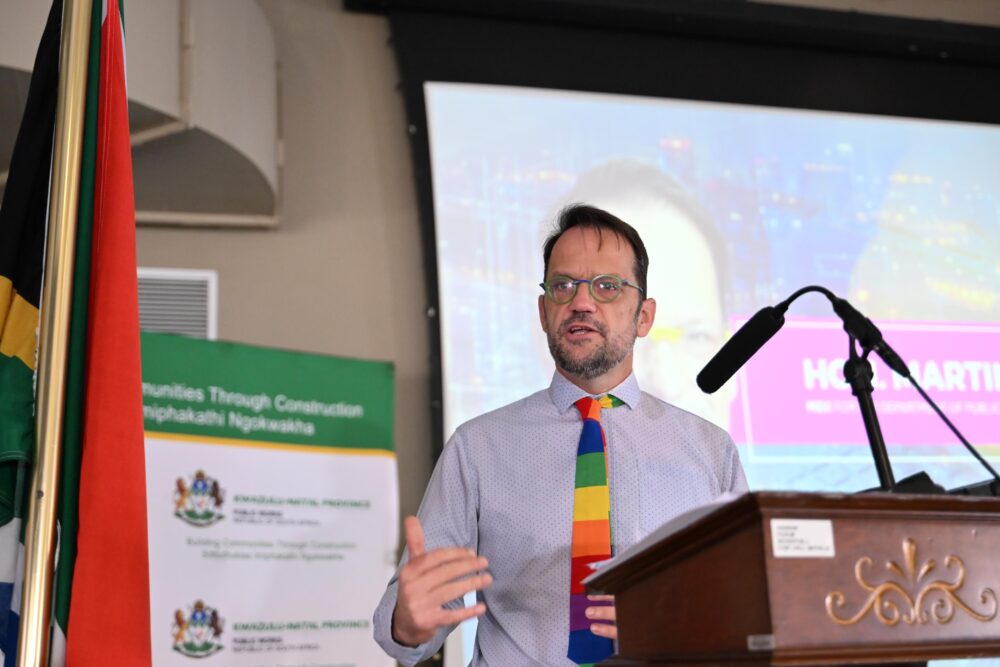
Meyer was speaking during a media briefing at the KZN DPWI Technology & Innovation Summit, which drew about 400 delegates, including chief financial officers and other senior officials from government departments and the private sector.
He announced at the summit that the department is partnering with the Council for Scientific and Industrial Research to launch a real-time infrastructure dashboard to manage projects. The tool allowed executives to monitor construction project statuses continuously, pinpoint bottlenecks early and base management decisions on live evidence rather than outdated reports.
R20m paperless drive
Meyer said the department had allocated R20m in its current budget specifically for the digitalisation of its operations. The goal was to be paperless in three years.
Mayer acknowledged that “R20m might not, in the bigger scheme of things, sound like a lot” but it represented a significant commitment given that the department operated on a budget of about R2.4 billion.
The primary objectives and benefits of the technological shift included eradicating procurement corruption, slashing administrative costs, boosting productivity and real-time oversight of infrastructure projects and lease deals.
Meyer said electronic submissions would prevent physical documents from being tampered with.
“One of the old tricks of making sure someone doesn’t give a tender is when those documents …. come, page 18 is suddenly missing … and then we have to discard the (incomplete) tender. If this whole thing happens electronically, no one can make page 18 go missing,” he said.
The roll-out of “e-leave” and electronic signature systems eliminated the need for officials to travel hundreds of kilometres across the province simply to hand-deliver or sign physical files, he said.
Head of department Dr Vish Govender said the transition from paper to digital files had radically compressed internal turnaround times as the department moved from “ancient” systems to digital platforms.
Govender said the turnaround had required dismantling deeply entrenched systemic inefficiencies.
“Look at our department where we were some 18 months ago, when we didn’t know what we owned. Processes were tedious [and happened] annually. The issues around corruption, we widely publicised it … But fast-forward 18 months later … we have automated workflows.
“Productivity has just increased tenfold … With a click of a button, our files are digitalised,” he said.
Automated systems save time
Vodacom KZN managing executive Imran Khan shared a case study of an automated proposal system executing a highly complex corporate pitch — a task that normally takes a corporate team up to 60 days and costs between R3m and R4m in salary resources — in just nine minutes.
“That shows you the power of digitisation when it’s put on top of a stack of qualified, controlled and managed data,” Khan said.
However, management consultant Dale Evans warned that throwing technology at a broken system was a recipe for expensive failure, urging the department to thoroughly clean up its administrative processes and standardise its data before rolling out complex software.
Drawing on her 30 years of global organisational transformation experience, she emphasised that a system was only as good as the foundational information feeding it.
“Technology automates the processes, AI augments the decisions. Data is what makes both possible,” Evans told delegates.
“Think of it like an engine. Your technology is the engine, data is your fuel. If you don’t have the fuel, you might as well not have the engine.”
Minister of Communications and Digital Technologies Solly Malatsi, speaking in a virtual briefing, commended the province’s initiative.
“This is exactly what we need in the public service — smarter infrastructure, better cities — When we digitise infrastructure delivery …. we do not just make government work faster, we make government work better, more equitably and with more accountability,” he said.
Is SA making good on its climate promises? Our sums say ‘yes’ — at least so far:
- In Part 1 today, we unpack what South Africa is doing to help keep global warming — and the fallout from changing weather patterns — at bay.
To make good on its climate promises, South Africa is aiming to pump no more than the equivalent of 420 million tonnes of carbon dioxide into the air by 2030 — and according to our sums, it looks like the country is on track.
That’s why a loan of about R3.8 billion (about €200million/R62bn) from Germany announced in April is such a boon.
The funding is part of the Just Energy Transition Partnership, which is meant to help South Africa switch to renewable energy sources like solar and wind power — something that is especially important seeing that coal-fired power stations and cars that run on petrol and diesel account for more than 80% of South Africa’s greenhouse gas (GHG) emissions.
Burning fossil fuels like oil and coal produces gases such as carbon dioxide and methane. These form a layer in the Earth’s atmosphere that traps heat from the sun, almost like how a greenhouse holds warmth inside — which is where the term greenhouse gases comes from. If too much of the gases build— as has been happening over the past century — the temperature of the air close to the Earth’s surface can creep up beyond what life on Earth can comfortably handle.
Over many years, the warming leads to changes in how much it rains in places, what minimum and maximum daytime temperatures look like and how long dry spells last. In other words, an area’s climate starts to change.
Experts predict that climate change will lead to extreme weather events like floods, storms, droughts and heatwaves becoming more intense and unpredictable, which could make it harder for people to stay well or get healthcare when they get sick, affect how people earn their livelihoods and make growing food more difficult.
A big survey before the 2024 general elections showed that for 11% of voters climate change — and by implication what politicians would do about it — was one of the top three things they’d think about when deciding who to vote for. And 13 of the 15 parties whose election manifestos Bhekisisa analysed at the time promised to do something about issues linked to climate change.
With extreme heat in parts of the Western Cape and heavy rainfall and storms in the northern and eastern parts of South Africa in the first three months of the year, would people again keep the effects of changing weather patterns — and how leaders will deal with the fallout — in mind when they decide how to vote in the upcoming local government elections on November 4?
We dived into thousands of data points linked to climate change indicators to put together a three-part series of stories to unpack what South Africa is doing to help keep global warming manageable and what the consequences could be of not putting plans in place to deal with extreme weather.
In our first story, we look at four questions about where the country stands when it comes to GHG emissions. Here’s what we found out.
How much carbon dioxide does SA emit?
In 2024, South Africa’s GHG emissions made up 1% of the world’s total. Four other countries — China, the US, India and Russia — together accounted for about half the world’s emissions.

Although South Africa’s contribution is just 1% of the world total, it’s a massive amount — in fact, the equivalent of about 570 million tonnes of carbon dioxide, international data shows. (Because carbon dioxide isn’t the only type of greenhouse gas, scientists use the term “carbon dioxide equivalents” (CO2-eq) as a standard reporting unit in calculations.)
That much carbon dioxide is enough to fill 116 million Olympic-sized swimming pools, we calculated — a figure close to double the number of people there are in South Africa. (We used standard conditions of 0°C (273.15 K) and 1 atm pressure in our calculations. It’s important to specify the temperature and pressure when working out the amount of space a gas would take up, because when the pressure increases — in other words, as a gas is compressed — its volume decreases. Similarly, when a gas warms, its volume increases.)
Twenty-two other countries, along with the world’s sea and air traffic, join South Africa in emitting about the same amount of carbon dioxide as China does. This means that 29 players (including ships and planes) are responsible for 83% of the world’s total carbon emissions.
How much does each person add?
The picture looks different when considering a country’s population size. For example, per person, Australia’s carbon emissions are almost 2.5 times that of South Africa, even though each country adds only about 1% to the world’s total.

Similarly, when ranked according to total emissions, China is in the top spot and India is the third biggest contributor in our list of 11 countries. But when ranked based on the per-person figures, China is in sixth place and India drops to the second-last spot. (The reason countries like China and India’s overall contributions are so high is because of the size of their populations.)
Looking at the numbers in this way tells us something about the link between economic development and carbon emissions. For example, the share of someone in the US is almost six times that of someone living in India and almost three times that of someone in Brazil.
Although emissions have been falling in many richer countries over the past few years, the per-person levels are high in some, especially in countries like the US, where President Donald Trump is defying evidence-based climate policies. If developing countries, which often have large populations, were to see these as an acceptable benchmark of carbon dioxide output while they rev up their economies, it could be “devastating for global efforts to curb emissions”, the UN’s trade and development body says.
Where do South Africa’s emissions come from?
In December 2024, South Africa, as part of the UN climate change treaty, submitted its first tracking report, to show how well plans to slow down climate change have progressed since 2020.
The report shows that more than 80% of the country’s net greenhouse gas emissions of 435 million tonnes CO2-eq (Mt CO2-eq) come from the energy sector — the industry that produces the power and fuel people use to run homes, cars, factories and businesses. This is not surprising given that the economy relies heavily on burning fossil fuels, which generates large amounts of carbon dioxide. In fact, emissions from the energy sector are about 3.5 times that of the combined output from factories, farming and dealing with waste.

Knowing how much each sector adds is important when tracking progress on climate actions, as signatories to the Paris Agreement have to report on, because it helps to see where the biggest or quickest gains could be — which is why something like Germany’s funding boost to help South Africa move away from coal is big news.
All countries who signed the Paris Agreement commit to doing their part to prevent the global average temperature from rising by more than 2°C compared with what it was 150 years ago, and do their best to try to keep the increase at 1.5°C by the end of the century.
To achieve this, all countries set out targets for their yearly total greenhouse gas emissions, based on what their specific development conditions look like. The targets are called a country’s nationally determined contributions (NDCs) and are updated every five years to become more and more ambitious in order to hit the world’s temperature goal.
According to the tracking report, keeping the economy running released the equivalent of 478 MtCO2-eq in total in 2022. But because of plants and soil absorbing some of the excess gas from the air, the net amount stands at 435 MtCO2-eq. (The amounts are lower than what international data shows for 2022 but because these are the numbers the government reported on, we’ve used them here.)
Will SA make good on its climate promises?
From our sums, it looks like South Africa is on track to hit the target of keeping greenhouse gas emissions below 420 MtCO2-eq by 2030.

We worked out results based on the trends over four periods between 2000 and 2022, shortening the time span by five years each time. Generally, considering longer periods, and therefore more data points, is better when looking at trends over time. But seeing that the Paris Agreement works in five-year cycles that become progressively more ambitious in its goal, it made sense for us to see how outcomes changed given the different time spans.
Using the full period from 2000 to 2022, our trend line calculations showed that yearly greenhouse gas emissions would probably be at 470 MtCO2-eq by 2030. By repeatedly shortening the period by five years, the slope of the line became steeper each time — that is, it pointed to a lower end point on every round, each within the target range set out by South Africa’s NDCs.
For example, when we used values from 2005 to 2022, the result sat at around 426 MtCO2-eq by 2030. Using data from 2010 to 2022 for the trend line, the probable yearly total was around 410 MtCO2-eq by 2030. From values between 2015 and 2022, it looks like hitting 360 MtCO2-eq would be possible by 2030. This suggests that even with some ups and downs over time, the efforts to cut down on carbon emissions could get us to where we want to be.
Look out for our next story on June 8, in which we’ll dive into what scientists say South Africa’s weather patterns could look like in the future.

This story was produced by the Bhekisisa Centre for Health Journalism. Sign up for the newsletter.
Rise Mzansi’s Makashule Gana elected impeachment committee chairperson:
Parliament’s Section 89 Impeachment Committee has elected RISE Mzansi MP Makashule Gana as its chairperson as it begins considering whether President Cyril Ramaphosa should face impeachment over the Phala Phala scandal.
“We will be in communication with all the members of the committee in terms of the next processes to be taken. The meeting is adjourned,” Gana said after his election.
Gana received 19 votes, defeating United African Transformation (UAT) leader Wonderboy Mahlatse, who secured 12 votes.
ANC MP Mikateko Mahlaule nominated Gana. Democratic Alliance MP George Michalakis seconded the nomination.
Economic Freedom Front (EFF) MP Omphile Maotwe nominated UAT’s Mahlatse and United Democratic Movement MP Nqabayomzi Lawrence Kwankwa seconded it.
Parliamentary Communication Services officer Faith Ndenze said the election marked the start of the committee’s work.
“The committee will now turn its attention to determining its programme of work and the next steps in the inquiry process. Details of future meetings and activities will be communicated in due course,” she said.
Gana was backed by parties aligned with the government of national unity (GNU), many of which have opposed calls for Ramaphosa’s impeachment. Mahlatse was supported by opposition parties, including the EFF and the uMkhonto weSizwe (MK) Party, which have called for the president’s removal.
National Assembly Speaker Thoko Didiza established the 31-member committee after the Constitution Court rendered the 2022 vote against the impeachment illegal.
The committee has been tasked to investigate whether Ramaphosa violated the Constitution or engaged in misconduct in a scandal that saw $ 580 000 stolen from his Phala Phala farm in Limpopo.
Ramaphosa is reported to have stated that he would not oppose the interim findings of the impeachment committee.
However, he is challenging the Phala Phala independent panel’s report in the Western Cape High Court, arguing that the panel misunderstood its mandate and the legal threshold required under section 89 of the Constitution
The independent panel found prima facie evidence that Ramaphosa might have committed serious violations of the Constitution and the law in relation to foreign currency stolen from his Phala Phala game farm.
The committee’s composition is based on proportional party representation with the inclusion of smaller parties. The ANC holds nine seats on the committee, the DA five and the MK Party three.
The EFF has two seats. Twelve smaller parties, among them the Inkatha Freedom Party, Patriotic Alliance, ActionSA, Freedom Front Plus, RISE Mzansi and Build One South Africa, each hold one seat.
The GOOD Party and the Pan Africanist Congress opted not to take part because their only MPs serve in the national executive.
Control of the committee chairmanship was closely contested. Parties in the GNU supported Gana’s nomination, while the Progressive Caucus, which comprises the MK Party, EFF, African Transformation Movement and UAT, backed Mahlatse.
If the committee concludes that Ramaphosa committed and engaged in serious misconduct, it could recommend his removal from office.
The recommendation would then be tabled before the National Assembly, where the removal of a president requires the support of at least two-thirds of MPs.
Submit and get free exposure here: Showcase Your Business | Advertise Your Special Offers.